A Flight Sim Enthusiast's Notebook
-
Title: X-Plane 10.10 is Finally Released, 10.10B2 is Very Stable
The long-awaited 10.10 is finally released. After the first Beta 1 was released last week, I saw poor online reviews, with many machines unable to start. So, I decided to wait a bit. This morning, I checked the developer blog again and found that B2 is out with many bugs fixed. No need to wait then; I installed it immediately to take a look.
It took about 30 minutes to download the updater from the official website to finish the installation. I started it up impatiently, and the “Quick Flight” dialog box appeared right away. Oh, this must be the first new feature of 10.10.
-thumb-640x482.png)
-
Title: Exploring the Airliner Cockpit 2.6 About Flaps
In the previous section, it was mentioned that flaps should be preset to the takeoff position before taxiing. Why is this?
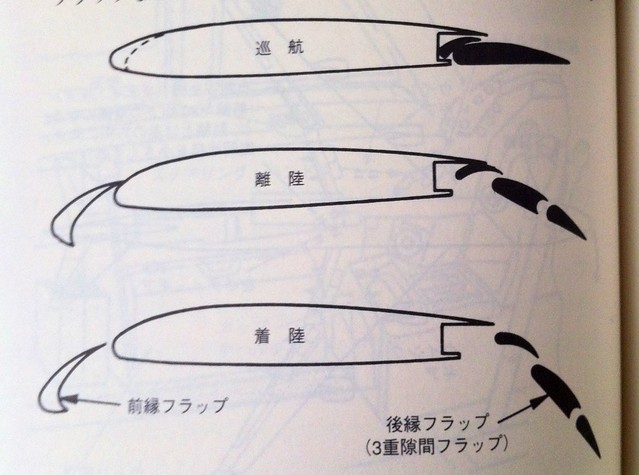
First of all, flaps are devices mounted on the trailing edge or leading edge of the wing that can deflect downward or (and) slide backward (forward), used to increase Lift. Depending on the installation location and specific function, flaps are divided into trailing edge flaps and leading edge flaps.
-
Title: Inside the Cockpit 2.5 Operations During Ground Taxiing
Below is an introduction to some operations involved in taxiing on the ground, covering aircraft turning and flight control surface checks.
When turning on the ground, the rudder pedals and the tiller must be used simultaneously. The control devices regulate the nose wheel steering via a hydraulic system. Some large aircraft, such as the Boeing 747/777 and Airbus 380, also have steering devices on their rear wheels.
In the pre-flight procedures section, it was mentioned that the rudder pedals are used to control the rudder on the vertical tail to make the aircraft turn in the air. In fact, they can also control the nose wheel, so pressing the rudder pedals on the ground allows the aircraft to turn. However, rudder pedal control only allows for slow turns at very small angles; essentially, you can only execute very wide turns. In reality, 90-degree turns are frequently required at airports, and relying solely on the rudder pedals is far from sufficient. The tiller must be used.
-
Inside the Cockpit 2.4 Ground Taxiing Taxi
The aircraft is pushed by the tug to the end of the Apron, and the ground crew contacts the flight deck again:
Ground Crew: “Flight deck, set parking brake.” Captain: “Brakes set.”
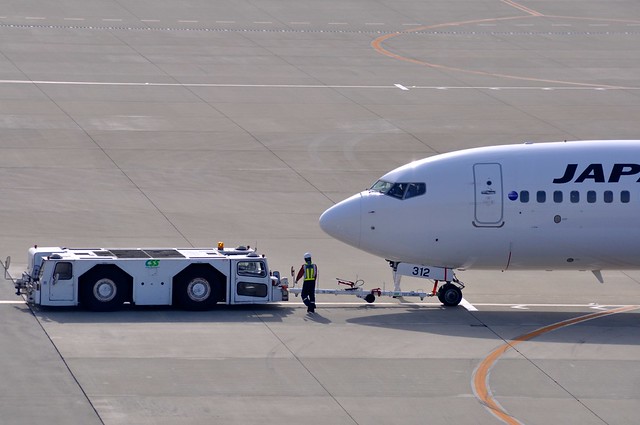 Consequently, the ground crew removes the tug’s tow bar from the nose landing gear, sets the wheel chocks again,
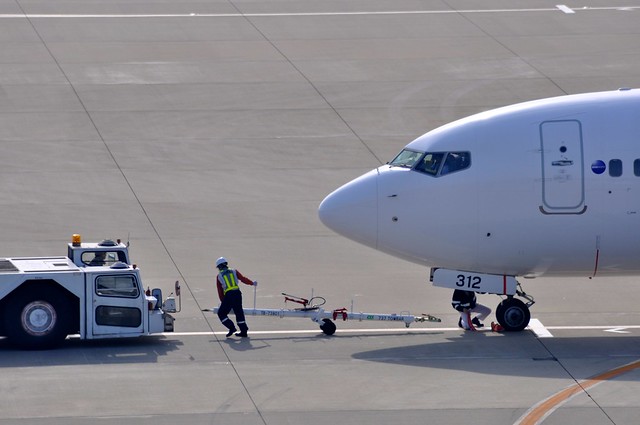 and the tug moves away from the aircraft.
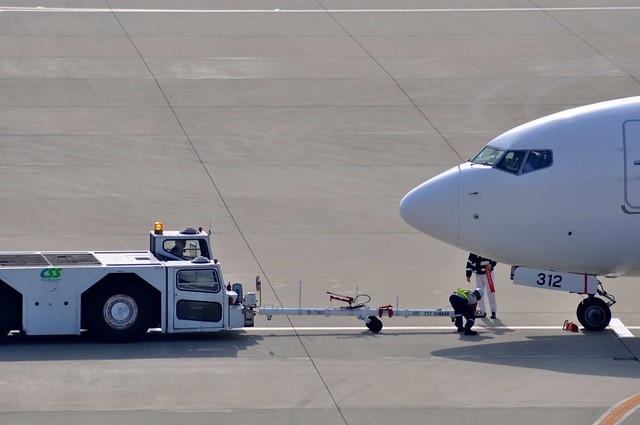 (Photo above taken at Chubu Centrair International Airport)
 -
Title: Inside the Airliner Cockpit 2.3 Push Back from the Gate and Engine Start
After the pilot obtains the clearance and completes the pre-departure 5-minute preparations (pre-start procedures), they can request pushback from Ground Control, for example:
Pilot: “Tokyo Ground, Air System 115, request push back, spot 2, information F”
This means: “Tokyo Ground Control, this is Air System 115, requesting pushback from Gate 2, we have Information F (Foxtrot).”
Upon receiving this radio request, the airport Ground Controller will check the traffic congestion on the Apron. If there are no other aircraft moving nearby, or if the movement of this flight will not affect other aircraft, they will reply:
-
Title: Airliner Cockpit Exploration 2.2 Standard Instrument Departure SID
In the previous section 5 Minutes Before Departure, it was mentioned that Air Traffic Control notified the pilot to use the Moriya 7 Departure procedure. So, what exactly is a Departure procedure?
Airplanes flying in the air are not without traffic rules. Because there are numerous airlines, especially at major airports where planes take off and land every few minutes. Similar to ground traffic, if there were no set of traffic rules to manage it, aircraft operations would be extremely dangerous. Therefore, many routes are established in the air. Although we cannot see these routes with the naked eye like roads on the ground, pilots must strictly follow the regulations to execute their flight missions. The routes and procedures set up for departing aircraft are called Standard Instrument Departures (SIDs).
-
Inside the Cockpit 2.1 5 Minutes Before Departure
While the pilot performs pre-flight preparations inside the cockpit, the ground crew is also busy preparing for the flight.
For example, they disconnect the power supply cable, ensure catering trucks, fuel trucks, and cargo dollies are moved away from the aircraft, and connect the tow tractor to the nose landing gear.
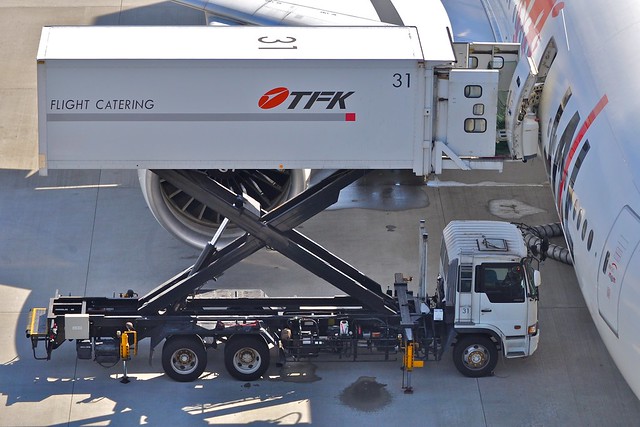 Catering truck, photographed by me at Tokyo International Airport.

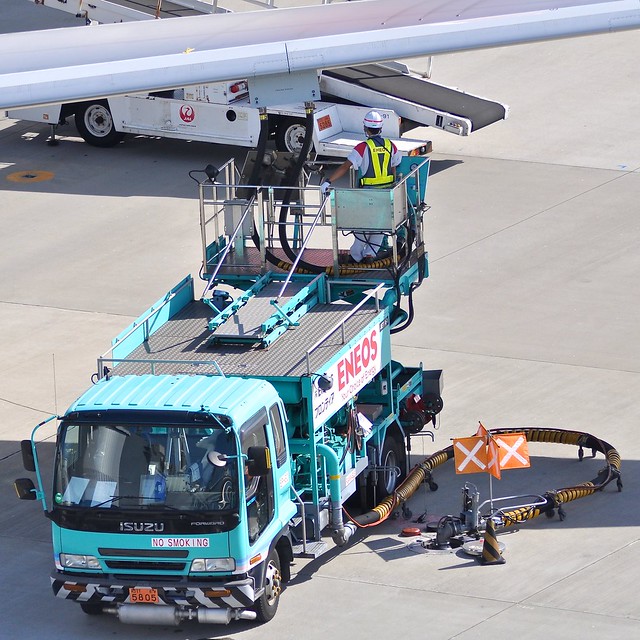 Fuel truck, photographed at Tokyo International Airport.
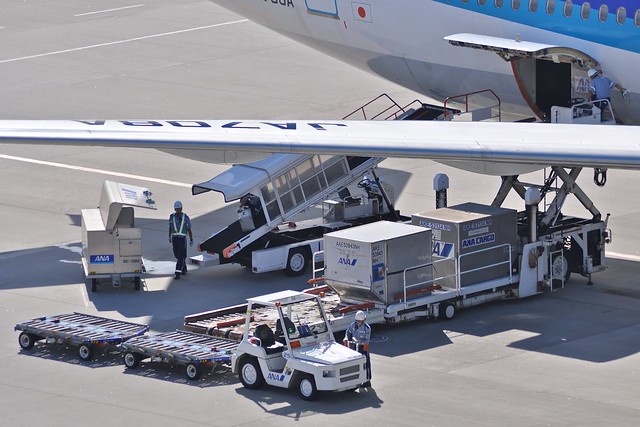 Cargo dolly, photographed at Tokyo International Airport.
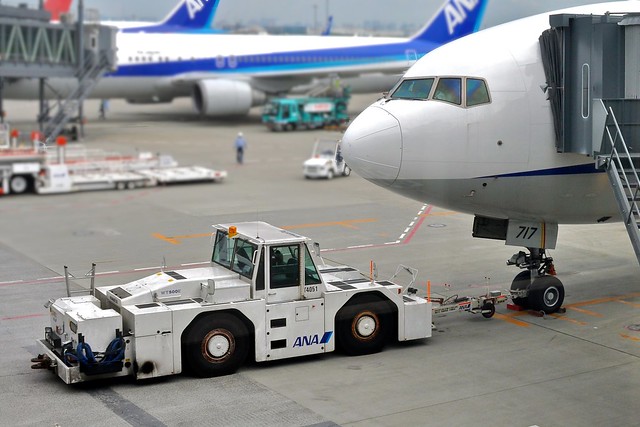 Tow tractor, photographed at Tokyo International Airport.
 Ground crew disconnecting the ground power cable from a Boeing 777, photographed at Hiroshima Airport.
Once all vehicles and equipment that could obstruct movement are removed from the vicinity of the aircraft, the ground preparation is complete.
-
Title: Inside the Cockpit 1.8 Preflight Procedures and Cockpit Interior
After completing various checks to confirm the aircraft meets airworthiness standards, the pilot can finally sit in the flight deck and begin manipulation. First, the pre-flight procedures must be completed, but before that, let’s take a look at the interior of the flight deck.
The Boeing 747-400 overhead panel, Electronic Flight Instrument System (EFIS), and control devices:


Generally speaking, there are 2 seats in the flight deck; the left one is the Captain’s seat, and the right one is the First Officer’s seat. Additionally, there are 2 folding seats for deadheading (non-revenue passengers), known as Jump Seats, used for training, audits, or other internal purposes such as hitching a ride.
-
Title: Uncovering the mysteries of airliner piloting 1.7 FMS CDU setup detailed explanation
Considering that flight simulation enthusiasts are likely interested in the detailed settings of the Flight Management System Control Display Unit (FMS/CDU), I have dedicated a specific section to introduce the initial setup of the CDU.
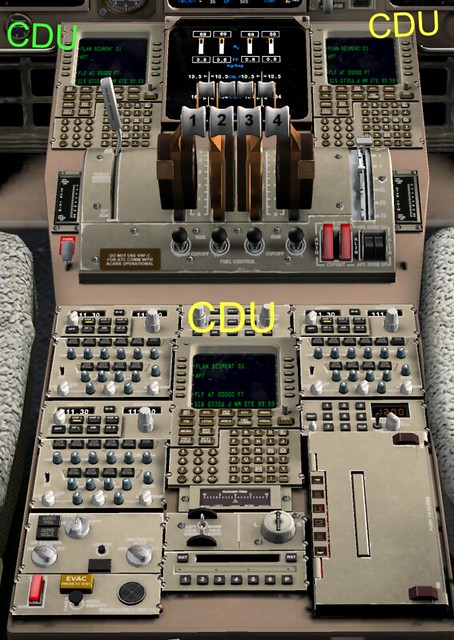
The CDU is the device used by pilots to input flight data. It looks like a large calculator, consisting of a square display and an alphanumeric keyboard. Modern airliner cockpits are generally equipped with 3 CDUs, located between the Captain and the First Officer seats, as shown in the 747-400 cockpit below:
-
Title: Development Progress on X-Plane 10.10
Since upgrading to 10.5-rc1 a few months ago, it seems the X-Plane development team’s progress has stalled. To support more developers of scenery and aircraft plugins, I assumed their main focus is now on third-party development tools. However, it seems they just updated their development blog, revealing details about the new version 10.10.
Here are a few points I’m particularly interested in: The release schedule for 10.10 is not yet certain; it seems there are still many bugs This version is not yet a 64-bit application The UI for aircraft selection and flight settings will change Road rendering will be more realistic System stability will be improved; even if you run the program continuously for 10 hours, it will not crash unexpectedly The low-level software for joystick hardware has been rewritten, allowing you to plug and play new hardware devices even during flight (currently requires restarting X-Plane)
-
Title: Summary of X-Plane 10/11 Flight Route Query and Setup Methods
User “CALL..ME..V!” asked about setting up flight routes when creating a flight plan in X-Plane. Here is a brief summary; I hope it helps.
0 How to submit a flight plan? Please refer to How to use ATC (Air Traffic Control) 1 The Issue X-Plane has built-in information for a large number of airports, Runways, and radio navigation stations (DME, VOR, NDB, ILS), and there is plenty of Waypoint information as well. However, the coverage of Waypoints used by general airlines is not very high. Therefore, if you input a route found online into the X-Plane FMC, it will likely result in an error.
-
Title: Exploring the Cockpit 1.6 Cockpit Preparation
While the Captain performs the exterior inspection on the ground, the First Officer is certainly not idle; they must complete the pre-flight preparation procedures and the CDU pre-flight procedures. Let me briefly introduce these tasks.
First, the First Officer must check various documents in the cockpit. Just like a car needs an annual inspection certificate, an aircraft needs an airworthiness certificate; an aircraft without an airworthiness certificate cannot fly. The flight log and maintenance documents record all flight and maintenance history of the aircraft, and these documents must not be missing.
-
Title: Airliner Cockpit Secrets 1.5 Pre-flight Ground Check
Before the pilot arrives at the aircraft, the ground maintenance crew has already completed the pre-flight inspection.
Generally speaking, aircraft maintenance management is divided into scheduled maintenance and line maintenance. Line maintenance includes pre-flight, post-flight, and transit maintenance work. Pre-flight maintenance requires two ground mechanics to spend approximately 1 hour performing checks such as tire pressure, landing gear, and electronic system power-on tests, confirming that the aircraft is sound and meets airworthiness requirements.
-
Title: x-plane 10 Small Aircraft Autopilot Basics
X-Plane 11 is out now, please check the latest coverage Installing and Trying the X-Plane 11 Free Demo!
The autopilot feature in X-Plane is simple to use and highly recommended. Here is a brief summary of how to use it. Today, I will start by introducing the usage for small aircraft, using the Cessna 172 as an example. The images might be a bit small; don’t forget to click on them to see the full-size version.
-
Title: Airliner Cockpit Exploration 1.4 Crew Briefing
After the pilot and dispatcher complete the flight briefing, they must also hold a crew briefing with other crew members, mainly the flight attendants. This meeting can be held at the company office, or possibly in the cabin; it seems to depend on the specific situation. The flight attendants report for duty 1.5 hours before the flight departure and hold a work preparation meeting covering passenger counts, division of duties during emergencies, and other topics.
-
Airliner Cockpit Secrets 1.3 Pre-flight Briefing
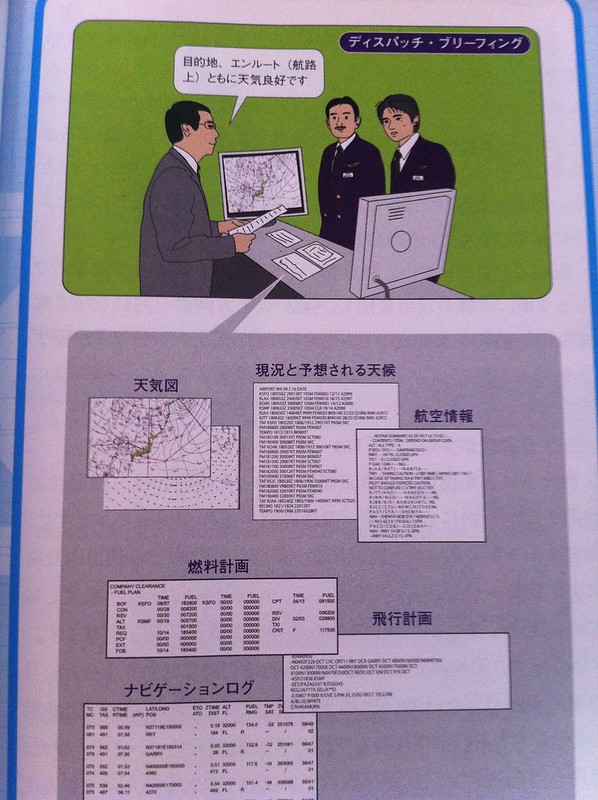
In 1.1 Pilot’s Work Schedule, it was introduced that pilots must report for duty 1.5 hours before departure time. After reporting to the company, they must hold a Dispatcher Briefing for the flight, which takes place in the flight dispatch office of the company’s flight management department. Because the pairing of the captain and first officer varies for each flight, they only meet and begin preparations together at this briefing.
-
Inside the Cockpit 1.2 What's Inside a Pilot's Flight Bag?

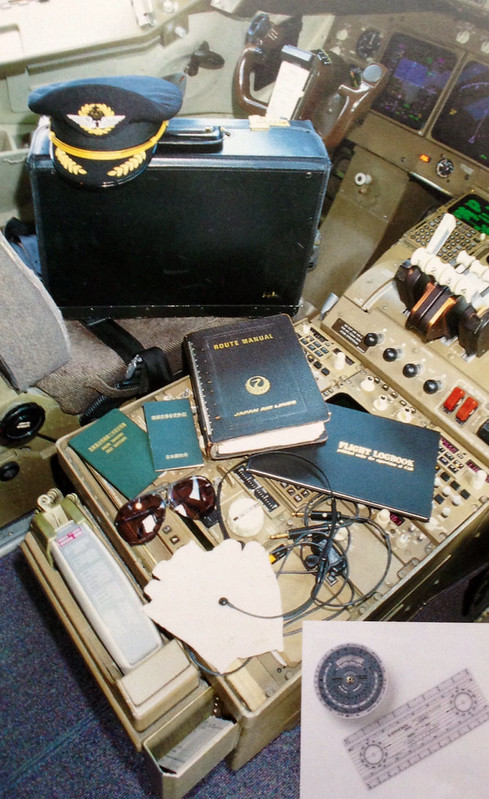
First, the heaviest and bulkiest items in the flight bag are undoubtedly the various regulations and manuals.
These include: OM: Operation Manual, including systems for pilot training reviews and duties, regulations on takeoff and landing weather conditions, and emergency procedures. AOM: Airplane/Aircraft Operation Manual, essentially the user manual for the aircraft, including aircraft operation and performance limits, normal and emergency operating procedures, descriptions and operations of various system units, performance data, weight and balance matters, etc. RM: Route Manual, which is the navigation charts, including summaries of various airports such as Runway length, Taxiway and Apron layouts, Standard Instrument Departure (SID) and Standard Instrument Arrival (STAR) flight routes, communication facilities status, etc.

-
Title: Unveiling the Cockpit 1.1 Pilot's Work Schedule
According to the book “How to Fly the Jumbo Jet (Boeing 747)”, the daily flight schedule and working hours of a pilot living in Tokyo are arranged as follows:
Day 1 06:00 - 14:00 Tokyo Haneda - Hokkaido - Tokyo Haneda - Fukuoka. Flying 3 flights in one day. Stay overnight in Fukuoka. Day 2 08:00 - 16:00 Fukuoka - Tokyo Haneda - Kumamoto - Tokyo Haneda. Flying 3 flights. Day 3 07:00 - 12:00 Standby at home (e.g., rush to the company in case of temporary shortage due to other pilots falling ill). Day 4 14:30 - 20:30 Tokyo Haneda - Kagoshima - Tokyo Haneda. Flying 2 flights. Day 5 Day off. Day 6 Day off. Day 7 14:30 - 10:00 (Local Time) Tokyo Haneda - Los Angeles International flight. Day 8 Day off. Day 9 12:30 (Local Time) - Depart Los Angeles International flight. Day 10 - 17:00 Arrive at Tokyo Narita. Day 11 Day off. …
-
Exploring Airliner Cockpits 0: Trying a Long Series on Flying Airliners
I have recently read some books on airliner operations and gained a preliminary understanding of a pilot’s duties, so I plan to write this down bit by bit as a summary. Of course, it would be even better if this material could be of some help to enthusiasts who are passionate about flight simulation.
As a personal learning summary from an amateur hobbyist, I primarily used the following books as reference material to write this. However, the method is not a simple translation of these books, but rather more like a book review.
-
Inside the Cockpit - Table of Contents
Inside the Cockpit — How Pilots Fly Civil Airliners
This series introduces the workflow and operational procedures of civil airliner pilots, using the Boeing 737-500 as an example.
Chapter 0: Introduction
Chapter 1: Pre-Flight Preparation
- Inside the Cockpit 1.1 - Pilot Work Schedule
- Inside the Cockpit 1.2 - What’s in a Pilot’s Bag?
- Inside the Cockpit 1.3 - Flight Briefing
- Inside the Cockpit 1.4 - Crew Briefing
- Inside the Cockpit 1.5 - Pre-Flight External Inspection
- Inside the Cockpit 1.6 - Cockpit Preparation
- Inside the Cockpit 1.7 - FMS CDU Setup Details
- Inside the Cockpit 1.8 - Pre-Flight Procedures and Cockpit Interior
Chapter 2: Pushback and Taxi
- Inside the Cockpit 2.1 - 5 Minutes Before Departure
- Inside the Cockpit 2.2 - Standard Instrument Departure (SID)
- Inside the Cockpit 2.3 - Push Back and Engine Start
- Inside the Cockpit 2.4 - Taxi Routes
- Inside the Cockpit 2.5 - Taxi Operations
- Inside the Cockpit 2.6 - About Flaps
- Inside the Cockpit 2.7 - Takeoff Clearance
Chapter 3: Takeoff and Climb
- Inside the Cockpit 3.1 - Three Types of Takeoff
- Inside the Cockpit 3.2 - Takeoff Roll
- Inside the Cockpit 3.3 - Rotate and Lift Off
- Inside the Cockpit 3.4 - Gear Up
- Inside the Cockpit 3.5 - Engaging Autopilot
- Inside the Cockpit 3.6 - ATC Handoff to Departure, Entering VNAV Mode
- Inside the Cockpit 3.7 - ATC Handoff to Center, Continuing Climb
- Inside the Cockpit 3.8 - Entering Cruise
Chapter 4: Cruise Flight
- Inside the Cockpit 4.1 - Basics of Navigation
- Inside the Cockpit 4.2 - Flight Speed Indicators and Maximum Speed
- Inside the Cockpit 4.3 - Flight Altitude, Pressure, and Maximum Altitude
- Inside the Cockpit 4.5 - About Cruise Speed
- Inside the Cockpit 4.6 - Fuel Consumption and Center of Gravity
- Inside the Cockpit 4.7 - Weather and Turbulence
- Inside the Cockpit 4.8 - Weather and Turbulence (continued)
- Inside the Cockpit 4.9 - Inside the Cockpit
Chapter 5: Descent Preparation
- Inside the Cockpit 5.1 - Descent Preparation
- Inside the Cockpit 5.2 - Approach Briefing
- Inside the Cockpit 5.3 - Standard Instrument Arrival
- Inside the Cockpit 5.4 - Instrument Approach Charts
- Inside the Cockpit 5.5 - Starting Descent
- Inside the Cockpit 5.6 - ATC Communication During Descent
- Inside the Cockpit 5.7 - Summary of Descent Operations
Chapter 6: Approach and Landing
- Inside the Cockpit 6.1 - Control During Radar-Guided Approach
- Inside the Cockpit 6.2 - Landing Aid Systems
- Inside the Cockpit 6.3 - Final Approach Fix and ILS Setup
- Inside the Cockpit 6.4 - Traffic Pattern
- Inside the Cockpit 6.5 - Landing Procedure
- Inside the Cockpit 6.6 - Go Around
- Inside the Cockpit 6.7 - Landing Operations
- Inside the Cockpit 6.8 - Post-Landing Procedures
- Inside the Cockpit 6.9 - Docking at the Gate
- Inside the Cockpit 6.10 - Shutdown Procedures
