Title: Exploring the Cockpit of Airliners 4.2 What are the indicators of flight speed and what is the maximum speed of an aircraft?
During the cruise phase, even though the autopilot instruments on the aircraft are very advanced and pilots do not need to manipulate the controls directly, this does not mean pilots can be idle. They must constantly scan various instruments, check various flight data, and record it from time to time; they are still quite busy.
Below is a simple summary of flight data information across a few sections. First, let’s look at speed.
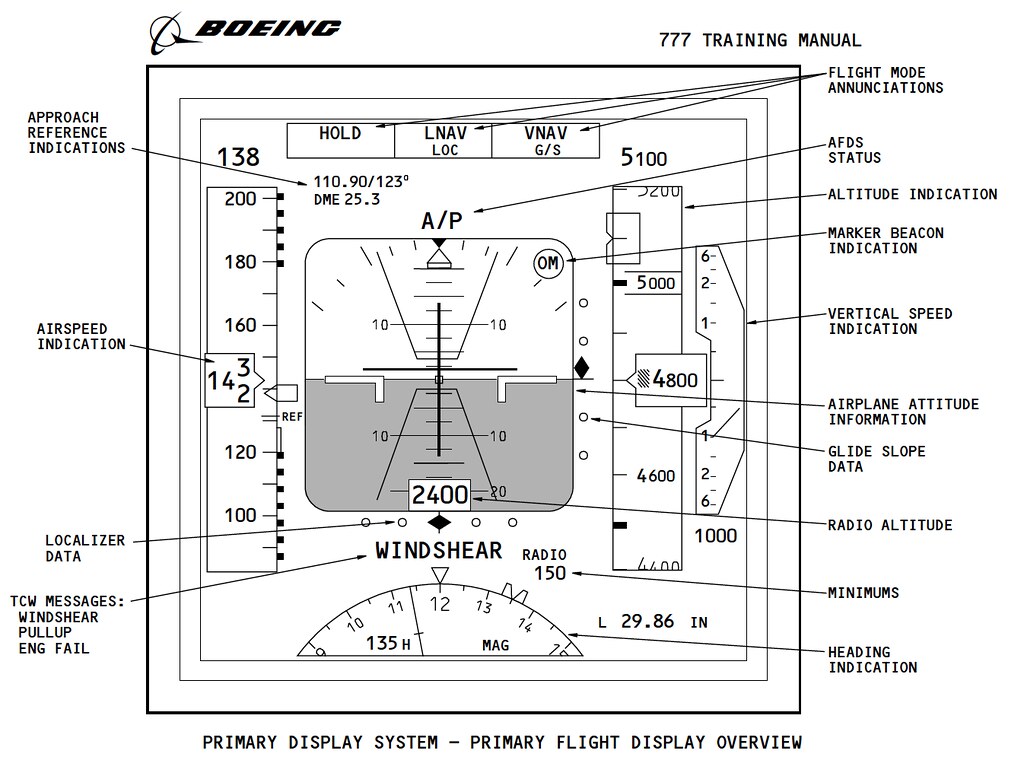
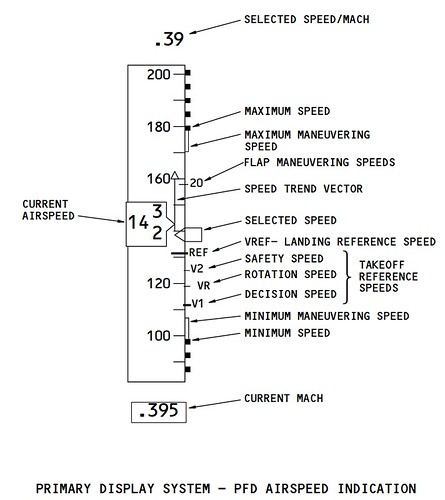
The first one is IAS Indicated Airspeed. This number is displayed in the central box on the left speed tape of the PFD. As shown in the Boeing 777 training manual below, the number pointed to by the AIRSPEED INDICATION arrow is the IAS, showing the current speed as 142.5 knots.
Indicated Airspeed is the speed of the aircraft relative to the air, measured by the Pitot tube (and static port). You can refer to the image below for the appearance of the Pitot tube.
 This is an All Nippon Airways Boeing 777 I photographed at the International Terminal of Tokyo Haneda International Airport. You can see two needle-like probes extending forward from the right side of the nose; these are the Pitot tubes. To ensure safety, aircraft are generally equipped with multiple Pitot tubes to improve reliability. For example, the Boeing 777 is equipped with 3: two on the right side and one on the left.
The principle of the Pitot tube is relatively simple. As shown in the figure below, the place labeled “Total Pressure” (i.e., Dynamic Pressure) at the bottom of the figure represents the front air intake of the Pitot tube, while the place labeled “Static Pressure” represents the static port, located in the middle of the side of the fuselage.
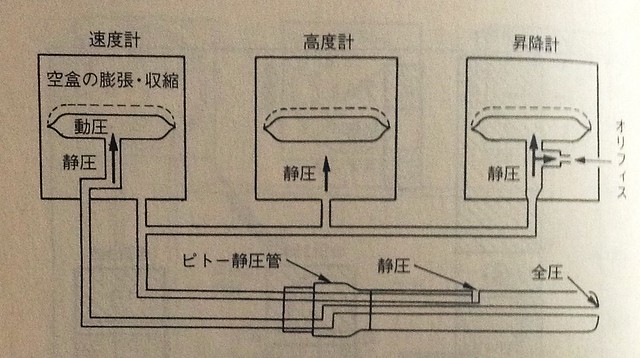 The input for Indicated Airspeed is the difference between the ram air pressure sensed by the Pitot tube directly ahead and the static pressure sensed by the static port on the side. When the aircraft speed is fast, the dynamic pressure is high, which pushes the “aneroid capsule” inside the Airspeed Indicator to expand; conversely, it contracts. The “capsule” here is welded from two very thin metal plates and deforms slightly under external pressure. The movement of the capsule is transmitted to the computer. Because dynamic pressure is proportional to the square of the speed, the system derives the Indicated Airspeed after calculation, in units of knots (nautical miles per hour).
Dynamic Pressure (value displayed on the Airspeed Indicator) = 1/2 * Air Density * True Speed^2
From this formula, we know that with the same dynamic pressure, i.e., the same IAS display, the flight speed varies at different altitudes. Regarding this point, I will explain specifically with actual numbers when discussing TAS below.
Indicated Airspeed (IAS) is uncompensated data, also known as meter speed, representing the speed of the aircraft relative to the air. IAS cannot represent whether the aircraft is flying fast or slow relative to the ground, but it is very important because IAS is the index of the aircraft’s aerodynamic performance. Various maneuvers and control surface operations (such as when to deploy Flaps, maximum flight speed, Stall speed, etc.) all need to use IAS as a standard. Therefore, pilots must constantly monitor this indicator during flight.
Also, it is important to know that dynamic pressure is directly proportional to air density. Therefore, the higher the flight altitude, the lower the air density. Thus, even when the aircraft is flying at high speed relative to the ground, for example, accelerating to 900 km/h relative to the ground, the IAS may still slowly decrease.
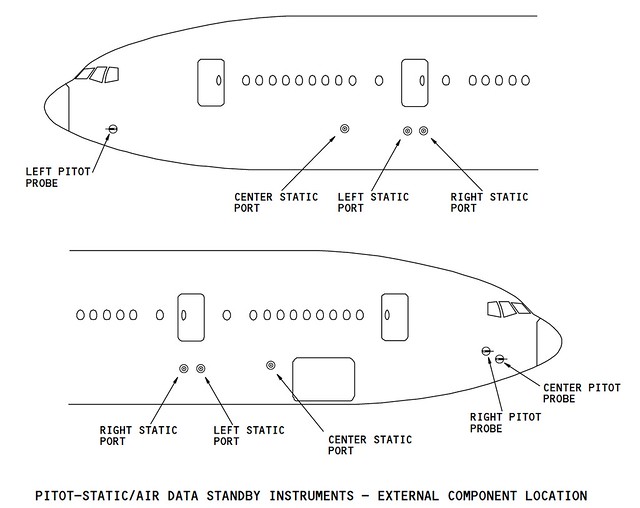
Reference: The image below is a schematic diagram of the Pitot tube and static port positions on a Boeing 777.
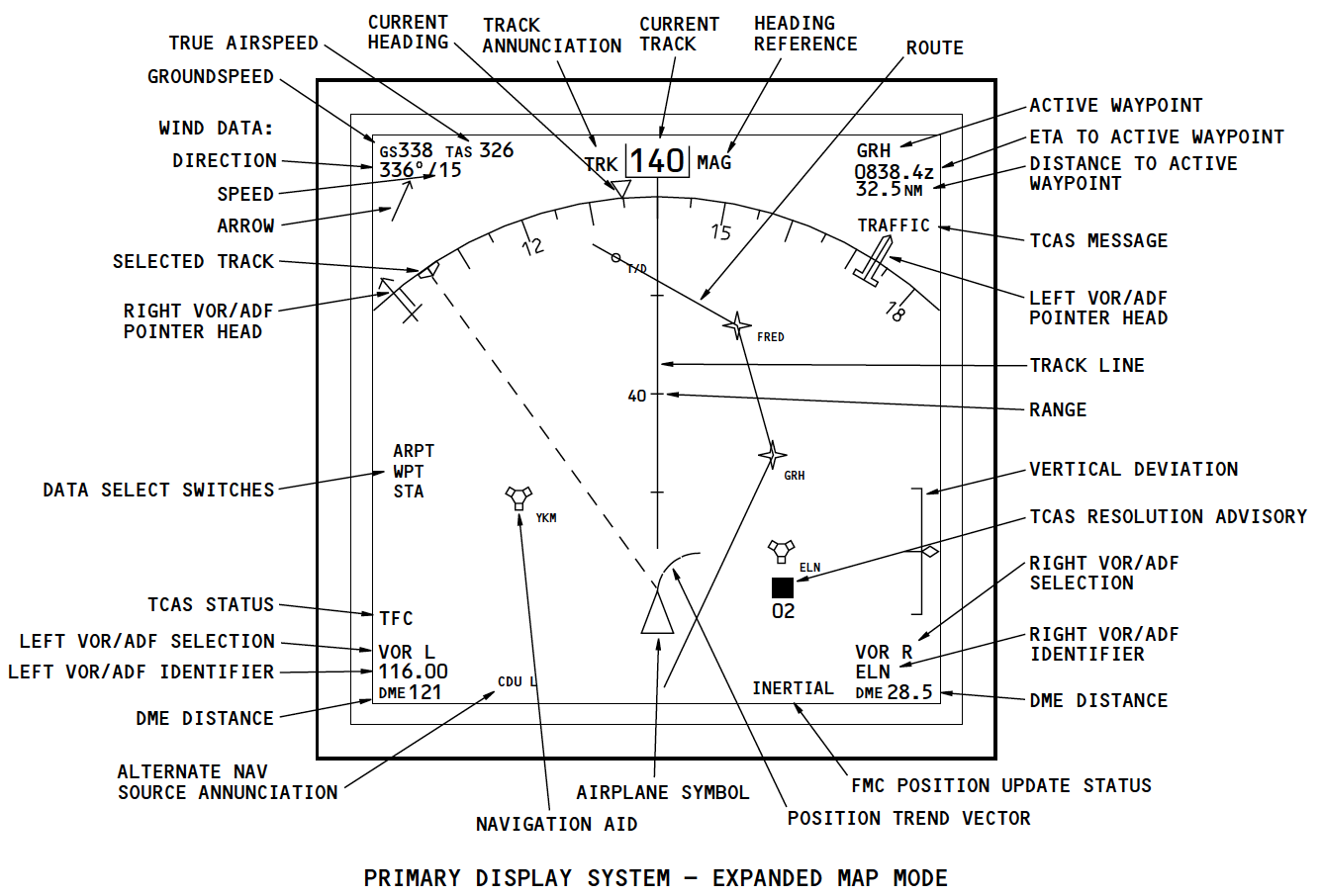
The second speed metric is TAS True Airspeed, also called True Airspeed. As shown in the “TAS 326” display in the upper left corner of the ND screen below.
The IAS mentioned above is calculated based on the air density relative to the ground, so the speed calculated based on the pressure at the aircraft’s current altitude is the true aircraft airspeed—this is TAS (True Airspeed). Only through TAS can one truly know the fast or slow speed of the aircraft. This is also why TAS is displayed on the ND (Navigation Display).
Let’s look at a comparison of IAS and TAS data. For example, when IAS is 270 knots: On the ground: TAS is naturally also 270 knots. Dynamic pressure is 17 atmospheres. At an altitude of 20,000 feet (approx. 6,100m): Air density decreases by 53%. To maintain the same dynamic pressure, TAS needs to be 362 knots, or a speed of 670 km/h. At an altitude of 30,000 feet (approx. 9,100m): Air density decreases by 37%. To maintain the same dynamic pressure, TAS needs to be 423 knots, or a speed of 783 km/h. At an altitude of 35,500 feet (approx. 10,800m): TAS is 462 knots, or a speed of 856 km/h.
It can be seen that the higher you fly, even without increasing engine Thrust, the actual speed of the aircraft becomes faster and faster. For airlines and passengers, saving journey time and arriving at the Destination as soon as possible makes flying at high altitudes a choice that pleases everyone.
The third speed metric is GS, or Ground Speed. The meaning of this metric is the easiest to understand: it is the flight speed of the aircraft relative to the ground.
GS speed is related to wind force and wind direction. In a headwind condition, subtracting the wind speed relative to the flight direction from the TAS (True Airspeed) gives the GS (Ground Speed); for a tailwind, adding the wind speed gives the GS.
Therefore, looking at the GS 338 in the image above indicates that the Ground Speed is 338 knots/hour. TAS 326 indicates True Airspeed is 326 knots. The “336 degrees / 11” below indicates the wind direction is 336 degrees, and the wind speed is 15 knots. The arrow below points to the wind direction, so it can be seen that the aircraft is basically in a direct tailwind state at this time, so the speed relative to the ground is faster than the speed through the air.
The fourth important metric is the Mach number.
The Mach number is named after the Austrian physicist Mach, abbreviated as M number. It is defined as the ratio of the speed of an aircraft flying in the air to the speed of sound, i.e., the multiple of the speed of sound. Since the speed of sound propagation in the air varies under different conditions, Mach is also only a relative unit; the specific speed per “Mach” is not fixed. At low temperatures, the propagation speed of sound is lower, so the specific speed corresponding to one Mach is also lower. Therefore, relatively speaking, it is easier to reach a higher Mach number at high altitudes than at low altitudes.
The Mach number is also displayed on the PFD, as shown by the number “.395” in the box at the bottom of the figure below, at the CURRENT MACH location.
 The Mach number on the aircraft is calculated from the IAS value. For example, at an altitude of 35,500 feet (approx. 10,800m), an IAS of 270 knots corresponds to a Mach number of 0.803. Additionally, the TAS value is calculated via the Mach number, and GS is calculated via the Inertial Navigation System.
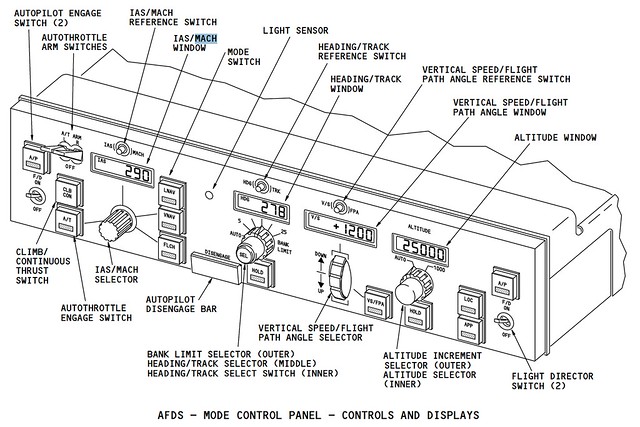
Generally, during high-altitude cruise, the Mach number is used for control instead of Indicated Airspeed. For example, the button above the IAS/MACH WINDOW on the Boeing 777’s MCP below allows switching between IAS and Mach to set the speed.
 This is because when the aircraft speed approaches the speed of sound, the airflow speed over the wing may exceed the speed of sound, causing powerful shock waves,
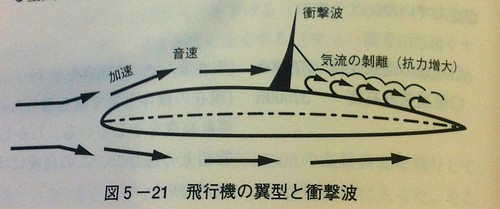 generating huge vibrations on the wing, known as the sound barrier. The sound barrier can damage the aircraft structure and, in severe cases, cause a crash. Therefore, civil aircraft have an Mmo indicator, indicating the maximum limit Mach number the aircraft can fly, to protect the structural strength of the aircraft from damage.
In addition to Mmo, there is also a Vmo, which is the maximum limit Airspeed that the aircraft can fly. Because the higher the Airspeed, the greater the Lift, and the greater the requirement on the body’s endurance. If a certain value is exceeded, the aircraft body may also be damaged.
Let’s look at some specific data on maximum limit speeds: Airbus A380 Vmo is 340 knots, Mmo is Mach 0.89 Airbus A330 Vmo is 330 knots, Mmo is Mach 0.86 Boeing 747 Vmo is 365 knots, Mmo is Mach 0.892 Boeing 777 Vmo is 330 knots, Mmo is Mach 0.87
You might say, wasn’t there the Concorde supersonic airliner? Why could it fly supersonically? To achieve supersonic flight, the aircraft must enhance structural strength and be designed with an aerodynamic shape that reduces air Drag. But enhancing strength inevitably makes the airframe heavier, which brings the disadvantages of fewer passengers and higher fuel consumption. To reduce air Drag, the wing leading edges must be thin, which reduces fuel capacity and shortens the range. At the same time, supersonic flight brings huge noise; its shock waves can even shatter the glass of buildings on the ground, leading to rules prohibiting supersonic flight over land. As a result, the Concorde could only perform supersonic cruise over the oceans, which greatly limited its scope of use. Ultimately, due to various economic reasons, it had to be retired from service. Therefore, modern airliners are basically subsonic, with maximum speeds between Mach 0.8 and 0.9. It can be said that this is the best balance point between safety and economy under current technological levels.
End