Title: Secrets of Airliner Cockpits 4.3 Flight Altitude, Air Pressure, and Maximum Flight Altitude
The previous section covered speed metrics; this section explains data regarding altitude.
There are two types of Altimeter on an aircraft: the barometric Altimeter and the radio Altimeter. Let’s look at the barometric Altimeter first.
We all know that as altitude increases, air density decreases, and atmospheric pressure drops accordingly. By measuring atmospheric pressure and comparing it with standard values, the absolute altitude (elevation above sea level) of the measurement location can be determined. This is the basic working principle of the barometric Altimeter. The advantage of using pressure for measurement is that the Altimeter is compact and simple in structure; however, the disadvantage is that besides altitude, changes in temperature and water vapor density also affect pressure changes. Therefore, pilots must calibrate the Altimeter based on local atmospheric conditions. This is indispensable before takeoff and landing, as the danger of landing without an accurate grasp of altitude goes without saying.
To give an example, the day before yesterday, under high-pressure sunny weather, a certain aircraft landed at Haneda Airport, which has an elevation of 6.4 meters. The pressure at that time was 1013 hPa, and the aircraft’s Altimeter was calibrated to a setting of 29.92 inches of mercury (inHg), with the Altimeter showing 21 feet. The next day, it started to rain, and the pressure dropped to 997 hPa. If not recalibrated, the Altimeter would then display 450 feet, which converts to 137 meters. An aircraft parked on the ground at an elevation of 6 meters showing 137 meters on the instrument demonstrates the significant impact weather has on the Altimeter. Therefore, before takeoff, the pilot must set the Altimeter to 997 hPa, which is an Altimeter setting of 29.45 inHg. This setting information can be obtained through the airport Air Traffic Controller, the airline dispatcher, or the Airport Terminal Information Service (ATIS).
There are a few terms regarding pressure that are frequently used; here is a brief summary.
-
“QFE” is the atmospheric pressure at the airport level. “FE” can be memorized as “Field Elevation.” If a pilot uses the QFE Altimeter setting to calibrate the Altimeter, the pointer on the Altimeter will point to 0 feet while at the airport.
-
“QNH” is a value converted from QFE based on the standard atmosphere established by the International Civil Aviation Organization (ICAO). “NH” can be memorized as “Not Here.” The value used when setting the Altimeter at the airport, as mentioned above, is the QNH value. If a pilot uses the QNH Altimeter setting to calibrate the Altimeter, the pointer on the Altimeter will point to the airport’s elevation above sea level. This is also the airport data marked on navigation charts. Therefore, when taking off, Climbing, Descenting, and landing near the airport, the Altimeter must be adjusted to the QNH value as a standard. This ensures that all aircraft taking off and landing use the same standard to measure flight altitude, preventing accidents such as ground collisions, mid-air collisions, or near misses.
-
“QNE” refers to the pressure at sea level under standard atmospheric conditions. Its value is 1013.2 hPa (29.92 inHg). Near the airport, QNH can be used as the standard, but when flying between airports, pressure changes are uncertain, and it is impossible to establish countless measurement stations on the ground or ocean to determine QNH. Therefore, if all aircraft use a unified standard, QNE, it simplifies Altimeter settings and ensures safety in the air. So, under what conditions is QNH adjusted to QNE? According to regulations, there is a Transition Altitude. When the QNH (Note: context implies altitude) exceeds this altitude, the pilot needs to set the Altimeter to QNE, which is 29.92 inHg or 1013.2 hPa. Additionally, regulations for the Transition Altitude vary by country; for example, during Climb, it is 3000 meters in China, 14,000 feet in Japan, 18,000 feet in the US, 6000 feet in the UK, and 11,000 feet in Singapore and Thailand.
Continuing with the Boeing 777 as an example to look at the actual instrument display, in the PFD (Primary Flight Display) below, the altitude indication is in the central box on the right altitude strip.
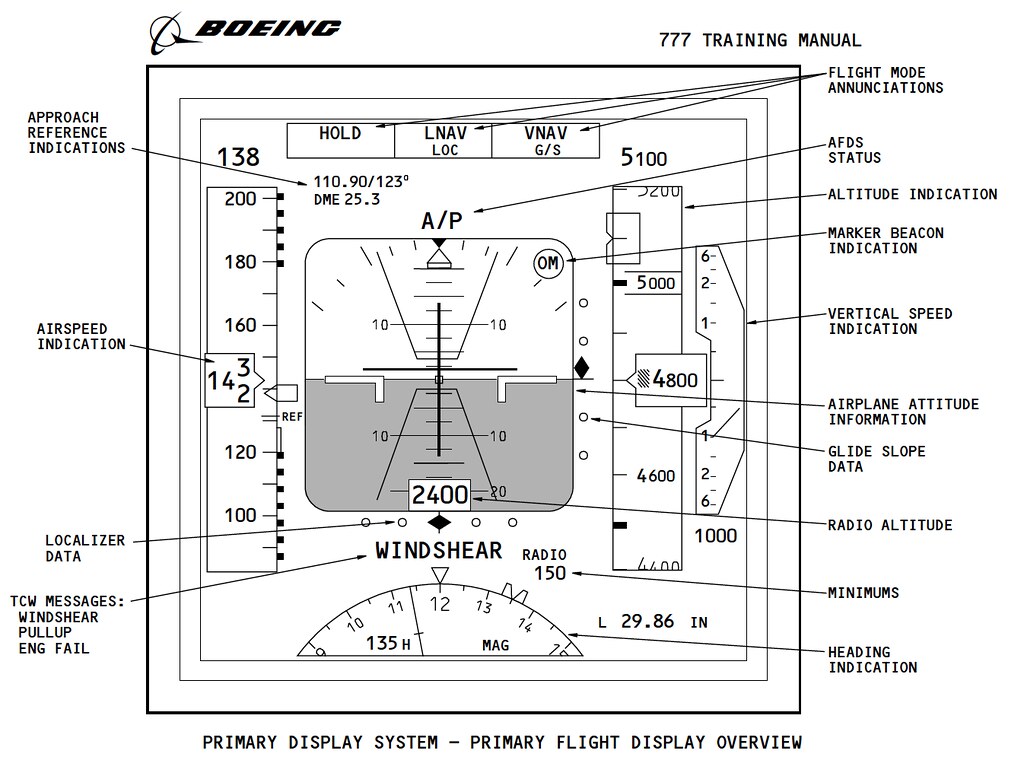 The number “4800” indicates that the Altimeter shows 4800 feet, while the “29.86 IN” data below indicates the Altimeter setting is 29.86 inHg, showing that the aircraft is using the QNH value at this time.
Looking at the diagram below, the Altimeter section is isolated with specific explanations for each number.
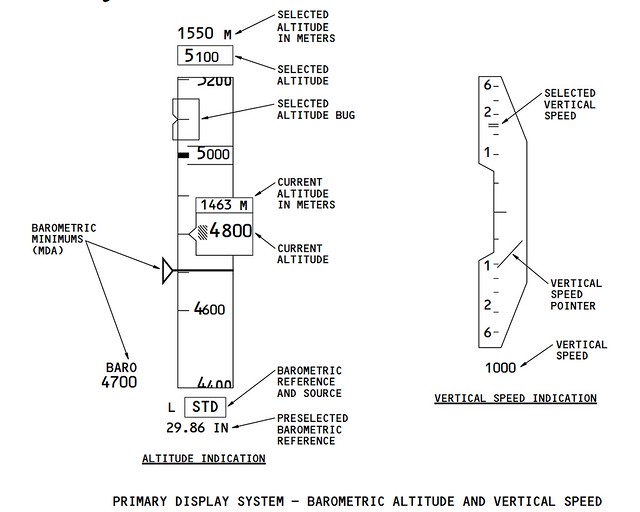 We can see in the central box where the “CURRENT ALTITUDE” arrow points, the number “4800” indicates the Altimeter displays 4800 feet. Below that, there is a box displaying “STD,” which indicates the aircraft is currently using the QNE standard pressure. At the same time, we can see the “29.86 IN” data pointed to by the “PRESELECTED BAROMETRIC REFERENCE” arrow below STD. This is the preset Altimeter value, set to 29.86 inHg. The pilot can preset the destination’s QNH value during the Descent phase; once below the Transition Altitude, they simply press a switch button, which greatly simplifies the operation.
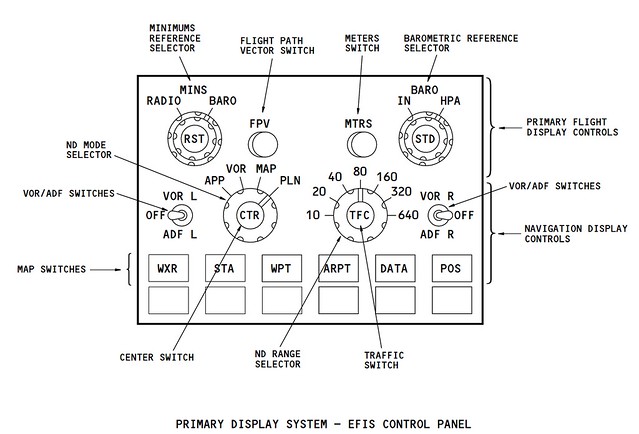 The STD button is located in the upper right of the EFIS control panel shown above. The BARO knob pointed to by the “BAROMETRIC REFERENCE SELECTOR” arrow is where the Altimeter setting is adjusted.
Regarding altitude units, generally, Europe, America, and Japan use feet, while China uses meters. However, when using the QNE altitude setting, the term “Flight Level” is used. When using Flight Level, the last two zeros of the number are omitted; therefore, 35,000 feet is called Flight Level 350, generally written as FL350. For example, in the Air Traffic Control dialogue mentioned in section 3.7, there was such an introduction: “Tokyo Control, Air System 115, Leaving 7800 for FL210, Initially Proposed FL410” “Tokyo Center, this is Air System 115, passing through altitude 7800 feet to 21,000 feet, final target altitude 41,000 feet.” Here, 7800, FL210, and FL410 are used to express altitude. Now we know that 7800 is the altitude of 7800 feet under QNH, and FL210 means an altitude of 21,000 feet under QNE.
So, generally speaking, how high can a civil airliner fly? Regarding the maximum flight altitude, or “Service Ceiling,” two factors are involved: Lift and structural strength.
We know aircraft can fly because of the presence of air. The engine pushes the aircraft, and upon reaching a certain speed, the airflow acting on the wings generates upward Lift, causing the aircraft to continuously Climb. However, the higher the altitude, the thinner the air becomes. The less air enters the engine, the lower the Thrust the engine can generate, eventually reaching the limit of how high the aircraft can Climb. At this point, the aircraft can only perform Level Flight. This brings about the concept of “Service Ceiling.” When the aircraft’s Climb speed becomes slower and slower, and its vertical rate of Climb drops to 300 feet per minute (90 meters per minute, as slow as a human walking speed), the corresponding altitude is the Service Ceiling. Therefore, for the same type of aircraft, the greater the engine power and the lighter the weight, the higher the Service Ceiling.
Structural strength involves the issue of the pressure difference between the inside and outside of the aircraft. At an altitude above 10,000 meters, the temperature is about minus 50 degrees, and the pressure is only 20% of that on the ground. Therefore, if the cabin lacks air conditioning and pressurization equipment to provide appropriate temperature and pressure, passengers cannot survive. Regarding air conditioning, the cabin temperature is generally standardized at 24 degrees. In summer, thinner clothing leads to a slightly higher temperature setting, while in winter, thicker clothing leads to a slightly lower setting. However, compared to temperature, pressurization control is more difficult.
For example, if one were to maintain one atmosphere of pressure inside the cabin while continuously Climbing, as the external pressure continuously drops, the aircraft would expand like a balloon under the action of the pressure difference. At 11,000 meters, the internal-external pressure difference force acting on the airframe reaches 8.1 tons per square meter, while at 13,000 meters it reaches 8.7 tons per square meter. This requires the aircraft’s structural strength to resist such great pressure without deforming. At the same time, with every flight constantly Climbing and Descenting, the forces of expansion and contraction acting on the airframe repeat endlessly, eventually causing metal fatigue and major structural issues such as hull rupture.
Therefore, in aircraft design, as altitude changes, the internal pressure is gradually adjusted alongside the external pressure changes to reduce the impact of the pressure difference. Of course, pressure that is too low can cause physical discomfort, so even when lowering the pressure, it is only lowered to 0.75 atmospheres, which is equivalent to the pressure at an altitude of 2400 meters. To distinguish it from the actual flight altitude, this altitude value is called “Cabin Altitude.”
Consequently, the aircraft’s maximum flight altitude is determined by the pressure difference compared to the Cabin Altitude. For example, the Boeing 747’s maximum pressure differential tolerance is 6.1 tons per square meter, and its maximum flight altitude to maintain a Cabin Altitude below 2400 meters is 13,750 meters.
Let’s look at the maximum flight altitude data for other modern jetliners. Airbus A380: Pressure difference 6 tons/sqm, Max altitude 13,100 meters Airbus A330: Pressure difference 5.8 tons/sqm, Max altitude 12,520 meters Boeing 777: Pressure difference 6 tons/sqm, Max altitude 13,130 meters
End
Prev: What are the metrics for flight speed and what is the maximum speed of an aircraft? TOC: Table of Contents Next: Regarding Cruise Altitude