Airliner Cockpit Exploration 5.2 Approach Briefing
“The approach briefing is a statement by the pilot flying to the other pilot before a certain phase or maneuver of flight, outlining the intended implementation. It is a brief review of normal and non-normal procedures, control techniques, notes, and crew coordination for a specific action. This ensures crew members are clear on their responsibilities—how to handle normal situations and how to coordinate during abnormal ones—much like a pre-war rehearsal.
Taking the approach briefing as an example, the requirements are: The approach briefing is conducted by the pilot flying, and their voice must be clear; all crew members must understand the intent. The approach briefing is a crucial part of approach preparation; both pilots in the cockpit must review the approach chart and instrument approach plate from top to bottom, reviewing the approach procedure and considering alternate plans. During the briefing explanation, the other pilot must listen attentively and provide immediate corrections to reach a consensus. The approach briefing must capture key points and be concise; the listed content need not be exhaustive. When special circumstances exist or any arrival factor differs from standard procedures, the approach briefing must include relevant content.” – Source: Baidu Baike
“Generally, the approach procedure can be divided into five phases: Arrival, Initial, Intermediate, Final, and Missed Approach.
(1) Arrival Phase: This refers to an arrival route from the en route phase to a navigation facility used for the procedure or to a fix (Initial Approach Fix). This route is depicted on the arrival chart. During this phase, the pilot should pay attention to effectively controlling the descent path. (2) Initial Approach Phase: This begins at the Initial Approach Fix (IAF) and ends at the Intermediate Fix (IF). During the initial approach phase, the aircraft has left the structured airway and is maneuvering to enter the intermediate approach phase. (3) Intermediate Approach Phase: If there is a Final Approach Fix (FAF), the start of the intermediate approach phase is when the aircraft turns onto the inbound track during a procedure turn or base turn; or when flying a pattern (like a holding pattern), when the aircraft turns onto the final approach track. If there is no Final Approach Fix (FAF), the inbound flight becomes the final approach segment. In this segment, the aircraft’s speed and configuration should be adjusted to prepare for the final approach. (4) Final Approach Phase: In this segment, the aircraft maintains track while descending for landing. (4.1) Final Approach for Non-Precision Approach (with FAF): The final approach segment begins at the station or fix (FAF) and ends at the MAPt. (4.2) Final Approach for Precision Approach: Begins when the aircraft intercepts the glideslope at a point (FAP) and ends at the missed approach point (MAP). (5) Missed Approach Phase: This is the phase where the climb action is initiated immediately upon reaching the Decision Height (DH) if the required visual reference cannot be established. During the missed approach phase, the aircraft’s configuration, attitude, and altitude must be changed. The missed approach phase is divided into initial, intermediate, and final missed approach phases. The initial missed approach phase is from the MAPt to establishing a climb. The intermediate missed approach phase is the straight climb to 50 meters obstacle clearance. The final missed approach phase is from 50 meters obstacle clearance to commence another approach, holding, or return to the airway. From the initial approach to the missed approach, all information is depicted on the approach chart.”
– Source: Online materials from Shandong Airlines Flight Department, article “Reflections on ILS Final Approach”
So, what exactly is included in an approach briefing?
Coincidentally, the book Captain’s Seat (機長席) in my possession provides a detailed explanation of the cockpit during a certain flight, complete with a live recording CD. It vividly recreates the calls between pilots and Air Traffic Control, serving as excellent first-hand material. Below, I have translated the content from this book (the dialogue during preparation for landing towards Haneda Airport).

First Officer: “The gate at Haneda Airport is Gate 2. There is no NOTAM information regarding Runway 16L.”
Captain: “No NOTAM, understood.
Plan to land on Runway 16L. Wind is 200 degrees at 17 knots. Well, that’s a crosswind from the right. Weather is good. No clouds. Temperature is 14 degrees, dew point is 2 degrees. Altimeter setting is 3019.
We will use the VOR/DME 16L approach.
Radar vector arrival procedure.
MDA (Minimum Descent Altitude) is 1000 feet.
The heading of the KWE Koto VOR is 320 degrees.
(Note: Since 2009, the Koto VOR has been decommissioned and replaced by the new Otaiba VOR. The book Captain’s Seat was published in 1999, when the Koto VOR was still in use. The KWE VOR/DME is represented by a circle with radiating lines and a solid black dot inside; its location can be found in the upper center of the chart below.)
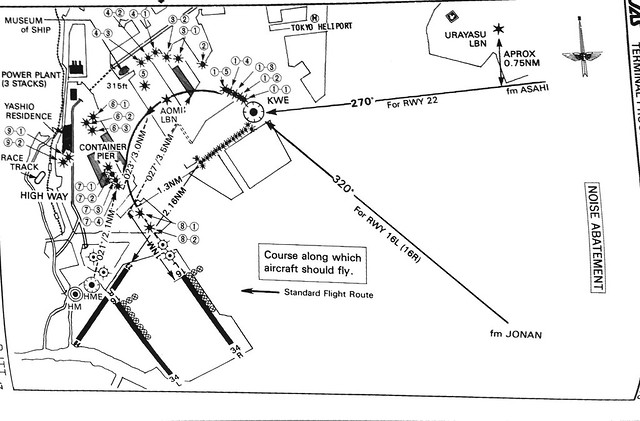
For the final segment, we will use L-NAV lateral navigation mode. To reduce noise over the city north of the Koto VOR, we should avoid turning north as much as possible; turn left early. Finally, I will fly manually using vertical deviation and flight path vector (on the PFD) to complete the approach.
In case of a Missed Approach, I will command the flap setting. Retract the landing gear after positive rate of climb is established. The missed approach route follows the direction of Uraga and Tateyama. Climb to an altitude of 4500 feet. Contact Tower as soon as possible and then accept radar vectors for the approach again.
Vertically, use V-NAV vertical navigation. Estimated final approach altitude is 1500 feet. Landing flaps will be 30 degrees. VREF (Reference Speed, which is the landing speed for the Flaps 30 landing configuration) is 130 knots. Autobrake setting is 2.
The planned runway exit after landing is C4, J3. Gate 2.
Any questions?”
First Officer: “No questions.”
After completing the approach briefing, the First Officer needs to execute the Descent procedure, inputting the various data decided above into the FMS. Once the Captain checks and confirms there are no errors, the setup is formally finalized. For example, the VREF mentioned above needs to be entered on the CUD APPROACH REF page.
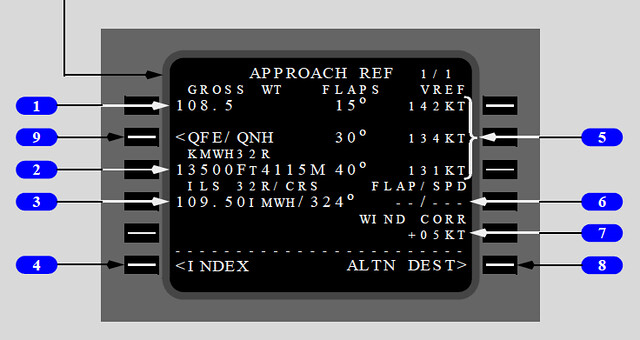 The arrow pointing to “5” in the image above indicates that setting.
The brake setting switch is located on the forward center panel. The First Officer needs to set the AUTO BRAKE selector switch to the required braking setting.
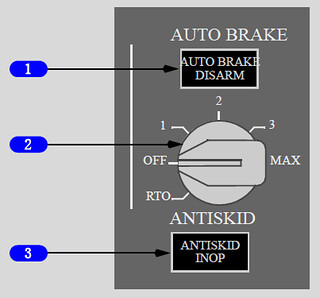 The image above shows the brake setting panel of a Boeing 737.
The example above skipped directly over the explanation of the arrival procedure, so in the next section, I plan to supplement and summarize knowledge regarding the Standard Instrument Arrival (STAR). Additionally, I plan to dedicate a specific section to the instrument approach procedures used by pilots, as this knowledge is crucial for understanding aircraft flight routes.
Prev: Descent Preparation TOC: Table of Contents Next: STAR Standard Instrument Arrival
End