Inside the Cockpit 1.2 What's Inside a Pilot's Flight Bag?

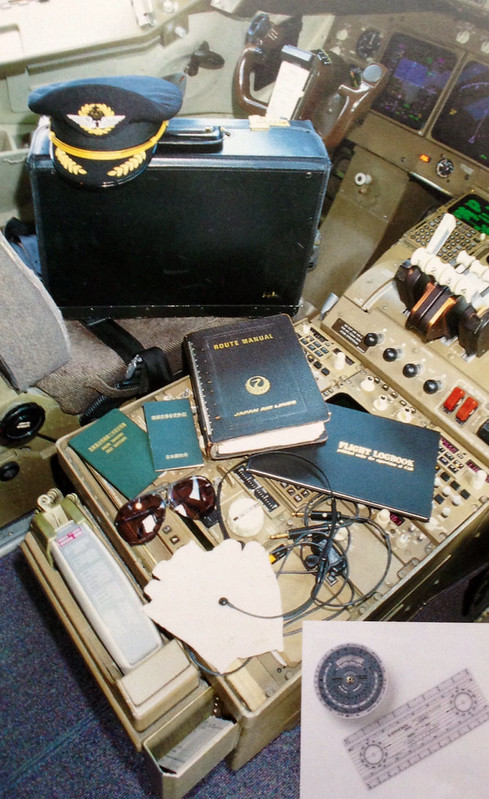
First, the heaviest and bulkiest items in the flight bag are undoubtedly the various regulations and manuals.
These include:
OM: Operation Manual, including systems for pilot training reviews and duties, regulations on takeoff and landing weather conditions, and emergency procedures.
AOM: Airplane/Aircraft Operation Manual, essentially the user manual for the aircraft, including aircraft operation and performance limits, normal and emergency operating procedures, descriptions and operations of various system units, performance data, weight and balance matters, etc.
RM: Route Manual, which is the navigation charts, including summaries of various airports such as Runway length, Taxiway and Apron layouts, Standard Instrument Departure (SID) and Standard Instrument Arrival (STAR) flight routes, communication facilities status, etc.

Additionally, the digitization of manuals is now very advanced. For example, in the photo below, Boeing’s Electronic Flight Bag (EFB):
 It is installed on the side of the control stick (yoke), allowing for convenient touch-based access to various electronic manuals.
This way, pilots don’t need to carry heavy books back and forth on their flights.
It is installed on the side of the control stick (yoke), allowing for convenient touch-based access to various electronic manuals.
This way, pilots don’t need to carry heavy books back and forth on their flights.
Just as driving a car requires a driver’s license, pilots also need to carry their pilot license, radio communication skill license (because communication with Air Traffic Control is required), and a medical certificate. Additionally, if operating international flights, a passport is also essential.
The checklist records every task from pre-flight preparation to engine shutdown, serving as a flowchart and memo for the flight. When performing flight missions, pilots must strictly adhere to the written checklist to ensure that flying is executed 100% according to standard procedures, without errors or omissions, regardless of complex or changing conditions.
The flight logbook (logbook) records the details of every flight, including time, location, aircraft type number, route, and duration.
Sunglasses: These are necessary to protect the eyes because UV radiation is stronger at high altitudes than on the ground.
A flight computer is a mechanical combination of various rotating discs, marked with units like miles, nautical miles, kilograms, and liters. By rotating and calculating, it can be used to solve simple calculations related to flight planning and navigation.

An Aviation Headset is a headphone set with a microphone, used for listening and conducting radio communications.

A flashlight: Night flying is inseparable from a flashlight; it is needed from ground preparation to viewing navigation charts during flight.
The items introduced above are all work-related. Regarding personal items, if staying overnight in another location, A change of clothes is, of course, essential. Additionally, for international flights, especially to countries in the Southern Hemisphere, more clothing is required. For example, when it is summer in the Northern Hemisphere, it is winter in the Southern Hemisphere. So even though you might wear very little clothing at departure, you will need to wear thick winter clothes upon arrival, so this luggage for clothing is relatively heavy.
Prev: 1.1 飞行员的工作安排 TOC: 目录 Next: 1.3 飞行准备会
End