Exploring Airliner Flying 4.9 Inside the Cockpit
Once the aircraft enters the cruise phase, although the pilot must still continuously monitor various flight data, the atmosphere in the cockpit is certainly more relaxed than during the takeoff phase. Before reaching the next checkpoint, the pilot can use the short break time to eat, get some drinks, use the bathroom, or just chat.
One thing to know about pilot food is that the Captain and the First Officer are absolutely not allowed to eat the same type of in-flight meal. This is mainly to prevent a situation where, in the event of an accident like food poisoning, both pilots cannot continue to perform the flying duties. Of course, there is generally no problem with the quality of the in-flight meals provided by airlines nowadays, but this rule is strictly enforced for safety reasons. Therefore, when a flight attendant comes to the cockpit to ask the pilots, for example, if today’s in-flight meals are Chinese and Western, if the Captain decides to order the Chinese meal, then the First Officer automatically gets the Western meal.
Pilots also eat at separate times. For instance, when the Captain is eating, the First Officer is fully responsible for the flying tasks. When the Captain is finished, their duties swap; the First Officer eats, and the Captain takes full responsibility for the flying. Of course, during flight, pilots cannot enjoy a delicious meal slowly like in a restaurant. Generally, they eat in a hurry, and during the meal, they keep their eyes on the flight instruments at all times, listen to air traffic control communications, and be ready to handle situations that may arise at any time.
Generally, domestic flights are short-haul, so two pilots are sufficient. However, for long-haul international flights, such as flights to Europe or the United States which take over 10 hours, a crew of 3 pilots is required, operating in shifts. In this case, the composition is usually 2 Captains (A, B) and 1 First Officer. First, Captain A and the First Officer are responsible for flying, while Captain B rests. After Captain B rests for 4 hours, he swaps with Captain A; Captain A goes to rest for 4 hours, and Captain B sits in the left Captain seat. After 4 hours, Captain A returns to the Captain seat, and the First Officer can go rest. At this point, Captain B will move to the First Officer seat to complete the remaining journey.
There are generally no specific regulations on what pilots can do during their rest time, so pilots do what they prefer. Some sleep for a while, some read books, newspapers, or magazines, or listen to music, and so on.
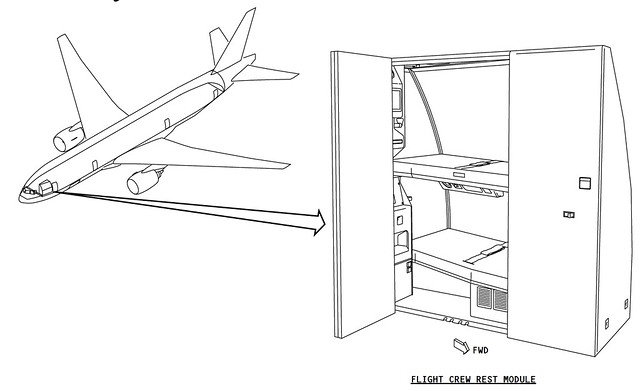
The picture below shows the crew rest area located behind the cockpit of a Boeing 777. You can see it consists of two bunk beds, and the interior space is quite spacious and comfortable.
The Captain and First Officer have different divisions of work, but sometimes they need to exchange tasks. For example, when the Captain makes a PA announcement to passengers after entering cruise, he needs to hand over the control of the aircraft to the First Officer. When the First Officer uses the company dedicated frequency to contact the company, he needs to hand over ATC communications to the Captain. This naturally applies to meals as well. At such times, a dialogue like this occurs between the two: Captain: “You have control” First Officer: “I have control” Or First Officer: “You have ATC” Captain: “I have ATC” And so on. Another example is when receiving a notification from ATC to change the Airway. After the First Officer modifies the route on the FMC/CDU and asks the Captain to review it, the same dialogue is used.
I have great admiration for China Eastern Senior Captain Liu Zhimin “Lengwage” who once said on Weibo: “The Captain’s duty is to identify danger sources, take control measures, and keep risks within an acceptable range.” This summarizes the pilot’s work very well.
One possible emergency situation in the air is if a passenger falls critically ill. If there is a doctor among the passengers, they can provide temporary treatment. However, if there is no doctor or immediate hospital treatment is required, the pilot needs to change the route, find a suitable nearby airport, contact air traffic control, execute an emergency landing procedure, etc.
If something unusual happens at the flight destination, such as a terrorist incident, earthquake, or severe weather, the pilot also needs to judge whether the flight needs to continue or return to the departure point. The Point of No Return is a midpoint in route time calculated in advance based on flying speed and wind direction, for example set at 16:25 GMT. If an anomaly occurs before this critical point, the pilot can execute a return procedure. However, if past this point, the pilot must continue flying towards the destination and constantly gather the latest information to judge whether a diversion is necessary.
Pilots receive rigorous simulation training for various dangers and anomalies that may occur during flight. Furthermore, to prevent their flying skills from degrading, they must undergo emergency simulation training twice a year. Everyone knows that modern flight simulators are very advanced; the external view, instruments, control equipment, and aircraft attitude are very realistic and not much different from the actual aircraft. In the past when simulator technology was not mature enough, emergency training was conducted in real aircraft. However, modern simulators can achieve the same training standard with high efficiency and low investment. In addition, simulators can simulate training that is impossible to do in a real aircraft, such as engine fires or hull damage. These training sessions play a major role in improving pilots’ skills in dealing with various abnormal emergencies. During training, pilots need to be highly concentrated. After completing one such training session, they are usually exhausted and sweating, showing the realism and strictness of this training.
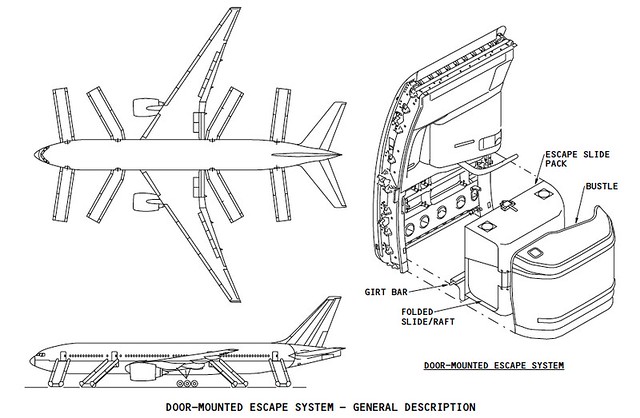
By the way, I should mention the famous “90-second rule”. This states that for every aircraft model with more than 44 passenger seats, it must be possible for all occupants, including crew members, to evacuate the aircraft within 90 seconds (inclusive). Aircraft that cannot meet this condition cannot pass the airworthiness approval of aviation departments of various governments and cannot be put into passenger operation. In addition to boarding doors and cargo doors, passenger aircraft also have emergency exits that are not usually opened and are only used after an emergency occurs. Recently, I saw news that a Chinese passenger opened an emergency exit on a plane out of curiosity. I sincerely hope my compatriots can learn more aviation knowledge and stop doing such ignorant acts.
The following is a diagram of the locations of emergency exits and emergency slides on a Boeing 777-200:
The 121.5 MHz frequency is an emergency dedicated communication channel, and air traffic control departments monitor this frequency at all times to handle various abnormal situations. Generally, large aircraft will also monitor this frequency. If any accident occurs that threatens human safety, makes self-rescue impossible, and requires immediate rescue, the radar Transponder should be set to 7700, and “Mayday” should be called to request rescue, such as: “Mayday, Mayday, Mayday, abc1234, abc1234, engine failure, force landing to xxxx, request search and rescue” This means “Mayday, flight abc1234 engine failure, force landing to xxxx, request search and rescue.” Note that here “Mayday” and your flight number must be called 3 times. For situations with a lower urgency than Mayday, “Pan-Pan” can be used for help, such as: “Pan, Pan, Pan, abc1234, abc1234, abc1234, over xxxx, 4500 feet, engine trouble, request landing priority to xxxx airport” This means “Pan, Pan, Pan, flight abc1234, over xxxx at 4500 feet, engine trouble, request priority landing to xxxx airport”. After receiving the request, ATC will issue the following notification to all aircraft listening on the radio: “All aircraft concern to xxxx tower, keep radio silence until further advice due to emergency situation occur” This means that due to an emergency situation, other aircraft are required to maintain radio silence until further notice.
There is still much I want to write about the cruise phase, such as the principles of flight, air conditioning and pressure control, and various emergencies. But I don’t want to drag this chapter out too long, so I plan to start writing the “Descent” chapter from the next section. I will fill these in later when I have time.
Prev: Regarding Weather and Turbulence (Continued) TOC: Table of Contents Next: Descent Preparation