Title: Uncovering the Mysteries of Airliner Cockpits 3.5 Engage Autopilot
The aircraft continues to climb. The number on the radio altimeter exceeds 400 feet (using the 737-500 from the airliner pilot manual as an example). At this point, the LNAV (Lateral Navigation) mode can be engaged. The Captain instructs the First Officer to press the LNAV button on the MCP.
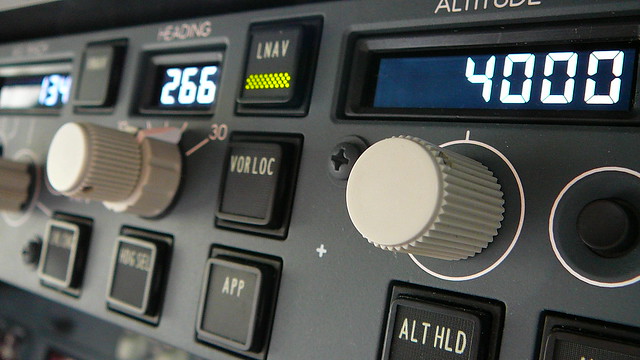
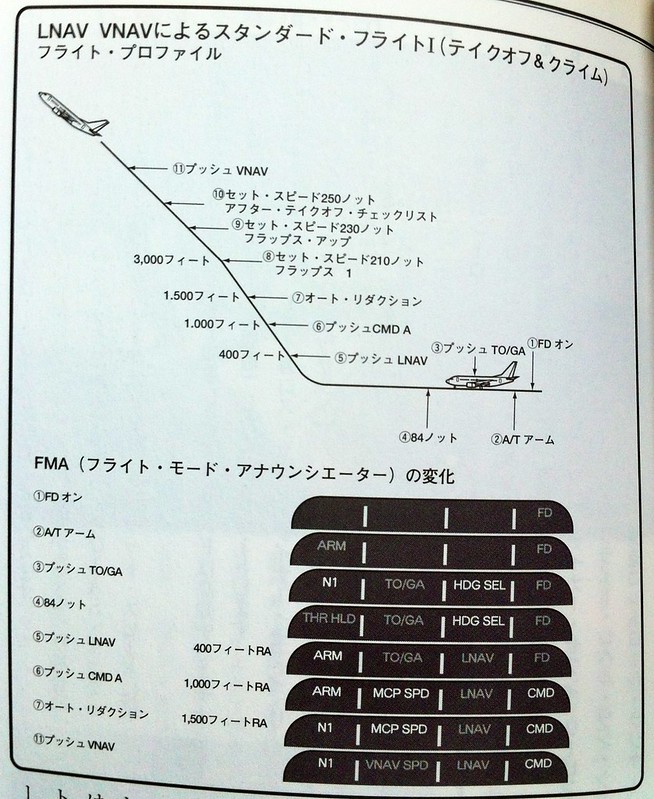
Consequently, in the mode annunciation at the top left of the PFD, the Heading setting changes from HDG SEL to LNAV, and the flight mode enters Phase 5 as shown in the figure below.
LNAV stands for Lateral Navigation. It controls the aircraft to fly automatically along a pre-determined route in the horizontal plane. The principle of LNAV first utilizes the Inertial Reference System (IRS). Using the laser gyroscopes on the aircraft, it determines acceleration based on the Doppler effect. After integrating with time, the aircraft’s current speed and position are calculated. Then, based on position data from ground-based radio navigation aids (VOR, DME, ILS/DME, VORTAC, TACAN, etc.) or GPS, the Flight Management Computer (FMC) continuously blends all this data. In other words, the FMC corrects IRS errors using data from various navigation aids to correctly control the aircraft along its intended route.
After the LNAV button on the MCP is pressed, the Flight Director (FD) bars on the PFD will guide the pilot according to the FMC’s instructions and the pre-set route. As long as the pilot flies the aircraft following the FD, the aircraft will not drift off course even in crosswind conditions. This is because the FMC calculates the Wind Correction Angle (WCA) based on weather conditions. The WCA is integrated into the FD bars, so the pilot only needs to focus on the FD while flying.
At the same time, the thrust control mode changes. The green THR HLD (Thrust Hold) changes to white ARM. This means that after the aircraft climbs past 400 feet and 18 seconds after liftoff, the automatic engine thrust hold mode is disengaged, and engine thrust enters a state where it automatically reduces as the Climb altitude increases.
After the aircraft altitude exceeds the predetermined airport height above ground (e.g., 1000 feet), the pilot can engage the Autopilot (A/P).
The 737 has two autopilots: A on the left and B on the right. Generally, the Captain will instruct the First Officer to use the left side and press the CMD A button in the A/P ENGAGE section on the right side of the MCP.
 Thus, the pilot’s hands can release the control column or yoke, and the control of all aircraft surfaces is handed over to the computer.
Consequently, in the mode annunciation at the top left of the PFD, the autopilot setting changes from FD to green CMD. Meanwhile, the pitch control mode changes from TO/GA to MCP SPD, and the flight mode enters Phase 6 as shown in the figure below.
MCP SPD means that the aircraft’s speed is now controlled by the IAS/MACH knob in the center of the MCP.
The pilot will continuously adjust this speed according to different phases of the flight.
In autopilot mode, the aircraft faithfully follows the route entered in the CDU, continuously turning to fly toward the next waypoint.
After exceeding a barometric altitude of 1500 feet, the thrust mode automatically transitions from Reduced Takeoff Thrust to Climb Thrust (or reduced climb thrust).
The sound of the aircraft engines becomes a bit quieter than before.
In the mode annunciation at the top left of the PFD, the autothrottle mode changes from white ARM to green N1 mode, and the flight mode enters Phase 7 as shown in the figure below.
End