Secrets of Airliner Flying 6.6 Go-around
Before landing, if unexpected circumstances occur that lead the flight crew to determine that continuing the Descent for landing would pose safety issues, the pilot must decisively execute the Go Around procedure.
These situations include:
- After reaching the Decision Height (DH) (for Precision Approach) or the Missed Approach Point (MAPT) (for Non-Precision Approach), the Runway and indicator lights are still not visible, and the required visual reference cannot be established.
- A failure in airborne equipment or ground navigation equipment prevents the provision of normal navigation accuracy.
- The Runway Visual Range (RVR) during the landing process cannot meet landing requirements, such as due to the influence of advection fog. Advection fog is formed when warm, moist air moves over colder land or water surfaces, cooling from below. It usually occurs in winter, lasts for a relatively long time, covers a large area, and is dense with significant thickness, sometimes reaching several hundred meters.
- When crosswinds or headwinds are too strong.
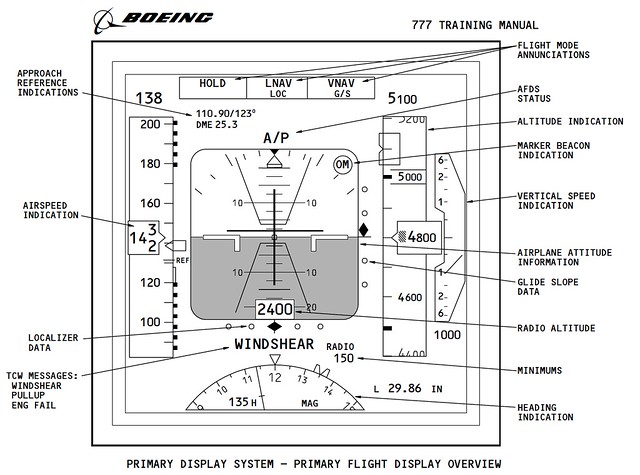
- When a wind shear warning occurs during the Approach. Modern airliners are generally equipped with wind shear detection and warning systems. If the aircraft suddenly starts shaking violently, or the wind direction and speed change significantly, the wind shear warning in the cockpit will sound, with the voice prompt “WIND SHEAR, GO AROUND,” and the warning text “WINDSHEAR” will also appear on the Primary Flight Display (PFD).
- When the Air Traffic Controller issues a Go Around instruction.
- When there are other aircraft or ground vehicles on the Runway, posing a risk of collision. Etc.
The Go Around flight path was summarized in the 5.4 Instrument Approach Charts section, so it will not be repeated here.
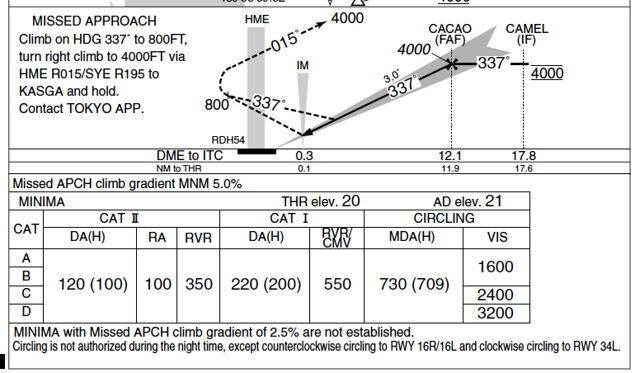
Taking the Boeing 737 as an example, the Go Around procedure is outlined as follows:
The Captain presses the engine TO/GA button and calls out “Flaps 15”;
The First Officer sets the flap lever to the 15 position and observes to verify that the flaps have retracted normally to 15;
The aircraft state begins to transition from Descent to a nose-up Go Around attitude;
Engine Thrust increases and it is confirmed that the thrust is sufficient for the Go Around;
Confirming a positive rate of climb on the Altimeter, the Captain calls out “Gear Up”;
The First Officer raises the landing gear lever;
The First Officer checks that the missed approach altitude set on the MCP is correct;
When the aircraft altitude is above 400 feet, a rolling Turn can be executed to enter the missed approach flight path;
Continue retracting the flaps according to the flap retraction schedule;
Vertical Navigation (VNAV) can be engaged;
Set engine mode to Climb thrust;
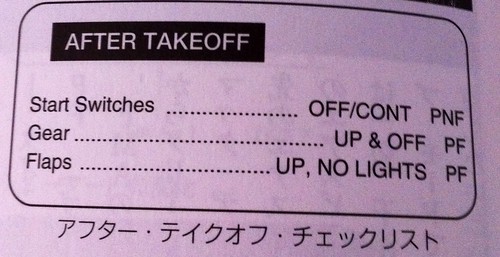
Execute the After Takeoff checklist.
After the aircraft has Climbed to the altitude specified in the missed approach path, it needs to enter the Holding procedure.
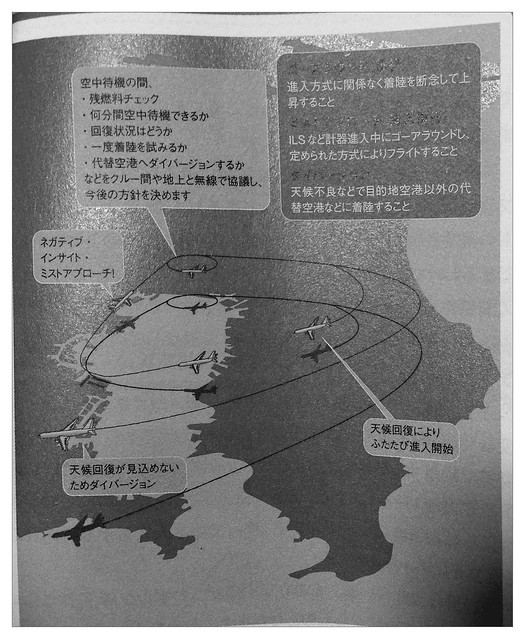 While holding, the pilot needs to check the remaining fuel quantity and estimate the possible holding time.
If the Go Around was due to severe weather conditions, the weather recovery status needs to be checked.
A judgment is made as to whether a second landing attempt is feasible if the weather conditions allow. If there is no sign of improvement in the weather,
then the diversion procedure must be executed to fly to the predetermined alternate airport.
Whether attempting another landing or flying to the diversion location, prior clearance from Air Traffic Control is required,
This also consumes time, so the pilot must take the fuel consumption during the hold into consideration.
While holding, the pilot needs to check the remaining fuel quantity and estimate the possible holding time.
If the Go Around was due to severe weather conditions, the weather recovery status needs to be checked.
A judgment is made as to whether a second landing attempt is feasible if the weather conditions allow. If there is no sign of improvement in the weather,
then the diversion procedure must be executed to fly to the predetermined alternate airport.
Whether attempting another landing or flying to the diversion location, prior clearance from Air Traffic Control is required,
This also consumes time, so the pilot must take the fuel consumption during the hold into consideration.
Writing this reminds me of a personal experience on a flight that included a Go Around and diversion, And although we eventually flew back to the original Destination, it was quite a rare experience.
It was a trip to the US on business one year. On the return leg, I was on an American Airlines Boeing 777 flying from San Jose, California to Tokyo. As the aircraft approached Narita Airport, the body kept shaking due to the strong winds. Later, as the plane slowly descended, suddenly the engine roar became loud, And the plane started to Climb again. That’s when I knew the wind was too strong and the pilot decided to abort the landing and Go Around. After circling in the air for a while, the in-flight broadcast announced that the weather conditions at Narita did not permit landing, and the flight might divert to Nagoya. But after waiting a while, another announcement stated we would divert to Haneda Airport. I guess there wasn’t enough fuel to reach Nagoya. From Narita to Haneda is quite close. It felt like we landed in just over ten minutes. After arriving at Haneda, we couldn’t get off the plane. We stopped at a spot on the Apron to refuel, and then waited for the weather at Narita to recover. After staying at Haneda for over an hour, we finally got the news that we could return, so we queued up for takeoff again, Finally successfully landing at Narita Airport 3.5 hours later than the scheduled time. Of course, being able to go home that day without staying overnight in Nagoya was something to be incredibly thankful for.
In summary, the Go Around is one of the measures to ensure flight safety, an inseparable part of the Approach and landing process, A method to prevent Approach errors, and an important measure for handling emergencies. The Go Around is not scary; executing it according to the procedure poses no danger. Civil aviation aircraft have pre-programmed Go Around procedures; this is a very basic flight operational procedure. At the same time, pilots during the Approach and landing process, especially when approaching DH (MDH), must have the decisive awareness to transition to a Go Around at any time. In severe weather (cumulonimbus and towering cumulus clouds, intermittent or heavy rain, strong gusts, etc.), one must never rely on luck. When landing conditions are not met, a decision to Go Around must be made immediately and decisively.
The video below captures the actual scene of an aircraft Going Around in heavy rain, which is very valuable for reference.
End
Prev: Landing Procedures TOC: Table of Contents Next: Landing Operations