Airliner Cockpit Secrets 4.6 About Fuel Consumption and Center of Gravity
As previously introduced, in autopilot navigation mode, the aircraft automatically flies along the pre-set route, but pilots cannot be idle. They must constantly monitor flight instruments and record the passing time and remaining fuel quantity after passing each waypoint.
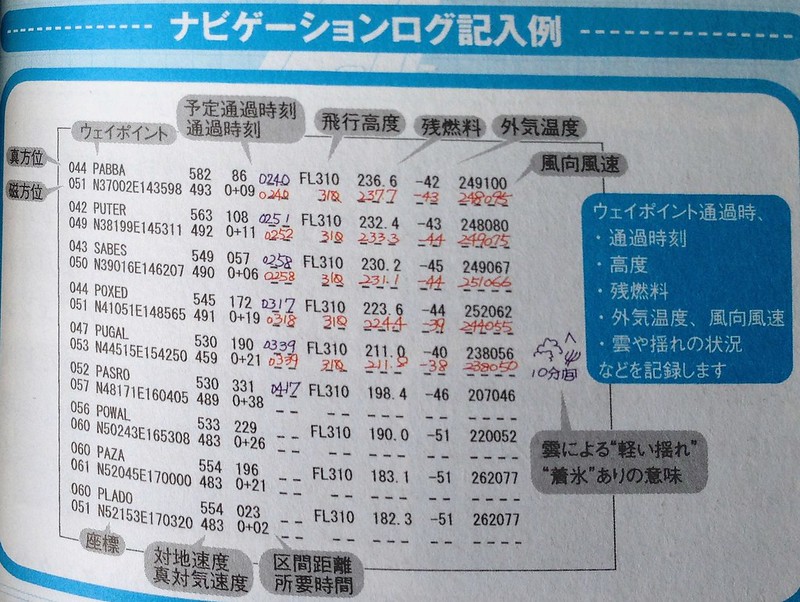 The above is an example of a flight log. You can see that for each waypoint, pilots record the passing time, flight altitude, remaining fuel, outside temperature, and wind direction/speed information. In the fifth line, information about 10 minutes of light turbulence during the journey is also recorded.
In this series 1.3 Flight Preparation Briefing, detailed flight planning was introduced. This plan is calculated based on the following information:
- Aircraft weight (can be calculated from the number of booked passengers)
- Flight distance
- Flight speed
- High-altitude wind direction and speed forecasts
- High-altitude temperature
High-altitude wind and temperature forecast information can be obtained from the World Area Forecast Center (WAFC). Under the framework of the International Civil Aviation Organization, the World Area Forecast System (WAFS) provides aviation meteorological data required for international aviation to meteorological departments and recognized users, including text-based flight meteorological information and weather maps. Two World Area Forecast Centers (WAFCs) located in London and Washington broadcast World Area Forecast System products via satellite. Currently, the meteorological support for China’s civil aviation international routes is mainly provided by the London Aviation Meteorological Center.
The accuracy of information provided by WAFC is quite high, but weather is unpredictable, and sudden changes in weather can also affect flight speed and route. In addition, in actual flight operations, flow control is inevitable due to traffic volume. Flight speed, altitude, and route will be changed according to air traffic control requirements, so the predicted fuel consumption in the original flight plan will also change. Therefore, it is very important to constantly check the remaining fuel quantity.
Aircraft fuel tanks are generally located in the left and right wings and the center of the fuselage. Each fuel tank is independent, so fuel will not flow from one tank to another when the aircraft tilts. If fuel could flow freely, the aircraft’s center of gravity would constantly change, making stable flight control very difficult.
The following diagram shows the fuel tank layout of a Boeing 777. You can see the relative positions of the Left Main Tank, Center Tank, and Right Main Tank.
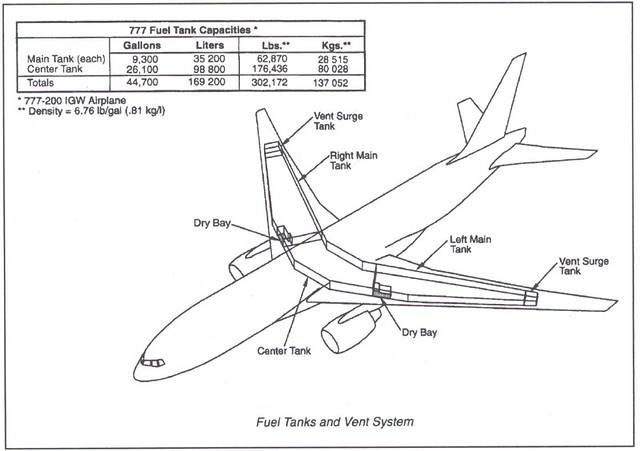 All three fuel tanks have corresponding fuel pumps and are connected through fuel pipes and check valves. When supplying fuel to engines, the system adjusts the fuel supply sequence from each tank and adjusts the weight of each tank to keep the center of gravity in an appropriate position, achieving the effect of reducing stress concentration at the wing root (the wing root is the part where the aircraft wing connects to the fuselage).
The diagram also shows the Vent Surge Tank, located at the highest position of the main wing, serving as a ventilation port between the fuel tank and the outside. As fuel is delivered to the engine, the pressure inside the fuel tank gradually decreases. If the pressure is lower than the external atmospheric pressure, a pressure that squeezes the fuel tank will be generated. For example, we have all drunk paper-packaged beverages with straws. As the beverage is sucked into the paper box, the pressure inside decreases, and the box will gradually be crushed by the external atmospheric pressure. The same applies to fuel tanks. To prevent being crushed by pressure, this vent keeps the pressure inside the fuel tank consistent with the outside, while also making fuel delivery smoother.
The main part of the aircraft’s weight and load is concentrated in the fuselage, while lift in the air mainly comes from the wings. Therefore, downward gravity and upward lift will generate a bending moment near the wing root, which has a strong impact on the aircraft structure. The weight of fuel in the main wing tanks can offset lift and reduce the wing root bending moment. This is why main wing tanks are filled first and fuel in the wings is maintained as much as possible.
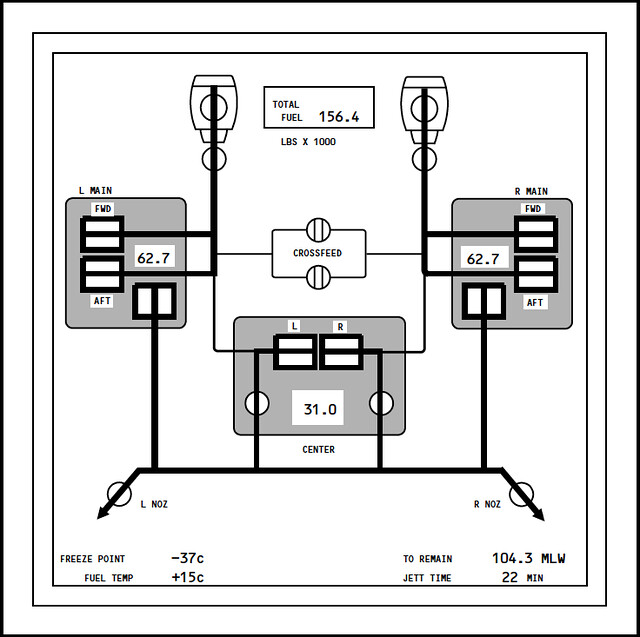
The older Boeing 747-200 aircraft uses fuel from the center tank first when supplying engines, and after the center tank is empty, uses the two wing main tanks. The Boeing 777 basically adopts the same method. Although the center tank is used first, the fuel pumps in all three tanks are actually running, but the center tank fuel pumps have higher power, so the center tank directly supplies fuel to both engines first. The advantage of this is that even if the center fuel pump fails, the wing tank fuel pumps are still running, serving as a backup. When the center tank is empty, the fuel pump automatically stops running.
Boeing 777 EICAS display:
However, the Airbus 330-200 operates slightly differently. Although it also uses the center tank first, it does not directly supply fuel from the center tank to the engines. Instead, it first transfers fuel from the center tank to the two main wing tanks, and then directly supplies fuel to the engines through the fuel pumps in the left and right wing main tanks.
Modern aircraft fuel supply systems are automated, but older aircraft like the Boeing 747-200 require continuous checking of the remaining fuel in each tank and manual adjustment of each tank.
Next, let me introduce the concept of weight and balance, that is, the aircraft needs to achieve the state of takeoff weight, center of gravity, and trim based on operational empty weight, payload and fuel weight and their distribution, while satisfying various constraints. Frequent flyers know that during flight, passengers are not allowed to change seats without authorization to avoid causing aircraft imbalance and affecting aircraft operability.
During aircraft operation in the air, there is no support point, so balancing the center of gravity is an important factor affecting flight safety. Each type of aircraft has a limit range for the forward and backward movement of the center of gravity to ensure flight safety, convenient control, and fuel saving. This limit range is called the center of gravity allowable range. The aircraft’s center of gravity must not exceed its forward and backward limits.
If the aircraft’s center of gravity is slightly forward, the aircraft has good stability and is not prone to turbulence when encountering airflow; if the aircraft’s center of gravity is slightly rearward, the aircraft has good controllability and saves fuel. If the aircraft’s center of gravity is too far forward or too rearward, or even exceeds the safe allowable range, serious consequences will result. In mild cases, it may cause damage to the aircraft landing gear, structural damage, increased fuel consumption, shortened aircraft life, and runway damage; in severe cases, it may cause aircraft tail scraping, runway overrun, or even stall and crash during takeoff and landing.
The center of gravity position is expressed as a percentage on the Mean Aerodynamic Chord (MAC) line, that is, the geometric center of the wing. The unit is %MAC. For example, the Boeing 777 in the following diagram has a MAC length of 7 meters. If the center of gravity value is 25%MAC,
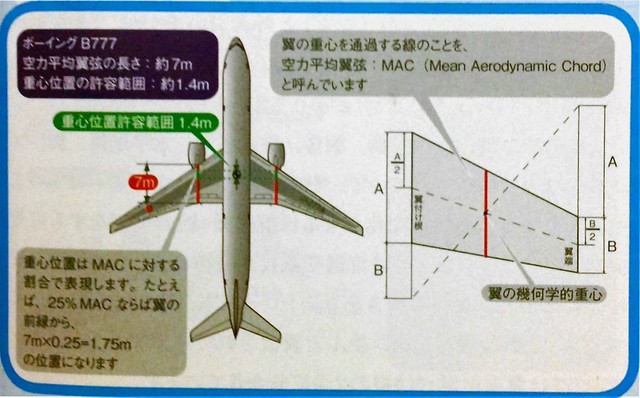 then the center of gravity is located at 7 meters × 25% = 1.75 meters from the leading edge of the wing. Generally speaking, the aircraft’s center of gravity allowable range is very small. For example, the allowable range of the 777 in the above diagram is only 1.4 meters. For another example, the allowable range of the Boeing 747 is 13-33%MAC, and the Airbus 380 is 29-44%MAC.
On the ground, the load control personnel are responsible for managing the aircraft’s weight and center of gravity. They refer to the aircraft takeoff performance chart and calculate the aircraft’s weight limit based on airport climate, terrain, obstacles’ impact on takeoff weight, and airport runway restrictions on aircraft takeoff and landing weight. They determine the optimal balance position center of gravity and arrange the positions of cargo, mail, and baggage in the aircraft accordingly, that is, the load balance sheet. If the aircraft’s actual weight does not match the weight data prepared by the load controller, it will affect the pilot’s control of the aircraft, resulting in incorrect flight speed and angle, posing a safety hazard. If the actual weight exceeds the aircraft’s maximum allowable weight, it may lead to the destruction of the aircraft and death of personnel.
Regarding weight calculation, it involves setting the average weight of passengers. For example, domestic routes are generally 64 kg, international routes are 73 kg, pilots are 77 kg, and flight attendants are 59 kg. But sometimes there are special circumstances. For example, if a flight needs to carry many sumo wrestlers, either the weight of each wrestler must be investigated in advance, and then the overall center of gravity position of the aircraft is calculated based on each person’s seat. For example, in the book From London to New York - Flying a Boeing 747-400, it was mentioned that when the pilot of a certain flight was executing a mission, they found the aircraft much more difficult to control than usual, such as long takeoff roll and low climb rate, but could not find any abnormal situation. After landing, an investigation revealed that many passengers on this flight belonged to an ancient coin collection association, and these collectors carried many heavy ancient coins with them when boarding, so the actual weight of the aircraft far exceeded the predicted weight. Fortunately, that flight did not result in an accident, as it was an extremely dangerous flight.
End
Prev: About Cruise Speed TOC: Table of Contents Next: About Weather and Turbulence