Title: Secrets of Airliner Flying 4.5 About Cruising Speed
Just like cruise altitude, cruise speed must also consider fuel economy.
Similar to how a car’s performance is often judged by how many kilometers it can travel on one liter of fuel, for an aircraft, this performance can be expressed as the flight distance per unit of fuel. This is called Specific Range.
Specific Range refers to the flight distance per unit of fuel in a windless condition (e.g., data at 10,000 lbs, or approx. 4.5 tons). The value is calculated by dividing the TAS (True Airspeed) by the fuel flow.
The relationship between Specific Range and speed can be seen in the chart below.
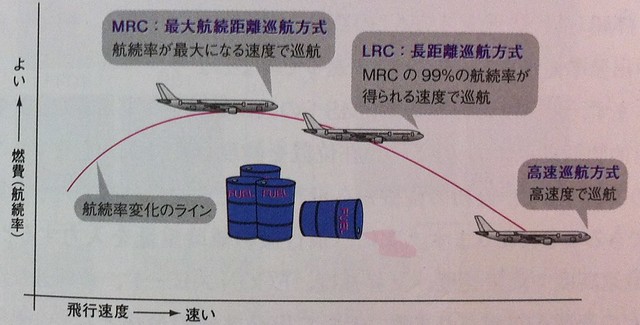
Speed is shown on the horizontal axis, with further to the right indicating higher speed. Specific Range is shown on the vertical axis, with higher up indicating better economy. The arc in the graph is the aircraft’s performance curve. You can see that the Specific Range is lower at both low and high speed segments, meaning fuel consumption is higher.
The speed at the very top of the curve is the MRC (Maximum Range Cruise speed). If the aircraft flies at this speed, it is the most fuel-efficient. However, you can see that the speed is too low at this point; neither passengers nor airlines would be satisfied with this figure. Therefore, even if it consumes a bit more fuel, getting to the destination faster and covering more distance became a priority. This led to the LRC (Long Range Cruise) index. LRC uses a standard of 99% of MRC. This means it consumes 1% more fuel than MRC but allows for a 9% increase in speed.
Of course, both MRC and LRC are ideal values. In actual operations, the concept of ECON Speed (Economy Speed) is used. Economy Speed is the speed that minimizes total operating costs.
So, what items are included in operating costs?
They are mainly composed of aircraft maintenance fees, insurance premiums, airport usage fees (airlines need to pay landing service fees, ground service fees, airway fees, air traffic control fees, and terminal facility rental fees to the airport management company), staff wages and bonuses, and fuel costs. The costs other than fuel can be considered time-related costs. For example, if the flight duration is longer, the allowances paid to the flight attendants will be higher (I wonder if it’s the same domestically?). Therefore, to calculate the relationship between operating costs and economy speed, the concept of the Cost Index (CI) was introduced:
CI = Time-related Cost / Fuel Cost
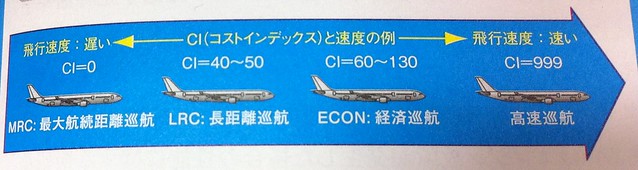
The speed when CI = 0, which prioritizes fuel cost above all else, is the MRC (Maximum Range Cruise speed). The speed when CI = 999, which prioritizes time cost above all else, is the Maximum Cruise Speed.
Airlines set their CI based on their management policies to determine the Economy Speed to be adopted. If fuel cost is prioritized, a smaller CI value is adopted to ensure a relatively high Specific Range, but the flight speed will be relatively low. If time-related operating costs are prioritized, a larger CI value is adopted, making the flight speed relatively faster.
You can see the relationship between CI and speed in the chart below. The CI value for Economy Cruise Speed is generally between 60 and 130, with a flight speed slightly greater than the LRC (Long Range Cruise) speed.
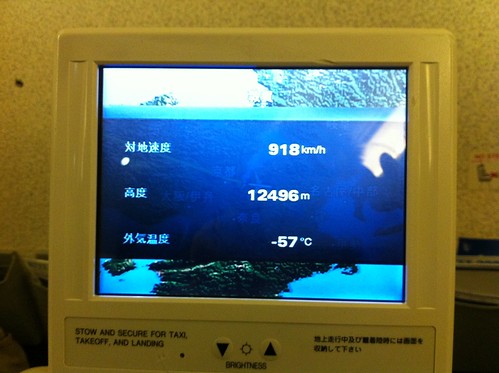
I suggest that every time you fly in the future, you deliberately check the speed displayed on the in-flight screen to see what the cruise speed for that flight is. The picture below shows a Boeing 777-200 I took on the Beijing-Tokyo route. You can see the ground speed was 918 km/h, and the flight altitude was about 12,500 meters.
Let me talk about a personal experience.
One winter, I flew from Tokyo to New Delhi. On the way there, we were flying east to west and fighting against high-altitude jet streams the whole way. The maximum ground speed was only 650 km/h. It was as slow as a turtle crawling, and the flight took 10 and a half hours.
On the return leg, however, the tailwind was fierce. I saw the ground speed hit 1100 km/h! Consequently, the return flight took only 6 and a half hours. It was truly an incredible experience.
Prev: About Cruise Altitude TOC: Table of Contents Next: About Fuel Consumption and Center of Gravity
End