Title: Into the Level Flight Cruise
At this point, the aircraft leaves the Tokyo North Kanto Area Control Center and begins to enter the Northeast Area. Taking the Boeing 777-200 “Air System 115” flight as an example, 16 minutes after takeoff, the aircraft has reached the Nasu area in Tochigi Prefecture, passing the NZE VOR navigation aid.
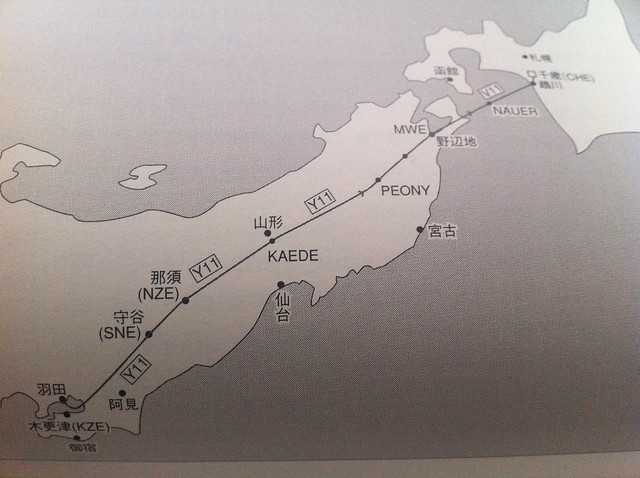
It has reached an altitude of 39,000 feet.
As seen in the image above, the aircraft entered the Y11 Airway of R-NAV (Area Navigation) starting from the Moriya SNE navigation aid, and will continue north along this airway all the way to the Chitose navigation aid in Hokkaido.
At this moment, ATC receives new contact from air traffic control and begins the handover between areas:
“Air System 115, Contact Tokyo 118.9”
This means
“Air System 115, contact Tokyo Northeast Area, frequency 118.9”,
The pilot read back
“Tokyo Control 118.9, Air System 115”
This means
“Roger, contact Tokyo Control 118.9, Air System 115”
The pilot then tunes the radio communication frequency to the Northeast Area Control’s 118.900 MHz and contacts:
“Tokyo Control, Air System 115, Leaving 396 Climb 410”
This means
“Tokyo Control, this is Air System 115, passing through 39,600 feet, climbing to 41,000 feet”
The Northeast Area Controller confirms receiving the flight’s signal and replies
“Air System 115, Tokyo Control, Roger”
This means
“Air System 115, Tokyo Control, Roger”
As the aircraft altitude gradually approaches the cruising altitude, when it reaches 900 feet from the target altitude (taking the Boeing 737 as an example), the altitude warning system in the cockpit will emit a “dong” reminder tone, and the amber Altitude Alert indicator light will illuminate, reminding the pilot that the aircraft is approaching the cruising altitude. When the altitude reaches 300 feet from the target altitude (taking the Boeing 737 as an example), the warning light will automatically extinguish.
A similar altitude warning is also issued during Level Flight if the aircraft altitude deviates 300 feet from the scheduled altitude.
After the aircraft approaches the cruising altitude, the Flight Management System begins to automatically lower the pitch angle,
the Stabilizer Trim (STAB TRIM) control wheel located near the throttle automatically rotates forward again, and the aircraft gradually enters a Level Flight attitude.
 From the PFD, it can be seen that the vertical speed bar on the right gradually approaches the center zero point, while the speed value in the speed bar on the left increases.
When the aircraft altitude reaches 100 feet from the scheduled altitude (taking the Boeing 737 as an example),
the pitch attitude setting in the FMA (Flight Mode Annunciator) bar at the top left of the PFD changes from VNAV SPD to the green ALT ACQ (Altitude Acquisition) mode,
as shown in stage 16 in the figure below.
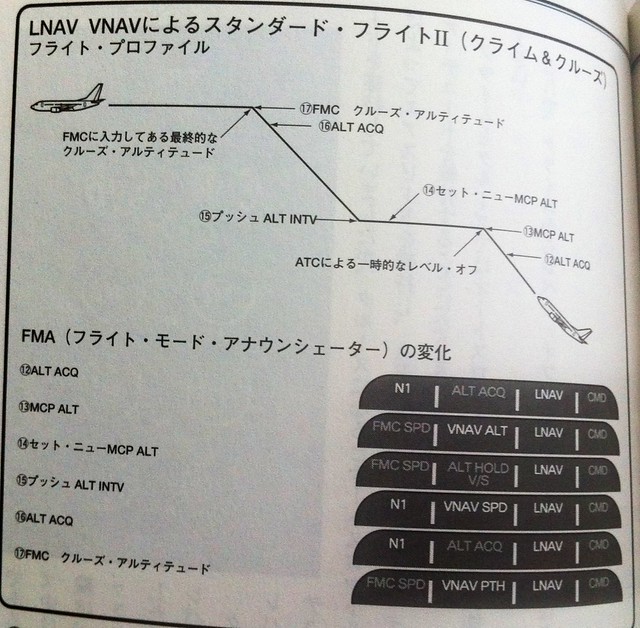
After reaching the cruising altitude, the aircraft enters Level Flight, and the thrust display in the FMA flight mode bar also changes, switching from N1 mode to FMC SPD mode, The pitch attitude also changes from ALT ACQ to VNAV PTH mode, as shown in stage 17 in the figure above.
When the flight speed increases to the economic cruising speed, the engine throttle is also automatically reduced, and the aircraft officially transitions from CLB (Climb) mode to CRZ (Cruise) mode.
The title of the page in the Flight Management System Control Display Unit (FMS/CDU) also changes from “ACT ECON CLB” to the cruise page “ACT ECON CRZ”, and the target speed TGT SPD calculated by the flight management system is displayed.
 The image above shows an example for the Boeing 737, where the current target speed is Mach 0.744.
During the flight, the computer continuously calculates the current economic cruising speed based on inputs from various sensors and constantly adjusts the control of the autothrottle system. You should recall that we mentioned earlier, during the Climb process, the computer changes the aircraft’s pitch angle via the ADFS to change speed, while the throttle setting remains fixed. However, after entering the Cruise Level Flight phase, altitude maintenance is controlled by the ADFS, while speed is controlled by the autothrottle system.
Prev: ATC Handover to Area Control, Continue Climb TOC: Table of Contents Next: Basic Navigation Knowledge
End