Title: Inside the Cockpit 1.8 Preflight Procedures and Cockpit Interior
After completing various checks to confirm the aircraft meets airworthiness standards, the pilot can finally sit in the flight deck and begin manipulation. First, the pre-flight procedures must be completed, but before that, let’s take a look at the interior of the flight deck.
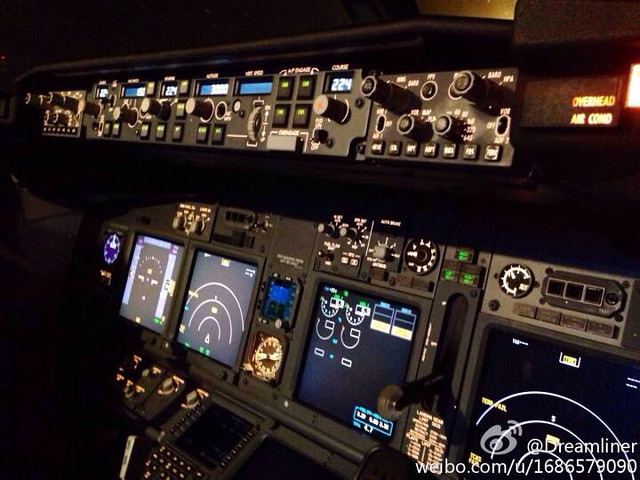
The Boeing 747-400 overhead panel, Electronic Flight Instrument System (EFIS), and control devices:


Generally speaking, there are 2 seats in the flight deck; the left one is the Captain’s seat, and the right one is the First Officer’s seat. Additionally, there are 2 folding seats for deadheading (non-revenue passengers), known as Jump Seats, used for training, audits, or other internal purposes such as hitching a ride.
The Overhead Panel is covered with various switches, primarily used for engines, APU, fuel, various navigation lights, air conditioning, oxygen control, etc. The EFIS instrument system below includes:
MCP (Mode Control Panel), the slender panel at the top of the dashboard, mainly used to control the autopilot. After the pilot sets the altitude, heading, and speed using the various knobs and buttons on it, the computer will automatically control the aircraft to complete various attitude adjustments. During flight, pilots frequently operate the MCP;
EICAS (Engine-Indicating and Crew-Alerting System), the Engine Indication and Crew Alerting System, is the screen in the center of the dashboard. It is a comprehensive display system showing the operation status of the aircraft’s engines and other systems, such as engine RPM, temperature, fuel capacity, oil pressure, hydraulic systems, pneumatic systems, electrical systems, de-icing systems, and control surfaces like landing gear and Flaps;
ND (Navigation Display), located on both sides of the EICAS. The Captain and First Officer each have their own ND, used to display navigation information such as the flight routes and waypoints entered via the CDU;
PFD (Primary Flight Display), also two in number. The Captain and First Officer each have their own PFD, mainly displaying flight information such as the aircraft’s attitude, speed, altitude, and heading. It also displays autopilot mode information set via the MCP;
Multifunction Display (MFD), displays data other than EICAS, or can serve as a backup display for other instruments;
Standby Instruments, located between the EICAS and the Captain’s ND, provide information on flight attitude, speed, and altitude, providing a safeguard for pilots in case of PFD failure;
(I don’t have a photo of the 747 on hand, so I’m using one of the 737-800. Thanks to Dreamliner for providing it to this site)
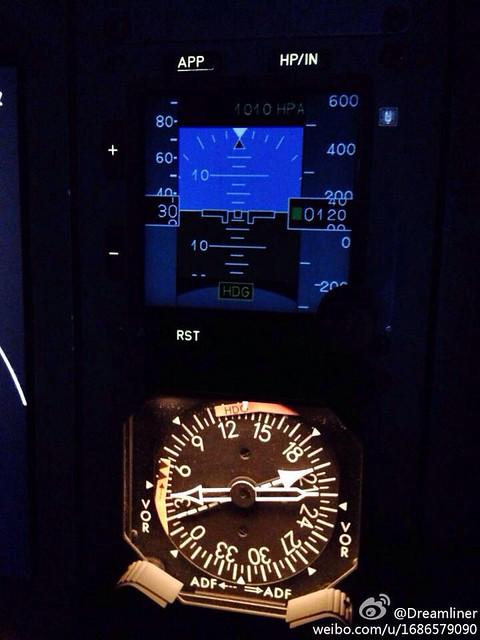
Control Devices:
Control Yoke, you can tell at a glance, mainly controls the aircraft’s pitch (horizontal stabilizer) and roll (Aileron; when turning left, the left aileron rises and the right one descends, so the right wing’s Lift is greater than the left wing, the right wing raises and the left wing lowers, causing the aircraft to Turn left) attitudes;
Rudder Pedals, control the rudder located on the tail for yaw control;
Speed Brakes, deploy the Speed Brakes;
Radio Control, setting frequencies for radio communication, etc.;
Thrust Lever, controls engine throttle;
Landing Gear, controls whether the Landing Gear is retracted or extended;
Flaps, increase Lift to prevent the aircraft from Stalling even at low speeds during takeoff and landing. Flaps are a type of airfoil-shaped movable device located on the edge of the wing. They can be installed on the trailing edge or leading edge of the wing and can deflect downwards or/and slide backwards (forwards). Generally, Flaps are extended 5-10 degrees during takeoff and 30 degrees during landing.
Below is a brief introduction to the pre-flight procedures, executed jointly by the Captain and the First Officer. The Captain executes light tests, EFIS control panel settings (including the Altimeter, barometric altitude, etc.), initial MCP settings, oxygen equipment tests, clock settings, flight instrument fault-free checks, clearing the MCP, standby instrument checks, Speed Brake/Thrust Lever/Flap lever settings, radio navigation settings, etc. The First Officer’s check of various data entered into the CDU is also crucial. The First Officer executes checks of various flight control/navigation/fuel panel switches, setting various power (cabin, passenger seats, galley, backup power, entertainment equipment, etc.) switches, fire and overheat protection settings, starting the APU, cabin pressurization settings, various lights, EFIS control panel settings, oxygen equipment settings, flight instrument checks, Landing Gear settings, auto-brake settings, engine instrument checks, radio navigation settings, etc.
What to pay attention to during this phase: make sure to turn off the hydraulic pumps and Flaps, because if there is an accidental mistake at this time, it may injure the ground crew who are still working on the ground. The frequency for departure air traffic control obtained in the Airport ATIS should also be preset. At large airports like Haneda, the frequency is generally not announced when the Tower transfers to Departure after takeoff, so it must be checked in advance.
In short, through this pre-flight procedure, the aircraft’s various devices are set to a state capable of safely starting the engines/takeoff/Climb/cruise, etc. At the same time, passengers have completed boarding, cargo is loaded, and all cabin doors are closed. The aircraft’s weight and center of gravity position data are transmitted to the flight deck via the ACARS radio device. After the pilot checks the data for errors, it is entered into the FMS, and the computer calculates takeoff data such as V1. The flight attendants also report the passenger count and cabin readiness.
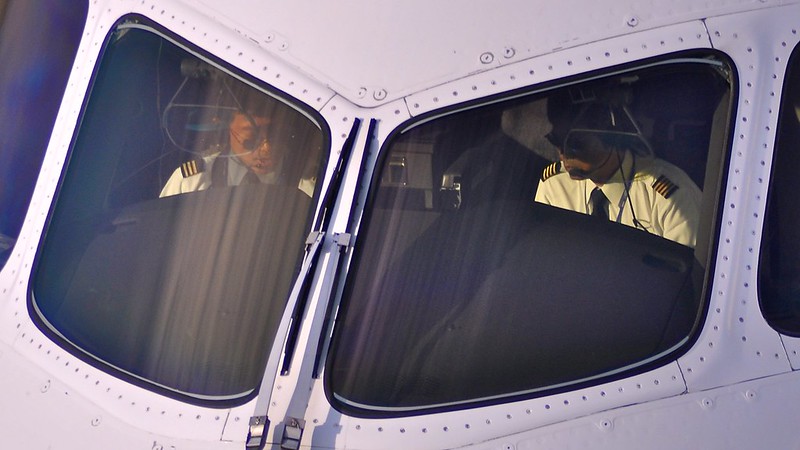 The photo above was taken at the Tokyo Haneda International Airport observation deck. You can see two pilots of a Boeing 787-8 performing pre-flight procedures.
The picture below shows the Cockpit checklist in the flight deck; the parts above the dotted line need to be completed at this stage.
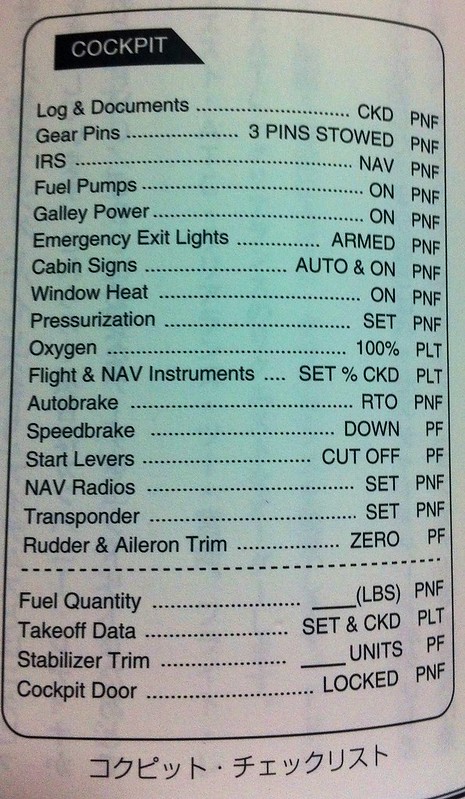
At this time, there are only 5 minutes left before departure from the gate.
Prev: 1.7 CDU设置详解 TOC: 目录 Next: 2.1 出发前5分钟
完