Aviation Safety
-
Investigation Report on the Cockpit Windshield Shatter and Depressurization Incident of Flight 3U8633 from Chongqing to Lhasa
Two years ago, the incident report regarding the Sichuan Airlines Flight 3U8633 Airbus A319 Cockpit Windshield Crack and Blowout was officially released. All materials can be found on the China Civil Aviation Safety Information System website.
SWCAAC-SIR-2018-1_Final_Report_Appendix1Ref_12-14.pdf
SWCAAC-SIR-2018-1_Final_Report_Appendix1Ref_1-7.pdf
SWCAAC-SIR-2018-1_Final_Report_Appendix1Ref_8-10.pdf
SWCAAC-SIR-2018-1_Final_Report_Appendix1Ref_11_part1.pdf
SWCAAC-SIR-2018-1_Final_Report_Appendix1Ref_11_part2.pdf
SWCAAC-SIR-2018-1_Final_Report_MainText.pdf
A partial excerpt of the content is as follows:
The most likely cause of this incident is: The seal (weather seal or sealant silicone) of the right windshield of aircraft B-6419 was likely damaged, and a cavity existed inside the windshield. External moisture intruded and accumulated at the bottom edge of the windshield. After long-term immersion, the insulation of the power wires decreased, leading to continuous electrical arcing in a humid environment at the lower-left corner of the windshield. The local high temperature generated by the arcing caused the double-layer glass structure to crack. The windshield could not withstand the pressure differential between the cockpit and the outside, leading to its explosive separation from the fuselage.
Based on the combined test results from both the Chinese and French sides, it was found that the sealing silicone possesses the following characteristics: · After aging, the main functional group structure, glass transition temperature, expansion rate, and hardness of the sealing silicone material showed no significant changes, indicating that the sealing silicone has a certain degree of weather resistance; · During the inspection, cracking of the sealing silicone was observed, with the direction of crack propagation extending from the inside out; craze cracking was observed on the contact surface between the sealing silicone and the glass layers. · According to ISO1817, after wet treatment (immersion) with deionized water at 70°C, the tensile mechanical properties of the sealing silicone declined.
The impact of the windshield rupture on the cockpit gas environment is mainly divided into two parts: the impact on cockpit pressure and the impact on cockpit temperature. Impact on cockpit pressure: According to flight data, after the A319 windshield cracked, the cockpit suffered decompression. At 07:07:51, the cockpit pressure altitude exceeded 25,000 ft. As the aircraft initiated Descent, the cockpit pressure altitude gradually decreased, dropping below 25,000 ft at 07:09:07. Therefore, the duration during which the cockpit pressure altitude exceeded 25,000 ft was 1 minute and 15 seconds. Impact on cockpit temperature: According to CFD simulation data, during the entire Descent process, the temperature inside the cockpit fluctuated between -24°C and 8°C, with the duration spent at -24°C not exceeding 1.5 minutes.
-
Air France Flight AF293 Flying Non-Standard Departure Procedure
I saw a news report stating that on the 8th of this month, Air France flight AF293 (Tokyo to Paris, Boeing 777) deviated from the standard instrument departure procedure after takeoff.
After departing from Runway 34R, the aircraft did not bank immediately as required. Instead, it flew in a straight line at an ultra-low altitude (1,380 meters) directly over the Tokyo Imperial Palace in the city center, only initiating a right turn when commanded by Air Traffic Control.
-
Case of Ground Personnel Stealing Aircraft and Crashing
The other day, the incident involving a Horizon Air employee stealing an aircraft and crashing it caught my attention. Here are some related reports:
US aircraft stolen and crashed, authorities have not released the identity of the thief
An aircraft at Seattle-Tacoma International Airport in the US took off without permission. The aircraft has crashed after being intercepted and tracked by fighter jets. According to US sources, there were no passengers on board at the time.
According to the official Twitter of Tacoma Airport, an airline employee took off in an unoccupied aircraft without permission. The aircraft crashed in the southern part of the local Puget Sound.
-
List of Individuals Seriously Discredited for Civil Aviation Restricted from Taking Civil Aircraft Published
A few months ago, I introduced taking civil aircraft and the social credit system. This system has now officially launched. Today, I saw on the Civil Aviation Administration of China (CAAC) website the Announcement of the List of Seriously Dishonest Persons Restricted from Taking Civil Aircraft (No. 1, 2018):
Based on the administrative penalty records of public security organs, 86 individuals were subjected to administrative penalties by public security organs for engaging in behaviors that violate the provisions of the "Opinions on Appropriately Restricting Specific Seriously Dishonest Persons from Taking Civil Aircraft within a Certain Period to Promote the Construction of the Social Credit System" (Fa Gai Cai Jin [2018] No. 385), and have been recorded in the civil aviation records of seriously dishonest persons restricted from taking civil aircraft in accordance with regulations.
The publicity period has now expired, and the involved persons are prohibited from taking civil aircraft for one year, calculated from June 1, 2018.
-
Sichuan Airlines Flight 3U8633 Airbus A319 Cockpit Windshield Cracks and Detaches
Undoubtedly, this is another miracle in aviation history. Although many facts have not yet been officially released, the cause of the windshield crack is unknown, and various data are still under investigation. This page will be continuously updated when there is new news.
According to this site’s past experience in summarizing accident reports, such as the investigation of the TransAsia Airways Flight GE235 accident, it took a year and a half to close the case. So, collecting information on the 3U8633 flight incident will also be a long process.
-
Traveling on Civil Aircraft and the Social Credit System
Saw news regarding the Opinions on Restricting Specific Seriously Dishonest Persons from Boarding Civil Aircraft within a Certain Time Limit to Promote the Construction of Social Credit System and Opinions on Restricting Specific Seriously Dishonest Persons from Boarding Trains within a Certain Time Limit to Promote the Construction of Social Credit System.
In recent years, the uncivilized behavior of a few passengers at airports and on aircraft has had a negative impact on aviation safety. The new regulations are believed to play a positive role in the good operation of airlines. Below is an excerpt of some content.
Objective To prevent the adverse effects of illegal acts by some passengers on civil aviation flight safety, and to further increase the punishment for serious illegal and dishonest behaviors in other fields.
-
Did a Garmin Smartwatch Save a Fighter Jet?
Saw someone discussing this on Weibo, so I looked up the original articles: Aircrew that landed a Growler while blind and freezing awarded for bravery Flying blind and freezing: Navy investigating terrifying EA-18G Growler flight It turns out it is indeed a case with significant reference value.
On January 29, a US Navy EA-18G fighter was cruising at 25,000 feet when the ECS (Environmental Control System) suddenly issued air conditioning and pressurization warnings. The temperature in the cockpit dropped to minus 30 degrees, water vapor fogged up, and ice formed on the glass and instrument panels, leaving the pilots with virtually zero visibility.
-
The Era of Free Flight for Micro and Light Unmanned Aircraft Has Arrived: Reading the Interim Regulations on Flight Management for Unmanned Aircraft (Draft for Comments)
Upon seeing the Notice from the Ministry of Industry and Information Technology on Soliciting Public Opinions on the “Interim Regulations on Flight Management of Unmanned Aerial Vehicles (Exposure Draft)", it indicates that restrictions on the management of micro drones will be relaxed in the future. This is truly great news.
The specific classification of drones is as follows:
Based on the level of operational risk, civil drones are categorized into Micro, Light, Small, Medium, and Large. Wherein: A **Micro drone** refers to a remotely piloted aircraft with an empty weight of less than 0.25 kg and design performance that simultaneously meets the following: true altitude does not exceed 50 meters, maximum flight speed does not exceed 40 km/h, and the radio transmission equipment complies with the technical requirements for micro-power short-distance radio transmission equipment. A **Light drone** refers to a remotely piloted aircraft that simultaneously meets the following: empty weight does not exceed 4 kg, maximum takeoff weight does not exceed 7 kg, maximum flight speed does not exceed 100 km/h, and possesses airspace retention capability and reliable surveillability that comply with airspace management requirements, but excludes Micro drones. A **Small drone** refers to a drone with an empty weight not exceeding 15 kg or a maximum takeoff weight not exceeding 25 kg, but excludes Micro and Light drones. A **Medium drone** refers to a drone with a maximum takeoff weight exceeding 25 kg but not exceeding 150 kg, and an empty weight exceeding 15 kg. A **Large drone** refers to a drone with a maximum takeoff weight exceeding 150 kg.
Note: Empty weight refers to the sum of the solid device weights such as the drone body, battery, and fuel containers, excluding the weight of filled fuel and mission payload.
-
ANA Flight NH37 Rapid Decompression Emergency Landing Captain ATC Recording
Yesterday, August 12th, marked the 32nd anniversary of the Japan Airlines JAL123 crash. However, on this very day (same month, same day) at roughly the same time (takeoff at 18:24), ANA Flight NH37, also flying from Tokyo to Osaka, experienced a terrifying moment that made everyone hold their breath. The aircraft type is Boeing 777-200, registration JA703A, manufactured in 1997.
However, the facts are not as severe as depicted by some media outlets. There was no loud bang in the air, no forced landing, and no emergency descent.
-
Mistake of Turning off APU during Engine Start Reading Japan ASRS Report 201603
This site has quite a few topics regarding the APU, such as: Taking Another Look at Details of the A350 Fuselage Trying out a Boeing 777 Cold and Dark Startup Boeing 787 APU Inlet Door Opened During Flight Comparison of APU Inlet Doors Airline Pilot Exploration 2.3: Push Back from the Gate and Engine Start and so on; perhaps I’m just a bit sensitive to this topic.
Today, while looking at the Japan Aviation Safety Reporting System ASRS Report 201603, I found a case where the APU was turned off during engine start, so I will briefly introduce it here.
-
CAAC Real-Name Registration Regulations for Drones
The Civil Aviation Administration of China (CAAC) issued the “Provisions on the Real-Name Registration Administration of Civil Unmanned Aircraft” on May 16. It requires that starting from June 1, 2017, owners of civil unmanned aircraft must conduct real-name registration. News Link Provisions on the Real-Name Registration Administration of Civil Unmanned Aircraft CAAC Civil Unmanned Aircraft Real-Name Registration System
Here is a summary of the main content.
These provisions apply to civil unmanned aircraft with a Maximum Takeoff Weight of 250 grams or more within the territory of the People’s Republic of China.
-
CAAC Regulations on Drones
I previously wrote about “Japanese Aviation Law Regulations on Drones” and “Another Look at Japanese Aviation Law Regulations on Drones.” Later, I saw someone introducing Chinese regulations on Weibo, “Provisions on the Operation of Light and Small Unmanned Aerial Vehicles (Trial)” Below is a simple excerpt of the parts I am interested in.
-
TransAsia Airways Flight GE235 Accident Investigation Concluded
It has been nearly a year since the release of the Factual Data Report on the TransAsia Airways Flight GE235 Accident. The Aviation Safety Council has published an extremely detailed Final Report. After spending over an hour reading through it, here are some excerpts of new facts.
The accident was attributed to numerous factors, ultimately causing the aircraft to lose control due to a Stall.
During the initial Climb phase after takeoff, an intermittent circuit discontinuity occurred within the No. 2 engine’s Auto Feather Unit (AFU), which initiated the Automatic Takeoff Power Control System (ATPCS) procedure, resulting in an uncommanded auto-feather of the No. 2 engine propeller.
-
Follow-up Report on Korean Air Flight KE2708 Engine Fire
Three weeks ago, I wrote about a Korean Air flight aborting takeoff due to an engine fire at Tokyo Haneda Airport, where I also became a victim, and took photos of relevant personnel checking the engine. I assumed the investigation would take a long time, but surprisingly, the Japan Transport Safety Board released an inspection report yesterday regarding airframe HL7534. Through a teardown investigation of the engine, it was discovered that damage had occurred to the turbine disk; debris detached and penetrated the engine cowling.
-
Korean Air Plane Catches Fire During Rejected Takeoff at Tokyo Haneda Airport, Becoming a Victim Itself
At 12:38 on Friday, May 27, during the takeoff roll on Runway 34R at Tokyo Haneda Airport, the No. 1 engine (left side) of a Korean Air Boeing 777-300 (registration HL7534), operating as flight KE2708 from Haneda to Seoul, suddenly caught fire. The aircraft made an emergency stop and immediately deployed slides to evacuate passengers. The airport fire brigade immediately initiated firefighting operations and fully brought the fire under control around 13:10. There were 302 passengers and 17 crew members on board, but fortunately, there were no casualties.
-
A Review of Japanese Aviation Law Regulations on Drones
A couple of days ago, I saw a news report about a Chinese international student who was using a drone to film cherry blossoms at the Kyoto Imperial Palace. Because he did not apply for permission in advance, he was arrested by the police and referred to prosecutors. Since he had also used the drone in Arashiyama and the Philosopher’s Path, he may face stricter penalties.
I previously summarized an article on Japanese Aviation Law regulations regarding drones. As noted in that article, flying in densely populated areas without prior application to the authorities can result in a fine of up to 500,000 yen.
-
MH370 Flight Disappearance Incident -- Wreckage Verification Report Part 1
Yesterday, the Australian Transport Safety Bureau (ATSB) released a Technical Examination Report: Debris examination - update No. 1 Missing aircraft, Boeing 777, 9M-MRO, 8 March 2014 Identification of two items of debris recovered from beaches in Mozambique identifying two pieces of aircraft debris found in Mozambique. The conclusion is that they are “almost certainly” from the missing Malaysia Airlines flight MH370 (registration 9M-MRO).
• Part No. 1 was a flap track fairing segment, almost certainly from the Malaysian Airlines Boeing 777 aircraft, registered 9M-MRO. • Part No. 2 was a horizontal stabiliser panel segment, almost certainly from the Malaysian Airlines Boeing 777 aircraft, registered 9M-MRO.
The first piece of debris is a Flap track fairing, specifically the No. 7 fairing on the right wing of the Boeing 777. Its dimensions, materials, and structure have been confirmed to be consistent with Boeing’s drawings.
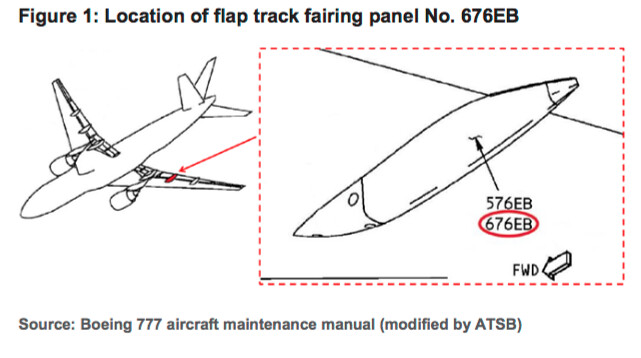
-
Impact of the Kumamoto Earthquake on Aviation Operations as Seen from NOTAMs
Although Tokyo is far away, watching the daily news reports about the Kumamoto Earthquakes, one cannot help but be concerned. Regarding how Kumamoto Airport (RJFT) is doing, one can only check the NOTAMs. Some abbreviations were seen for the first time, but the AIM-J (Aeronautical Information Manual Japan) on hand was very helpful.
170057 RJAAYNYX
(0188/16 NOTAMR 0175/16
Q)RJJJ/QLJAS/IV/BO/A/000/999/3250N13051E005
A)RJFT B)1604170057 C)UFN
E)A PART OF RLLS(NR.15,NR.16) FOR RWY 25-U/S DUE TO TROUBLE)
LJ stands for Runway alignment indicator lights, AS stands for Unserviceable. Everything below is IV, meaning both IFR and VFR are included. RLLS is short for runway lead-in lighting system; let’s translate it as Runway Lead-in Lighting System, meaning lights No. 15 and No. 16 for Runway 25 are unusable due to trouble.
-
Small Aircraft without Insurance
Recently, there have been several small aircraft accidents in Japan, including last year’s JA4060 PA-46 Malibu takeoff failure and crash at Chofu Airport, and this year on March 26th, the crash of JA3788 Mooney M20C at Yao Airport resulting in 4 deaths, which have had a significant social impact.
Therefore, it is said that Japan’s Ministry of Land, Infrastructure, Transport and Tourism (MLIT) has begun discussions on revising airport usage regulations. For small aircraft that have not purchased third-party liability insurance— in other words, aircraft with inadequate safety management—takeoff will be prohibited.
-
Brussels EBBR Airport Shutdown
Two explosions occurred in the departure hall at Brussels Airport EBBR in the Belgian capital, resulting in several injuries. Following reports of the explosions, Brussels Airport closed the airport, and rail traffic to the airport has also been suspended.
Looking again at the NOTAM: Following the issues of the last tel-conference at 15.00 UTC, we have been informed that EBBR airport will be closed until tomorrow 23 rd March at 23:59 UTC.