Title: Secrets of Airliner Flying 3.4 Gear Up
Based on the Boeing 737-500 Operating Manual from the “Airline Pilot Handbook,” let’s continue discussing the operations after the aircraft lifts off the ground.
The previous section mentioned that the Captain should keep both feet off the rudder pedals and use only the control yoke or stick to control the aircraft’s pitch and roll attitudes.
You might ask: Isn’t the rudder necessary to control adverse yaw during rolls? Isn’t it important to “call the ball” by keeping the inclinometer centered in the Turn Coordinator?
Regarding adverse yaw: when the control stick is moved left to bank the aircraft left, the right aileron goes down. This increases the Lift on the right wing, which consequently increases the induced Drag on that side. The result causes the aircraft to yaw to the right—opposite to the direction the nose should yaw during a turn. This phenomenon is called adverse yaw. Thus, moving the stick left to bank causes the nose to yaw right. This is when the pilot needs to manipulate the rudder to counteract this effect.
By the way, asking this question proves you are a true expert. Indeed, for small aircraft, rudder operation is indispensable. However, most modern jet airliners are equipped with a device called a Yaw Damper. Once the Yaw Damper switch is turned on, the system computer sends opposite commands to the rudder during flight to proportionally damp the aircraft’s yaw, ensuring the aircraft moves forward in the direction of the nose.
Therefore, in highly modernized airliners, pilots don’t need to be distracted by rudder operations and can focus on the control yoke, thereby improving flight safety.
After the main landing gear leaves the ground, the numbers on the radio altimeter in the bottom right of the PFD keep increasing. The Vertical Speed Indicator (VSI) needle points upward, and the barometric altimeter shows a gradual rise. This indicates that the condition of a “positive climb” has been met, so the landing gear can be retracted (Gear Up).
 The image above compares the radio altimeter in traditional aircraft versus modern glass cockpit aircraft. The traditional altimeter is a needle-based analog gauge, while in modern aircraft, the altitude value is digitally displayed in the bottom right corner of the PFD, below the Decision Height (DH).
At this moment, the callout in the cockpit is as follows:
First Officer: Positive climb Captain Command: Gear Up! First Officer Repeat: Gear Up (Then pulls the landing gear lever located in the center, between the forward EICAS and the First Officer’s PFD, and moves it to the Up position).
 The photo above shows the 737NG cockpit from the internet; you can clearly see the shape of the landing gear lever.
At this point, you can hear a “whirring” sound as the hydraulic system actuates to retract the gear into the fuselage. Accompanied by the hydraulic pump’s running sound, a moment later you hear a soft “thud” and feel a slight vibration; this is the sound of the landing gear doors closing. After the “whirring” hydraulic sound stops, the pilot can also confirm on the instrument panel that the gear is fully retracted.
With the landing gear, which was exposed to the airflow, now retracted and the doors closed, the aircraft’s air resistance (Drag) drops significantly. Passengers in the cabin will clearly feel that the outside noise has become much quieter.
From accelerating on the Runway to liftoff and Climb, and finally retracting the gear, the total time has not exceeded 30 seconds. Retracting the wheels early reduces Drag as soon as possible, allowing for a faster Climb, and also reduces noise pollution around the airport.
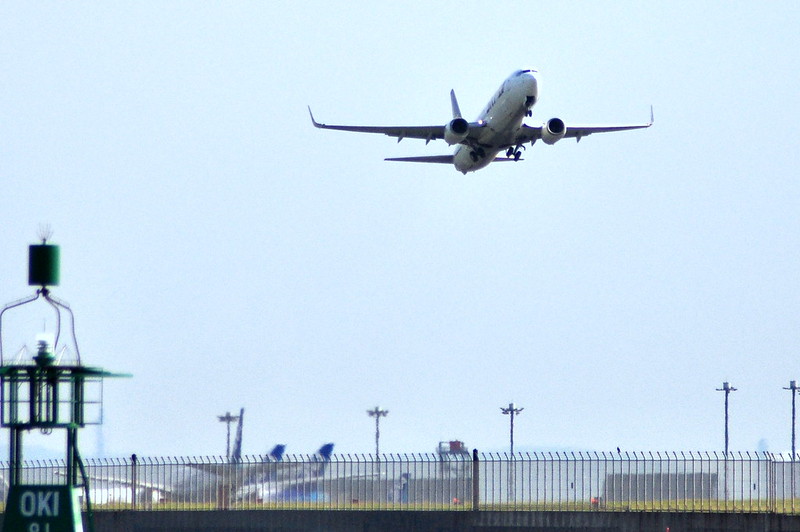 The photo above was taken by me at Tokyo International Airport (Haneda). You can see that this Boeing 737-800 has just lifted off, and the retraction of the landing gear begins right above the runway.
Regarding the flight status, the aircraft is currently in Flight Director (FD) mode. The computer calculates the pitch angle required to maintain a speed of V2+20 knots, which is reflected on the FD command bars of the PFD. Therefore, the pilot only needs to make fine adjustments to the yoke or stick to operate faithfully according to the FD’s indications. Before reaching the Flap Retraction Altitude (FRA), the aircraft will continue to fly at a speed of V2+20 knots.
At the same time, the page title display on the Flight Management System Control Display Unit (FMS/CDU) automatically changes to the economic climb mode “ACT ECON CLB.” Only at this point is the takeoff operation considered completely finished.
Prev: Takeoff Rotation TOC: Table of Contents Next: Engage Autopilot
End