A Flight Sim Enthusiast's Notebook
-
Korean Air Plane Catches Fire During Rejected Takeoff at Tokyo Haneda Airport, Becoming a Victim Itself
At 12:38 on Friday, May 27, during the takeoff roll on Runway 34R at Tokyo Haneda Airport, the No. 1 engine (left side) of a Korean Air Boeing 777-300 (registration HL7534), operating as flight KE2708 from Haneda to Seoul, suddenly caught fire. The aircraft made an emergency stop and immediately deployed slides to evacuate passengers. The airport fire brigade immediately initiated firefighting operations and fully brought the fire under control around 13:10. There were 302 passengers and 17 crew members on board, but fortunately, there were no casualties.
-
Email Exchange Over the Atlantic
I saw something quite interesting on a pilot blog, so I got the author Anzai-san’s permission to translate it into Chinese and publish it here.
-
Waypoints Named After Beer
I went to Fukuoka on a business trip last week. Before the flight, I checked the route information and discovered that the route from Haneda (RJTT) to Fukuoka (RJFF) is extremely simple.
It involves the SEKID Departure procedure out of Haneda, followed by flying west all the way along Airway Y20 (SEKID is also the starting point of Y20). Once reaching STOUT, the end of Y20, you are already very close to Fukuoka.
-
Major Zone Index
I have a Japanese book titled “Guide to Reading English Aircraft Manuals.” It is intended for aircraft maintenance personnel at airlines and explains a large number of English technical terms. Just flipping through it, I found this diagram to be quite helpful: the Major Zone Index Diagram.
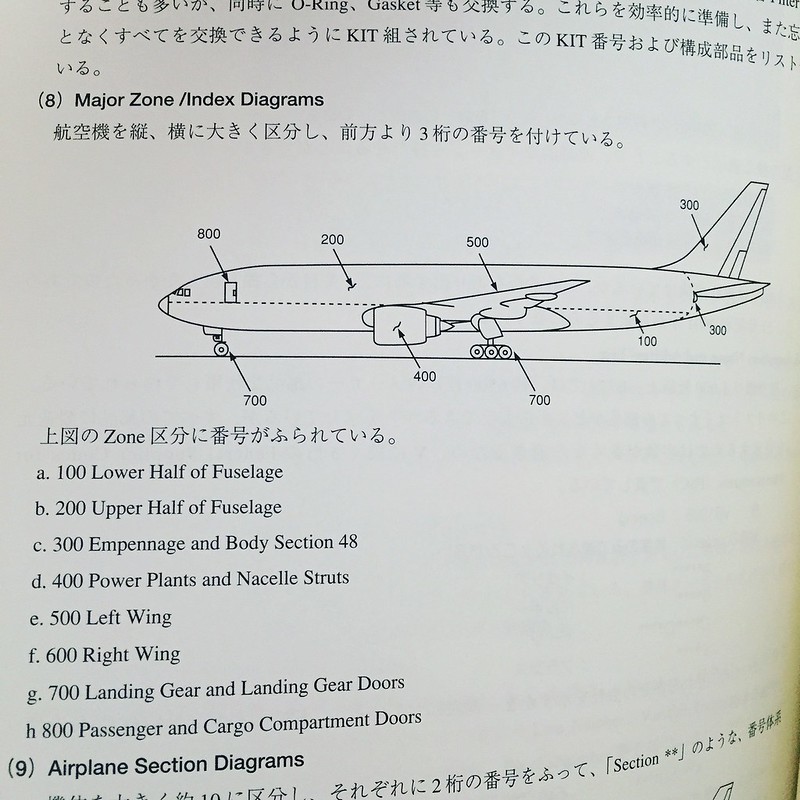
It turns out that every zone of the airframe is assigned a 3-digit number for management:
100 Lower Fuselage 200 Upper Fuselage 300 Empennage (Tail Section) 400 Engines and Nacelles 500 Left Wing 600 Right Wing 700 Landing Gear 800 Doors
-
Shoddy Construction Work During Runway Reinforcement at Tokyo International Airport
Most people’s impression of Japanese architecture is that it is very meticulous and sturdy, with high earthquake resistance. However, this does not mean that all construction is flawless. For example, last Friday, NHK reported on corner-cutting in the Runway construction work at Haneda Airport.
The purpose of this project was to prevent soil liquefaction of the Runway during an earthquake, and was contracted to Toa Construction Corporation.
Soil liquefaction mainly occurs in water-saturated sandy or clayey soils distributed at shallow depths. During liquefaction, sand and water mix into a slurry-like liquid, causing the soil to lose its bearing capacity. This results in tilting houses, land subsidence, and rupture or floating of underground pipelines. Historically, soil liquefaction occurred during the 1906 San Francisco earthquake, the 2011 Great East Japan Earthquake, and the February 2016 earthquake in southern Taiwan.
-
A Review of Japanese Aviation Law Regulations on Drones
A couple of days ago, I saw a news report about a Chinese international student who was using a drone to film cherry blossoms at the Kyoto Imperial Palace. Because he did not apply for permission in advance, he was arrested by the police and referred to prosecutors. Since he had also used the drone in Arashiyama and the Philosopher’s Path, he may face stricter penalties.
I previously summarized an article on Japanese Aviation Law regulations regarding drones. As noted in that article, flying in densely populated areas without prior application to the authorities can result in a fine of up to 500,000 yen.
-
GUMPS checklist
Pre-landing Mental Preparation Checklist: GUMPS, a simple note. G - Gas Fuel selector BOTH, Fuel pump ON, Proper fuel pressure, etc. U - Undercarriage Landing gear down M - Mixture Fuel mixture RICH P - Propeller Propeller pitch high (coarse) S - Seat belts and Switches Seat belts, Lights, Pitot heat, etc. -
Anti-Servo Tab on Small Aircraft
Horizontal Stabilizer: Horizontal Stabilizer
Elevator: Elevator
Stabilator: Stabilator
Anti-Servo Tab: Anti-Servo TabThe Elevator is typically installed at the rear section of the Horizontal Stabilizer.
 The Horizontal Stabilizer is fixed, while the Elevator is movable.
However, for a Stabilator, the stabilator itself functions as the elevator.
Trim is still necessary, and this is often achieved by the movable section at the rear of the Stabilator
—the Anti-Servo Tab.<img src=http://image.slidesharecdn.com/aircraftbasics-140927035356-phpapp02/95/aircraft-basics-35-638.jpg?cb=1411790115>
-
Application of VR Technology in Flight Simulation and Flight Training
In the IT industry this year, VR technology has been a very hot topic. It was originally thought that Oculus Rift would start becoming popular in flight simulations like X-Plane; for instance, there was an announcement last year titled Oculus Rift: Apparently Windows First.
However, surprisingly, JAL (Japan Airlines) has already started using VR technology to train pilots and maintenance personnel. They are not using Oculus Rift, but rather Microsoft HoloLens.
According to JAL’s announcement, during the initial training of first officers, HoloLens is used to simulate the cockpit environment of a 737-800. It serves as an auxiliary tool to help trainees more easily understand the locations of various instruments. The HoloLens also features explanatory audio, which guides trainees through operating procedures and the execution of checklists.
-
MH370 Flight Disappearance Incident -- Wreckage Verification Report Part 1
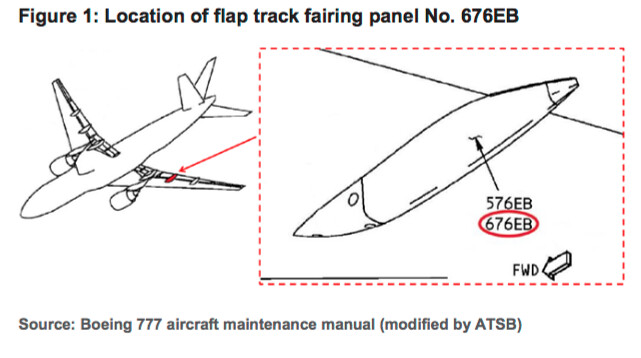
Yesterday, the Australian Transport Safety Bureau (ATSB) released a Technical Examination Report: Debris examination - update No. 1 Missing aircraft, Boeing 777, 9M-MRO, 8 March 2014 Identification of two items of debris recovered from beaches in Mozambique identifying two pieces of aircraft debris found in Mozambique. The conclusion is that they are “almost certainly” from the missing Malaysia Airlines flight MH370 (registration 9M-MRO).
• Part No. 1 was a flap track fairing segment, almost certainly from the Malaysian Airlines Boeing 777 aircraft, registered 9M-MRO. • Part No. 2 was a horizontal stabiliser panel segment, almost certainly from the Malaysian Airlines Boeing 777 aircraft, registered 9M-MRO.
The first piece of debris is a Flap track fairing, specifically the No. 7 fairing on the right wing of the Boeing 777. Its dimensions, materials, and structure have been confirmed to be consistent with Boeing’s drawings.
-
Overview of New Features in X-Plane 10.50
A list of new features for X-Plane 10.50 has been released on the official developer blog, and it looks very attractive!!
The ones I’m interested in are:
New Autogen New ground building models added to automatically generated scenery.
apt.dat 1050 with Static Aircraft and New Models Airport data now supports static aircraft models. Hopefully, no more complaints about “bare airports” in the future.
Global Winds Aloft High-altitude wind data uses NOAA’s global data. Previous versions only supported the US.
-
FlightRadar24 Redesign: Highly Immersive Experience in 3D Mode
It seems flightrader24 has been updated, and the 3D mode looks quite nice.
For instance, after checking the NOTAMs for Kumamoto Airport RJFT, I looked at the airspace above the airport and spotted this Tottori Prefecture Fire Department helicopter, JA31TA.
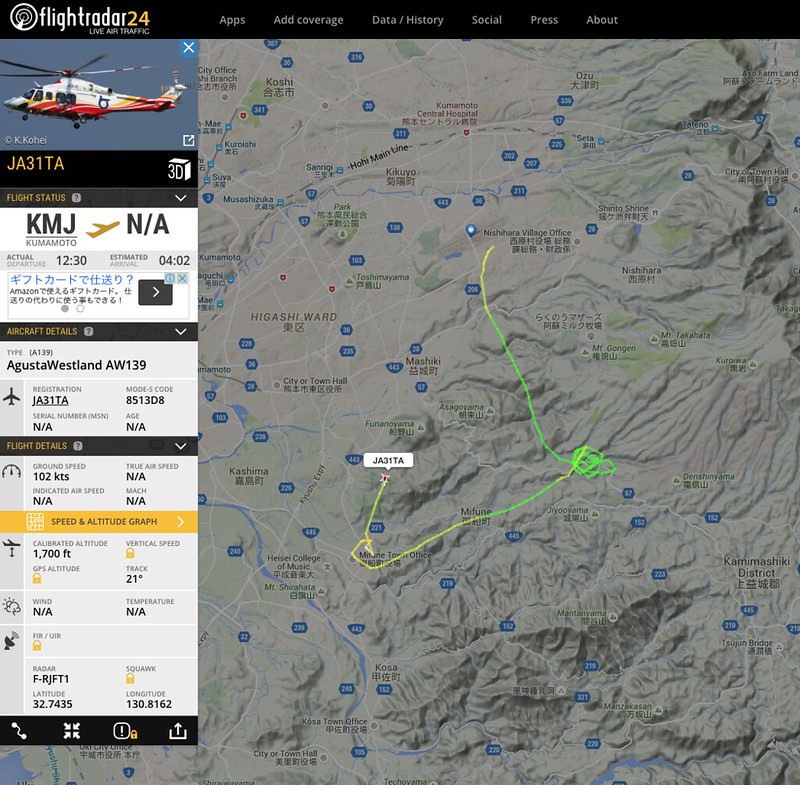 Its model is the Italian AgustaWestland AW139, and it appears to be carrying out an earthquake rescue mission.
So, I opened the 3D mode, which features Cockpit View and External View functions.
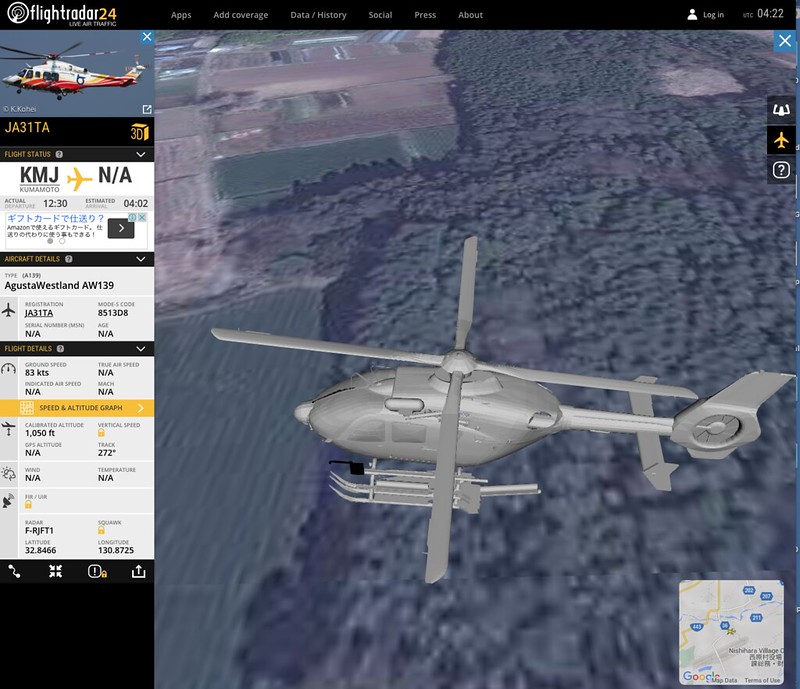 You can see the helicopter flying over the town hall of “Mifune-machi,” gradually descending in altitude to begin the rescue mission.
 You might not be able to tell from the static images above, but watching it live offers a truly immersive experience.
 -
Impact of the Kumamoto Earthquake on Aviation Operations as Seen from NOTAMs
Although Tokyo is far away, watching the daily news reports about the Kumamoto Earthquakes, one cannot help but be concerned. Regarding how Kumamoto Airport (RJFT) is doing, one can only check the NOTAMs. Some abbreviations were seen for the first time, but the AIM-J (Aeronautical Information Manual Japan) on hand was very helpful.
170057 RJAAYNYX
(0188/16 NOTAMR 0175/16
Q)RJJJ/QLJAS/IV/BO/A/000/999/3250N13051E005
A)RJFT B)1604170057 C)UFN
E)A PART OF RLLS(NR.15,NR.16) FOR RWY 25-U/S DUE TO TROUBLE)
LJ stands for Runway alignment indicator lights, AS stands for Unserviceable. Everything below is IV, meaning both IFR and VFR are included. RLLS is short for runway lead-in lighting system; let’s translate it as Runway Lead-in Lighting System, meaning lights No. 15 and No. 16 for Runway 25 are unusable due to trouble.
-
Small Aircraft without Insurance
Recently, there have been several small aircraft accidents in Japan, including last year’s JA4060 PA-46 Malibu takeoff failure and crash at Chofu Airport, and this year on March 26th, the crash of JA3788 Mooney M20C at Yao Airport resulting in 4 deaths, which have had a significant social impact.
Therefore, it is said that Japan’s Ministry of Land, Infrastructure, Transport and Tourism (MLIT) has begun discussions on revising airport usage regulations. For small aircraft that have not purchased third-party liability insurance— in other words, aircraft with inadequate safety management—takeoff will be prohibited.
-
Clouds Over the Airport
The shapes of clouds are always changing; no two clouds in the world are exactly alike. If the clouds near the airport display distinctive shapes, and an aircraft happens to fly into the frame, it presents a perfect photo opportunity.
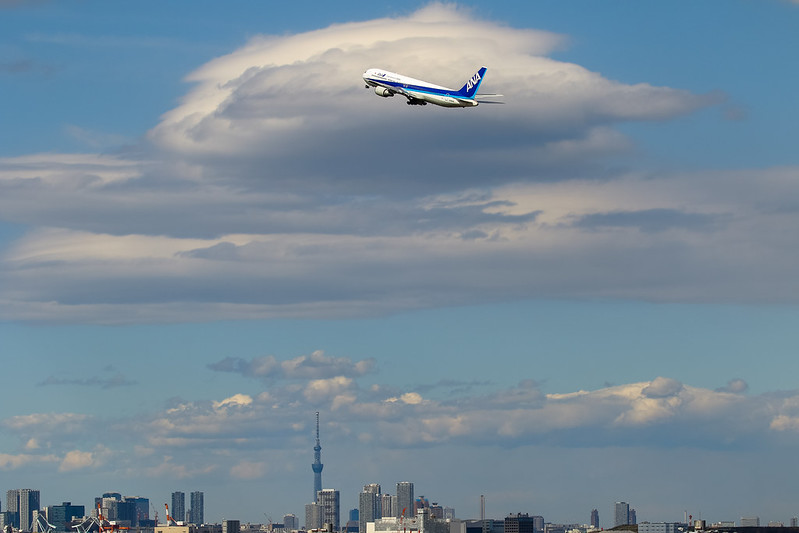
At Haneda Airport, large white cumulus clouds appear in the background. An aircraft taking off from Runway 34R has just lifted off, and for those few seconds while retracting the landing gear, the high-rise buildings of downtown Tokyo serve as a perfect backdrop.
-
Suction Mount for iPad in the Cockpit
Continuing from the topic of photography at Haneda, speaking of watching the ANA pilot perform pre-flight preparations,
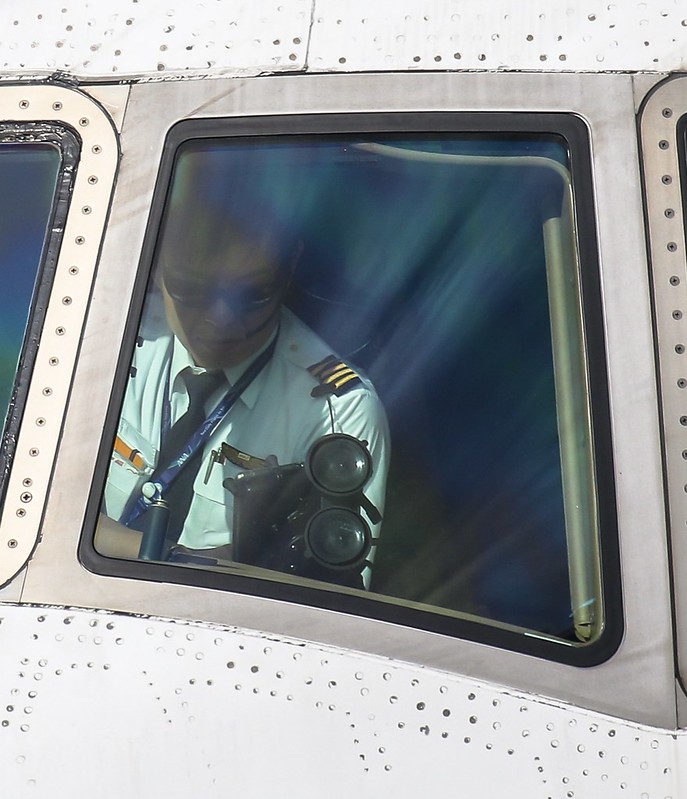 They used a suction cup mount to fix an iPad to the cockpit windshield glass,
A detail I hadn’t paid much attention to before.
They used a suction cup mount to fix an iPad to the cockpit windshield glass,
A detail I hadn’t paid much attention to before.It is hardly news that pilots use iPads as EFBs for flight management, etc., There were Japanese news articles introducing ANA’s usage methods a few years ago, For example: 事例で学ぶiPhone/iPad活用術 ANAがパイロット2,500名にiPadを配布 - ドラム缶28万本の燃料を削減; iPadありき、ではないANAパイロットへの導入 EFBやマネジメント改善視野に──雲上のiPad活用術, This includes flight plan management (number of passengers, cargo weight, fuel load adjustment, etc.), charts, cloud charts, weather maps, turbulence information, and more. However, due to legal regulations at the time regarding the use of electronic products on board, they could not be used during flight.
-
ANA Star Wars Livery Aircraft No. 2
I have previously introduced the first passenger flight of the ANA Star Wars livery 787-9 and watched the R2-D2 special livery take off again. Actually, there are a total of 3 Star Wars livery aircraft. The 2nd aircraft, JA604A Boeing 767-300 – “STAR WARS ANA JET”, has been in operation since last November, but I just hadn’t specifically gone out to find and photograph it until this day, when I accidentally captured it at Haneda Airport.
-
Brussels EBBR Airport Shutdown
Two explosions occurred in the departure hall at Brussels Airport EBBR in the Belgian capital, resulting in several injuries. Following reports of the explosions, Brussels Airport closed the airport, and rail traffic to the airport has also been suspended.
Looking again at the NOTAM: Following the issues of the last tel-conference at 15.00 UTC, we have been informed that EBBR airport will be closed until tomorrow 23 rd March at 23:59 UTC.
-
Impact of French ATC Union Strikes on ATC
What happens when air traffic controllers go on strike? Of course, takeoffs and landings near airports are impossible, and airspace is blocked—these are predictable outcomes. For example, today the French air traffic controllers’ union is holding a strike. Checking the news on the European Network Operations Portal,
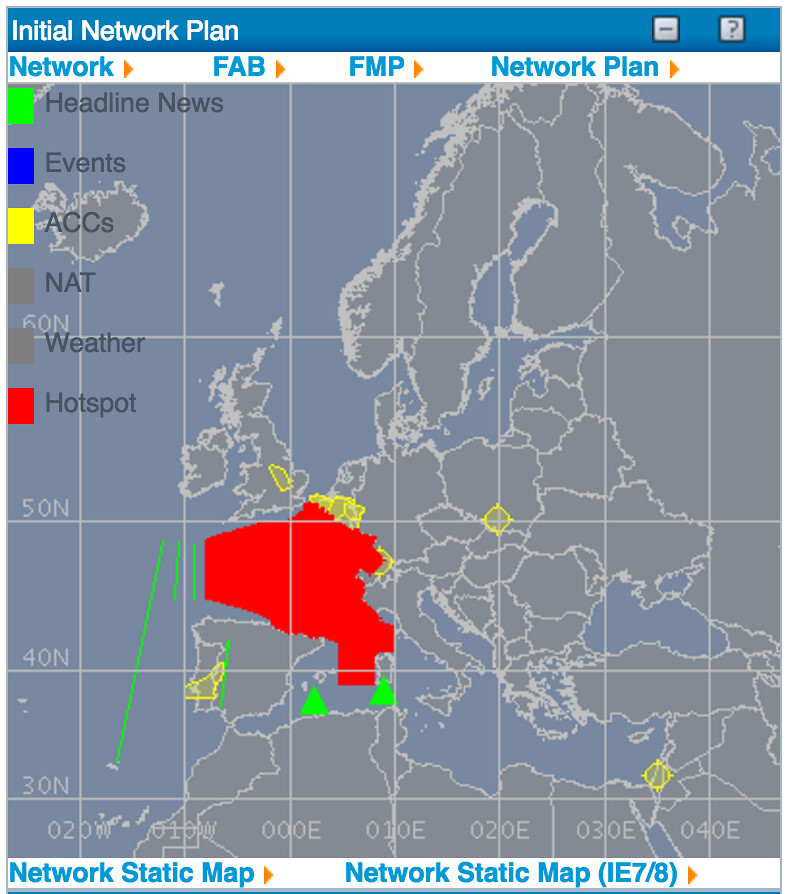 Sure enough, France is covered in red.
Now let’s look at the latest NOTAM 0502/16 on the same site.
(F0502/16 NOTAMR F0500/16
Q) LFXX/QAFXX/IV/NBO/E /000/999/4504N00053E999
A) LFBB LFMM LFFF LFRR LFEE B) 1603201653 C) 1603220500
E) DUE TO A STRIKE AFFECTING FRENCH CIVIL AVIATION SERVICES,
SOME IMPORTANT DISTURBANCES WILL AFFECT FRENCH ATS, AIS AND COM services

1-A MINIMUM SERVICE WILL BE ENSURED IN NOTAM OFFICE, ACCS AND AT
LFPG/LFPO/LFSB/LFST/LFLL/LFLC/LFMN/LFML/LFKB/LFKC/LFKJ/LFBD/LFBI/LFBL
/LFBO/LFRG/LFRS AND OVERSEAS AIRPORTS.
ACTUAL ATC CAPACITY WILL BE DETERMINED ACCORDING TO AVAILABLE STAFF.

2-AT OTHER AERODROMES, ATS SERVICES MIGHT BE UNAVAILABLE DURING
CERTAIN PERIODS NOTIFIED BY NOTAMS.

3-AIRCRAFT OPERATORS ARE REQUESTED TO REDUCE BY ONE THIRD THEIR
SCHEDULED FLIGHTS ON MONDAY MARCH 21ST ON THE SLOT 0500AM-1100PM
UTC ON PARIS-ORLY AND MARSEILLE PLATFORMS AND BY TWENTY PER CENT ON
BEAUVAIS, LYON ST EXUPERY AND NICE PLATEFORMS

4-TERRITORIAL CONTINUITY FLIGHTS (CORSICA, DOM-TOM) ARE NOT CONCERNED
BY THIS REQUEST

5-THE APPROVAL OF NEW PROGRAMS FOR NON SCHEDULED FLIGHTS MAY BE
RESTRICTED DEPENDING ON THE EVOLUTION OF THE SITUATION

6-AIRCRAFT OPERATORS SHALL SEND IMMEDIATELY REMAINING PROGRAM AND
CANCELLED FLIGHTS TO DGAC/DTA BY MAIL TO:
DTA-PROGRAMMES-CRISES-BF(AT)AVIATION-CIVILE.GOUV.FR

7-FLIGHT PLANS EXCEEDING THOSE LIMITATIONS COULD BE REJECTED.

8-AIRCRAFT OPERATORS MUST SYSTEMATICALLY CANCEL ALL PLN, RPL OR FPL
FOR THE FLIGHTS NOT PERFORMED AND THEIR AIRPORTS SLOTS TO COHOR
RMK:INFORMATION ON REAL TIME SITUATION WILL BE AVAILABLE
ON THE FOLLOWING INTERNET WEBSITE HTTP://DSNADO.CANALBLOG.COM)
Aircraft operators should cancel flight plans, as ATC will only provide minimum service, flights to Paris and Marseille should be reduced by 1/3, and flights to Beauvais, Lyon, and Nice should be reduced by 20%, etc.
-
Rich of Peak and Lean of Peak
I picked up some more knowledge from the experts on Baidu Tieba, so I’m sharing it below.
When you pull the mixture back, you will eventually reach a highest EGT value —- Peak. At this point, if you push the mixture forward a bit, it is called Rich of Peak. At this point, if you pull the mixture back a bit, it is called Lean of peak.
When you push forward a bit to reach a value slightly lower than the maximum EGT, you often obtain a maximum Thrust mixture ratio. For example, if the peak is 500 degrees and you push the mixture forward to reach 475 degrees where the Thrust is maximum, it is called 25 degree rich of peak.