Sichuan Airlines Flight 3U8633 Airbus A319 Cockpit Windshield Cracks and Detaches
Undoubtedly, this is another miracle in aviation history. Although many facts have not yet been officially released, the cause of the windshield crack is unknown, and various data are still under investigation. This page will be continuously updated when there is new news.
According to this site’s past experience in summarizing accident reports, such as the investigation of the TransAsia Airways Flight GE235 accident, it took a year and a half to close the case. So, collecting information on the 3U8633 flight incident will also be a long process.
1. 2018/5/15 CAAC Southwest Regional Administration Regional News 2. 2018/5/15 Other Reports 3. 2018/5/15 Photos during the alternate landing 4. 2018/5/15 Data on FlightRadar24 5. 2018/5/15 Photos from inside the cockpit 6. 2018/5/15 About the accident aircraft B-6419 7. 2018/5/17 China Civil Aviation Network “Flight without windshield” 8. 2018/5/18 A segment of ATC recording 9. 2018/5/19 Dual Captains: The Key to High-Altitude Safety in Chinese Civil Aviation 10. 2018/5/20 Recreating the thrilling 34 minutes of ATC after the aircraft malfunction: 8 passenger planes “grounded” 11. 2018/5/20 How to complete a life-and-death emergency landing at 10,000 meters? Listen to the Sichuan Airlines heroic crew 12. 2018/5/22 Co-pilot of Sichuan Airlines Flight 3U8633 recovered and discharged 13. 2018/5/24 Analysis on ram air and oxygen masks - The heroic captain’s luck 14. 2018/5/28 Body stress response helps heroic captain survive the limit 15. 2018/5/31 Sidebar: Southwest ATC ensures Sichuan Airlines Flight 3U8633 special situation 16. 2018/6/12 Report on the advanced deeds of the Sichuan Airlines Flight 3U8633 crew 17. 2018/6/22 ATMB holds commendation meeting for Sichuan Airlines Flight 8633 major special incident in Beijing 18. 2018/6/26 Sichuan Airlines Flight 3U8633 Crew June 2018 “China Goodness List” 19. 2019/10/06 Movie The Captain (2019) 20. 2019/10/06 Lasting one year, Southwest Regional Administration completes the “5.14” incident preliminary investigation report
Summary. Flight process compiled based on the above materials
Supplementary Materials: Transponder code 7700, Chengdu Shuangliu Airport charts, Aircraft hull damage status, etc. a About 7700 squawk code b About radar services and procedures c About search and rescue d TCAS panel for transponder settings e About Chengdu Shuangliu Airport chart materials f About hull damage g “Cockpit Windshield/Window Crack” non-normal procedure in A321 Quick Reference Handbook h About stress i “CCTV Lecture”: From Ordinary to Extraordinary · Sichuan Airlines Heroic Crew Captain Liu Chuanjian: Pilots fight against flight accidents every day 20190323 | CCTV “Lecture” Official Channel j The Captain k Recommendation this issue: The Captain movie, Sichuan Airlines Flight 3U8633 life-and-death landing, prototype Captain Liu Chuanjian restores the real scene and details! A world miracle!
1 CAAC Southwest Regional Administration Regional News Sichuan Airlines Flight makes safe alternate landing in Chengdu due to cockpit windshield crack
On May 14, 2018, Sichuan Airlines Flight 3U8633 was performing the Chongqing-Lhasa flight mission. During the cruise phase in the Chengdu area, the right front cockpit windshield cracked and detached, and the crew implemented an emergency descent.With the close coordination of various civil aviation support units, the crew handled the situation correctly. The aircraft made a safe alternate landing at Chengdu Shuangliu Airport at 07:46. All passengers landed safely, disembarked in an orderly manner, and received proper arrangements.
During the alternate landing, the co-pilot in the right seat suffered facial scratches and a waist sprain, and a flight attendant suffered minor injuries during the descent. Sichuan Airlines has assisted passengers in arranging subsequent travel, and relevant follow-up support is being carried out in an orderly manner.
The Southwest Regional Administration of CAAC and the Sichuan Supervision Bureau have rushed to the scene to conduct investigation and disposal immediately.
2 Cockpit windshield cracks at high altitude, Sichuan Airlines crew handles professionally for safe alternate landing The “Epic Alternate Landing” of the Sichuan Airlines passenger plane was done by them!
Captain Liu Chuanjian, Two injured crew members: Flight attendant Zhou Yanwen and Co-pilot Xu RuichenThe aircraft entered Sichuan Airlines’ fleet on July 26, 2011. As of May 14, 2018, it had been used for 19,912.25 hours and 12,920 cycles.
The most recent A-check was 4A5, completed in Kunming on April 12, 2018. The most recent C-check was 3C, completed on March 9, 2017, outsourced to Chengdu Chuangwei. The aircraft had no deferred fault items on the day. Checking maintenance records for the past 15 days, the aircraft had no windshield fault information. Detailed circumstances require further investigation.
According to the current investigation, Preliminary findings are that the front right windshield of the aircraft detached in the air, The FCU in the front of the cockpit, specifically the right third of the Flight Control Unit, also detached in the air. Throughout the incident, the crew’s response was rapid and effective, In a critical situation, bringing the aircraft to a safe alternate landing in Chengdu.
Corresponding ground departments, including the Southwest Air Traffic Management Bureau, Chengdu Shuangliu Airport initiated corresponding emergency plans in a timely manner, cleared obstacles, and ensured a normal alternate landing for the aircraft.
When the windshield cracked, crew members immediately followed procedures to handle it, descending and decelerating. During this period, due to excessive noise, unable to establish radio contact with the ground, the crew set the transponder to emergency mode.
At the same time, oxygen masks deployed in the cabin, and the crew immediately broadcasted and handled the situation. “The entire crew responded calmly as required, worked together, and successfully completed the safe alternate landing.”
3 Photos of 3U8633 (Airbus A319, registration B-6419) during the alternate landing
You can see that the windshield in front of the co-pilot on the right is completely gone!

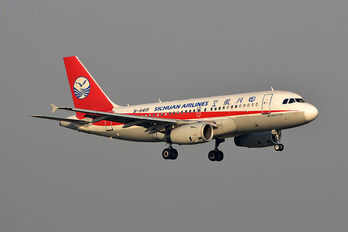 Image copyright belongs to WANBI, please click to see the large image in the China Aviation Photo Gallery.
#3U8633 flight path. https://t.co/XgIc59PkuW pic.twitter.com/4ToZBv2pVk
— Flightradar24 (@flightradar24) May 14, 2018
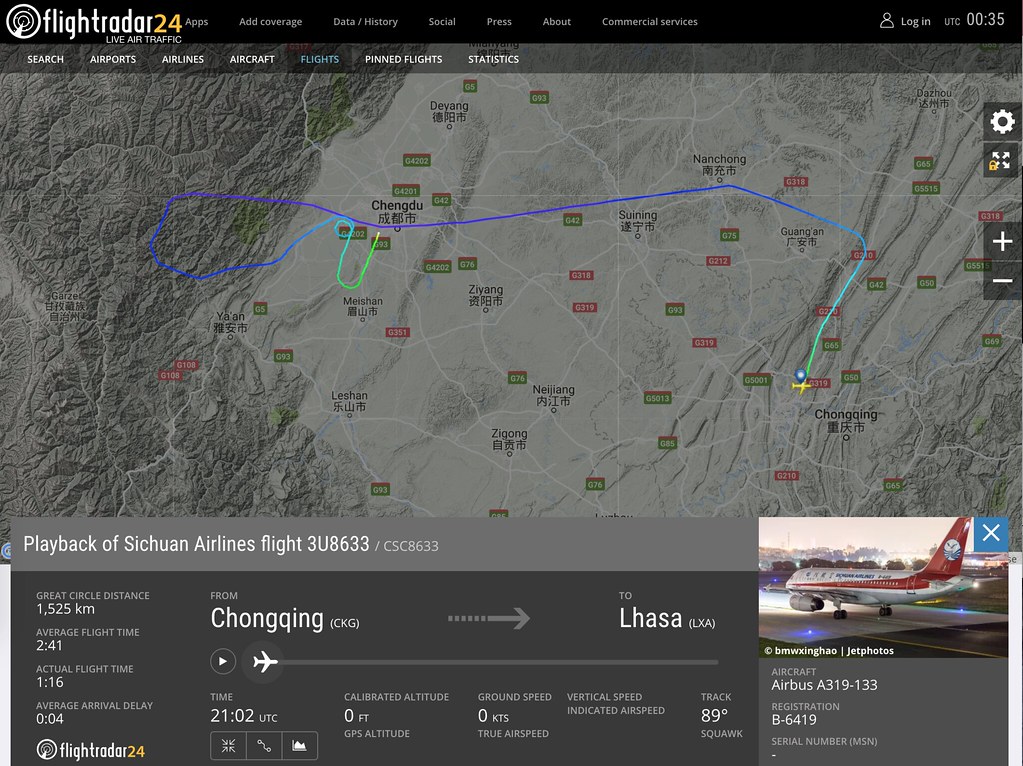
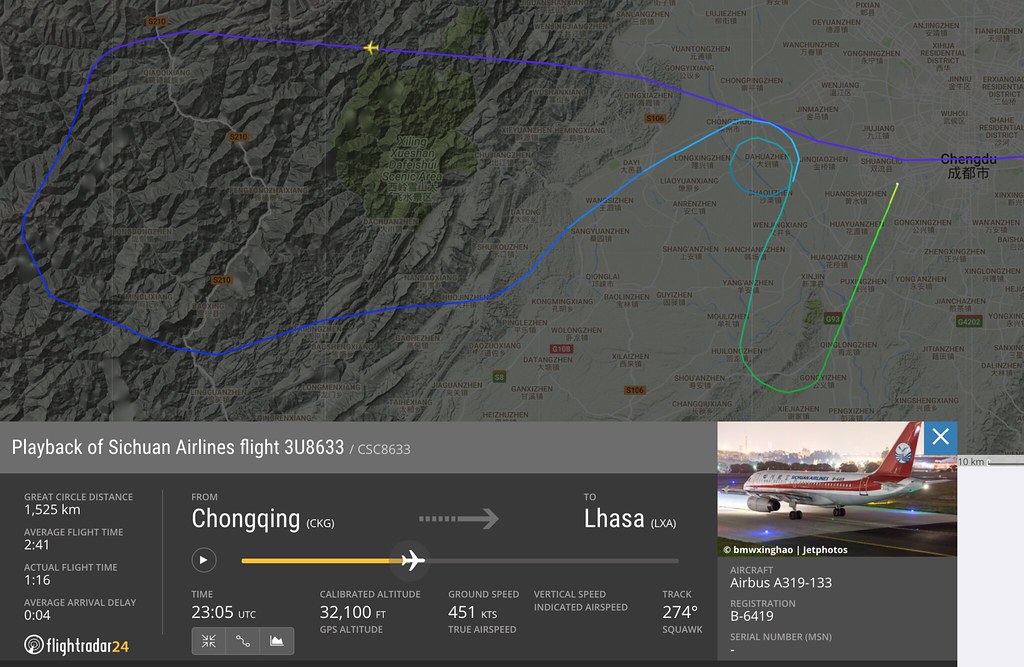
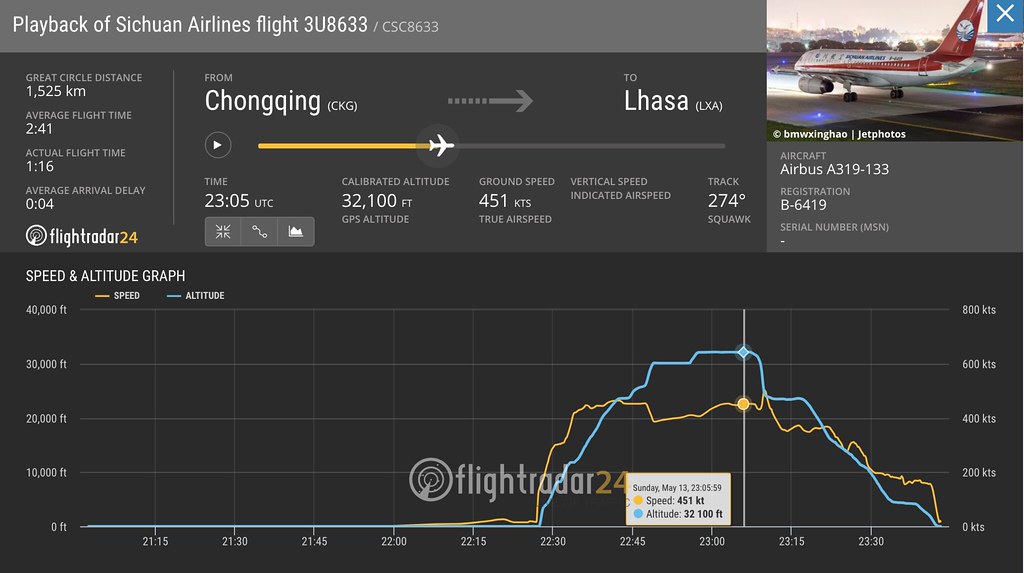 It can be seen that at the time of the accident, the aircraft's altitude was 32,000 feet, speed was 450 knots,
located near the north side of Xiling Snow Mountain Dafeishui Scenic Area.
It can be seen that at the time of the accident, the aircraft's altitude was 32,000 feet, speed was 450 knots,
located near the north side of Xiling Snow Mountain Dafeishui Scenic Area.
Xiling Snow Mountain is located in Dayi County, Chengdu City, Sichuan Province, only 110 km from Chengdu, reachable by a 2.5-hour drive. The total area of the scenic spot is 483 square kilometers, with altitudes ranging from 1260 meters to 5364 meters. It is part of the World Natural Habitat for Giant Pandas, a National Scenic Area, National Forest Park, and AAAA-level tourist attraction.The highest peak in the area, Daxuetang, is 5364 meters above sea level, with perennial snow. It is the highest peak in Chengdu. The great Tang Dynasty poet Du Fu praised this scene and wrote the eternal “Jueju”: “The window contains the millennium snow of Xiling, the door moors the ten-thousand-mile ship of Wu”, Xiling Snow Mountain is thus named.
This is how cockpit looks after the emergency landing.#3U8633 pic.twitter.com/9tMsdOZB0q
— ChinaAviationReview (@ChinaAvReview) May 14, 2018
#3U8633 Crew had to operate manually because part of FCU sucked out. No windsield, lost pressure, extremely noisy, 300kt wind, multiple failure. This is a remarkable incident in aviation history. Hero pilots saved everyone. pic.twitter.com/ShVyXArh34
— ChinaAviationReview (@ChinaAvReview) May 14, 2018
6 About the accident aircraft B-6419 Model Airbus A319-100, produced by Airbus Tianjin Final Assembly Company, equipped with 2 IAV V2500 engines. The aircraft cabin configuration is C8Y124, first flown on July 11, 2011, and delivered to Sichuan Airlines on July 26 of the same year.
7 China Civil Aviation Network: Flight without windshield [Exclusive · Full Replay] Flight without windshield Source: China Civil Aviation Network
8 A segment of ATC recording on Weibo [Air-ground communication during 3U8633 windshield crack] On May 14, the windshield of Sichuan Airlines Flight 3U8633 from Chongqing to Lhasa cracked mid-flight. The video edits a segment of dialogue between the crew and ATC. The crew responded calmly to the sudden situation, and the controllers cooperated closely with other crews! Thumbs up to the aviation people!! Editing and subtitles by: @Water Grass Rabbit wants to be strong
9 Dual Captains: The Key to High-Altitude Safety in Chinese Civil Aviation China Civil Aviation Network Dual Captains: The Key to High-Altitude Safety in Chinese Civil Aviation
General plateau airports refer to airports with an elevation of 5000-8000 feet (1524-2438 meters), High plateau airports refer to airports with an elevation of 8000 feet (2438 meters) or above, General plateau airports and high plateau airports are collectively referred to as plateau airports.A flight crew operating to high plateau airports should be equipped with at least three pilots. Besides the captain, it should include a pilot with at least the qualifications of a senior first officer specified in Section 121.451 of CCAR-121. And Section 121.451 of CCAR-121 clearly stipulates that In operations with three or more pilots, If a cruise pilot is required to replace the captain during the cruise phase, That pilot “shall be fully qualified to act as captain on that type of aircraft”.
10 Sichuan Daily: Recreating the thrilling 34 minutes of ATC after the aircraft malfunction Recreating the thrilling 34 minutes of ATC after the aircraft malfunction: 8 passenger planes “grounded” urgently
11 Shanghai Observer: How to complete a life-and-death emergency landing at 10,000 meters? Listen to the Sichuan Airlines heroic crew How to complete a life-and-death emergency landing at 10,000 meters? Listen to the Sichuan Airlines heroic crew
12 Sichuan Airlines Flight 3U8633 Co-pilot recovered and discharged
13 Analysis on Ram Air and Oxygen Masks -Heroic Captain’s Luck I personally do not agree with the statement in the text, because the author did not consider the issue of oxygen content in the air. But I have listed the reference information, as many people are interested in this issue. Also, the dynamic pressure calculation formula was introduced in Airline Pilot Secrets 4.2 Flight speed indicators and what is the maximum flight speed of an airliner?, It seems the author’s understanding of the formula is also incorrect.
14 -Body stress response helps heroic captain survive the limit There is some truth to resisting cold, but it also does not consider the issue of oxygen content in the air.
Many people are surprised that when the aircraft's windshield shattered, and the environment deteriorated rapidly, the captain and co-pilot were not seriously harmed. How did this happen? This is mainly because, under the extremely harsh conditions at the time, their body's stress response helped greatly.Yue Maoxing, the founder of the narrow-space medicine and manned astronaut medical support and rescue project and a specialist in special medicine, said, We all have body stress responses, Some stress responses have a certain protective effect on the body, When in a harsh environment, it will kick in, mobilizing the body’s potential to deal with sudden emergencies and reduce damage, thereby protecting ourselves.
Special medicine research has shown that people with strong physiques are better able to adapt to harsh environments, For example, in an environment of -40℃, the stronger the physique, the longer one can persist. Moreover, as Liu Chuanjian made the aircraft descend rapidly, the temperature environment improved rapidly.
15 Southwest ATC ensures Sichuan Airlines Flight 3U8633 special situation sidebar
The aircraft's position at this time: about 24 kilometers to the north is the Siguniang Mountains with a maximum elevation of 6258 meters, about 93 kilometers to the southwest is the Gongga Mountains with a maximum elevation of 7566 meters, about 17 kilometers to the east, the mountain elevation is 5364 meters, The minimum safe altitude for the aircraft was 7200 meters.Before landing, the aircraft attitude was normal and speed was slightly high.
16 Sichuan Airlines Flight 3U8633 Crew Advanced Deeds Report
At the moment of the explosion, hearing was lost. Then hearing slowly recovered, but all that could be heard was noise, very loud; Our eye sockets, eardrums, and skin were being torn by tremendous force, our bodies distorted; The violent shaking of the aircraft and the strong airflow made it impossible to see the instrument panel clearly; operation was extremely difficult ...... After the co-pilot sat back in the seat, fastened his shoulder harness, and put on his oxygen mask, he immediately set the transponder code to 7700 upon my signal.Then, the second captain, Liang Peng, entered the cockpit from the cabin, fastened his seat belt, put on his oxygen mask, assisted me in handling the special situation, executed necessary procedures and actions such as the high-altitude decompression checklist, and continuously reported special situation information to ATC. However, due to inability to communicate normally, Liang Peng could only blindly transmit “MAYDAY MAYDAY MAYDAY” and cabin decompression information to ATC.
After the windshield burst and detached, relying only on the left seat PFD (Primary Flight Display) and ND (Navigation Display), we conducted manual flight with difficulty. …… About 20 minutes after the windshield cracked, the cabin altitude began to drop below 10,000 feet. During this time, we attempted to start the APU, but were unsuccessful. When we flew over Chongzhou, we could see the ground. The flight speed was maintained at about 400~500 km/h, Then, we executed the ILS approach to Runway 02R at Chengdu Shuangliu. Since the aircraft exceeded the maximum landing weight, we executed an overweight landing procedure and finally landed safely at 7:41. …… I sat in the left seat to fly. After the autopilot failed, I could only control the aircraft manually with my left hand. With my right hand, I reached around my body awkwardly to retrieve the oxygen mask. Since the strong airflow rushed into the cockpit after the right windshield detached, the wind made it impossible for me to put on the oxygen mask with one hand, so I had to endure hypoxic flight. …… You can imagine that when the aircraft is damaged and an emergency descent is made at excessive speed, it may cause further damage to the airframe, and the violent airflow may cause further injury to the crew; but if a small speed and low descent rate are maintained, the crew members will have to continue to endure the state of hypoxia and low temperature, which may also cause more serious injury and increase safety risks.
Between high speed and low speed, we made a moderate choice —-while minimizing the impact of strong shock on the body, ensure the aircraft’s descent rate. …… When the aircraft lost pressure, emergency descent was a memory item in the handling procedures, However, entering the Tibetan area, the plateau terrain was also our biggest “concern”. The second captain, Liang Peng, immediately assisted me in executing the emergency descent procedure and determining a safe altitude, and continued to report to Chengdu ATC via radio, issuing an emergency distress signal.
After the aircraft stabilized, co-pilot Xu Ruichen tried his best to return to his seat, enduring the pain to assist us in executing the descent procedure and monitoring key aircraft parameters.
During the descent, our crew constantly reminded each other, to pay attention to maintaining safe altitude and avoiding terrain-derived risks. Facing the extreme cold of nearly minus 40 degrees Celsius and the hypoxic environment, we needed to fly out of the mountain area as soon as possible and descend to a lower altitude to ensure passenger safety. The moment we “left the mountains,” my mood instantly relaxed a lot. …… The sudden explosion and decompression caused the central part of the FCU to flip up, causing the failure of the main instruments on the right seat, and the failure of the autopilot and autothrottle. Under manual control, I tried my best to control the aircraft’s state. The huge wind noise made it impossible for me to communicate verbally with the second captain and co-pilot, and we also couldn’t hear the radio.
Through body language, the three of us reminded each other, confirming the aircraft’s track and altitude. Under normal circumstances, automatic equipment helps us reduce workload; In the case of multiple failures, manual control and crew coordination become crucial.
17 ATMB holds commendation meeting for Sichuan Airlines Flight 8633 major special incident in Beijing
Awarded the collective second-class merit to the Songyuan team of the Terminal Control Office of the Southwest ATMB Control Center; awarded collective third-class merit to the Wangmo team of the Area Control Office of the Southwest ATMB Control Center, the Xu Zhiwen team of the Tower Control Office, and the Jin Jun team of the Flow Management Office; awarded individual second-class merit to Luo Tianyu, controller of the First Office of the Area Control Office, Song Yuan, supervisor of the First Office of the Terminal Control Office, and Xu Zhiwen, supervisor of the First Office of the Tower Control Office; awarded individual third-class merit to Li Ke, duty director of the Control Center on the day, Li Jie, duty director of the Tower, Wang Mo, supervisor of the First Office of the Area Control Office, Huang Jianming, controller of the First Office of the Terminal Control Office, and Yao Anqi, controller of the Operation Monitoring Office of the Flow Management Office.
18 Sichuan Airlines Flight 3U8633 Crew June 2018 “China Goodness List”
Captain Liu Chuanjian, the on-duty flight crew captain, is an A320 Type B Instructor with a total flight time of 13,666 hours and a total experience time of 11,454 hours; Co-pilot Xu Ruichen is an A320 Type Co-pilot with a total flight time of 2,801 hours and a total experience time of 1,430 hours; Third crew member Captain Liang Peng is an A320 Type B Instructor with a total flight time of 8,789 hours and a total experience time of 6,959 hours. The on-duty cabin crew consisted of 5 flight attendants: Bi Nan (Purser), Zhang Qiuyi, Zhou Yanwen, Huang Ting, and Yang Ting, plus 1 security officer, Wu Shiyi.
When the cockpit windshield was damaged, the cabin experienced instantaneous decompression, and all oxygen masks deployed, the 4 flight attendants serving passengers in the cabin all experienced weightlessness and floated. They pulled down the nearby oxygen masks to breathe, sat down, and secured themselves. Purser Bi Nan picked up the broadcast microphone, and the entire cabin crew commanded passengers with all their might through verbal commands and gestures: "Pull down the oxygen mask firmly, cover your mouth and nose, breathe normally, fasten your seat belt, and follow our commands." In a very short time, after confirming that all passengers had pulled down their masks to breathe, the cabin crew established contact via hand signals in the cabin, confirmed area by area, and conveyed the information that all passengers in the cabin had protected themselves to the purser. Security officer Wu Shiyi continued to maintain the "air defense tactical" position in the forward cabin, maintaining high vigilance, observing, understanding, and watching the dynamics of all passengers in the cabin, avoiding other factors in the cabin from affecting flight safety again, and continued to cooperate with the cabin crew to guide, comfort, and assist all passengers. Subsequently, Purser Bi Nan called the cockpit twice, but received no response. Unable to determine clearly whether a safe altitude had been reached, the cabin crew kept their oxygen masks on and required all passengers to do the same.
The movie "The Captain" is adapted from the real incident of the successful handling of a special situation by the crew of Sichuan Airlines Flight 3U8633 on May 14, 2018: While the crew was performing the flight mission, they suddenly encountered the extremely rare and dangerous situation of cockpit windshield glass shattering and detaching and cabin decompression at 10,000 meters. At the critical moment of life and death, they remained calm, responded decisively, and handled it correctly, ensuring the safety of all personnel on board and creating a miracle in the history of world civil aviation.
20 Lasting one year, Southwest Regional Administration completes the “5.14” incident preliminary investigation report
On May 13, 2019, on the occasion of the first anniversary of the "5.14" incident, the Southwest Regional Administration submitted the preliminary investigation report on the "5.14" incident to the CAAC. On May 14, 2018, Sichuan Airlines Co., Ltd. Airbus A319-133/B-6419 operated flight 3U8633 from Chongqing to Lhasa with 119 passengers and 9 crew members on board. While cruising at an altitude of 9800 meters, about 2.2 nautical miles west of MIKOS on airway B213, the right cockpit windshield suddenly burst and detached, the aircraft lost pressure, passenger oxygen masks deployed, and the crew declared Mayday before making an safe alternate landing at Chengdu Shuangliu Airport. After the incident, the CAAC quickly established the "5.14" investigation team led by Deputy Director Li Jian, with the specific investigation work organized and implemented by the Southwest Regional Administration. According to the relevant provisions of Annex 13 to the Convention on International Civil Aviation, the incident information was notified to France, the country of design and manufacture of the aircraft. Authorized representatives and technical advisors from the French Bureau of Investigation and Analysis for Civil Aviation Safety (BEA), the European Union Aviation Safety Agency (EASA), Airbus (AIRBUS), and the Saint-Gobain Sully Factory (SGS) participated in the investigation. Windshield burst and detachment is a very rare fault in civil aviation history, and the "5.14" incident has received high attention from all sectors of society and the civil aviation industry. Over the past year, the "5.14" investigation team has overcome pressure and difficulties, actively carried out various investigation work, completed on-site evidence collection and experimental verification in China, and went to the French manufacturer for experimental investigation. The investigation team held various meetings with the French side 7 times and organized more than 20 internal special investigation analysis meetings, and dispatched professional investigators to various parts of China to conduct incident investigation-related experiments and demonstrations many times. The "5.14" investigation work was the first international investigation conducted mainly by the Southwest Regional Administration, testing the capability construction of the investigator team that the Southwest Regional Administration has long carried out in many aspects, and also exercising and improving the actual work ability of the investigators. In the next step, the investigation team and the foreign side will complete follow-up verification experiments as planned, find out the most probable cause of the incident, formulate risk prevention measures, and complete the final investigation report that can withstand the test of science and history based on facts.
Summary. Flight record compiled based on the above materials
Sichuan Airlines Flight 3U8633 Crew
- Captain Liu Chuanjian (Pilot Flying), Left seat
- Co-pilot Xu Ruichen, Right seat
- Second Captain Liang Peng, Cabin. Entered the cockpit jump seat after the accident occurred
- Purser Bi Nan
- Flight Attendants Zhang Qiuyi, Zhou Yanwen, Huang Ting, Yang Ting
- Security Officer Wu Shiyi
Duty ATC
- Chen Li, Deputy Director of Southwest Regional ATMB Control Center
- Zheng Jian, Deputy Director of Southwest Regional ATMB Area Control Center
- Wang Mo, Area Control Supervisor
- Luo Tianyu, Southwest Regional ATMB Area Controller
- Xiao Lei, Party Secretary of the First Office of Chengdu Shuangliu Airport Tower
- Xu Zhiwen, Duty Supervisor of the First Office of Chengdu Shuangliu Airport Tower
- Song Yuan, Terminal Control Office Supervisor
May 14, 2018 6:26 Sichuan Airlines Flight 3U8633 took off from Chongqing Jiangbei Airport 6:42 The aircraft entered the Chengdu area, ATC radar identification and two-way communication established
- Afterwards, the aircraft climbed to a cruising altitude of 9800 meters (around 6:55 according to flightradar24 data) 7:07 Passed waypoint MIKOS, entered the Tibetan area, maintained cruising altitude of 9800 meters
7:07
- The right glass of the cockpit shattered. Warning lights of various kinds began flashing on the instrument panel – An explosion occurred, a bursting sound (volume like popcorn), the captain and co-pilot simultaneously noticed something was wrong when it burst – The captain touched the glass and felt it was sharp, cutting his hand – The aircraft was about 150 kilometers west of Chengdu
- The captain sent a message to ground control “The windshield is cracked, we decided to divert to Chengdu” – Captain: “Chengdu! Sichuan 8633, the aircraft has a malfunction now, request descent.” – Area Controller: “Sichuan 8633! Descend to 8400 meters, maintain!” – Captain: “Descend to 8400!” – Captain: “I’m preparing to return, the windshield is cracked now!” – Area Controller: “Turn right!” – After that until 7:24, there was no reply from the aircraft
- The captain issued an instruction to the co-pilot to set 7700
- One second later the windshield completely burst (burst three times), the cockpit glass was entirely sucked out the window – Because the co-pilot only fastened the lap belt, not the shoulder belt, “due to the pressure difference inside and outside the cabin, Xu Ruichen’s half body was still sucked out of the cabin” – The FCU (Flight Control Unit) panel was blown open, many flight instruments could not be used normally, the entire aircraft began to shake violently – The strong wind caused a tearing sensation on the pilots’ faces – The whole fuselage was shaking, making it impossible for the pilots to see the instruments clearly – The cockpit door was blown open by the wind, all oxygen masks in the cabin deployed
- Since entering the southeast edge of the Qinghai-Tibet Plateau, the captain determined that the minimum safe altitude must be maintained at about 7300 meters, or 23,000 feet (For the definition of 23,000 feet, please refer to the supplementary materials below regarding “Cockpit Windshield/Window Crack” non-normal procedures, which shows that the pilot clearly remembered this handling procedure)
- To reduce impact pressure, the captain decided to use a slightly lower speed and descent rate – 20 to 30 seconds after the windshield burst, due to the reduced pressure difference between the inside and outside of the aircraft, the co-pilot who was sucked out of the cockpit by the strong pressure difference returned to the cockpit
- Less than a minute after the windshield cracked, the second captain, Liang Peng, entered the cockpit and found the aircraft turning, with mountains below.
- The second captain sat behind Liu Chuanjian and Xu Ruichen, put on his oxygen mask, used the Electronic Flight Bag to find the decompression procedure for Lhasa, and determined the flight destination “Chongzhou”. Chongzhou VOR CZH is located about 25 kilometers west of Chengdu Airport. For the specific location, please refer to the charts in the supplementary