China-Japan routes overfly Korea without Korean control? Does Korean Air still have to pay transit fees to China?
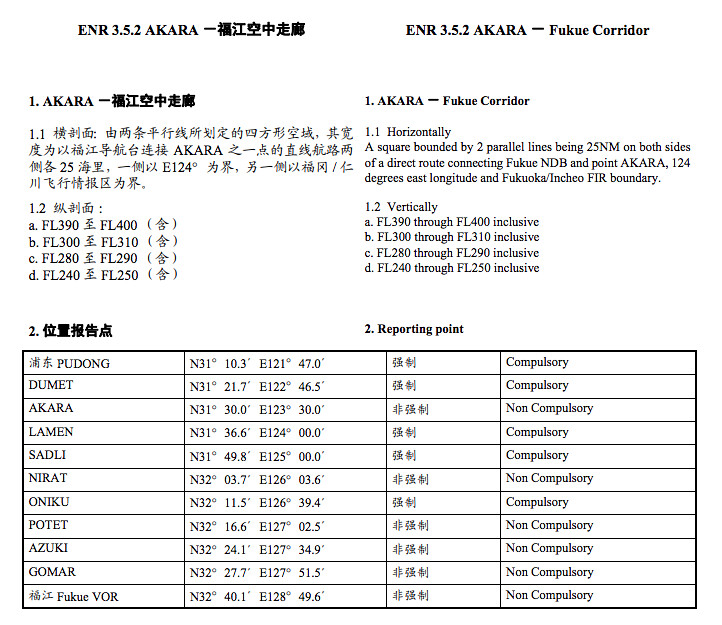
Two years ago, I wrote an article titled Waypoints Named After Cars and Food, introducing some interesting names of navigation points. Among them, I mentioned a segment on the China-Japan route located south of Jeju Island, where the “AKARA Fukue Air Corridor” uses names like Ramen and Leeks for waypoints.
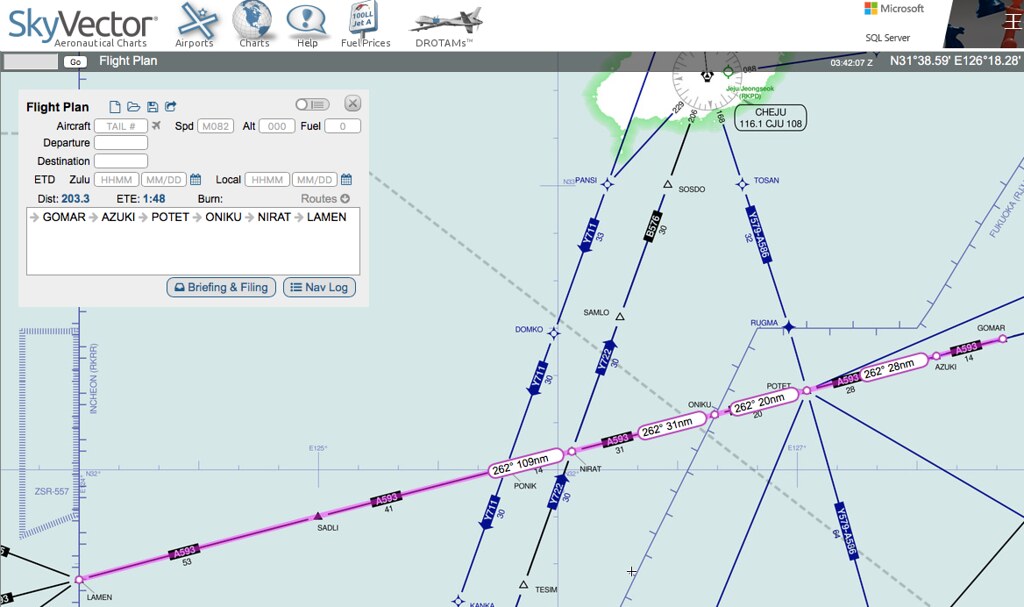 (The green area at the top of the image is Jeju Island)
Recently, I came across this article: China and Japan Controlled Korean Airspace for 35 Years; China Even Collects Transit Fees. It explains that although the AKARA Fukue Air Corridor passes through the Flight Information Regions (FIR) of China, South Korea, and Japan, it is not managed by South Korean air traffic control when flying over it, which makes Koreans quite unhappy.
Even more interesting is that even when South Korean airlines fly over their own territory, they居然 have to pay management fees to China’s air traffic control authorities. For example, Korean Air pays 12 million US dollars a year, which is indeed a very bizarre situation.
Let’s take a closer look at this route.
First, the map near the “Ramen/LAMEN” waypoint.
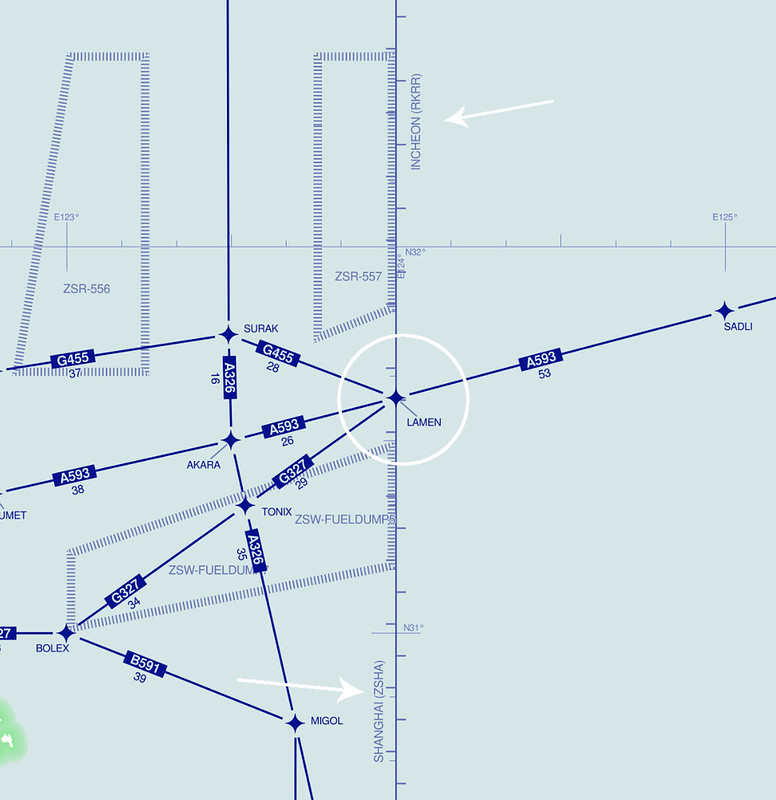 You can see that to the west of LAMEN is China’s Shanghai Flight Information Region ZSHA/SHANGHAI,
and to the east is South Korea’s Incheon Flight Information Region RKRR/INCHEON.
You can see that to the west of LAMEN is China’s Shanghai Flight Information Region ZSHA/SHANGHAI,
and to the east is South Korea’s Incheon Flight Information Region RKRR/INCHEON.
Now let’s look at the map near the “Meat/ONIKU” waypoint.
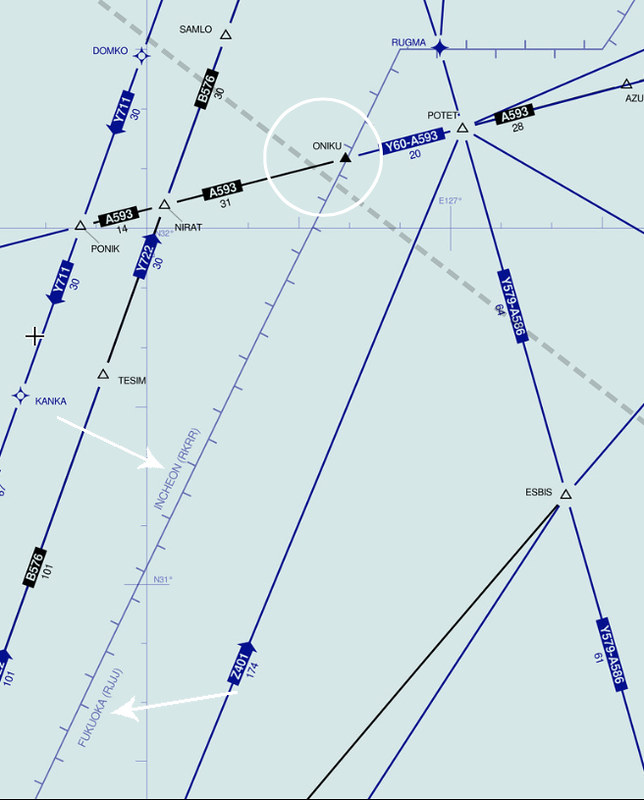 The boundary line is diagonal; to the left is the South Korean Incheon FIR RKRR/INCHEON,
and to the right is the Japanese Fukuoka FIR RJJJ/FUKUOKA.
The boundary line is diagonal; to the left is the South Korean Incheon FIR RKRR/INCHEON,
and to the right is the Japanese Fukuoka FIR RJJJ/FUKUOKA.
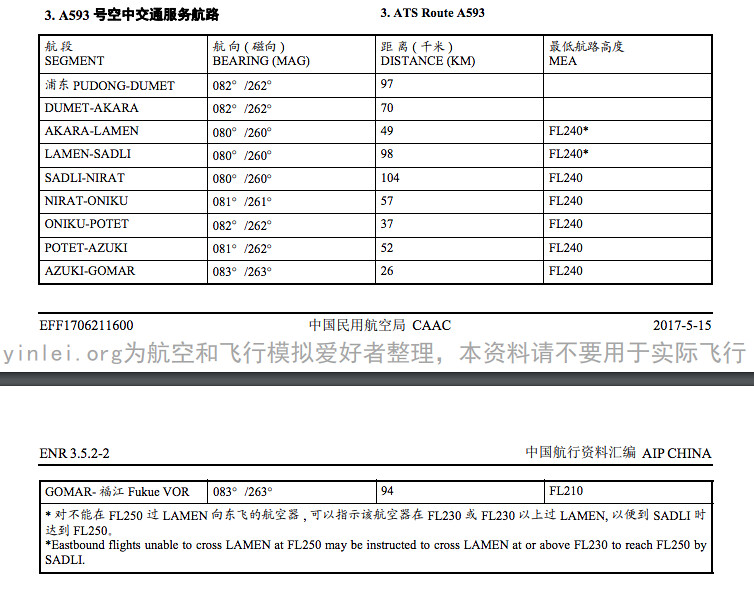
But why does the 257-kilometer route between LAMEN and ONIKU belong to the South Korean Incheon FIR’s airspace, yet is directly managed by China and Japan? It turns out there is a historical reason for this.
In 1983, the AKARA Fukue Air Corridor was opened between China and Japan, mainly used for routes from various Japanese airports to Shanghai. At that time, China and South Korea had not established diplomatic relations (They were referred to as South Korea, the capital was not called Seoul but Hanseong, and the two countries were still in a hostile relationship, right?). The two countries could not establish a communication system, so they could not complete the handover of air traffic control. Finally, through arbitration by the International Civil Aviation Organization (ICAO), it was decided that this route would be directly managed by China and Japan.
In addition, the Incheon FIR was established in 1963, while the People’s Republic of China joined ICAO in 1975. At that time, there were discussions about transferring part of the South Korean FIR to the management of the China Shanghai FIR, but South Korea was unwilling to reduce the size of its own flight information region, so the status quo was maintained. When the AKARA Fukue Air Corridor was established, South Korea weighed the control rights and airspace, and probably chose to give up air traffic control rights.
Therefore, the current situation is that the airspace within 99 kilometers west of Incheon is managed by the Chinese side. Airlines passing through here need to pay navigation and control fees to the Chinese management section. This leads to the situation mentioned above where Korean Air planes flying on Southeast Asian routes still have to pay China when passing through this segment.
From an aviation safety perspective, on such a short route, if encountering bad weather and needing to change the route or flight level, which air traffic control should one request from? After all, the route distance is so short; at high-speed cruise, it’s just over ten minutes of flight. Maneuvering to avoid dangerous weather on one hand, while negotiating with air traffic control departments of three countries on the other, this is definitely not a safe scenario.
Aviation operations certainly prioritize safety first, so ultimately, let’s just let the Koreans endure it a bit. This way, we passengers can feel a bit more at ease, right?
Update: Supplementing with China’s Aeronautical Information Publication (AIP)