Close-up Shot of Boeing 787 Air Conditioning Intake
On that day, during the ANA and JAL Maintenance Factory Tour, I was able to observe many details of the 787 airframe up close, such as the intake of the cabin air conditioning system.
In the past, when shooting from the observation deck at the airport terminal,
it was difficult to see clearly due to the angle,
but this time I was finally able to take satisfactory photos.
 Top: Heat exchanger inlet
Bottom: Deflector door and cabin air compressor inlet
Top: Heat exchanger inlet
Bottom: Deflector door and cabin air compressor inlet
In previous aircraft, the air conditioning systems bled air from the engines or APU, and supplied the cabin with cooled air after passing through a heat exchanger and turbine compressor to cool the high-temperature and high-pressure compressed air coming from the engines.
Compared to traditional aircraft, the 787 uses electrical control to a greater extent, specifically the so-called “787 no-bleed systems architecture”, achieving the effect of fuel saving.
Referring to Boeing’s data, we can see:
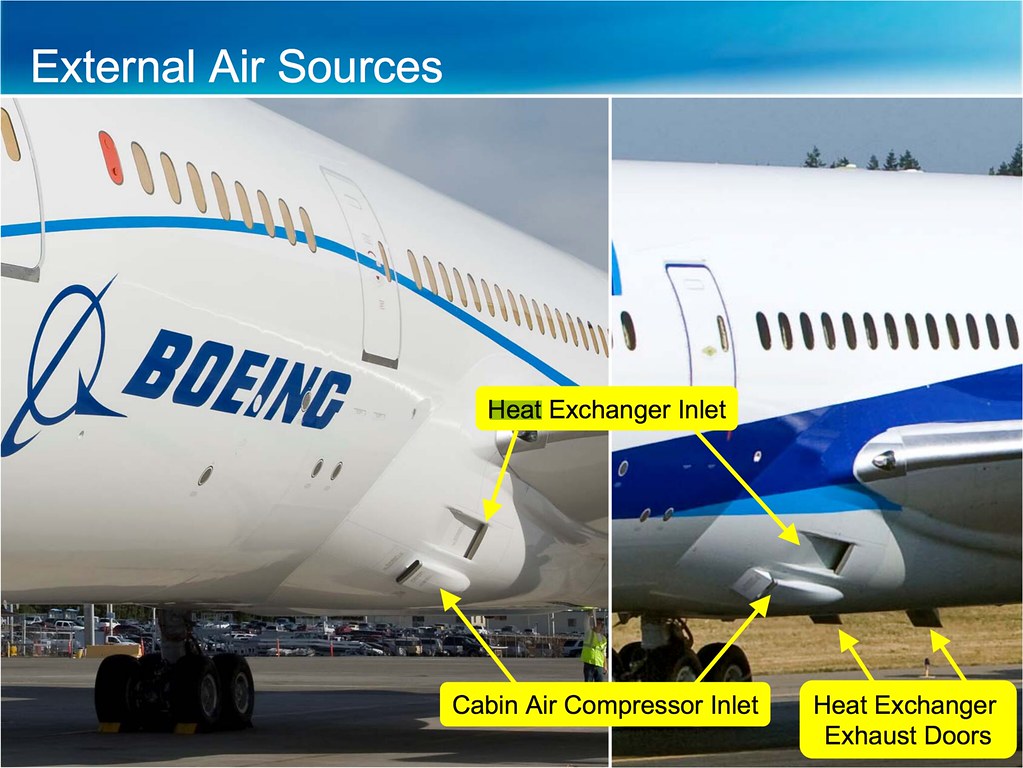
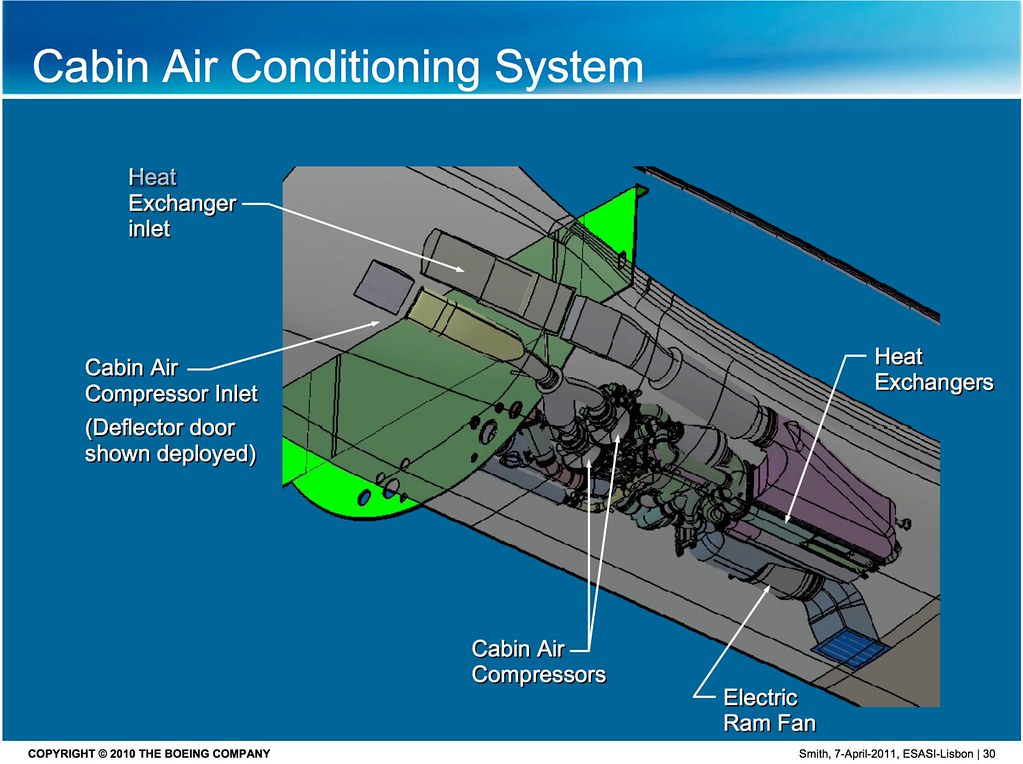 Regarding the air conditioning system, the 787 does not bleed air from the engines or APU, but rather:
- Utilizes the heat exchanger inlet at the wing root,
- As well as the deflector door and cabin air compressor inlet at the wing root,
- Uses cabin air compressors to directly draw in air from outside,
- And passes it through the rear heat exchanger and electric ram air fan,
- To deliver air with suitable temperature/humidity/pressure into the cabin.
Finally, here is a photo taken from directly in front, shot from the roof of the Tokyo International Airport International Terminal.

End