Title: Inside the Cockpit 2.5 Operations During Ground Taxiing
Below is an introduction to some operations involved in taxiing on the ground, covering aircraft turning and flight control surface checks.
When turning on the ground, the rudder pedals and the tiller must be used simultaneously. The control devices regulate the nose wheel steering via a hydraulic system. Some large aircraft, such as the Boeing 747/777 and Airbus 380, also have steering devices on their rear wheels.
In the pre-flight procedures section, it was mentioned that the rudder pedals are used to control the rudder on the vertical tail to make the aircraft turn in the air. In fact, they can also control the nose wheel, so pressing the rudder pedals on the ground allows the aircraft to turn. However, rudder pedal control only allows for slow turns at very small angles; essentially, you can only execute very wide turns. In reality, 90-degree turns are frequently required at airports, and relying solely on the rudder pedals is far from sufficient. The tiller must be used.
The tiller is located on the outer side of the control stand and is a black, rotatable handle, as shown below:
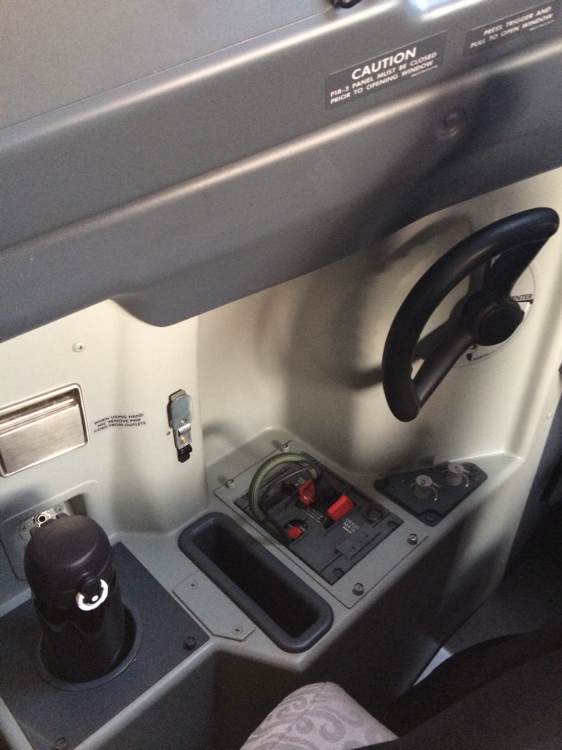 (This is a photo of a Boeing 737-800, provided by Mr. berqiang from Baidu Tieba, sourced from here. The Airbus handwheel looks slightly different, but I do not have a good photo on hand.)
By rotating it, the pilot can execute sharp turns of 60-80 degrees. Therefore, even on narrow airport taxiways, these massive airframes—dozens of meters wide—can flexibly navigate perpendicular intersections with a turning radius of just a few dozen meters. For example, the Boeing 777-300, with a total length of 74 meters, has a turning radius of only 56 meters. Note that when you start using the tiller, you must turn it slowly. After all, if the wheel is turned abruptly in such a massive machine, passengers will feel their bodies swaying left and right like on a roller coaster; if they aren’t wearing their seatbelts tightly, they might even get injured.

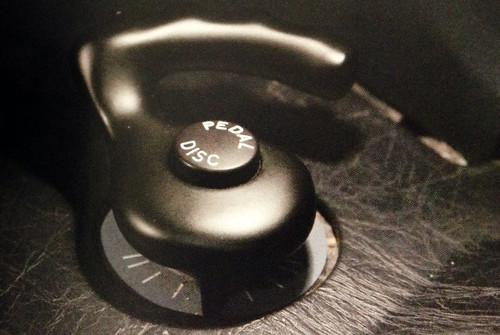
The position and shape of the Airbus tiller are slightly different; it is located on the same plane as the sidestick.
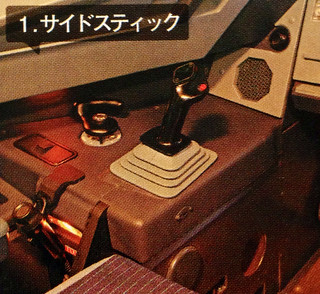 Zooming in, it looks like this:
Additionally, pressing the upper part of the rudder pedals acts as a brake for the nose wheel. Pressing only the left brake affects only the left wheel, and pressing only the right brake affects only the right wheel. Therefore, using a single brake during a turn makes it easier for the aircraft to turn. If the thrust of the outer engine is increased at this time, the turning radius can be further reduced. However, it is said that due to recent high fuel prices, pilots generally no longer use this trick of increasing single engine thrust in order to save fuel.
A yellow center line is painted in the middle of the taxiway, and the pilot must carefully keep the nose wheel on this center line while moving forward. For some large aircraft, the fuselage is so high that pilots find it difficult to see the position of the nose wheel. Therefore, cameras are usually installed on the nose landing gear, allowing pilots to observe a screen in the cockpit to make taxiing safer. At night, green lights are turned on along the center line, while blue lights on both sides of the taxiway indicate the direction to the pilots.
In large aircraft like the 747-400, pilots in the cockpit sit about 10 meters above the ground. This is equivalent to driving and taxiing from the viewing height of a 4th-story window, making it difficult to have a sense of speed like when driving a car. Therefore, pilots mainly regulate thrust by constantly monitoring the ground speed indication on the ND (Navigation Display).
During taxiing, pilots also perform checks of the aircraft’s various control surfaces. They check the action of the ailerons by turning the control yoke (Boeing aircraft) or sidestick (Airbus aircraft) left and right, and check the elevators by pushing and pulling the control yoke or sidestick. Because of the limited viewing angle in the cockpit, pilots cannot see the movement of the control surfaces directly behind them, so they mainly perform checks by observing the indications on the System Display (SD). When checking rudder pedal control of the rudder, since the nose landing gear steering and the rudder are integrated, to prevent the aircraft from weaving left and right on the taxiway, the pilot must hold the tiller firmly. This is because the tiller has a higher control priority than the rudder pedals; when operated simultaneously, the action of the pedals is overridden by the handwheel.

Regarding the various control surfaces, the diagram on this page on CARNOC is quite good. I will borrow it here for the benefit of readers who are not familiar with this knowledge.

Aircraft obtains forward force by expelling jet exhaust backwards, rather than transmitting power directly to the wheels like a car. Therefore, taxiing speed can only be regulated by controlling engine thrust and brakes. At some airports, the ground is not flat, so increasing engine thrust is necessary to maintain speed on an uphill taxiway, while idling and braking are needed to reduce speed on a downhill slope.
Generally, on sunny, dry runways, the aircraft’s taxiing speed is 25 knots, or just under 50 km/h. When encountering rain or snow and the runway is slippery, speed needs to be reduced, and extra attention must be paid to slowing down during turns.
Also, note that when you need to apply brakes to control speed, you cannot ride the brakes continuously. Doing so causes the temperature inside the brake disks to rise continuously, and braking effectiveness will get worse and worse. Therefore, once the speed has dropped, you must release the brakes.
When many aircraft are lined up on the taxiway, pilots will be careful not to get too close to the aircraft in front. If the wind is blowing from the front, it will suck the exhaust from the aircraft ahead into the cabin. This tainted air will cause discomfort to the passengers’ breathing.
During taxiing, the ground controller will also issue instructions, asking the pilot to contact the tower frequency, such as: “Air System 115, contact tower 118.1” This means “Air System 115, contact tower 118.1” The First Officer then repeats: “Air System 115, 118.1” And switches the radio frequency to 118.1 MHz.
In the cabin, the flight attendants have also finished the safety briefing, requiring passengers to stow their tray tables, fasten their seatbelts, and return their seat backs to the upright position, completing all safety preparations before takeoff.
While taxiing on the ground, the Captain uses the left hand to control the tiller, the right hand to control the thrust levers, both feet to control the rudder pedals, the eyes to constantly scan various instruments and occasionally observe traffic outside the window, and the ears to constantly listen for air traffic control instructions. At the same time, they complete the taxiing and before takeoff checklists (using the Boeing 737-500 as an example, the portion above the dotted line is completed at this stage),
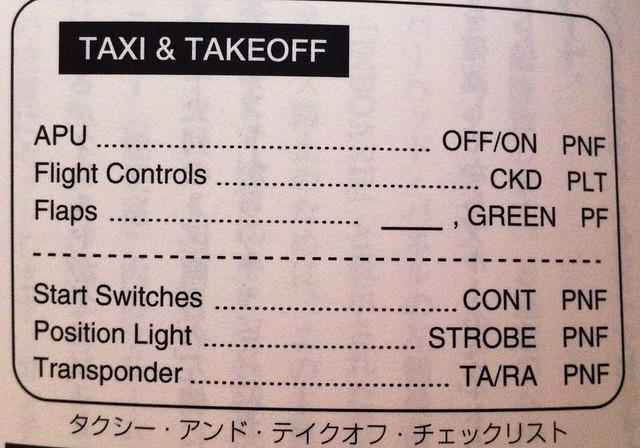 safely moving the aircraft forward until it gradually reaches the takeoff Runway.
Prev: Ground Taxiing Routes TOC: Table of Contents Next: About Flaps
End