A Flight Sim Enthusiast's Notebook
-
First 787-9 Deliveries: Air New Zealand and ANA
The first 787-9 (registration ZK-NZE) has been delivered to Air New Zealand and arrived in Auckland on July 10. On July 25, it flew to Sydney for the first time, presumably for commercial flight training.
Its initial commercial operations will begin on August 9, and from November it will be deployed on Japanese routes. According to the official website, by the end of 2014 the 787-9 will be put into service on three routes: Perth in Australia, Shanghai in China, and Tokyo in Japan.@FlyAirNZ @Boeing #787-9 #Dreamliner first time arrival at @SydneyAirport #avgeeks #aviation pic.twitter.com/jmJ2NjRMcP
— Jaryd Stock (@stock_jaryd) July 25, 2014The second 787-9 will be delivered to ANA; this aircraft, registration JA830A, is expected to arrive in Japan on July 29. I really want to go see it if I have time.
-
Japan's Airport Management Challenges and the Lease Plans for Kansai and Itami Airport Operations
Here are two news items. The first is from Nikkei, reporting on the fiscal year 2012 financial results for 27 airports managed by the Japanese government.
24 airports, or 90% of the total, posted an operating loss, increasing by one compared to the previous year. The total deficit was 39 billion yen (approximately 390 million USD), an 8% reduction from the previous year. While revenue from landing fees increased due to the growth of LCCs (Low-Cost Carriers), costs rose by 9% due to factors such as restoration work at Sendai Airport following the 2011 Great East Japan Earthquake.
-
Encounter with a V-22 Osprey in Downtown Kyoto
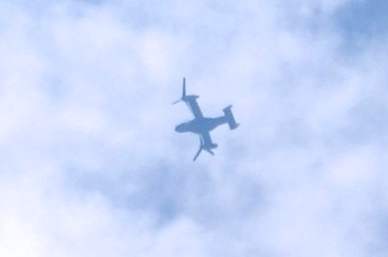
A few days ago, while wandering around a temple in downtown Kyoto, I suddenly heard the sound of unfamiliar aircraft engines. Looking up, I saw the famous V-22 Osprey directly overhead! By eye, the altitude was under 20,000 feet. I immediately grabbed my camera and snapped a quick shot; I didn’t even have time to switch to a telephoto lens. While the photo quality isn’t great, it’s still very easy to distinguish its unique configuration—the large, vectorable rotary propulsion systems on both wingtips.
-
Air Algérie Flight AH5017 Disappears from Radar and Crashes
What is going on with the aviation industry this year? Major air disaster incidents keep occurring, and it is truly distressing to summarize them all…
On July 24, 2014, Air Algérie Flight AH5017 lost contact 50 minutes after Takeoff. The flight departed from Ouagadougou Airport (OUA/DFFD), Burkina Faso, with a Destination of Algiers-Houari Boumediene Airport (ALG/DAAG), Algeria. The flight was operated by Spanish airline Swift Air, using a McDonnell Douglas MD-83 aircraft.
-
World's Youngest Pilot Attempting Round-the-World Flight Crashes Plane
This year has been truly full of bad luck for the aviation world… Last week, I heard about the 17-year-old American teen attempting to fly around the world. Sadly, the news turned out to be tragic, and it is deeply regrettable.

Haris Suleman, a 17-year-old attempting to become the youngest person to fly around the world, died after his plane crashed, killing his father, Babar Suleman, during the trip. Reports state that the Suleman team departed from Indianapolis, USA, with stops in Greenland, Egypt, Pakistan, Sri Lanka, and American Samoa. The aircraft departed from Pago Pago, the capital of American Samoa, on the night of the 22nd, with Honolulu, Hawaii as the Destination. Shortly after Takeoff, it crashed in the Pacific Ocean due to unknown weather conditions. It is reported that wind gusts reached 40 miles per hour at the time. The National Transportation Safety Board (NTSB) recovered Haris’s body at the crash site; a search for his father’s body is currently ongoing in the ocean.
-
TransAsia Airways Flight GE222 ATR72 Forced Landing Failure (Updated 2014/12/27)
Today, TransAsia Airways Flight GE222 (departing daily at 16:00 from Kaohsiung KHH/RCKH, arriving at Magong MZG/RCQC at 16:35) was involved in a major accident. According to reports, there were 54 passengers and 4 crew members on board, resulting in 47 fatalities and 11 injuries.
According to various media sources, due to the impact of a typhoon today, the flight was delayed until 17:43 before takeoff. Due to weather conditions, the aircraft was unable to land and circled in the air. Until 19:06, when Magong Airport received a request for a go-around from the aircraft, but subsequently lost contact, and it disappeared from radar.
-
Private Pilot License Practical Test Standards PPL
The “Private Pilot License Practical Test Standard DOC NO. FS-PTS-001R1” issued by the Flight Standards Department of the Civil Aviation Administration of China. Those who want to learn to fly can refer to it. The link is here.
-
Two Aviation Photos
On a business trip in Osaka, I don’t have time to write a long post, so let me share two interesting aviation news photos with everyone.
The first one is the Boeing 787-9 from the Farnborough Airshow. Taken from directly behind the tail, it surprisingly looks like a cute bear face. Source: ainonline.com.

The second one involves the A340 aircraft carrying British diving prodigy Tom Daley from Shanghai to London, which made an emergency landing in Russia due to technical reasons. He posted a photo on Instagram showing fuel being dumped before the landing. Source: news.sky.com.
-
World's Largest Airliner A380's World's Shortest Route
The Airbus A380 is the world’s largest civil passenger aircraft. It feels like this giant of the skies only flies long-haul routes, but that is just a feeling; in fact, it can fly short-haul routes as well.
And here is proof: Emirates recently announced a new shortest route, with a total flight time of only 1 hour and 45 minutes. This route covers flight EK857 from Dubai to Kuwait and flight EK858 from Kuwait to Dubai. Starting July 28, the aircraft operating this route will change from a Boeing 777-300 to an A380, featuring 14 First Class seats, 76 Business Class seats, and 399 Economy Class seats.
-
Airline of the Year 2014年度全球最佳航空公司奖
Skytrax has announced the winners of the 2014 Airline of the Year Awards. Let's take a look at the top 20 rankings.
Airline 2014 Rank 2013 Rank Cathay Pacific 1 6 Qatar Airways 2 2 Singapore Airlines 3 3 Emirates 4 1 Turkish Airlines 5 9 ANA All Nippon Airways 6 4 Garuda Indonesia 7 9 Asiana Airlines 8 5 Etihad Airways 9 7 Lufthansa 10 11 Qantas Airways 11 10 EVA Air 12 12 Swiss 13 16 Thai Airways 14 15 Virgin Australia 15 13 Air New Zealand 16 18 British Airways 17 27 Malaysia Airlines 18 14 Hainan Airlines 19 19 Bangkok Airways 20 31 Congratulations to Cathay Pacific, headquartered in Hong Kong, for taking the top spot—that's impressive! I haven't flown with Cathay much myself, so my impression isn't very deep. I did write a flight review on Flight CX543 from Haneda to Hong Kong back in the day; looking back at it, I realized I didn't mention much about the service. I guess my attention was focused entirely on the route and taking photos, which is a real pity.
-
Malaysia Airlines Flight 17 Crash Incident
I woke up early this morning, shocked by the news that Malaysia Airlines Flight MH17 (KLM codeshare flight KL4103) had been shot down. With various claims of uncertain veracity, I will refrain from commenting for now. I can only express my condolences and sympathy for the deceased and their families, and examine the facts.
- Malaysia Airlines Statement
- KLM Royal Dutch Airlines Statement
Flight MH17 was a Malaysia Airlines international flight operating once daily. It departed Amsterdam, Netherlands at 12:00 noon local time and arrived at Kuala Lumpur, Malaysia at 5:50 am local time, with a flight duration of 11 hours and 50 minutes. The flight utilized a Boeing 777-200ER aircraft. The registration number of the crashed aircraft was 9M-MRD, and the model was 777-2H6ER, having entered service in July 1997. On July 17, 2014, while flying at approximately 10,000 meters over eastern Ukraine, the aircraft was shot down by a missile. All 283 passengers and 15 crew members aboard perished.
-
787-8 VS 787-9
Watching the video of the 787-9 released at the Farnborough Airshow, it is incredibly cool. It is powerful, climbing almost vertically like a fighter jet, yet sometimes light and agile like a small general aviation aircraft.
So, what are the specific differences between the 787-8 and 787-9? I checked Boeing's official website and excerpted the information below.
Item 787-8 787-9 787-10 Passengers 242 280 323 Range 7850nm 14500km 8300nm 15372km 7020nm 13000km Fuselage Width 5.74m 5.74m 5.74m Wingspan 60m 60m 60m Length 57m 63m 68m Height 17m 17m 17m Cruise Speed Mach 0.85 Mach 0.85 Mach 0.85 Cargo Volume 4000 cubic feet 5400 cubic feet 153 cubic meters 6187 cubic feet 175 cubic meters Max Takeoff Weight 227 tonnes 252 tonnes 252 tonnes EIS 2011 2014 2018 As you can see, the biggest difference between these models is the fuselage length, which results in different passenger capacities. The 787-9 has 16% more capacity than the 787-8, and the 787-10 has 15% more than the 787-9. However, the weight of the 787-10 is about the same as the 787-9, but its range is significantly reduced, indicating that the fuel tanks are much smaller.
-
Proceedings of the 2014 China Civil Aviation Flight Technology Seminar
I found many excellent learning materials on the website of the China Civil PBN Flight Procedure Design Center. For example, the materials in the “2014 China Civil Aviation Navigation New Technology Seminar” are fantastic. They provide a great understanding of technologies such as Performance-based Navigation (PBN), Automatic Dependent Surveillance-Broadcast (ADS-B), Electronic Flight Bag (EFB), and Head-Up Display (HUD), as well as their domestic implementation trends.
Attachment 1: China Civil Aviation Navigation New Technology Application and Reflections Attachment 2: RNP AR Procedure Design and Application Attachment 3: RNP AR Deployment and Surface Management – An International Perspective Attachment 4: RNP-AR Case Study Attachment 5: RNP-AR Engine Failure Study Attachment 6: Electronic Flight Bag Attachment 7: 4D Configuration Management Attachment 8: Global Aviation Development Status and Latest ICAO Safety and Air Navigation Initiatives and Introduction to PBN Implementation in the Asia-Pacific Region Attachment 9: Navigation Database Coding and Validation Attachment 10: China Civil Aviation ADS-B Planning and Construction Attachment 11: ADS-B Technical Principles and Applications Attachment 12: Application of ADS-B in Airline Dynamic Monitoring Attachment 13: Application of ADS-B in Airlines Attachment 14: Introduction to PBN New Technology Promotion in the Northwest Region Attachment 15: RAIM Availability Prediction Attachment 16: Operation and Development of the BeiDou Satellite Navigation System Attachment 17: Ground-Air Broadband Communication Assisting Civil Aviation Big Data
-
Saitek Cockpit - The Ultimate Flight Simulation Hardware
Saitek has finally launched a heavyweight product in flight simulation equipment, a complete cockpit hardware solution.
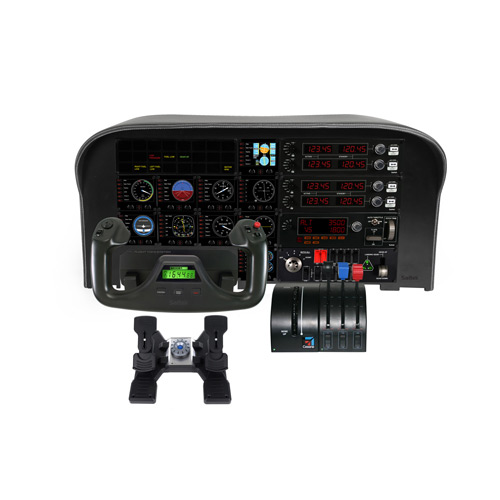
This product includes:
10 instrument panel units, each featuring a 3.5-inch LCD screen that can display the following data in real-time: Airspeed Indicator Attitude Indicator Altimeter Turn/Slip Indicator Horizontal Situation Indicator Vertical Speed Indicator PFD: Primary Flight Display VOR 1 VOR 2 Engine Gauges
1 Civil Aviation Flight Yoke (Saitek Pro Flight Yoke)

 1 Throttle Quadrant (Saitek Three Lever Pro Throttle Quadrant)
1 Rudder Pedals (Saitek Pro Flight Rudder Pedal)
1 Trim Wheel (Saitek Pro Flight Cessna Trim Wheel)
2 Radio Panels (Saitek Pro Flight Radio Panel)
1 Switch Panel
1 Standalone Throttle Quadrant
1 Autopilot Panel
1 Throttle Quadrant (Saitek Three Lever Pro Throttle Quadrant)
1 Rudder Pedals (Saitek Pro Flight Rudder Pedal)
1 Trim Wheel (Saitek Pro Flight Cessna Trim Wheel)
2 Radio Panels (Saitek Pro Flight Radio Panel)
1 Switch Panel
1 Standalone Throttle Quadrant
1 Autopilot Panel -
A330neo Aircraft to be Delivered in Q4 2017
The biggest news yesterday was the official launch of the A330neo by Airbus at the Farnborough Airshow in the UK. Although there had been some rumors last week, the official release revealed more details. The aircraft is scheduled for delivery in Q4 2017. The models are designated A330-800neo and A330-900neo. Let’s take a look at the specific announcement details.

New Engines: Rolls-Royce Trent 7000, 112-inch diameter, bypass ratio 10:1 Wingspan: 64 meters (original model was 60.3 meters) Efficiency: 14% reduction in fuel consumption per seat compared to the current model Cash Operating Costs per Seat: On par with the Boeing 787 Range: Increased by 400 nautical miles compared to the current model Wing Design: Features the same blended winglets as the A350 XWB Seating Capacity: A330-800neo has 252 seats (an increase of 6); A330-900neo has 310 seats (an increase of 10) In-flight Entertainment: 4th-generation high-definition in-flight entertainment (IFE) Lighting: Uses full LED mood lighting throughout, just like the A350 XWB Cabin Intercommunication Data System (CIDS): New panel controls lighting, temperature, water pressure (what is this?), and public address systems Galley Equipment: Includes espresso machines, chillers, and microwave ovens with baking capabilities Crew Rest Area: Movable, isolated single compartments Airframe Maintenance Costs: Only 95% of the current model’s costs
-
Unique JAL Aviation Tourism Project - JAL Island Hopping
Generally, travel is aimed at sightseeing destinations, be it cultural landscapes or natural scenery; the aircraft is merely a mode of transport. However, in Japan, there is a special travel project where the sole purpose is simply flying. It offers a two-day itinerary for aviation enthusiasts, making it quite unique.
This travel project is launched by Japan Airlines (JAL) and is called “Island Hopping in the Satsunan Islands by Small Propeller Aircraft 2 Days”. The specific content involves taking a small propeller plane from Tokyo or Osaka, and then constantly flying back and forth between the various small islands in the Satsunan Islands.
-
X-Plane 10.30 Beta 6, Very Unstable
I noticed that Beta 6 for version 10.30 was just released. It claims significant performance improvements, and a new GPS navigator is built into the C172, King Air, and Baron. Plus, hundreds of new airports were added. So, I decided to upgrade and give it a try.
By the way, the official blog mentions that the updater has a bug and requires manually copying the executable file, but I didn’t encounter any issues myself.
-
Follow-up Report on the Asiana Airlines Flight OZ214 Crash
The crash of Asiana Airlines Flight 214 (OZ214/AAR214) was an aviation accident that occurred on July 6, 2013. The Asiana Airlines Boeing 777-200ER, operating as Flight 214, departed from Incheon International Airport, South Korea, and crashed while landing at its scheduled destination, San Francisco International Airport in the United States. There were 291 passengers and 16 crew members on board, resulting in 3 fatalities and 181 injuries.
On June 24, 2014, nearly a year after the accident, the National Transportation Safety Board (NTSB) released a detailed report. This PDF file is 207 pages long and contains extensive analysis of the accident, including specific introductions to the 777’s flight instruments. If you are interested, please visit the link above. Here are some excerpts of parts I found interesting.
-
Haneda Airport Expansion Plan
The 2020 Olympics will be held in Tokyo, but as an aviation hub, the throughput of Haneda Airport is approaching its limit, making it difficult to accommodate greater traffic volume.
Therefore, the “Capital Region Airport Function Enhancement Technology Study Subcommittee” of the Japanese Ministry of Land, Infrastructure, Transport and Tourism (MLIT) conducted an investigation and research, publishing improvement proposals last week. These include changing existing Arrival and Departure procedures to increase the number of takeoffs and landings per hour, and there are plans to add a fifth Runway after the Olympics. Let’s introduce a part of the materials below.
-
METAR Format Specifications
Write a simple memo.
Found the METAR format specification by chance on the website of the World Meteorological Organization (WMO). The original document is here; refer to the section on FM 15 METAR. It’s quite dry, so I probably won’t read it from start to finish. Just use it as a manual for looking up unfamiliar codes when you encounter them in the future.