A Flight Sim Enthusiast's Notebook
-
Photos of the Week
1 The Bardarbunga volcano in Iceland erupted again. The Icelandair pilot specifically made an extra circle to let passengers enjoy this rare natural phenomenon.
Our pilot made an extra circle around #Bardarbunga this morning to let passengers check it out. Thanks to Erla Vinsý! pic.twitter.com/7JUerxD0tE
— Icelandair (@Icelandair) September 3, 20142 I have been to Senri River at the end of the Runway at Osaka Itami Airport many times to take photos, but I just can’t capture the same effect as this. Truly amazing.
-
Recommending In-Flight Video Again, Full 64-Minute Flight
Found another video documenting the full flight process of ANA Flight 34 from Osaka Itami Airport to Tokyo Haneda Airport. It’s 64 minutes in total, starting from the pushback. Watch the aircraft extend its Flaps, then taxi east to Runway 32, take off, rotate, and more—it is thoroughly enjoyable. (I guess normal people don’t watch this carefully though…)
There are a few other highlights: During taxiing, the crew announcement specifically mentioned that electronic devices in Flight Mode are allowed. This is a new change effective from September; The cabin was very quiet, no one was speaking loudly, and the order was excellent; Also, around the 51-minute mark, the airplane Circling and Descending under the setting sun, the Spoiler rising, the Aileron movements, the colorful clouds, and then diving into the clouds—flying through the clouds is a beautiful segment; The Landing segment on Haneda’s Runway 34L is also very good. Watching the movements of the various control surfaces is very helpful for understanding aircraft control.
-
Senior Featured in Magazine! China Eastern's Liu Zhimin: The Five-Star Captain with Grit
My senior at university, Lengwa Yige, made it to the magazine cover! Sharing this with everyone!
This article from the July 2014 issue of Global Flight Magazine —— “China Eastern Liu Zhimin: A Five-Star Captain with ‘Stubborn’ Energy” has been published in full on Carnoc, so friends who haven’t bought the magazine yet can read it first.

This photo is just too cool.
-
Aero Museum Scavenging Near Narita Airport
Near Narita Airport, there is an Aviation Science Museum that is generally not well known. I hadn’t had a chance to visit until now, but I was interested in their “Aero Junk Market” (basically a flea market for retired aviation parts), so I took a weekend trip to check it out.
The museum is located on high ground just outside the 34L Runway at Narita Airport, offering a panoramic view of the airport interior and the runway itself.
 It takes only 15 minutes by bus from the airport. The bus stops at Bus Stop 30 at Terminal 1 and Bus Stop 5 on the 3rd floor of Terminal 2, with a fare of 250 yen. However, since the bus service is infrequent, you must check the schedule in advance if you plan to go.

-
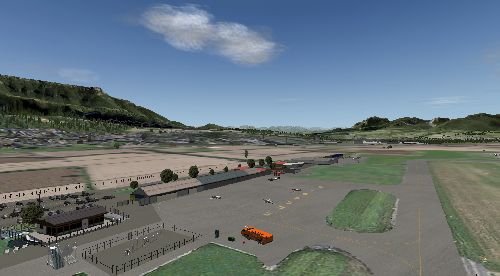
Free Scenery Addon Savoie Airport, Lac de Bourget, France
Chambéry - Savoie Airport (Lac du Bourget) / Aix-les-Bains Airport (ICAO code: LFLB / IATA code: CMF)
LFLB is a small airport located near Lac du Bourget, one of the three most beautiful lakes in Europe. XPFR has released a free scenery for it. You are welcome to try installing it and enjoy an aerial tour of this beautiful lake.

Please note that this scenery Plugin requires OpenSceneryX. If you are not familiar with it, please refer to the instructions here.



-
Released on gateway.x-plane.com
I heard about this feature a few months ago, and it seems to have just gone live. Here, users can more easily find airport scenery from third-party developers. http://gateway.x-plane.com/
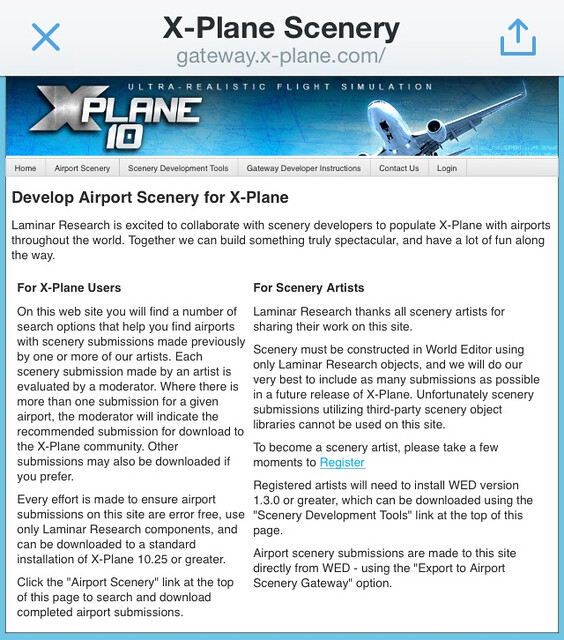
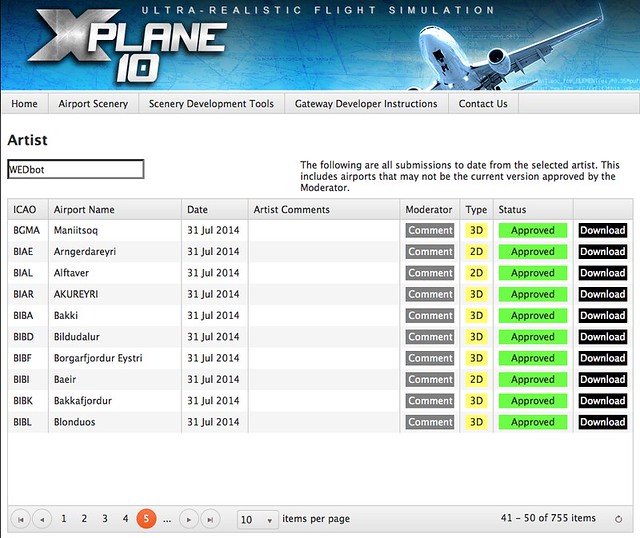
I tried downloading and installing two airports and found the method to be very simple: just copy the downloaded directory directly into the
Custom Sceneryfolder. There is no need to modifyscenery_packs.ini. Below is a screenshot of KAVX airport.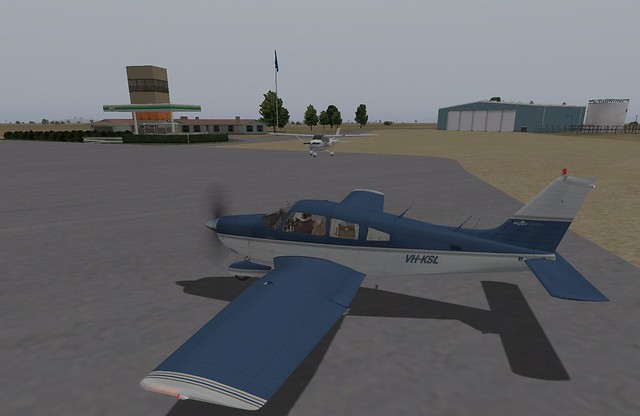
-
Recommended Takeoff and Landing Videos
As previously introduced, starting from yesterday, September 1, 2014, regarding the Ministry of Land, Infrastructure, Transport and Tourism (MLIT) of Japan’s decision to lift the ban on the use of electronic products during takeoff and landing and the follow-up report on Japan lifting the ban on electronic product usage on aircraft, it turned out that the very same evening, a seasoned netizen had already uploaded high-definition footage taken during takeoff and landing. One can’t help but marvel at the immense skill and deep passion of Japanese aviation enthusiasts.
-
Weekly Photo Selection (weekly photos 2014/09/02)
1 A Boeing 737-800 in the sunset glow, please click to see the large image. Note that the highlight of this photo is: the photographer is also the subject being photographed. Look closely and you can see the co-pilot leaning out of the cockpit to take a photo too :-)
2 An Airbus Beluga is opening its cargo door.
RT @Airbus: Open wide! #Beluga pic.twitter.com/QXz2JdaoOv < @F1isP1 @Parnelli98 @MarkRWheeler2
-- Mario. (@mario_eb) August 25, 20143 The magnificent sight of a Dream Lifter taking off. I really want to find time to go back to Nagoya to see this big fat plane again.
-
Free Airport Scenery - Toulouse Blagnac Airport
Toulouse Blagnac Airport is the fourth-largest airport in France, located approximately a 15-minute drive from the city of Toulouse. By 2013, the airport featured 4 terminals, over 100 international and domestic routes, and 6 public parking lots with more than 13,000 parking spaces. A free scenery for this airport has been released on xpfr.org; if you are interested, please visit the <a href=http://www.xpfr.org/?body=scene_accueil&sc=277>official website to download it.

Here are a few more screenshots provided by the official site:
-
Wheel Stand Pro for Saitek Pro Flight Yoke System - Deluxe V2
I recently bought another hardware stand, the Wheel Stand Pro for Saitek Pro Flight Yoke System. It is a custom-made, collapsible stand specifically designed for Saitek, capable of mounting all my existing equipment together:
Saitek Pro Flight Yoke Saitek Throttle Quadrant Saitek Pro Flight Rudder Pedals Saitek Pro Flight Cessna Trim Wheel Saitek Pro Flight Radio Panel
When in use, simply unfold it and place it in front of your computer screen. When not in use, just fold it up (takes no time at all) and store it away.

-
X-Plane 10.30r1 Official Version Finally Released
According to the official blog, the final version r1 of the latest version 10.30 is finally here.
I updated and found the download for this release to be quite fast; it took less than 5 minutes to complete. I tried running it and found that the startup time is much faster than 10.30b8, which is very satisfying. Additionally, I selected a location in Germany and flew for nearly an hour in a C172 without finding any issues. This version is very stable, so everyone can use it with confidence.
-
Five-Star Free Flight Simulation Training Website Aviator90
Today I discovered a flight simulation training website called Aviator90. It provides a vast amount of free training content and is likely one of the best online resources available. Highly recommended!!
Through simple, easy-to-understand animations, this website covers everything from the basics of flight and piloting techniques to flight planning and cross-country flights. I am truly impressed. Of course, the content is currently entirely in English, but I look forward to the release of Chinese and Japanese versions in the future.
-
PBN (Performance Based Navigation)
PBN (Performance Based Navigation)
1 PBN Basic Concepts
Performance Based Navigation (PBN) is a new operational concept proposed by the International Civil Aviation Organization (ICAO) based on the integration of regional navigation (RNAV) and required navigation performance (RNP) operational practices and technical standards from various countries. It combines advanced airborne aircraft equipment with satellite navigation and other advanced technologies, covering all flight phases from en-route, terminal areas, to approach and landing, providing a more precise and safe flight method and a more efficient air traffic management model. At the 36th Session of the Assembly in September 2007, ICAO formally required all Contracting States to fully transition from traditional ground-based navigation flight modes to PBN in a globally consistent and coordinated manner by 2016.
-
Most Popular Free Plugins on x-plane.org in August 2014
The results for this month are available <a href=http://forums.x-plane.org/index.php?showtopic=79289>here, please download them yourself.
Best Aircraft 1 Tupolev Tu 204 Project by #athebooss# <img src=http://forums.x-plane.org/index.php?app=downloads&module=display§ion=screenshot&record=263004&id=23681> 2 Sikorsky S-76C++ by DMO <img src=http://forums.x-plane.org/index.php?app=downloads&module=display§ion=screenshot&record=267199&id=23855>
3 SAAB 2000 Crossair by nOble_Xx <img src=http://forums.x-plane.org/index.php?app=downloads&module=display§ion=screenshot&record=2355&id=1352&full=1>
Best Scenery 1 CYYZ Toronto Pearson Intl (ISDG) by chris k <img src=http://forums.x-plane.org/index.php?app=downloads&module=display§ion=screenshot&record=265886&id=23805> 2 Aerobridge Studios LJPZ by tkpx8 <img src=http://forums.x-plane.org/index.php?app=downloads&module=display§ion=screenshot&record=265955&id=23818> 3 PHOG KAHULUI AIRPORT MAUI HD by frede <img src=http://forums.x-plane.org/index.php?app=downloads&module=display§ion=screenshot&record=260198&id=23596>
-
Aileron Reversal
The following is an excerpt from Baidu:
Due to the elasticity of the wing, the moment generated by the **Aileron** acting on the wing also causes the wing to twist and deform in the direction opposite to the **Aileron** deflection. This changes the wing's Angle of Attack (AOA), thereby generating a moment under the action of aerodynamic forces that opposes the rolling moment produced by the **Aileron**. When the flight speed reaches a certain value, the rolling moment generated by manipulating the **Aileron** and the moment generated by the elastic deformation caused by the aerodynamic forces on the wing cancel each other out, causing the **Aileron** to fail (i.e., the **Aileron** effect is zero), and the aircraft becomes uncontrollable. This flight speed is called the reversal speed. When the flight speed continues to increase and exceeds the reversal speed, the rolling moment generated by manipulating the **Aileron** will be less than the opposing moment generated by the wing deformation under aerodynamic forces. At this time, the **Aileron** effect is negative and plays an opposite role. ---- This situation is referred to as "**Aileron** Reversal".

Methods to solve the **Aileron** reversal problem include first, increasing the torsional stiffness of the wing box. Another method is to move the **Aileron** closer to the wing root, where the wing stiffness is higher. However, during low-speed flight, due to low aerodynamic efficiency, one must still rely on the outer **Aileron**, where the moment arm is long. Therefore, some aircraft are equipped with inner **Aileron**s and outer **Aileron**s. However, because inner **Aileron**s interrupt the **Flaps**, affecting takeoff and landing performance, aircraft with inner **Aileron**s are not common. Modern transport aircraft, in addition to increasing wing torsional stiffness, more frequently use **Spoiler**s to assist **Aileron**s in roll control at high speeds, sharing part of the load of the outer **Aileron**s.
The following is an attempt to summarize the Aileron configurations of common passenger aircraft models.
-
Selected Photos of the Week
1 The A350’s nose is very distinctive, looking like someone wearing a pair of black-rimmed sunglasses.
2 The Milky Way seen from the cockpit. This photo was taken using a multiple exposure technique: one exposure for the cockpit interior, and a long exposure for the starry sky. At the time, the aircraft was flying at an altitude of 36,000 feet with a speed of 846 km/h.

Recent Reading Memo 201408
I haven’t bought many books recently, so I’ll just write a simple note.
1 空中航法入門
 This is a textbook from the Japanese Aviation University, equivalent to the Chinese “Air Navigation”. I seem to have already bought 4 books on this subject, and the content is almost identical in each, with few new points of knowledge. However, the previous ones I bought are quite old, from the 80s and 90s, while this is a revised edition from 2009, fitting the times. After all, GPS is so prevalent now that content like Dead Reckoning has been reduced significantly. Buying such books is almost like collecting now.
''Popular Science Audio on ATC Air Traffic Control Knowledge -- "Elective Course'
Thanks to Wu Yong for presenting new aviation knowledge in the “Elective Course” again. This time, Yan Xiaodong, Chief Engineer of the North China Air Traffic Control Bureau, was invited to introduce air traffic control knowledge. The content of this episode is:
“Directing the Traffic in the Sky”—Air Traffic Controllers: Unseen, but Flying with Us
The website is here, and I highly recommend it.
FIS-B and TIS-B
ADS-B ground stations can transmit information to aircraft, which is specifically divided into two categories: Traffic Information Service Broadcast (TIS-B) and Flight Information Services-Broadcast (FIS-B).
TIS-B: The ADS-B ground station receives ADS-B position reports transmitted by aircraft and transfers this data to the Surveillance Data Processing System (SDPS). Simultaneously, the SDPS also receives data from radar and other surveillance equipment. The SDPS fuses this data into unified target position information and sends it to the TIS-B server. The TIS-B server integrates and filters the information to generate a comprehensive air traffic surveillance picture, which is then sent to the aircraft via the ADS-B ground station. This allows the flight crew to obtain complete and clear air traffic information. The application of TIS-B enables users of different ADS-B data link types to obtain surrounding airspace operational information, thereby achieving indirect mutual visibility.
Buffet Margin
The buffet boundary is the second most important aerodynamic performance parameter in aircraft design, following the Lift-to-Drag ratio (L/D).
Wing buffet is the random excitation response of the wing structure to pressure pulsations caused by airflow separation. When an aircraft flies at low speeds and high angles of attack, buffet occurs once the airflow separation on the lifting surfaces reaches a certain degree. This type is referred to as lift-type buffet.