A Flight Sim Enthusiast's Notebook
-
A More Realistic Flight Sim Mount Volair Sim™ Cockpit
I stumbled upon the Volair Sim™ Cockpit, which is a fantastic piece of equipment. It not only secures three monitors and various Saitek devices but also includes a seat and a stand for your PC. It can truly be described as a complete solution. Let’s just look at the pictures: <img src=http://cache.nebula.phx3.secureserver.net/obj/RjM5QTY4MEY1OTk2MUE3QzY3NkE6N2IxZDRkZTRiMzNlOGNkODBjYmMyN2JhYjBhZGJkNWU=>
I watched the instructional video on YouTube,
and if you have enough space at home, this really is an ideal product.
The price of this product isn’t too high either—at $579. Quite a reasonable setting, wouldn’t you say? You can take a look at this feature comparison table:

-
Vulnerable Ground Crew
This morning, I saw another piece of news on Sina Weibo about ground maintenance personnel suffering eye injuries due to strong lights from an aircraft. It reminded me of similar incidents I had previously seen in the Aviation Safety Reporting System (ASRS), and I truly hope such misfortunes can be eliminated.
According to the record on Weibo, on September 8th at Changchun Airport, the nose gear steering light of an A320 was not turned off, and then the takeoff taxi light was suddenly turned on, causing retinal injuries to the maintenance personnel directing the parking position, who required hospitalization; The Weibo post also disclosed that on May 5th at Hongqiao Airport, an aircraft kept its taxi lights on the entire time. The strong light not only interfered with the ground guidance by maintenance personnel but also posed a significant hazard to human vision, yet it seems the captain in command lacked appropriate awareness of this issue.
-
Japan Airlines JAL123 Flight Crash -- Recent Reading Memo 20141024
I recently read this documentary literature – 墜落の夏 日航123便事故全記録,
 which records every aspect of the Japan Airlines (JAL) Flight 123 disaster in great detail, leaving me with many deep thoughts.
Regarding this air disaster, the explanation on Wikipedia introduces the process and cause of the accident very comprehensively. Here is a summary of the outline— The Japan Airlines Flight 123 disaster was an air crash caused by the detachment of the tail due to improper maintenance on a Japan Airlines flight from Tokyo Haneda Airport to Osaka Itami Airport. On the evening of August 12, 1985, at 18:56 Tokyo time, JAL’s Boeing 747SR-46, carrying 509 passengers and 15 crew members, crashed into the ridge of Mount Takamagahara near Ueno Village, Tano District, Gunma Prefecture in the Kanto region (about 100 km from Tokyo). Despite severe delays in the local rescue operation, four women miraculously survived 17 hours after the crash, including an off-duty flight attendant, a mother and daughter, and a 12-year-old girl. The remaining 520 people (including 21 non-Japanese passengers) all perished, including the famous singer Kyu Sakamoto and a pregnant woman. Because the crashed Boeing 747SR was a short-range, high-capacity model dedicated to Japanese domestic routes, and adopted a very high proportion of Economy class seating configuration, the number of passengers was far higher than general aircraft of the same class, making this air disaster the deadliest one involving only a single aircraft in the world.
-
Back to Chofu Airport Open Day
The Chofu Airport Open Day is usually held every year, but it was cancelled last year due to the natural disaster on Oshima Island. After waiting for two long years, the day finally arrived. My previous blog post is here: Tokyo Chofu Airport (Chofu Hikojo, Chofu Airport) Shooting Notes.
In the morning, I took the Keio Line from Shinjuku to Chofu Station, and then a 10-minute bus ride took me to the airport. This year’s schedule was the same as previous years: a lottery for Cessna flights, local snacks, visiting the Apron, various aviation supplies for sale, used aircraft parts, dance performances, aviation knowledge lectures, etc. This time, I specifically asked a professional about the ATC rules in this area. It turns out that this airport is just an info station, and FSC still needs to contact Haneda. To avoid the US military base, everyone flying south heads towards Yokohama.
-
Carenado PA28 181 Archer II X-Plane V3
I received an email from Carenado stating that the following 5 aircraft have been updated for X-Plane 10.30, upgraded to version 3.
- Carenado M20J 201 X-Plane
- Carenado PA32R 301 Saratoga SP X-Plane
- Carenado C152 II X-Plane
- Carenado PA28 181 Archer II X-Plane
- Carenado C172N Skyhawk II X-Plane
According to the release information, the version 3 aircraft are only compatible with X-Plane 10.30. They support the new GNS430 or GNS530 navigation equipment and have added Mouse Scroll support.
-
Haneda Airport Runway C Extended by 360 Meters
The Japan Civil Aviation Bureau (MLIT) announced that starting from December 11, 2014, Runway C (RWY 34R/16L) at Haneda Airport would be extended by 360 meters. Consequently, the takeoff position is situated further south than before, bringing the total Runway length to 3,360 meters.
 The benefit of the longer Runway is the ability to utilize a higher takeoff weight. In particular, international flights can carry increased fuel, passenger, and cargo loads. Additionally, taking off from a position further out over the sea helps reduce noise pollution on land.
 -
Touring Japan in 2 Days: A Showdown of 6 Airlines
I previously introduced a unique travel project: The Unique JAL Air Travel Sightseeing Project - JAL Island Hopping which provided aviation enthusiasts with a full two days of pure flying, hopping between various islands.
Today, I discovered another similar project organized by ANA, called "~Domestic 6-Airlines Comparison, 2-Day Trip Around Japan~ A Special Project Utilizing ANA + All Codeshare Partner Airlines" It is also very interesting, so let me introduce it to you.
-
Five Schools of Aviation Photography
An article in the Airliner magazine I have on hand categorizes common aviation photos into five major types. I found it quite interesting, so let me give you a brief introduction.
School 1: The Contextual School Photos in this category integrate the aircraft with the surrounding environment to form a distinct theme. As a result, the photos tend to be narrative and emotional, effectively expressing the photographer’s mood and intent. For instance, utilizing natural landscapes like grasslands, forests, lakes, and mountains—whether it’s sunny, foggy, windy, rainy, or snowy—placing the aircraft within a vast environment easily creates a strong sense of imagery. The following photo is quite representative:
-
Photos of the Week (Weekly Photos 2014/10/09)
1 After Typhoon No. 18, a twilight scene at Haneda Airport. With Mount Fuji in the background, the silhouette of a B747 is truly beautiful.
本日の羽田。 定刻14:05のLH717は今日は台風の影響で135分遅れで16:40に出発。 オレンジ色に染まる地平線に浮かび上がる富士山とジャンボジェットの特徴的なシルエット。 最高のコラボレーションであります。 pic.twitter.com/xYUSeNp2XD
— そらてつ (@sorate_2) October 6, 20142 Applying deicing fluid to a B787 at Oslo. The Dreamliner’s nose is truly cute.
PHOTO @Fly_Norwegian #B787 at Oslo. The amount of deicing fluid is incredible! (C) Javier de la Cruz pic.twitter.com/NwI5SpMUDQ via @VatsimPilot
— AirLive.net (@airlivenet) October 4, 20143 Look at the smiling A380, forget the fatigue of work.
-
The Perfect Landing / What Does a Genius Pilot Look Like? -- Recent Reading Notes 201410
Found another great book at a second-hand bookstore: 機長の一万日 コックピットの恐さと快感!
 It is an autobiographical aviation popular science book written by JAL’s senior captain “Mikio Taguchi”.
Captain Taguchi has carried out numerous flight missions for government dignitaries, such as the Southeast Asian visit of the Emperor and Empress, the European visit of Prime Minister Kaifu, and the European visit of the Crown Prince. It is evident that he is an exceptionally excellent pilot. In this book, he introduces some aviation knowledge, his own flight experiences, and some successful and failed flight cases. For instance, his explanation regarding his airliner accidentally straying into cumulonimbus clouds and lenticular clouds was very beneficial.
-
''Watching the US Navy "Blue Angels" Demonstration Team at Hickam Air Force Base'
That day while practicing flying at Honolulu airport, the flight school owner told me there is an air show this weekend, The location is Hickam AFB on the west side of the airport, which is the headquarters of the Pacific Air Forces. For these two days, the base is fully open to the public, and everyone can enter and visit, And there will be flight performances by the F22 Raptor and the “Blue Angels” flight demonstration team.
-
PIBOT: The First Humanoid Robot Pilot in X-Plane
There is a video on YouTube featuring a robotic pilot developed in Korea. Using Saitek peripherals, it successfully completed takeoff, turns, and landing while flying a PA-24 in X-Plane 9.
The robot uses a Point Grey Firefly camera to monitor the X-Plane display. After reading the data, it controls the Saitek hardware to fly. It’s really cool.
-
Cessna C172 Flight Training in Hawaii (Real Flight)
I recently took a short vacation to Hawaii and managed to squeeze in an hour of flying, mainly to see if my understanding of flying had improved through practicing with X-Plane. This time, I booked with a very small flight school run by a Japanese owner, because the company I flew with last time didn’t have a Cessna, and after all, I haven’t flown a 172 yet.
This flight school has two fixed-wing Cessnas and a Robinson R44 helicopter. Besides teaching flying, their main business is sightseeing flights for tourists. I chatted with the owner for a while, asking about training prices and the flight hours required to get a PPL. It was interesting that he said Western tourists almost 100% choose the helicopter, while Japanese tourists almost 100% choose to fly the Cessna. The reason for such a huge difference is mainly Japan’s strict laws; you cannot experience flying domestically in Japan, so aviation enthusiasts have to come to Hawaii to get their fix. Since the owner knew I had previous flight experience, he didn’t introduce any basics and we went straight to the Apron.
-
Photo Highlights of the Week (Weekly Photos 2014/09/23)
1 On September 8, Boeing released photos of a new model in the 737 MAX family — the 737 MAX 200.

According to Boeing’s data, this model features a newly added door in the middle of the fuselage, a maximum seating capacity of 200, a 5% improvement in fuel economy, a fuselage length 2.2 meters longer than the A320neo, and a more spacious cabin.
2 A small aircraft at the site of a volcanic eruption
-
Complex RJFS Saga Approach
Found another fantastic cockpit video, from Narita to Saga Airport, totaling 1 hour and 20 minutes. The flight is LCC Spring Airlines’ IJ/SJO 601.
The aircraft registration is JA01GR, and the model is a 737-81D (B738).
The most exciting part is the final Arrival phase. How many orbits did they make? It was thoroughly satisfying to watch. So, I checked the Saga Airport charts hosted on this site and summarized the process. Please correct me if there are any errors.
-
Cathay Promotion for Aviation Enthusiasts: Round Trip Between Japan and Hong Kong for Over 1,000 RMB
Cathay Pacific launched a price slash promotion for several routes starting this Wednesday, September 17. Judging by the same-day return design, the content is clearly aimed at aviation enthusiasts.
For example, the details of this “Eco-toku Special Ultra Bullet Ultra Dangan Travel!" promotion are: Take flight CX509 from Narita on Saturday or Sunday, departing at 9:35 AM and arriving in Hong Kong at 13:25. The return flight is CX524 on the same day, departing at 1:00 AM and arriving at Narita at 6:25 AM. The round-trip ticket price is 22,000 yen, which is just over a thousand RMB.
-
X-Plane 10.30 Is Out the Door
The official version of X-Plane 10.30 is finally released. You can check out the announcement on the official blog here.
The development cycle for this version was quite long. It spanned a total of 5 months, from Beta 1 in late May, Beta 3 in June, Beta 6 in July, Beta 8 in early August, r1 in late August, to r2 in early September. The features of 10.30 have been introduced in previous blog posts, so I won’t go into details here.
-
Featured Photos of the Week (weekly photos 2014/09/17)
1 Honeywell International Boeing 757-225 Flight Test This Honeywell Boeing 757 is quite special; it is equipped with an engine mounted on the fuselage, and it is unclear what special test purpose this serves. It arrived at Kansai Airport in Japan last Thursday. Unfortunately, I didn’t have the chance to see it in person, so I will just introduce it here.
from Anchorage to Osaka https://t.co/yf0NP4O3oC 非常にレアなB5がKIXに向かっているようです。 pic.twitter.com/Lbv0mNinCA
— Flightradar24ウォッチャー (@FR24spotter_jp) September 11, 2014Click to enlarge:

© Oates Peter -
The First Prototype Boeing 777-300ER - JA732J
After photographing this JAL Boeing 777 at Narita the other day, I looked up its registration and discovered it has quite a story to tell—a glorious history!
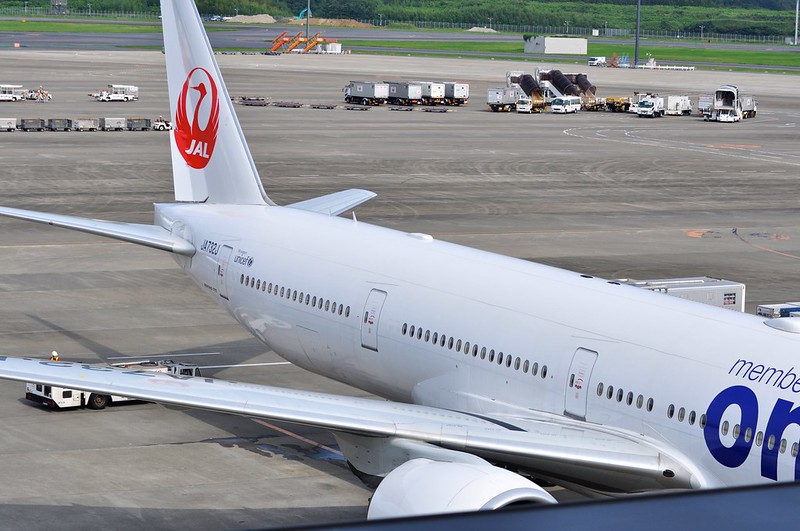
It turns out this aircraft was the first test plane for the Boeing 777-300ER, registered at the time as N5017V, with its maiden flight on February 24, 2003.
JAL was actually the first airline to decide on introducing the Boeing 777-300ER. As a result, Boeing used this aircraft and another, N5016R (now JAL’s JA731J), to fly around the world, completing numerous test flights. However, quite regrettably, the first 777-300ER to be delivered (April 29, 2004) and enter commercial operation went to Air France. You can see Boeing’s official press release here. After completing various tests, N5017V was finally delivered to JAL in July 2004. This history is documented in the Japanese version of Wikipedia.
-
Release of 10.30r2 and Plan for the Next Fix Version
According to the official blog, X-Plane 10.30r2 has been released, so development of version 10.30 is coming to a close, and it is estimated that it will be fully completed next week.
However, there are some known issues that haven’t had time to be fixed, so version 10.31 will be released just 1-2 weeks after 10.30! Of course, although the version number is changing, this will only include bug fixes and there won’t be any new features.