A Flight Sim Enthusiast's Notebook
-
Participate in the X-Plane 10 Mobile Beta Test
Received an official invitation email from X-Plane this morning to participate in the internal beta testing of x-plane 10 mobile.
So, I logged in via the webpage below: Sign Up for the X-Plane 10 Mobile Beta
A few hours later, I received the test invitation email sent by Apple.
Next, I went to the App Store to download the app and launched it to get started.
Please note that this is still an internal beta test. According to the agreement, participants are required to maintain strict confidentiality and must not upload screenshots or other content to the internet or SNS.
-
Red Bull Air Race Chiba 2015
The Red Bull Air Race World Championship will feature a Japan leg next year, taking place in Makuhari, Chiba. It’s geographically very close to Tokyo, and I really want to go see it.

Here is some official news: Press Release Red Bull Air Raceが日本とロシアで初開催へ Ticket Prices and Info 世界最速のモータースポーツ 日本初開催決定!
Tickets can be reserved via the official website and l-tike, seemingly starting in December.
Finally, attached is the Red Bull Air Race 2015 schedule:
-
X-PLANE 10 MOBILE
It looks like the X-Plane 10 mobile app is coming soon. Right now, there is only an official landing page, and the content is very simple: This is an app for iPhone and iPad, and it is free!
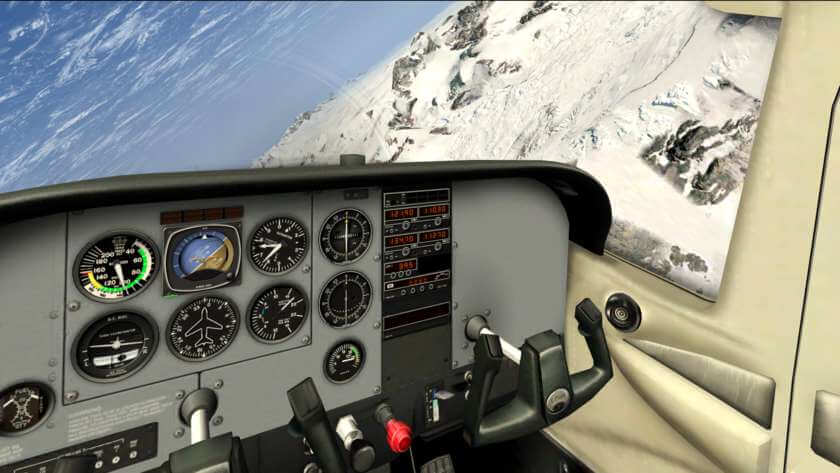
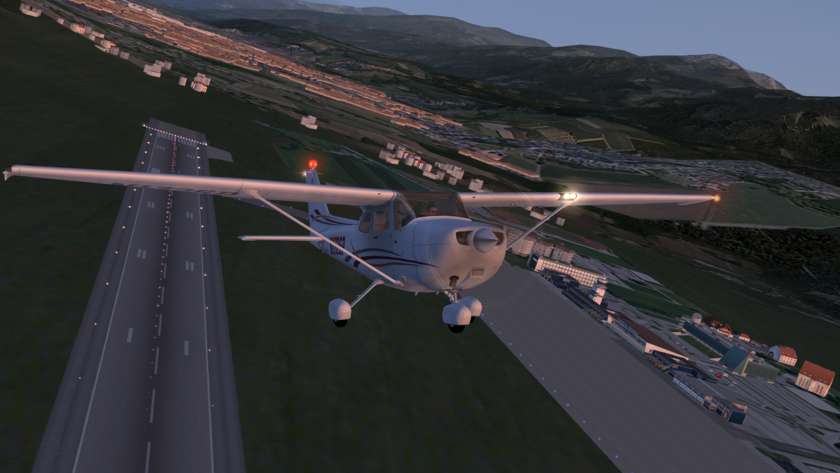
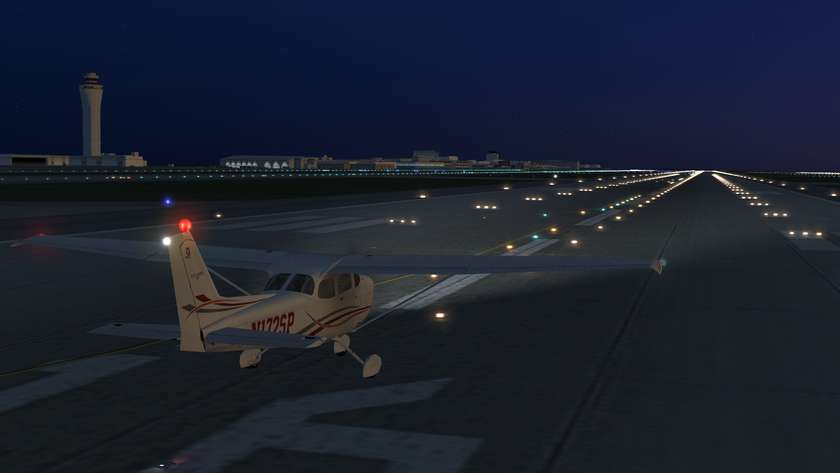
It might be released before Christmas; let’s wait and see
-
'Rain Man" Meets the A350 XWB'
In Japanese, there is a term “Rain Man” (雨男) referring to someone who always encounters rain when they go out. Therefore, an umbrella is a travel necessity, just like a wallet. Regrettably, in a sense, I am also a “Rain Man.” For instance, in recent years, whenever I traveled to Nikko, Fukuoka, Hamamatsu, or Kyoto, I always ran into rain. This was proven true again during my trip to see the A350.
-
A350 First Flight to Haneda RJTT
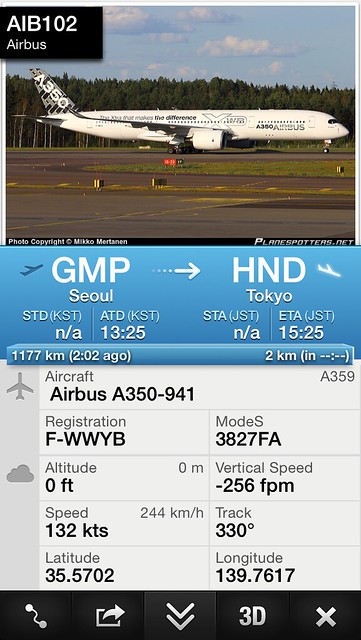
On the afternoon of November 19 at 3:25 PM, the A350 visited Haneda Airport for the first time. I didn’t have time to go to the airport to see it in person, but with the abundance of resources online, receiving a massive amount of information instantly made for a very fulfilling experience.
On flightradar24, as soon as the A350 took off from Korea, the entire route was tracked via flightradar24.com/AIB102/. The final landing was also expected on 34L; the weather was clear, and the aviation enthusiasts who went to the airport to photograph it all returned with a bountiful harvest.
-
Spotting Planes at Haneda Airport @ Ukishima-cho Park
Recently, I was asked online about photography spots at Haneda Airport. It seems like a good idea to polish up the “Haneda Airport Spotting@” series, so I’ll write about Ukishima-cho Park this time.
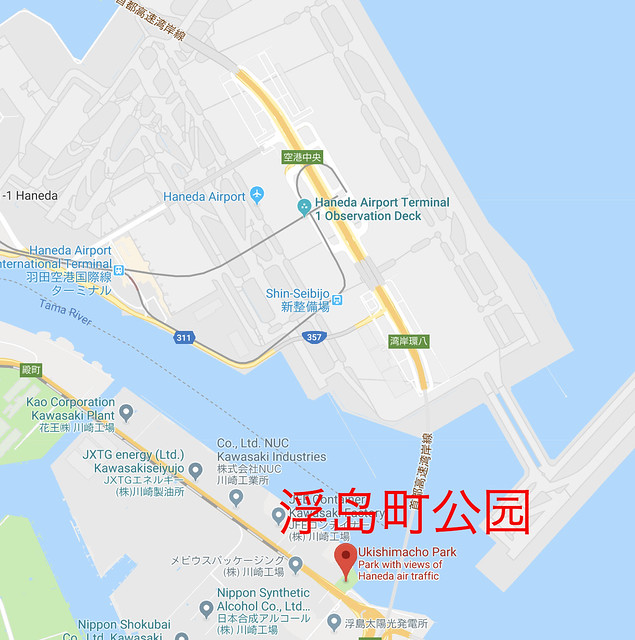
Ukishima-cho Park is located within Kawasaki City, just off the seaside on the outer side of Runway A and Runway D. It is not only a very famous aircraft spotting location, but also a popular spot for fishing.
-
Highways in the Sky -- Popular Science Video on PBN RNAV RNP
I previously wrote a note on PBN (Performance Based Navigation); it was purely text-based and quite tiring to read.
Today, I came across an excellent educational video on Youku. It was translated and produced using materials from the U.S. Federal Aviation Administration (FAA). It is easy to understand and highly recommended.
-
Air Canada Introduction to 787 Maintenance
Found a great piece of knowledge on Twitter, introducing Air Canada Boeing 787 maintenance new technology, simple and easy to understand, so I will introduce it here.

- Maintenance Laptop
In the past, thick paper manuals were required, but now, by using just one laptop computer on the observer seat in the cockpit, all maintenance manuals can be queried, and they are updated monthly.
- Instant Response
Notification messages in the cockpit, such as when a certain system or part needs inspection, can be immediately sent to a ground management station and then to the maintenance personnel’s mobile phones. Therefore, parts that need replacement can be prepared in advance, and work can start immediately after the 787 lands. Even on rest days, various statistical information from the aircraft is provided to maintenance personnel.
-
X-Plane 10.31 Is Out
The official release of X-Plane 10.31 is out. You can check the brief notes on the official developer blog. It basically boils down to two sentences:
10.31 is out The Steam version will be released soon
So, feel free to upgrade and see if stability has improved.
-
Airbus A350 WXB Planned Visit to Haneda Airport
Finally have a chance to see an A350 in Tokyo. According to this report, as part of an Asian tour, the A350 will be staying at Haneda Airport for 2 days. The specific details are: Wednesday, November 19, around 15:30 Arriving at Haneda Airport from Seoul Gimpo, entering the JAL maintenance hangar for internal viewing Thursday, November 20 Demonstration and tour flight 12:45-13:55 Friday, November 21, around 13:00 Departing Haneda Airport, Destination is Hanoi, Vietnam
-
Converting Meteorological Visibility to CMV
When viewing Japanese aeronautical charts, it is common to see CMV (Converted Meteorological Visibility) used in the Landing Minima. This metric is used when the airport does not have RVR equipment or when the equipment is inoperative. CMV needs to be calculated using METAR or ATIS. The conversion is divided into Day and Night, and takes into account the status of lighting equipment. The CMV value is obtained by multiplying the Meteorological Visibility VIS by a factor.
-
ADS-B Decoding Software for Mac OS X
After installing MacPorts and Gqrx 2.3.1, it seems many driver libraries were automatically installed in the system. So, can I receive ADS-B signals as well? I searched online and found a decoding software called Cocoa1090 that works. I installed and tried it, and it succeeded easily.
The specific method is as follows: Download Cocoa1090 from <a href=“http://www.blackcatsystems.com/download/Cocoa1090.zip"" target="_blank”>http://www.blackcatsystems.com/download/Cocoa1090.zip and unzip it.
Execute
rtl_tcpincluded in Cocoa1090 from the Terminal, and run the following command: $ rtl_tcp -g 9999 Found 1 device(s): 0: Realtek, RTL2838UHIDIR, SN: 00000001 Using device 0: Generic RTL2832U OEM Found Rafael Micro R820T tuner Tuned to 100000000 Hz. Tuner gain set to 9999.000000 dB. listening… Use the device argument ‘rtl_tcp=127.0.0.1:1234’ in OsmoSDR (gr-osmosdr) source to receive samples in GRC and control rtl_tcp parameters (frequency, gain, …). client accepted! set freq 1090000000 set sample rate 2000000 Exact sample rate is: 2000000.052982 Hz -
Upgrade to Gqrx 2.3.1 to Get Squelch Functionality
I previously introduced Using a Digital TV Tuner on Mac to Listen to Software Defined Radio (SDR) – Listen to the Aviation Band for just tens of yuan, using the open-source software Gqrx. Today I discovered that Gqrx has been upgraded to 2.3.1, so I upgraded to see what new features are available.
First, I upgraded MacPorts. Since I was using MacPorts 2.2.1, I went to http://www.macports.org/install.php and downloaded MacPorts 2.3.2, which supports OS X 10.10 Yosemite. After installation, I executed the following in the terminal to verify everything was working. $ port -v MacPorts 2.3.2 Next, I followed the documentation and typed
agreeto accept the license. $ sudo xcodebuild -license -
Spotting Planes at Haneda Airport @ Keihinjima Tsubasa Park
For taking photos of aircraft at Haneda Airport, the observation decks on the terminal buildings are generally the easiest spots (Terminal 1 allows shooting of 34R/16R, while Terminal 2 and the International Terminal allow shooting of 34L/16L). Additionally, Jonanjima Seaside Park (for takeoffs on 34R and landings on 22) and Ukishima Park (for landings on 34L) are also quite well-known.
Keihinjima Tsubasa Park is also a decent spot for photography. It is a seaside park located to the right of Runway 22, basically parallel to the runway, so it allows for side-profile shots of aircraft on landing approach.
-
Captain's 30,000 Feet -- Recent Reading Notes 20141102
After reading Captain Taguchi’s Memoirs and finding it quite good, I bought another book he wrote: 機長の三万フィート (Captain’s 30,000 Feet).

It took me about 4-5 days to finish it, and following convention, here is a brief book review.
The main thread of this book is Captain Taguchi’s professional career, highlighting flight school training, the era of flying the propeller airliner DC-6, the era of flying the jet airliner DC-8, the instructor era, and the era of flying the Boeing 747. While narrating his personal growth, he very naturally weaves in a lot of aviation knowledge, which I think is a unique feature of this book. I have read many books written by captains; some focus on aviation popular science, while others focus on personal biographies. Although they are all well-written, their focus is quite obvious. However, this book perfectly combines popular science with his professional career, making it an effortless read with many learning points, which is truly rare. For example, in the section about flight school, it introduces the control methods of primary aircraft, which is very helpful for flight simulation players. Regarding the phase of flying as a First Officer, it introduces how to make passengers more comfortable, covering both advanced aircraft techniques and professional ethics, which is convincing. When discussing his method for using the Autopilot, he mentioned that he generally performs manual operation first to bring the aircraft attitude to a balanced state—that is, after trimming—before engaging the Autopilot. This recalls the books by Kan-ichiro Kato on aircraft accidents, which mentioned that many accidents were caused by pilots trusting the Autopilot system too much and engaging it while the aircraft was not trimmed, leading to disasters. Therefore, I find Taguchi’s explanation quite persuasive.
-
New RNP AR Approach Procedure at Toyama Airport RJNT
According to the eAIP Japan AIP published on 13 NOV 2014, Toyama Airport will commence the use of RNP AR approach procedures starting in December. Let’s take a detailed look below.
First, let’s look at the simpler RNAV (RNP) Y RWY20. As shown in the figure below, the large “RNP AR” text and “Special Authorization Required” in the lower right corner indicate that this is a procedure requiring special authorization, specifically an RNP AR APCH. Performance Based Navigation (PBN) and RNP AR APCH were introduced in this site’s article PBN (Performance Based Navigation).
-
X-Plane 10 The Official Guide User Guide
Calling all X-Plane 10 fans! PC Pilot magazine’s Official Guide is now on sale (for less than $10), so don’t miss out if you’re interested.
The PC Pilot Official X-Plane guide goes on sale today! Be sure to order it here! https://t.co/tXfKEC3NIW pic.twitter.com/i5id4MSwrh
— X-Plane (@XPlaneOfficial) October 30, 2014The contents of the book are as follows: Produced by the editorial team behind PC Pilot magazine, X-Plane 10 - The Official Guide, is a 100-page publication giving a comprehensive profile of Laminar Research’s advanced flight simulator and the aircraft, scenery and add-ons, which make it one of the most significant developments in flight simulation history.
-
X-Plane 10.31r2 Released
The latest version of X-Plane, 10.31r2, has been released. According to the official release notes, this version is a bug fix release and includes the following updates:
Fixed quit mid-flight when DNS network lookup times out. Fixed rendering of prop angle for counter-clockwise props. Cylindrical projection does not show black screen when the option is picked for the first time. Use the correct localizer and glideslope reference so that the glideslope in the local map displays precision approaches correctly. Preserve existing contents of logbook when opened with the “Choose Pilot Logbook” function. Added support for the newest USB keys.
-
Check Star 6
I previously wrote an article about inspecting and verifying equipment at Kansai Airport, which covered how Japan’s Ministry of Land, Infrastructure, Transport and Tourism (MLIT) uses a Saab 2000 to check ground navigation aids.
Today, I came across another video on YouTube. This time, it features a different inspection aircraft from the MLIT: a Bombardier BD-700, registration number JA006G, affectionately nicknamed “Check Star 6”.
Since it is a jet aircraft, it flies at a higher altitude and faster speed compared to the Saab 2000 from the last time, so everyone can compare the two.
-
Listening to ATC at Chofu Airport RJTF from Home
Quite a bit of traffic from Facebook in the last couple of days, wonder which expert recommended it?
After returning from Chofu Airport, I wanted to see if I could hear the Tower ATC from home. So I set up the antenna and listened for a while, only to find the signal was very poor. I couldn’t hear the Tower voice at all. I could hear the aircraft voices, but the noise was quite loud; slightly disappointed.