A Flight Sim Enthusiast's Notebook
-
Aboard Flight HA457
Last week, after watching a concert and having a drink with a friend, we inadvertently started talking about flying. My friend mentioned having experienced a flight with prolonged turbulence once, which has since led to a fear of flying.
Personally, I prefer to enjoy the flight, Of course, I wouldn’t want to encounter bad weather like Clear Air Turbulence or rapid changes at the tropopause.
After all, humans are land-dwelling creatures, and our eyes are accustomed to viewing the world from the surface. But since we have the opportunity to fly and look down at this world from above, This is in itself a rare opportunity to see countless sights we usually can’t see from the ground. Everyone is willing to travel far and wide, spending time and energy just to glimpse unfamiliar cultures and scenery; Actually, flying in a plane can achieve the same effect.
-
Revisiting the Aviation Science Museum
I previously wrote about the Flea Market at the Museum of Aeronautical Sciences, which is held at Narita on the first weekend of March and September every year. In the blink of an eye, it was early September, so I made a run for it over the weekend.
The Museum of Aeronautical Sciences opens at 10:00 AM, and I arrived basically at 10:00. However, entering the flea market required queuing for a number; I got number 270. Just look at this long line. Fortunately, reviewing things like the JT8D, the 757 tail, and the DC8 landing gear kept me from getting bored.
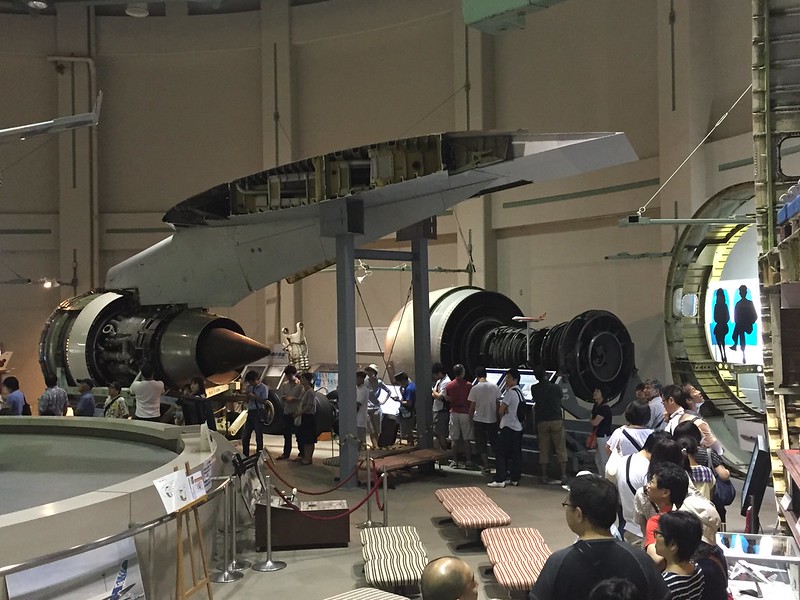 Later, I saw in the news that the earliest arrivals actually started queuing at 5:00 PM the previous day. I really admire their enthusiasm.
 -
Experience with Anabatic Simulation's C172 Simulator
There are two small companies in the Tokyo area with fixed-base flight simulators,
providing Boeing 737NG and Airbus A320 flight experience facilities for aviation enthusiasts and flight trainees.In terms of equipment, I estimate their investment to be around $200,000 USD,
which means they provide a fairly realistic cockpit and electronic instruments,
but they are not full-motion, and cannot perform free movement on 3 axes.
After all, the full-motion simulators used by airlines to train pilots are incredibly expensive,
requiring an investment of tens of millions of dollars for just one unit. -
A Trip on Flight HA458
Taking a night flight from Haneda to Honolulu that arrives around noon is quite comfortable. You just sleep after boarding, wake up for breakfast, and then disembark. Since you have the rest of the afternoon to go shopping, you hardly feel the jet lag at all.
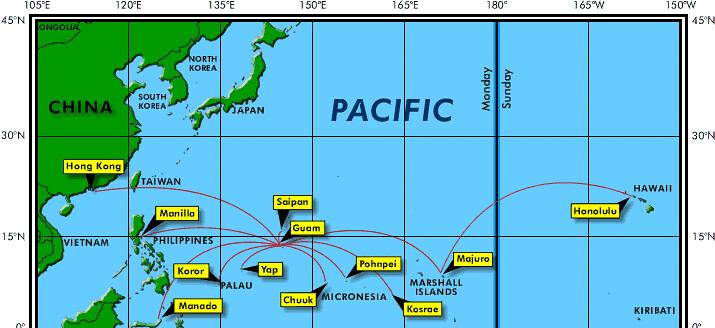
However, there is one downside: there is very little enjoyment in the middle of the night. You can only look at the islands and the ocean before landing. So, the plan for this flight was quite monotonous, consisting mainly of sleeping. Recently, I don’t seem to watch movies on planes anymore; I only look at the route map on the entertainment system.
-
Watching Trijets at Honolulu Airport
Went on a sightseeing flight in Hawaii again, took a few snapshots of some trijets on the Apron that are rarely seen in Japan anymore, sharing them here.
First is the Boeing 727, a 727-200 from Asia Pacific Airlines, registration number N705AA.
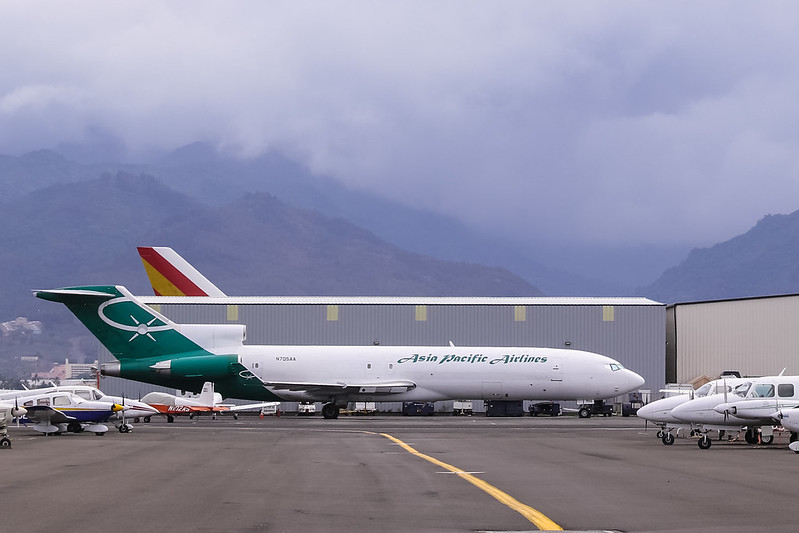
Asia Pacific Airlines is a cargo airline providing cargo charter services in the Asia-Pacific region, operating a total of 3 Boeing 727s.
-
X-Plane 10.40 Beta 10
10.40 Beta 10,估计这是10.40的最后一个beta版, 内容还基本上是修改一些比较小的bug,说明本版本已经很接近稳定状态了。
Ben说正式发布候选版rc1将在两周内推出, 有一些Windows 10上的问题要花一些时间, 不过对于还在观望的朋友来说是个仍然是个好消息。
每次看Release Notes,Windows版总是bug最多的, Mac版本相对要稳定得多,所以Mac用户一般总是可以大胆的尝试各种最新的Beta。
-
Taking a Week Off
I will be taking a week’s leave starting today,
 The blog will be on hiatus, and replies to comments may be slow. Apologies for the inconvenience.
 -
SkyVector Introduces Flight Planning Feature
I opened SkyVector today to check the charts and found that the Flight Plan feature has been improved. It allows for creating very nice flight plans, which I highly recommend. However, you need to register an account to use this feature.
This is the data entry screen. Put the Waypoints in. For example, the image below shows the route from Tokyo to Shanghai.
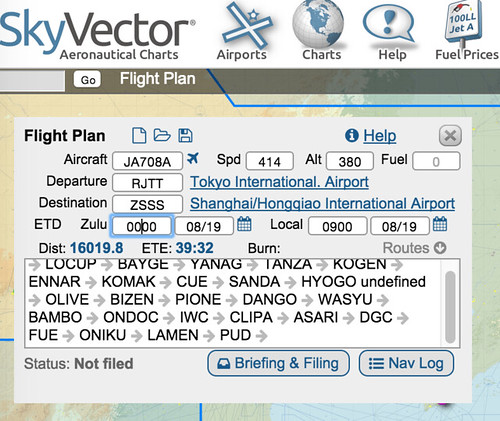 The entire route will then be displayed on the map.
 -
A320 Load Sheet
From time to time, you can see A320 landing load reports on SNS. There is a great article on CARNOC on how to read an A320 load report.
I particularly like the section on the cause of the overload. For instance, if a landing is too heavy, there is data for a second touchdown (touchdown), whereas the introduction above shows 0.
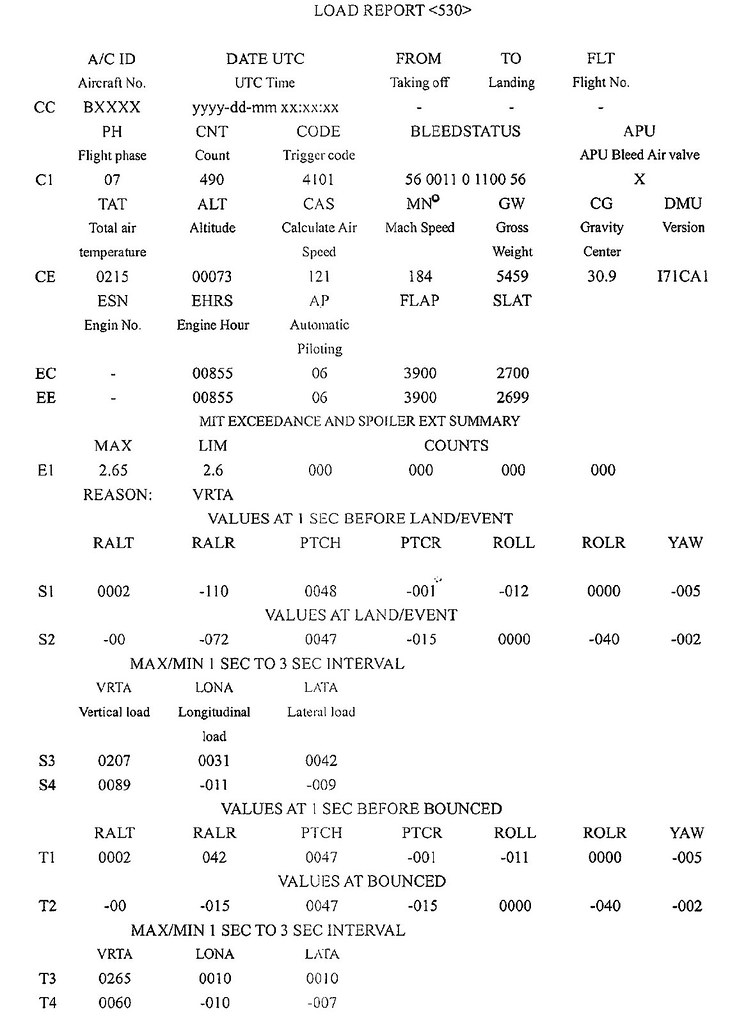 The information above is from a Google Patent page.
Explanation of Terms in the Cause Section
-
Visual Perspective Changes During the Flare
I won’t write out the specific procedures; the materials from the Federal Aviation Administration (<a href=https://www.faasafety.gov/gslac/ALC/course_content.aspx?cID=34&sID=164&preview=true>FAA) below are easy to understand:
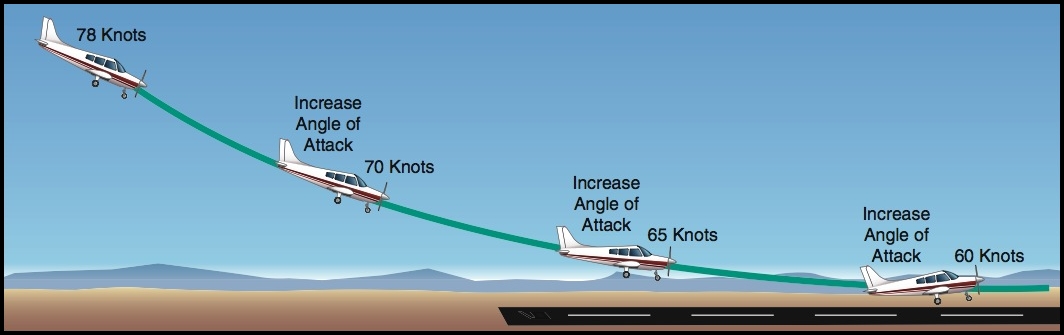
However, regarding how to observe the changes in the visual perspective of the Runway, the explanation by the <a href=http://tieba.baidu.com/p/3970321943?pid=73705731249>Beautiful Pilot is very good, so I have transcribed it here.
During the Roundout, it is generally believed that you should look at the far end of the Runway. This is because, when you focus on the distance, you can see more details, and all the surrounding scenery is "telling you" the sink rate and altitude.
When focusing on the distance, you actually need to pay attention to the area in front of and to the sides of the nose cowling as well. When looking far ahead, there will be a moment when you feel the Runway being “flattened” significantly; at the same time, when you scan the front and sides of the nose cowling, there will be a moment when you feel the Runway expanding significantly. That is when you should perform the Roundout.
-
China Civil Aviation's New NOTAM International Series Classification
Current NOTAMs are categorized into three series: A, E, and F. Starting from 08:00 on August 29, 2015, five new series—G, L, U, W, and Y—will be added, effectively subdividing the airspace into more detailed segments. Specific details are provided in the new AIP PART 1 GEN 3.1, transcribed as follows:
Series A: Contents include regulations, standards, services, and procedures; Airways/Airways; Airspace, navigation aids, and aviation warnings related exclusively to en-route flight; And other aeronautical information not included in Series E, F, G, L, U, W, and Y NOTAMs.
-
X-Plane 10.40 Beta 8 Is Out
According to the official blog, the Beta 8 version of the 10.40 beta has been released, fixing a large number of bugs. You can check the Bug Fixes section in the <a href=http://www.x-plane.com/?article=x-plane-10-40-release-notes>release notes, although the content is quite dry.
I haven’t had time to upgrade and test it yet, but based on past experience, there shouldn’t be any major issues. There is only one thing I don’t quite understand: “Using METAR weather works again.” I don’t know what that refers to.
-
Trip to Osaka Kansai Airport RJBB for Plane Spotting in 2015 (Part 3)
Following the previous post, here are a few more aircraft photos. The content this time is relatively monotonous, mainly simple spotting, focusing on aircraft from various international airlines rarely seen at Haneda Airport.
But let’s start with a landscape photo.
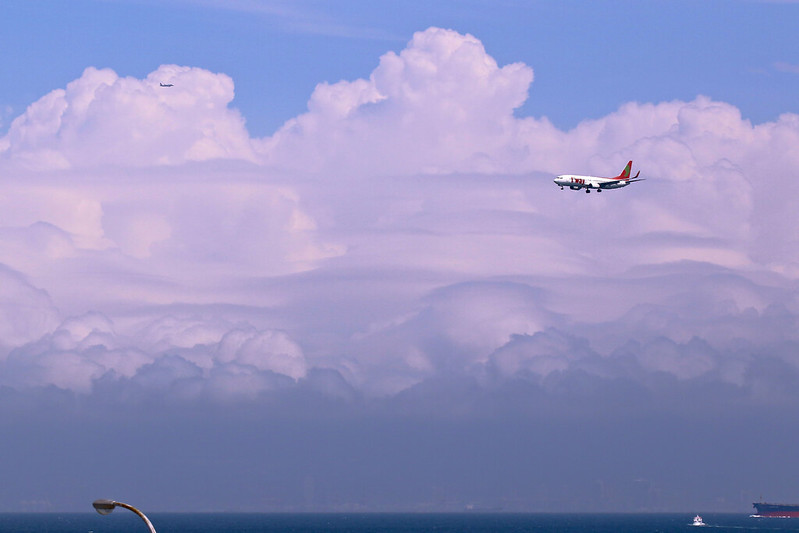 On the day of the shoot, summer-specific cumulonimbus clouds towered over Osaka city and Osaka Bay, reaching altitudes of one or two thousand meters.
With these striking clouds as a backdrop, airliners flying at an altitude of tens of meters in the final approach phase make for the best photography targets.
This Boeing 737-800 belongs to T’Way Air, a Korean LCC.
On the day of the shoot, summer-specific cumulonimbus clouds towered over Osaka city and Osaka Bay, reaching altitudes of one or two thousand meters.
With these striking clouds as a backdrop, airliners flying at an altitude of tens of meters in the final approach phase make for the best photography targets.
This Boeing 737-800 belongs to T’Way Air, a Korean LCC. -
Uneven Runway
I previously wrote a post about the 360-meter extension of Haneda Airport’s Runway C. Today, I checked the latest AIP again and found this diagram quite interesting, so I’m posting it here for a look.
This is a runway slope diagram for RJTT. You can see that each runway has ups and downs; they are surprisingly uneven.
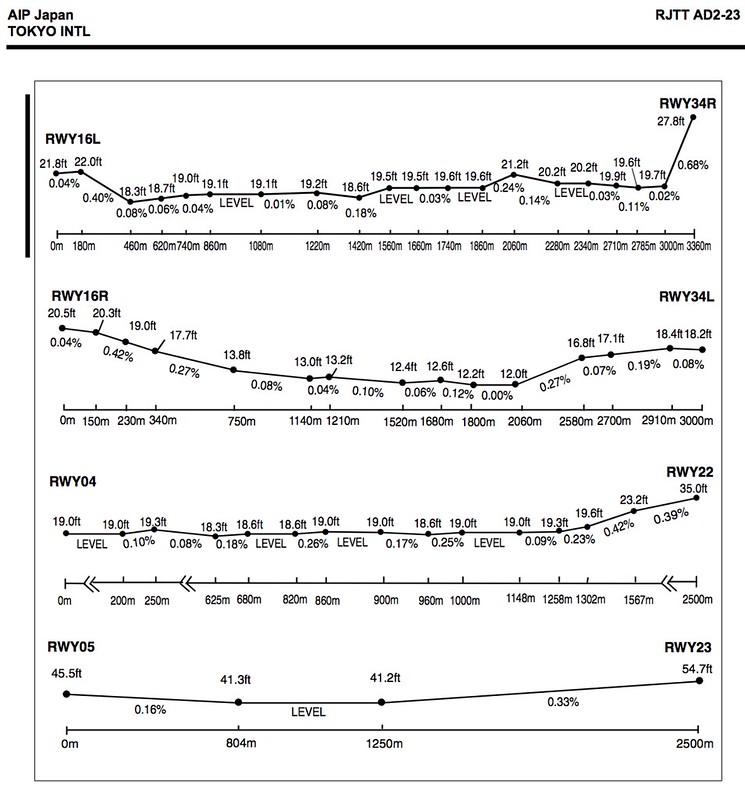 The common feature is that the runway thresholds are higher, while the middle sections are lower.
This is likely to ensure visibility during takeoff and landing.
The common feature is that the runway thresholds are higher, while the middle sections are lower.
This is likely to ensure visibility during takeoff and landing. -
2015 Return to Osaka Kansai Airport (RJBB) Plane Spotting Part 2
Previous post introduced some special liveries; now let’s switch themes and take a look at aircraft during twilight and at night, as well as Kansai International Airport.
On this day, the runway configuration was RWY24L for departures and RWY24R for arrivals. From the observation deck, the arriving aircraft were directly to the west, making it quite easy to take sunset-themed photos.
For example, this Thai Airways Airbus A330-300, registration HS-TBF, is just about to touch down.
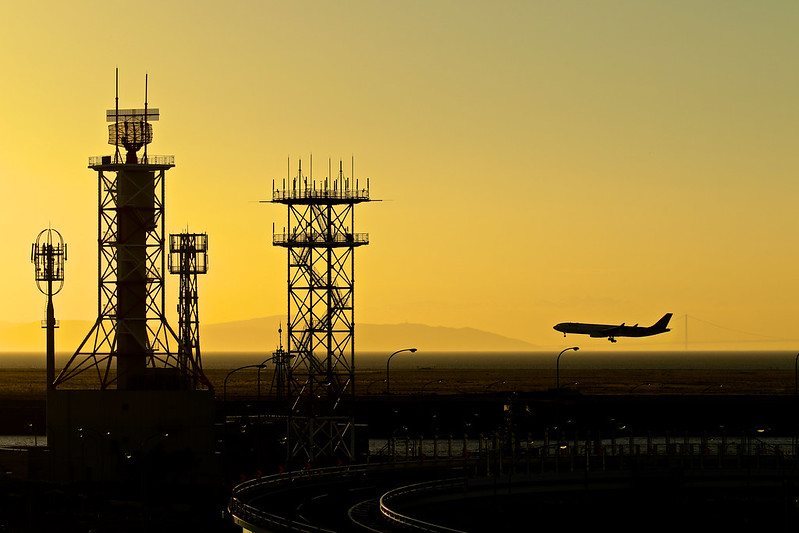 With the Akashi Kaikyo Bridge and Awaji Island in the background, and the reflection of the airport radar, various antennas, and rails in the foreground, this silhouette photo looks decent enough.
 -
2015 Return to Osaka Kansai Airport (RJBB) Plane Spotting Part 1
It had been a long hot summer since I last went plane spotting. I’ve been to Haneda quite a lot this year, so I decided to go to Osaka Kansai Airport (RJBB) to review what I knew and learn something new.
Compared to two years ago, I found that there were quite a few more aircraft with special liveries. It was a very fruitful trip.
The biggest highlight of this trip should be this brand new Boeing 787-9 from Singapore’s LCC, Scoot.
-
Latest Developments on the MH370 Disappearance and Flaperons
The flaperon wreckage discovered on the French island of Réunion in the southwest Indian Ocean is likely from Malaysia Airlines Flight MH370, which went missing last year.
BREAKING Is this piece found this morning could be flaps of #MH370 ? https://t.co/MlhHe6Px4F pic.twitter.com/FyRC4L7X9e
— AirLive.net (@airlivenet) July 29, 2015According to the “657BB” marking on the wreckage, this should be a “Flaperon” from the trailing edge of the left wing of a Boeing 777.
BREAKING '657BB' code found on wreckage is Boeing 777 flaperon according to manual #MH370 https://t.co/MlhHe777Wd pic.twitter.com/bM9DPNW5gw
-
Rare Usage of ILS RWY22 and RWY23 at Haneda Airport
During summer seasons with frequent southerly winds, landings at Haneda Airport typically utilize the LDA Runway 22 and Runway 23 approaches. Essentially, to minimize ground noise, aircraft make a wide turn over Tokyo Bay. However, under adverse weather conditions, ILS Runway 22 and Runway 23 procedures are still available. The difference is that aircraft cannot execute turns within the confines of Tokyo Bay; instead, they must queue up early over the northeastern part of Tokyo city.
-
JA4060 PA-46 Malibu Takeoff Failure and Crash at Chofu Airport
This site has previously introduced the general aviation airport in Tokyo—Chofu Airport RJTF, Tokyo Chofu Airport Photo Note and Revisiting Chofu Airport Open Day, and I have quite a fondness for this place.
It is heartbreaking that last Sunday, July 26th, a Piper PA-46-350P Malibu crashed just over twenty seconds after taking off from here. The aircraft fell into a dense residential area, causing 3 deaths and 2 serious injuries.
-
Chongqing Jiangbei Airport Implements New Taxiway Numbering
Checking the news at Chongqing Jiangbei Airport officially启用s new Taxiway numbering and AIP 2015 Nr.08, the long-criticized “double-letter” taxiway numbering format at this airport has finally been changed to the standard “letter-plus-number” format, and officially commenced operations on July 23.
Comparing the new and old airport diagrams, first look at the previous numbering,
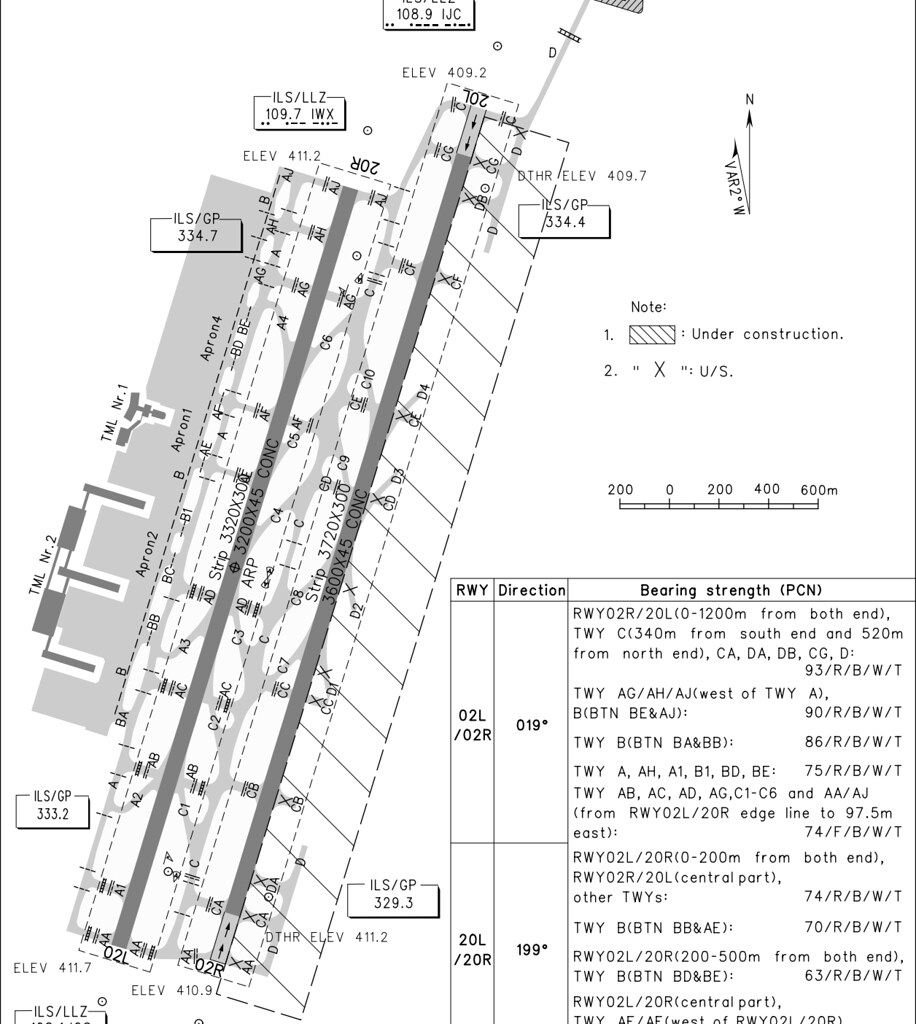 For example, the exit numbers on the Taxiway in front of the Apron are AJ, AH, AG, BE, BD, AF, AE, B1, BC, BB, BA,
showing no discernible pattern; it must have been very effortful for pilots to locate them on the charts every time.
For example, the exit numbers on the Taxiway in front of the Apron are AJ, AH, AG, BE, BD, AF, AE, B1, BC, BB, BA,
showing no discernible pattern; it must have been very effortful for pilots to locate them on the charts every time.