Practice Notes
-
Marking Practice Traffic Pattern with OverlayEditor
OverlayEditor is a free X-Plane addon tool that can be used to create Scenery plugins. You can use it to place various buildings on the map, acting like a construction worker to build your own dedicated airports and other Scenery.
Here, I do not intend to introduce how to create exquisite plugins, but rather from the perspective of practicing rectangular patterns (i.e., practicing traffic patterns), I will introduce how to use OverlayEditor to help improve your flight techniques.
-
Climb, Descent, and Level Flight Practice
I was away on another business trip for a week. In the spirit of not letting this blog go to waste, here is a quick update.
Yesterday after getting home, I fired up X-Plane for a bit of relaxation and focused on practicing the Vertical Speed during Climb and Descent.
For instance, maintaining the Vertical Speed at 1000 feet per minute, and noting the two points of applying gentle pull and push pressure when changing the pitch attitude.
-
Review of ILS Approach and Landing
I basically haven’t touched X-Plane for a week; finally, the weekend is here, so I can have some fun. What should I practice? I realized it’s been a long time since I practiced ILS, so let’s do a quick review.
As always, I’m flying the Cessna 172, taking off from Narita Airport Runway 16L. I checked the weather; there are cloud layers at 3,000 and 8,000 feet. So, I continued a straight Climb along the Runway direction to 13,000 feet. After passing the famous Kujukuri Beach in Chiba Prefecture, I flew west toward the Arlon waypoint.
-
Title: About ATIS Automatic Terminal Information Service
Let’s first copy the introduction from Wikipedia:
“Automatic Terminal Information System (ATIS) is an automatically continuous broadcast information service at busy airports, usually broadcast on a separate radio frequency, including major flight-related information such as weather, active Runway, altimeter setting, and other information. Pilots typically listen to the broadcast before establishing contact with controllers and other units to understand the relevant situation, reducing the workload of controllers and preventing frequency congestion. Under normal circumstances, the broadcast is updated hourly, but can be updated at any time when weather changes rapidly, denoted sequentially by letter codes A, B, C…Z, read using the ICAO published standard letter pronunciation.”
-
Training Diary: Traffic Pattern at Honolulu International Airport
I’ve always treated RJTA near my home as my home base, doing all my practice there.
But the wind’s been strong these days—lousy for training—so I switched to Hawaii’s Honolulu International Airport, a field I’ve actually flown myself.At first, I wasn’t quite used to the new environment. I picked Runway 26L at random and spent an hour doing touch and goes.
The flight path was all over the place,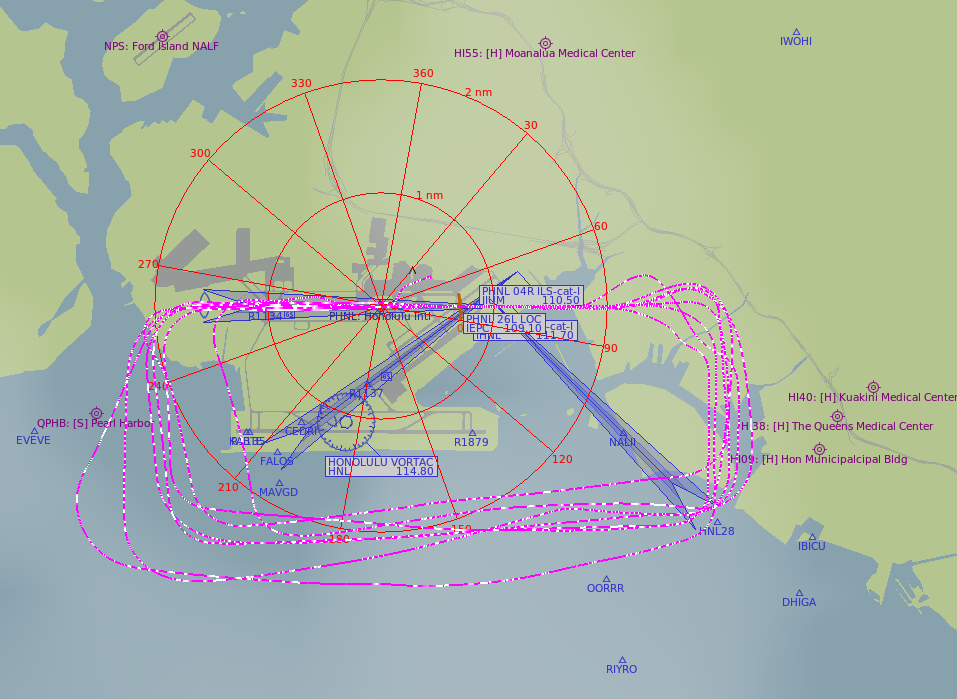 and altitude control was erratic—up and down,
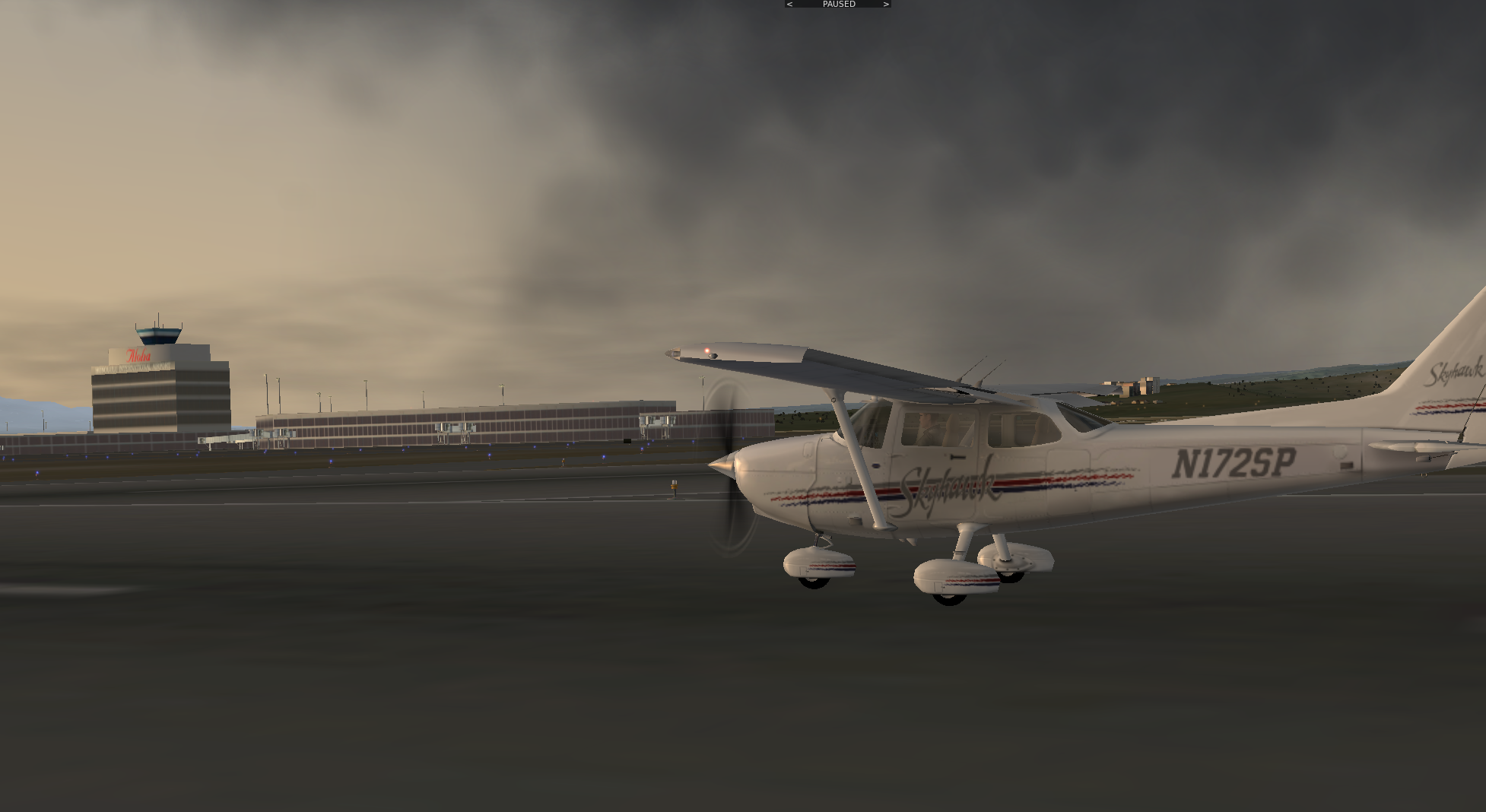
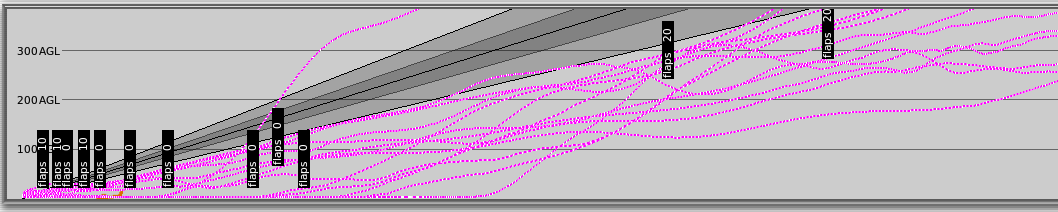 but after an hour, I finally got the hang of the terrain. Control on final leg gradually became second nature. The last landing was pretty satisfying; after a full stop, I snapped a photo with Aloha Tower in the background to commemorate the moment.
-
Training Diary: Basic Flight Maneuvers Practice
Personal Summary of Basic Operations: Level Flight, Climb, and Descent
I’m writing this down now so I don’t forget it later.
To maintain a steady state of Level Flight, Climb, or Descent, you must follow this sequence: first adjust Thrust, then control the aircraft’s pitch attitude, and finally adjust the trim.
The reason the first step, power adjustment, is so important is that engine Thrust determines the aircraft’s state of ascent or descent. Most people have the impression that a pilot pulls back on the stick to make the plane Climb and pushes forward to make it Descent. In reality, this is a misconception. Pulling back on the stick does indeed cause the aircraft to gain some altitude, but if Thrust remains unchanged, the Airspeed will continuously decrease until the aircraft enters a Stall. Similarly, if you try to force the plane to Descent by pushing the stick forward, the nose will drop continuously, causing Airspeed to increase. This increase in speed generates more Lift, which will actually cause the altitude to rise instead. Therefore, remember: to maintain a stable altitude change, you must adjust Thrust. When transitioning from a Climb to Level Flight (level-off), you must first appropriately reduce engine Thrust; when transitioning from Level Flight to a Climb, increase Thrust; and when transitioning from Level Flight to Descent, reduce Thrust.
-
Training Diary: Practicing Traffic Pattern and Touch and Go After a Two-Week Break
Due to a business trip, I haven’t practiced X-Plane for two weeks. Fearing my skills might have gone rusty, I hurriedly took the weekend to review. Today was mainly repetitive touch and go maneuvers, circling the airport round and round.
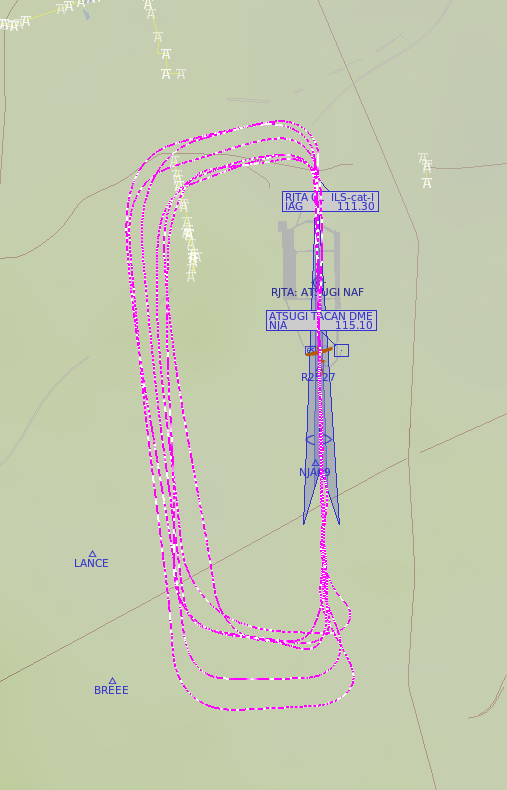
Looking at the track plot, I feel the base leg is still the biggest problem. The airspeed is a bit too fast, the timing for entering the final approach is quite late, and additionally, the nose isn’t properly aligned with the runway.
-
Training Diary: The Difficulty of Maintaining Speed and Altitude
Continuing to practice touch and go and steep turns in the Cessna 172, maintaining altitude and bank angle during steep turns is slightly better than before, looking at the near figure-eight track drawn on the local map still brings a sense of accomplishment. In the past, my attention was mainly focused on altitude and bank angle; after a few days of practice, there has been some improvement, but I hadn’t paid much attention to speed stability. During today’s flight, I paid closer attention to the Airspeed Indicator and found that the speed fluctuated quite a bit, very unstable between 80 and 100 knots; this simply won’t do. From now on, I still need to focus on keeping speed variations within 10 knots and practice more.
-
Training Diary: Touch and Go
It’s Saturday today, and I finally have time to practice to my heart’s content. So, I chose the airport near my home, RJTA. I disregarded ATC, took off, and immediately flew the rectangular traffic pattern, followed by touch and go. One lap after another—I probably did about 15 circuits—before finally doing a full stop.
Today’s takeaway is the importance of observing ground markings: when to enter the crosswind leg, when to enter the downwind leg, and when to enter the base leg. At first, I was using the runway as my reference point, which forced me to constantly switch views, making it extremely cumbersome. Later, I started spotting distinct landmarks on the ground—such as tall buildings, highways, or large patches of greenery like parks. Using these as references meant I could focus on maneuvering the aircraft during the Turn without constantly checking the Runway’s position.
-
Title: Insights on Practicing Steep Turns
I’ve been practicing Steep Turns for the past couple of days.
I recently read blogs from people getting their pilot licenses in the US. It seems they usually practice this maneuver after just one or two flights, and most beginners find it very difficult to maintain altitude while holding a 45-degree bank angle.
I wanted to see if I could handle it in X-Plane, so I flew a few sorties. Sure enough, my altitude control was terrible—I instantly dropped 500 feet…