Aviation Safety
-
Impact of French ATC Union Strikes on ATC
What happens when air traffic controllers go on strike? Of course, takeoffs and landings near airports are impossible, and airspace is blocked—these are predictable outcomes. For example, today the French air traffic controllers’ union is holding a strike. Checking the news on the European Network Operations Portal,
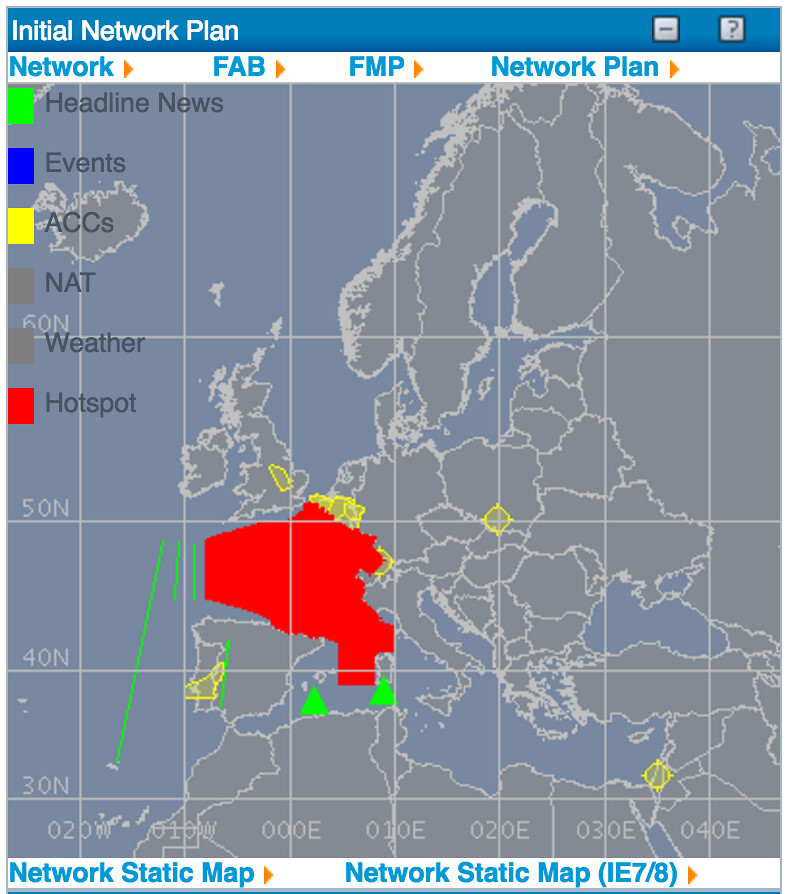 Sure enough, France is covered in red.
Now let’s look at the latest NOTAM 0502/16 on the same site.
(F0502/16 NOTAMR F0500/16
Q) LFXX/QAFXX/IV/NBO/E /000/999/4504N00053E999
A) LFBB LFMM LFFF LFRR LFEE B) 1603201653 C) 1603220500
E) DUE TO A STRIKE AFFECTING FRENCH CIVIL AVIATION SERVICES,
SOME IMPORTANT DISTURBANCES WILL AFFECT FRENCH ATS, AIS AND COM services

1-A MINIMUM SERVICE WILL BE ENSURED IN NOTAM OFFICE, ACCS AND AT
LFPG/LFPO/LFSB/LFST/LFLL/LFLC/LFMN/LFML/LFKB/LFKC/LFKJ/LFBD/LFBI/LFBL
/LFBO/LFRG/LFRS AND OVERSEAS AIRPORTS.
ACTUAL ATC CAPACITY WILL BE DETERMINED ACCORDING TO AVAILABLE STAFF.

2-AT OTHER AERODROMES, ATS SERVICES MIGHT BE UNAVAILABLE DURING
CERTAIN PERIODS NOTIFIED BY NOTAMS.

3-AIRCRAFT OPERATORS ARE REQUESTED TO REDUCE BY ONE THIRD THEIR
SCHEDULED FLIGHTS ON MONDAY MARCH 21ST ON THE SLOT 0500AM-1100PM
UTC ON PARIS-ORLY AND MARSEILLE PLATFORMS AND BY TWENTY PER CENT ON
BEAUVAIS, LYON ST EXUPERY AND NICE PLATEFORMS

4-TERRITORIAL CONTINUITY FLIGHTS (CORSICA, DOM-TOM) ARE NOT CONCERNED
BY THIS REQUEST

5-THE APPROVAL OF NEW PROGRAMS FOR NON SCHEDULED FLIGHTS MAY BE
RESTRICTED DEPENDING ON THE EVOLUTION OF THE SITUATION

6-AIRCRAFT OPERATORS SHALL SEND IMMEDIATELY REMAINING PROGRAM AND
CANCELLED FLIGHTS TO DGAC/DTA BY MAIL TO:
DTA-PROGRAMMES-CRISES-BF(AT)AVIATION-CIVILE.GOUV.FR

7-FLIGHT PLANS EXCEEDING THOSE LIMITATIONS COULD BE REJECTED.

8-AIRCRAFT OPERATORS MUST SYSTEMATICALLY CANCEL ALL PLN, RPL OR FPL
FOR THE FLIGHTS NOT PERFORMED AND THEIR AIRPORTS SLOTS TO COHOR
RMK:INFORMATION ON REAL TIME SITUATION WILL BE AVAILABLE
ON THE FOLLOWING INTERNET WEBSITE HTTP://DSNADO.CANALBLOG.COM)
Aircraft operators should cancel flight plans, as ATC will only provide minimum service, flights to Paris and Marseille should be reduced by 1/3, and flights to Beauvais, Lyon, and Nice should be reduced by 20%, etc.
-
Unbelievable Korean ATC
I browsed the China Aviation Safety Reporting System SCASS again to check for updates, and saw this incredible <a href=http://scass.hangankeji.com/pcReportShow.action?allreportsId=1139>Hazards Caused by Premature Descent and Transfer of Control, copied below.
The original report is as follows:
-
Impact of North Korean Rocket Launches on Civil Aviation
This morning (February 7th), North Korea conducted a satellite launch using a rocket. Let’s take a look at the impact of this event on aviation.
On February 3rd, South Korean authorities issued a NOTAM (Notice to Airmen).
030946 RKRRYNYX (A0170/16 NOTAMN Q)RKRR/QRPCA/IV/NBO/W/000/999/ 3542N12442E030 A)RKRR B)1602072230 C)1602250330 D)2230-0330 E)TEMPO PROHIBITED AREA ACT DUE TO MISSILE LAUNCHING BY DPRK : AREA BOUNDED BY 360400N1243000E-360400N1245400E -351900N1245400E- 351900N1243000E TO THE BEGINNING. RMK : MISSILE DEBRIS WILL FALL IN THIS AREA. F)SFC G)UNL)
-
Close Call Near Haneda Airport Today?
I saw this message on Twitter, so I looked it up. The ATC communication at the time can be heard on LiveATC, around the 26:30 mark.
However, the audio quality of the file above isn’t great. Since the Tower and TCA (Terminal Control Area) recordings are mixed together, with TCA conversations inserted in between, you cannot hear the entire process clearly.
Here is roughly what happened: Approaching from the north, Lufthansa Flight DLH716 (747-8) was originally scheduled to land on Runway 34R. However, perhaps because 34L is closer to the international terminal, the pilots asked the Tower if they could switch to 34L. It seems the Tower agreed.
-
What is an Air Tug? -- Re-reading the Japan Aviation Safety Reporting System (JASR) Report
I took some time to look at the ASRS updates. The previous summary is here.
-
Waiting for pushback at Singapore Airport Ground notified: “Aircraft is cleared, but we are waiting AIR TUG.” The crew didn’t understand what “AIR TUG” was and interpreted it as waiting for another Airbus to pass. It turns out AIR TUG means tow tractor or pushback vehicle, but the crew had no idea, causing a misunderstanding. It seems that different countries have different names for many things; inconsistent terminology is a no-go.
-
-
Latest Developments on the MH370 Disappearance and Flaperons
The flaperon wreckage discovered on the French island of Réunion in the southwest Indian Ocean is likely from Malaysia Airlines Flight MH370, which went missing last year.
BREAKING Is this piece found this morning could be flaps of #MH370 ? https://t.co/MlhHe6Px4F pic.twitter.com/FyRC4L7X9e
— AirLive.net (@airlivenet) July 29, 2015According to the “657BB” marking on the wreckage, this should be a “Flaperon” from the trailing edge of the left wing of a Boeing 777.
BREAKING '657BB' code found on wreckage is Boeing 777 flaperon according to manual #MH370 https://t.co/MlhHe777Wd pic.twitter.com/bM9DPNW5gw
-
JA4060 PA-46 Malibu Takeoff Failure and Crash at Chofu Airport
This site has previously introduced the general aviation airport in Tokyo—Chofu Airport RJTF, Tokyo Chofu Airport Photo Note and Revisiting Chofu Airport Open Day, and I have quite a fondness for this place.
It is heartbreaking that last Sunday, July 26th, a Piper PA-46-350P Malibu crashed just over twenty seconds after taking off from here. The aircraft fell into a dense residential area, causing 3 deaths and 2 serious injuries.
-
Factual Report of TransAsia Airways Flight GE235 Accident
Yesterday, the Taiwan Aviation Safety Council (ASC) released the Factual Data Report on the TransAsia Airways Flight GE235 accident and a press conference briefing (in Chinese). Compared to previous summaries, the new report contains very detailed data. However, since it is in English, I didn’t read it all through and just selected the parts I was interested in.
Looking at the Chinese briefing first, the fatal part is here:
10:52:38
 The aircraft passed through 1,200 ft, an aural warning sounded in the cockpit;
 The procedure "ENG2 FLAME OUT AT TAKE OFF" appeared on the Engine and Warning Display (EWD).
10:52:43
 PF said: I'm bringing back No. 1 engine;
 PM replied: Wait a second, cross check;
 At this time, the ENG1 throttle position was recorded moving from 75 degrees to 66 degrees.
10:53:00
 PM: Okay, engine flame out check.
 Continued: Check up-trim yes, auto feather yes.
10:53:06
 PF: Number one brought back;
 Afterward, ENG1 throttle was moved to 49 degrees,
 Meanwhile PM: Okay, now confirmed it's No. 2 engine flameout.
10:53:09
 PF replied: Okay;
 ENG1 throttle remained at the 49-degree position.
Regarding the alarm for the No. 2 engine, the PF immediately disengaged the autopilot and then began to retard the throttle on the No. 1 engine. Although the PM mentioned the No. 2 engine, the PF seemingly didn’t notice. He then continued to pull the throttle back, and shockingly, the PM failed to spot this error and neglected his monitoring duties, ultimately resulting in the terrible tragedy of the aircraft’s destruction and loss of life.
-
Reading ASRS Reports from the Japan Aviation Safety Reporting System
I have previously introduced the Aviation Safety Reporting System (ASRS) in mainland China and Taiwan. Recently, Japan’s ASRS has also launched; its system is called 航空安全自発報告制度 (Voluntary Information Contributory to Enhancement of the Safety), or VOICES for short. Its registration system uses a different URL, which can be found here.
Currently, VOICES has released two information feedbacks, published quarterly on the website: No. 2014-001 from last December and No. 2014-002 from this March. After reading them, I found that the information here not only reflects problems but also includes many reflections and information sharing from aviation practitioners. This may be related to the national character, I suppose.
-
Another Runway Incursion Incident in Okinawa
Yesterday, another major Air Traffic Control error occurred at Naha Airport in Okinawa. Since I had just summarized the incident involving the China Eastern A319 mistakenly entering the runway at Naha Airport, this has inevitably created a bit more distrust regarding the operations in Okinawa.
Of course, we must wait for the official investigation reports for specifics—it might not be impossible to wait 2 or 3 years for that. So, for now, let’s just summarize based on media reports. NHK Report Mainichi Shimbun Report <a href=http://www.jiji.com/jc/zc?k=201506/2015060300800>Jiji Press Report
-
China Eastern A319 Incursion into Runway at Naha Airport, Okinawa
On July 5, 2012, a China Eastern Airlines A319 (registration B2332, flight MU586) mistakenly entered the Runway at Naha Airport in Okinawa, causing a Japan Asia Airways A320 (registration JA01AJ) on final approach to go around. On May 28, the Japan Ministry of Land, Infrastructure, Transport and Tourism (MLIT) released a recent investigation report, so here is a brief summary. The detailed report is here; it is 33 pages long, which isn’t too long, so you can finish it in a while.
-
Asiana Airlines Flight OZ162 Landing Failure Accident
On April 14, 2015, at 20:05, Asiana Airlines flight OZ162 from Incheon Airport, Korea, to Hiroshima Airport, Japan, was conducting a Standard Terminal Arrival Route (STAR) using Area Navigation (RNAV). While landing on Runway 28 on the east side of Hiroshima Airport, the aircraft struck the ILS localizer antenna 325 meters from the runway threshold because its flight altitude was lower than the standard altitude. After landing, the aircraft overshot the runway, skidded sideways, turned approximately 180 degrees, and finally came to a stop on the grass area outside the runway.
-
JAL Charity Sale and Aviation Shrine
JAL hosted a charity bazaar inside the terminal at Haneda Airport, aiming to support the economic reconstruction of the disaster areas in Tohoku affected by the major earthquake 4 years ago.
The items on sale were, of course, all aircraft-related. Larger items included passenger seats, sold for 50,000 yen a set, which were extremely popular.

There were also aircraft models; the large ones were 1/50 scale, priced at 100,000 yen, making them collectibles for aviation enthusiasts.

-
Harrison Ford and the Ryan PT-22 Trainer
Harrison Ford, the famous Hollywood actor, crashed a small aircraft in Santa Monica, California.
It has long been known that Harrison Ford is a very famous general aviation pilot who frequently flies at Santa Monica Municipal Airport. I never expected such a major accident to happen. Fortunately, thanks to his extensive piloting experience, he managed a successful forced landing, which is truly a blessing in disguise.
Harrison Ford completes safe emergency landing. We wish him a speedy recovery. https://t.co/NcHR0vDmS8 pic.twitter.com/2tZ4J8AY9G
-
TransAsia Airways Flight GE235 Crash
-
Investigation Report on JAL 777 Tail Strike
On March 31, 2012, a JAL Boeing 777-200ER (registration JA701J) experienced a tail strike at Haneda Airport RWY34L while performing a Go Around after landing. On the 18th of this month, Japan’s Transport Safety Commission released the <a href=http://jtsb.mlit.go.jp/jtsb/aircraft/detail.php?id=2039>Investigation Report, and after reading it, I found it to be quite valuable.
The sequence of the accident was as follows: The Pilot Flying (PF) was the 29-year-old First Officer, and the 42-year-old Captain was the Pilot Monitoring (PM). Upon landing, the aircraft was slightly tilted to the right; the right main landing gear touched down first, followed by the left main landing gear, with the shock absorbers reaching maximum compression. The Captain felt the aircraft bounce and decided to go around (though it did not actually bounce), issuing the “go around” command three times in succession. At this point, the First Officer had already deployed the thrust reversers, and the spoilers had automatically deployed; however, the Captain was focused on external observations and did not notice this. The First Officer intended to advance the thrust levers to TOGA, but because the reversers were in the interlock state (interlock condition), the thrust could not be changed. The Captain noticed the First Officer was not executing the go around correctly and initiated a takeover, stating “I have control,” and pushed to TOGA, but similarly, it was ineffective due to the interlock. The Captain looked at the thrust levers, noticed the interlock, stowed the reversers, and continued the go around. During the above stages, the Captain pulled back on the yoke to raise the nose, but due to the state of the reversers and spoilers, the aircraft’s Attitude reached 10.2 degrees, resulting in a tail strike. Subsequently, the aircraft was flown by the Captain during the go around and landed normally. According to the post-landing inspection, there was an 11-meter long, 40-centimeter wide scratch on the lower rear exterior of the fuselage, along with cracks, holes, and deformation.
-
Japan Airlines JAL123 Flight Crash -- Recent Reading Memo 20141024
I recently read this documentary literature – 墜落の夏 日航123便事故全記録,
 which records every aspect of the Japan Airlines (JAL) Flight 123 disaster in great detail, leaving me with many deep thoughts.
Regarding this air disaster, the explanation on Wikipedia introduces the process and cause of the accident very comprehensively. Here is a summary of the outline— The Japan Airlines Flight 123 disaster was an air crash caused by the detachment of the tail due to improper maintenance on a Japan Airlines flight from Tokyo Haneda Airport to Osaka Itami Airport. On the evening of August 12, 1985, at 18:56 Tokyo time, JAL’s Boeing 747SR-46, carrying 509 passengers and 15 crew members, crashed into the ridge of Mount Takamagahara near Ueno Village, Tano District, Gunma Prefecture in the Kanto region (about 100 km from Tokyo). Despite severe delays in the local rescue operation, four women miraculously survived 17 hours after the crash, including an off-duty flight attendant, a mother and daughter, and a 12-year-old girl. The remaining 520 people (including 21 non-Japanese passengers) all perished, including the famous singer Kyu Sakamoto and a pregnant woman. Because the crashed Boeing 747SR was a short-range, high-capacity model dedicated to Japanese domestic routes, and adopted a very high proportion of Economy class seating configuration, the number of passengers was far higher than general aircraft of the same class, making this air disaster the deadliest one involving only a single aircraft in the world.
-
Air Algérie Flight AH5017 Disappears from Radar and Crashes
What is going on with the aviation industry this year? Major air disaster incidents keep occurring, and it is truly distressing to summarize them all…
On July 24, 2014, Air Algérie Flight AH5017 lost contact 50 minutes after Takeoff. The flight departed from Ouagadougou Airport (OUA/DFFD), Burkina Faso, with a Destination of Algiers-Houari Boumediene Airport (ALG/DAAG), Algeria. The flight was operated by Spanish airline Swift Air, using a McDonnell Douglas MD-83 aircraft.
-
TransAsia Airways Flight GE222 ATR72 Forced Landing Failure (Updated 2014/12/27)
Today, TransAsia Airways Flight GE222 (departing daily at 16:00 from Kaohsiung KHH/RCKH, arriving at Magong MZG/RCQC at 16:35) was involved in a major accident. According to reports, there were 54 passengers and 4 crew members on board, resulting in 47 fatalities and 11 injuries.
According to various media sources, due to the impact of a typhoon today, the flight was delayed until 17:43 before takeoff. Due to weather conditions, the aircraft was unable to land and circled in the air. Until 19:06, when Magong Airport received a request for a go-around from the aircraft, but subsequently lost contact, and it disappeared from radar.
-
Follow-up Report on the Asiana Airlines Flight OZ214 Crash
The crash of Asiana Airlines Flight 214 (OZ214/AAR214) was an aviation accident that occurred on July 6, 2013. The Asiana Airlines Boeing 777-200ER, operating as Flight 214, departed from Incheon International Airport, South Korea, and crashed while landing at its scheduled destination, San Francisco International Airport in the United States. There were 291 passengers and 16 crew members on board, resulting in 3 fatalities and 181 injuries.
On June 24, 2014, nearly a year after the accident, the National Transportation Safety Board (NTSB) released a detailed report. This PDF file is 207 pages long and contains extensive analysis of the accident, including specific introductions to the 777’s flight instruments. If you are interested, please visit the link above. Here are some excerpts of parts I found interesting.