Aviation Around Us
-
Encounter with a V-22 Osprey in Downtown Kyoto
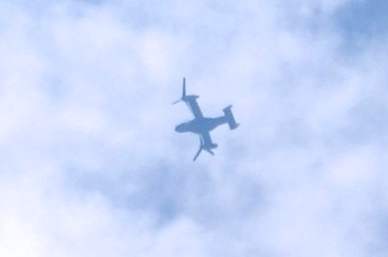
A few days ago, while wandering around a temple in downtown Kyoto, I suddenly heard the sound of unfamiliar aircraft engines. Looking up, I saw the famous V-22 Osprey directly overhead! By eye, the altitude was under 20,000 feet. I immediately grabbed my camera and snapped a quick shot; I didn’t even have time to switch to a telephoto lens. While the photo quality isn’t great, it’s still very easy to distinguish its unique configuration—the large, vectorable rotary propulsion systems on both wingtips.
-
787-8 VS 787-9
Watching the video of the 787-9 released at the Farnborough Airshow, it is incredibly cool. It is powerful, climbing almost vertically like a fighter jet, yet sometimes light and agile like a small general aviation aircraft.
So, what are the specific differences between the 787-8 and 787-9? I checked Boeing's official website and excerpted the information below.
Item 787-8 787-9 787-10 Passengers 242 280 323 Range 7850nm 14500km 8300nm 15372km 7020nm 13000km Fuselage Width 5.74m 5.74m 5.74m Wingspan 60m 60m 60m Length 57m 63m 68m Height 17m 17m 17m Cruise Speed Mach 0.85 Mach 0.85 Mach 0.85 Cargo Volume 4000 cubic feet 5400 cubic feet 153 cubic meters 6187 cubic feet 175 cubic meters Max Takeoff Weight 227 tonnes 252 tonnes 252 tonnes EIS 2011 2014 2018 As you can see, the biggest difference between these models is the fuselage length, which results in different passenger capacities. The 787-9 has 16% more capacity than the 787-8, and the 787-10 has 15% more than the 787-9. However, the weight of the 787-10 is about the same as the 787-9, but its range is significantly reduced, indicating that the fuel tanks are much smaller.
-
Proceedings of the 2014 China Civil Aviation Flight Technology Seminar
I found many excellent learning materials on the website of the China Civil PBN Flight Procedure Design Center. For example, the materials in the “2014 China Civil Aviation Navigation New Technology Seminar” are fantastic. They provide a great understanding of technologies such as Performance-based Navigation (PBN), Automatic Dependent Surveillance-Broadcast (ADS-B), Electronic Flight Bag (EFB), and Head-Up Display (HUD), as well as their domestic implementation trends.
Attachment 1: China Civil Aviation Navigation New Technology Application and Reflections Attachment 2: RNP AR Procedure Design and Application Attachment 3: RNP AR Deployment and Surface Management – An International Perspective Attachment 4: RNP-AR Case Study Attachment 5: RNP-AR Engine Failure Study Attachment 6: Electronic Flight Bag Attachment 7: 4D Configuration Management Attachment 8: Global Aviation Development Status and Latest ICAO Safety and Air Navigation Initiatives and Introduction to PBN Implementation in the Asia-Pacific Region Attachment 9: Navigation Database Coding and Validation Attachment 10: China Civil Aviation ADS-B Planning and Construction Attachment 11: ADS-B Technical Principles and Applications Attachment 12: Application of ADS-B in Airline Dynamic Monitoring Attachment 13: Application of ADS-B in Airlines Attachment 14: Introduction to PBN New Technology Promotion in the Northwest Region Attachment 15: RAIM Availability Prediction Attachment 16: Operation and Development of the BeiDou Satellite Navigation System Attachment 17: Ground-Air Broadband Communication Assisting Civil Aviation Big Data
-
Unique JAL Aviation Tourism Project - JAL Island Hopping
Generally, travel is aimed at sightseeing destinations, be it cultural landscapes or natural scenery; the aircraft is merely a mode of transport. However, in Japan, there is a special travel project where the sole purpose is simply flying. It offers a two-day itinerary for aviation enthusiasts, making it quite unique.
This travel project is launched by Japan Airlines (JAL) and is called “Island Hopping in the Satsunan Islands by Small Propeller Aircraft 2 Days”. The specific content involves taking a small propeller plane from Tokyo or Osaka, and then constantly flying back and forth between the various small islands in the Satsunan Islands.
-
Haneda Airport Expansion Plan
The 2020 Olympics will be held in Tokyo, but as an aviation hub, the throughput of Haneda Airport is approaching its limit, making it difficult to accommodate greater traffic volume.
Therefore, the “Capital Region Airport Function Enhancement Technology Study Subcommittee” of the Japanese Ministry of Land, Infrastructure, Transport and Tourism (MLIT) conducted an investigation and research, publishing improvement proposals last week. These include changing existing Arrival and Departure procedures to increase the number of takeoffs and landings per hour, and there are plans to add a fifth Runway after the Olympics. Let’s introduce a part of the materials below.
-
The Blog Has Been Redesigned
They say it’s a redesign, but it basically just changed the style, switched to the Movable Type Rainier template, because this template offers better support for mobile devices, optimizing display for phones and tablets via Media Queries. Also added a comment section to the blog posts, so readers can give feedback and ask questions directly on the site, hoping this will help improve communication.
If you find any issues after the redesign, please let me know. Thanks.
-
Analysis of Korean Air HL7724 Landing on Taxiway at Akita Airport
After seeing the news about a flight mistakenly landing on a Taxiway yesterday, I looked up some information on this topic. I found a report from the Japan Transport Safety Board regarding the Korean Air incident involving a mistaken landing on a Taxiway at Akita Airport. I decided to study it briefly. (The original report is 30 pages long; here, I have only translated and excerpted a small portion.)
The report is dated November 28, 2008, and the incident occurred on January 6, 2007. The investigation took one year and ten months. The summary of this serious incident is that on that day, a Korean Air Boeing 737-900, registration HL7724, took off from Incheon. When landing on Runway 10 at Akita Airport, it mistakenly landed on a Taxiway parallel to the Runway. This Taxiway is located on the south side of the Runway.
-
Recent Reading Memo 201406
The rainy season isn’t exactly the best time to go out, so I’ve been staying home reading. I thought I’d record a few aviation-related books I’ve finished or am currently reading over the past two or three months. I generally buy used books, either from second-hand bookstores or via auctions on Amazon or Yahoo Japan. Since the quality of used books here in Japan is excellent—clean, with no writing or marks, and printed on good paper—even books from a decade ago look brand new. Lately, I rarely buy new books. (Also to save money.)
-
Using phpVMS and xacars to Log Flight Records
XACARS is a free plugin for X-Plane. It simulates the use of the ACARS protocol to transmit basic aircraft information—such as departure and arrival airports, altitude, speed, heading, etc.—via HTTP to a web server and records it into a server-side database.
phpVMS is open-source software (a web application) for simulating virtual airlines. It allows you to open an airline on the internet where flight simulation enthusiasts can join to execute simulated commercial flight missions and continuously improve their flight ratings.
-
The Aviator's Apple Pie CARNOC Live Show
This site has previously recommended A Dispatcher’s Blog — Flying Apple Pie. Many of his blog posts are highly professional and offer excellent reference value.
Today, I stumbled upon a real photo of him. It turns out his story was featured by CARNOC (Civil Aviation Resource Net). The article is titled Flying Apple Pie — A Profile on Shanghai Airlines Duty Dispatcher Cheng Xu. Congratulations
-
AIP China Updated to amd201403
The China Aeronautical Information Publication (AIP China) I previously compiled hadn’t been updated for a year. Today, I finally gathered all the amendment files from the past year and merged them to upgrade to the latest version amd201403. You are welcome to use it: China Aeronautical Information Publication AIP China version amd201403
-
Houston Beijing Route KIAH - ZBAA Flight Plan
For reference, here is the flight plan information from George Bush Intercontinental Airport (ICAO code KIAH) in Houston to ZBAA in Beijing. The flight time is nearly 15 hours.
KIAH LOA8 FUZ J58 SPS J168 LAA J20 FQF J17 CYS J13 COUTS J516 YQL J510 YYC J485 YXJ BINGA GABUL YXY NCA13 YESKA TED J111 OME FDV G212 ARNAP R213 JMU G212 DABMA W74 SABEM G332 GITUM GIT01A ZBAA
End
-
LFPG - ZSPD Flight Plan: Paris to Shanghai Route
Just a simple note recording the route information from Paris Charles de Gaulle Airport to Shanghai Pudong Airport. Thanks to the senior working at [airline name omitted] for providing this information. Wishing you a prosperous Year of the Horse!
(Actual flight plan, the route below is not classified information, confirmed.)LFPG RANU3E RANUX UN858 MASEK UN851 MAKEL N851 GESKA P605 MALIV P862 LIMAK R822 METAT R30 KTL R22 UNISO A819 LITUN B228 XV R348 BA R104 ABK A308 TR P982 DARNO A575 MU B208 NIXAL G343 TMR X1 JB W159 IDKUP W40 YQG W142 DALIM A593 PIX A470 DALNU W166 ZJ VMB11A ZSPD
-
Learning Python X-Plane Plugin Programming -- PythonInterface Hello World Program
I am not a programmer, nor do I know the Python development language. I purely looked into these materials out of interest, and wrote this simple introductory guide, hoping to cast a brick to attract jade, and look forward to the continuous emergence of more excellent Python plugins in the future.
Resources:
-
The official development documentation is excellent for getting started. This article is based on this document. http://www.xpluginsdk.org/downloads/Using%20Python%20with%20the%20PythonInterface%20Plugin.pdf
-
The sample programs provided by the official source; ultimately, it all comes down to reading the code. This is the best way to learn. http://www.xpluginsdk.org/downloads/PythonScripts.zip
-
-
Comparison of 777-200LR and 777-300ER
The 777-200LR Worldliner is hailed as the world’s longest-range airliner. So, compared to the 300ER, just how much farther can it actually fly? The Boeing official website features a performance comparison of these two models. For instance, the 200LR has a range of 17,395 km, while the 300ER has 14,490 km. The 200LR wins by 2,900 km—truly impressive.
Consequently, the 200LR can operate routes lasting up to 19 hours, such as: New York-Singapore Perth - London New York - Auckland Chicago - Sydney Miami - Taipei It is capable of directly connecting the cities listed above.
-
Notes on Flying in Japan's Air Defense Identification Zone (ADIZ) Based on the Aeronautical Information Manual AIM-J
This week, the Air Defense Identification Zone (ADIZ) has become one of the hottest topics in China, Japan, and the US, following the issuance of relevant regulations by our government:
Statement by the Government of the People’s Republic of China on Establishing the East China Sea Air Defense Identification Zone Announcement of the Aircraft Identification Rules for the East China Sea Air Defense Identification Zone of the People’s Republic of China
I am not a military enthusiast, but since this topic is trending, I decided to check the Aeronautical Information Manual Japan (AIM-J) I have on hand to see what it says about the Air Defense Identification Zone and learn a bit.
-
A Visit to JAL SKY MUSUME and the Maintenance Factory
Recently, I visited the Japan Airlines (JAL) Maintenance Facility located inside Haneda Airport.
 There are dedicated staff members explaining aviation knowledge, allowing you to observe aircraft and the inside of the maintenance facility up close. Best of all, it’s completely free—quite a bargain, isn’t it?
I recommend everyone to go and take a look if you have the chance.
To participate, you need to make a reservation in advance online. The website is here.
You can also find an overall introduction to this tour on the official website.
There are dedicated staff members explaining aviation knowledge, allowing you to observe aircraft and the inside of the maintenance facility up close. Best of all, it’s completely free—quite a bargain, isn’t it?
I recommend everyone to go and take a look if you have the chance.
To participate, you need to make a reservation in advance online. The website is here.
You can also find an overall introduction to this tour on the official website. -
How to Become a Pilot Series
A netizen studying flight in the US, 蘑菇头的小银子, has started writing a series on how to become a pilot. Although it is still under construction, let us follow along and learn from it.
How to Become a Pilot Series (1) —- Preparations How to Become a Pilot Series (2) —- First Semester (Fall) Course Notes on Becoming a Pilot
Looking forward to more updates, keep it up!
-
Introduction to the Blog of Veteran Flight Simulation Enthusiast Fly Pig Club
In the world of the flight simulator X-Plane 10, I generally grab the charts I have on hand, pick a familiar place, and go for a leisure flight; or use the X-Plane world terrain to take an aerial tour before or after traveling to a location; or fly over for a stroll after seeing a scenic spot introduced on TV or a website.
The aircraft I mainly use are the Piper PA-28 and Cessna 152. Basically, over 98% of the time, I fly single-engine piston propeller planes for VFR flights. I observe the terrain using pilotage while looking for the next Waypoint, just strolling around leisurely. If there are too many clouds to see the ground, I refer to the VOR or similar instruments; anyway, I don’t do much IFR.
-
A Taiwan Captain's Flight Guide (Personal Biography)
I stumbled upon a blog that appears to be the personal biography of a senior captain from Taiwan. It is titled 初學飛行者指南 (Guide for the Beginning Pilot). It has just started serialization and is constantly being updated.
Here is the introductory text from the site:
“For friends who have a special passion for aviation or plan to learn to fly in the future, we have carefully curated a long-form serialized novel based on a true story (Guide for the Beginning Pilot – tentative title) for you. You can learn from the protagonist’s valuable lessons before you even start your flight training.”