Aviation Around Us
-
Clouds Over the Airport
The shapes of clouds are always changing; no two clouds in the world are exactly alike. If the clouds near the airport display distinctive shapes, and an aircraft happens to fly into the frame, it presents a perfect photo opportunity.
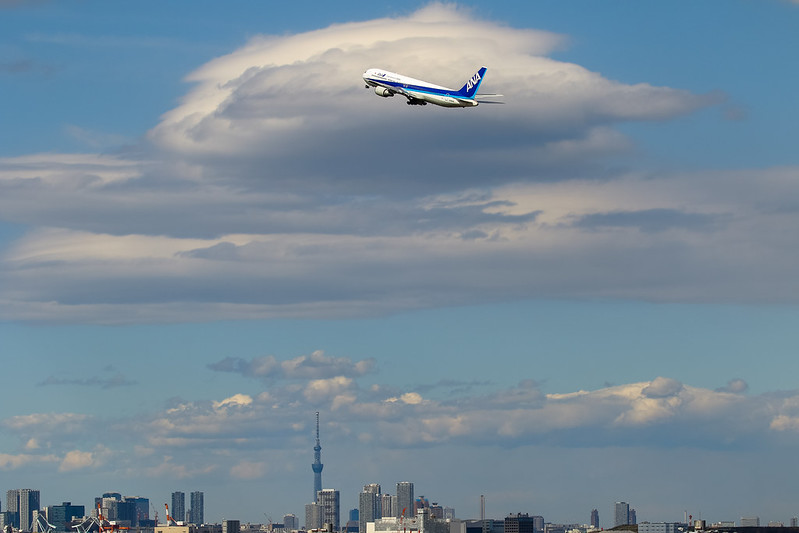
At Haneda Airport, large white cumulus clouds appear in the background. An aircraft taking off from Runway 34R has just lifted off, and for those few seconds while retracting the landing gear, the high-rise buildings of downtown Tokyo serve as a perfect backdrop.
-
Suction Mount for iPad in the Cockpit
Continuing from the topic of photography at Haneda, speaking of watching the ANA pilot perform pre-flight preparations,
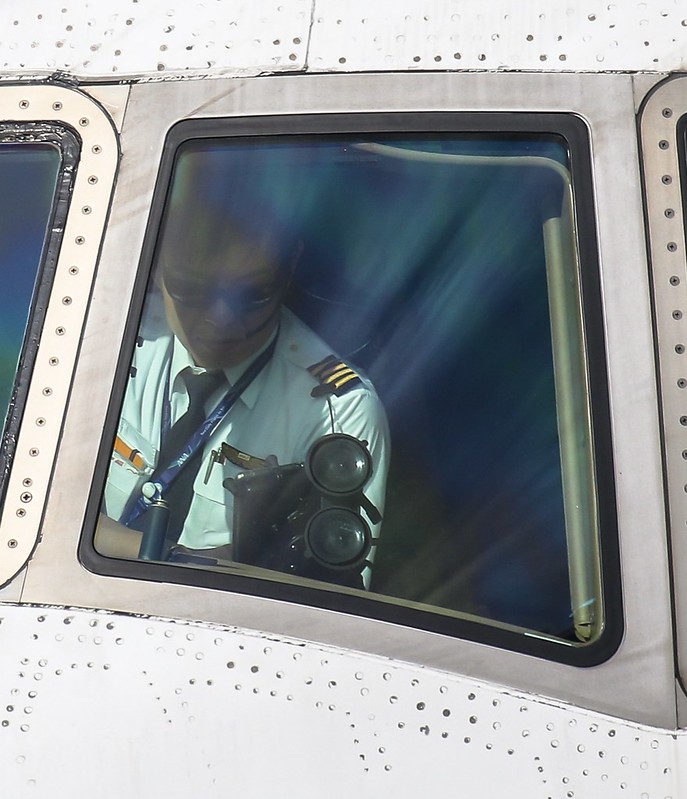 They used a suction cup mount to fix an iPad to the cockpit windshield glass,
A detail I hadn’t paid much attention to before.
They used a suction cup mount to fix an iPad to the cockpit windshield glass,
A detail I hadn’t paid much attention to before.It is hardly news that pilots use iPads as EFBs for flight management, etc., There were Japanese news articles introducing ANA’s usage methods a few years ago, For example: 事例で学ぶiPhone/iPad活用術 ANAがパイロット2,500名にiPadを配布 - ドラム缶28万本の燃料を削減; iPadありき、ではないANAパイロットへの導入 EFBやマネジメント改善視野に──雲上のiPad活用術, This includes flight plan management (number of passengers, cargo weight, fuel load adjustment, etc.), charts, cloud charts, weather maps, turbulence information, and more. However, due to legal regulations at the time regarding the use of electronic products on board, they could not be used during flight.
-
Hummingbird Departure Procedure
The names of airport departure procedures are usually named after waypoints, which can sound quite boring. But Tokyo Haneda Airport has a departure procedure with a beautiful name, called the “Hummingbird Departure SID”.
Why am I mentioning this SID? Because a couple of days ago, a relative was on a business trip and sent me this photo via iPhone:
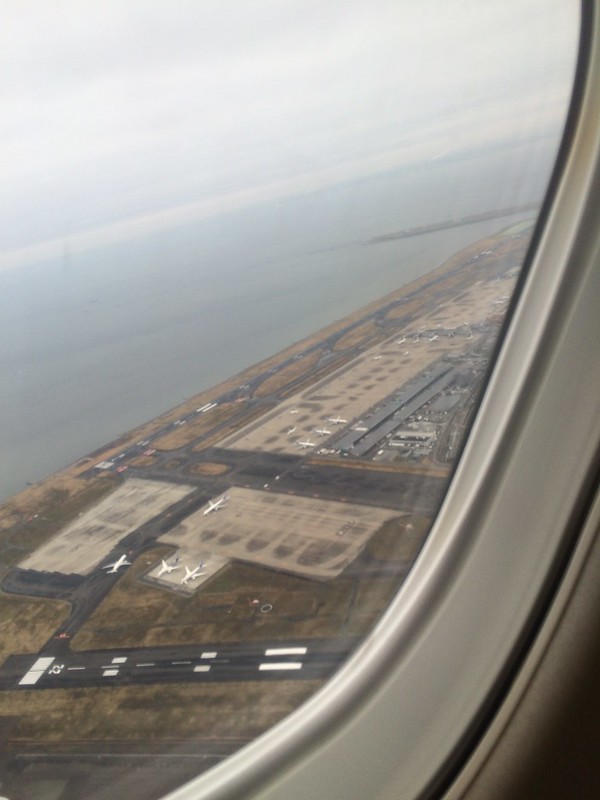 Looking closely, isn’t this the famous Hummingbird Departure procedure? I was quite envious.
 -
How Much Fuel Is Prepared for a One-Hour Flight?
Another low-pressure day, with persistent rain—perfect for staying in and organizing photos. I found this shot I took a few months ago from the observation deck at Terminal 2 of Haneda Airport. It shows an Obbli ground crew refueling an All Nippon Airways (ANA) Boeing 787-9 for a Tokyo-Osaka flight. On the left, a female pilot is performing a walk-around inspection.
After they finished fueling, I got curious about the actual amount, so I zoomed in with my telephoto lens and got this result:
-
GBAS and GLS
GBAS: Ground-Based Augmentation Systems, a satellite navigation augmentation system where user receivers receive navigation enhancement information from ground transmitters. It consists of three parts: a space navigation satellite constellation system, a ground augmentation system, and an airborne receiver system.
GLS: GBAS Landing System, a satellite landing system based on GBAS navigation performance enhancement. It includes the GBAS system enabling precision approach and landing, as well as related aircraft functions.
The traditional Instrument Landing System (ILS) relies on technology from the 1930s. It provides approach and landing guidance to aircraft through multiple pairs of antennas installed for each Runway, thereby helping aircraft land accurately on airport Runways.
-
On the Use of the Chinese Aeronautical Information Publication EAIP
After using the China Aeronautical Information Publication (AIP) website for over a year, they have changed their policy. Now, individuals generally cannot query the latest charts for free, which is a great pity.
However, it seems that data from 2015 is still accessible, for example: eaipchina.cn/Version/201512 www.aipchina.org/Version/201512 Although it is unknown whether these will be taken down in the future, at least for now, everyone can continue to query them for free.
In addition, I found an app for mobile devices called eAPI-China: eAIP-China iOS version, eAIP-China Android version You can also view Chinese charts on it. Although it is not officially offered on the App Store, it seems to allow free queries. Friends with iPhones and iPads can give it a try.
-
Website Now Supports HTTPS
Recently, SSL-enabled websites have become the mainstream standard. Since all HTTP communication is encrypted, visitors feel a greater sense of security. Additionally, search engines like Google have started to prioritize HTTPS websites, giving them higher placement in search results.
To keep up with this trend, I have imported an SSL certificate for this site and changed the default access address to HTTPS. Of course, HTTP access remains available as before.
-
GPS Navigation Regulations
I checked the updates to the Japan eAIP and found a new supplement regarding the GPS navigation regulations below:
“AIC Nr 004/16 Operational Standard for the use of GPS when flying under Instrument Flight Rules GPS を計器飛行方式に使用する運航の実施基準”
The content is:
“1-3 Policy for the Use of GPS Because GPS do not fully meet the performance requirements applicable to a sole-means of navigation, they shall be augmented to be used for navigation, if needed.
-
Using simbrief.com Maps to Check Routes and Waypoints
I have previously recommended using the most powerful route query tool simbrief.com to query flight routes, Recently, I found that its map function is also very good, providing information such as Waypoints on a single screen.
For example, if you are just looking at the route, skyverctor is indeed sufficient, Looking at the simbrief.com display below, there isn’t a huge advantage,
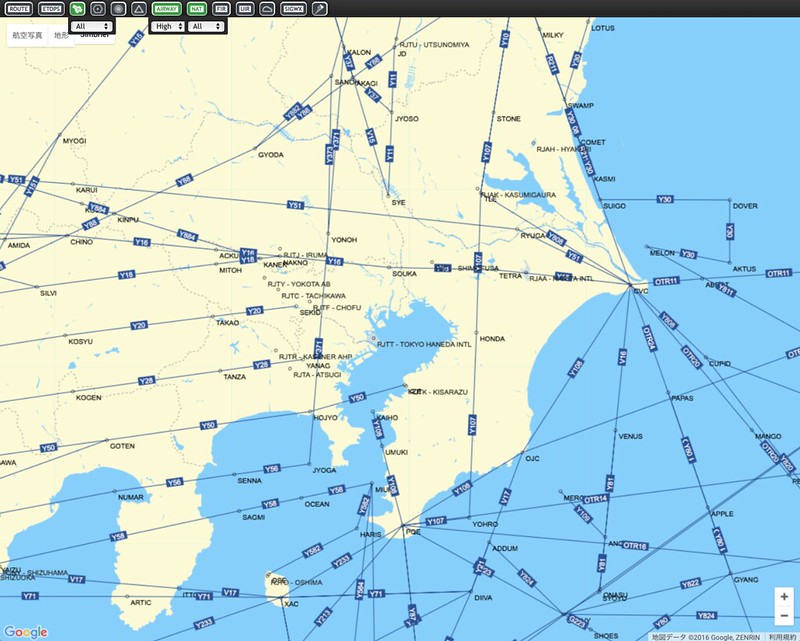 But if you select the AIRWAY point in the toolbar at the top of the screen,
You can immediately see the Waypoints displayed,
But if you select the AIRWAY point in the toolbar at the top of the screen,
You can immediately see the Waypoints displayed, -
Center Main Landing Gear Not Extending
I came across an article online that mentioned there is a landing gear between the left and right main landing gears of the MD-11. This landing gear is generally extended during takeoff and landing. However, when the aircraft is empty, this landing gear does not need to be deployed. The remaining landing gears are sufficient to absorb the impact upon landing, so doing this can reduce tire wear, serving to save on maintenance costs.
-
A Visit to the JAL Safety Promotion Center
I have previously written notes on the JAL123 crash, and I was deeply impressed by this air disaster, which involved the largest number of fatalities on a single aircraft in aviation history.
To improve safety awareness among its employees, Japan Airlines (JAL) specifically established the Safety Promotion Center in the maintenance building at Haneda. They display wreckage from flight JL123, belongings of the passengers, etc., and it is open to the public for safety-related companies and individuals to visit.
-
Landing Gear Override Trigger
Take a look at FlightDeck Solutions’ B737NG Landing Gear Lever. The product is crafted with great precision, including this red Landing Gear Override Trigger:
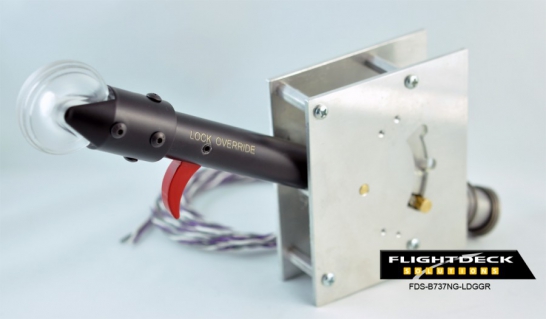 Of course, in the world of flight simulation, this Override Trigger is just a cosmetic piece and doesn’t actually work.
So, what is its purpose in reality?
Of course, in the world of flight simulation, this Override Trigger is just a cosmetic piece and doesn’t actually work.
So, what is its purpose in reality?Below is an excerpt from the textbook “Turbine Engine Aircraft Structure and Systems”.
When the landing gear lever is in the “UP”, “DOWN”, or “OFF” position, there are detents to secure it, preventing the landing gear from being retracted due to accidental contact. In the air, the pilot must pull the lever out to move it.
-
Special Departure Frequencies: A Look at China's Aviation Safety Reporting System SCASS
Reviewing the terminology one last time against the provided tables.
- 离场 - Used Departure.
- 频率 - Used Frequency.
- 高度 - Used Altitude.
- 改平 - Used Level Off.
- 西离场 - Used West Departure.
- 离港程序 - Used Departure Procedure (SID is the code, Departure Procedure is the term).
- 情境意识 - Situational Awareness (Standard Aviation English).
- 特情 - Emergency / Abnormal Situation.
- 管制员 - Air Traffic Controller.
Everything looks solid.
One tiny detail: “离场时更换管制频率”. My translation: “Changing Control Frequency During Departure”. This is a noun phrase suitable for a title/link.
-
Let's Check the Domestic Content Ratio of the MRJ
In modern aircraft design and manufacturing, it is standard practice to select required products from major component suppliers and integrate hundreds of thousands to millions of components. A 100% domestic production rate is completely unnecessary; just look at the example of the MRJ.

Components Parts Region Supplier Location Partner Slats, Flaps, Fairing, Rudder, Elevator, Aileron, Spoiler Slats, Flaps,
Belly Fairing, Rudder,Elevator, Aileron, SpoilersTaiwan Aerospace Industrial Development Corp. Taiwan AIDC Doors Doors Europe Airbus Helicopters Europe Airbus Helicopters Speakers, Communication Controllers, Handsets Speakers, Controllers, Handsets USA AvtechTyee USA AvtechTyee High Pressure Air Duct System High Pressure Duct France Daher Group France Daher Overhead Control Panel, Cockpit Control Panel Overhead Control Panel, Cockpit Control Panel USA Esterline Technologies USA Esterline Wiper System Wiper System France Falgayras France Falgayras Cabin Windows Cabin Windows UK GKN Aerospace UK GKN Aerospace Inertial Reference System Inertial Reference System USA Honeywell Aerospace USA Honeywell Cabin Lighting System Interior Lighting Japan Koito Manufacturing Japan Koito Tail Cone Fairing Tail Cone USA LMI Aerospace USA LMI Aerospace Airframe Structure and Flight Control Bearings Airframe Structure, Flight Control System Bearings Japan Minebea Japan Minebea Airframe Manufacturing Airframe Manufacturing Japan Mitsubishi Heavy Industries Japan Mitsubishi Heavy Industries Flight Control Actuation System Flight Control
Actuation SystemJapan Nabtesco Japan Nabtesco Hydraulic System Hydraulic System USA Parker Aerospace USA Parker Aerospace Cockpit Windshield Windshield USA PPG Aerospace USA PPG Aerospace Engine, APU Engine
Auxiliary Power UnitUSA Pratt & Whitney USA Pratt & Whitney Flight Instruments, Flight Control Computers, Pilot Control System, Horizontal Stabilizer Trim System Avionics,
Flight Control Computer,
Pilot Control System,
Horizontal Stabilizer
Trim SystemUSA Rockwell Collins USA Rockwell Collins Radome Radome France Saint-Gobain France SAINT-GOBAIN Low Pressure Air Duct System Low Pressure Duct UK Senior Aerospace BWT UK Senior Aerospace BWT Rack, Pinion Rack, Pinion Japan Shimadzu Corporation Japan Shimadzu Engine Pylon Pylon USA Spirit AeroSystems USA Spirit Aerosystms Landing Gear Landing Gear System Japan Sumitomo Precision Products Japan Sumitomo Precision Products Cabin Curtains, Carpets Cabin Floor Carpet, Curtains Japan Tatsumura Textile Japan Tatsumura Health Monitoring Unit Health Monitoring Unit USA Teledyne Controls USA Teledyne Controls Door Controller, Landing Gear Control Unit Door, Landing Gear Interface UK Ultra Electronics Controls UK Ultra Electronics Controls Air Conditioning, Explosion Proof, Power Supply, High Lift, Fire Protection, Lighting, Various Interior Equipment Air Conditioning System, Explosion Proof System,
Power System, High Lift System,
Fire Protection System, General Lighting,
Individual Equipment (Electrical/ Mechanical)USA UTC Aerospace Systems USA UTC Aerospace Systems Interior Equipment (including Galley/Lavatory), Waste/Water System, Economy Class Seats, Business Class Seats, Fuel System, Attendant Control Panel Interior (Galley, Lavatory included),
Waste/Water System, Economy Seats,
Premium Seats, Fuel System,
Attendant Control PanelFrance Zodiac Aerospace France Zodiac Aerospace Website, Spare Parts Selection Support, Airframe Monitoring Web Portal,
Spare Parts Selection Support,
Airframe Health Monitoring, etc.USA Boeing USA Boeing Training Simulator Training Canada CAE Canada CAE Manuals Manuals Sweden SAAB Group Sweden SAAB End
-
Hawaiian Airlines In-flight Safety Video
Following up on the previous notes, I’d like to continue writing about the joys of flying. For instance, watching the safety video on board is actually quite interesting.
It is said that Hawaiian Airlines updated its video (Hawaiian Airlines In-Flight Safety Video) starting from August 19th this year, changing the traditional approach of crew members wearing uniforms to demonstrate inside the cabin. The exterior shots for the video were selected at various famous tourist attractions in Hawaii, such as cliffs, beaches, and volcanic lava zones. The scenery is beautiful, which also serves as a tourism promotion, achieving two goals at once. When explaining the safety equipment, company employees wear various ethnic costumes or casual wear, creating a relaxing effect for the audience. I wonder if this helps passengers who get nervous as soon as they board the plane feel better? The video was filmed in 5 languages: English, Hawaiian, Japanese, Chinese, and Korean, showcasing their emphasis on tourists from Asia.
-
Gqrx 20150906 Upgrade
The Gqrx version update adds the long-awaited bookmark feature, making it increasingly convenient to listen to the radio and ATC on the computer.
The specific installation method is as follows:
1 sudo port -v selfupdate 2 sudo port -v upgrade outdated
Encountering a “gnuradio-analog not found” error here, I executed:
3 sudo port install gnuradio
to install gnuradio, and then executed command 2 again.
2 sudo port -v upgrade outdated
-
Revisiting the Aviation Science Museum
I previously wrote about the Flea Market at the Museum of Aeronautical Sciences, which is held at Narita on the first weekend of March and September every year. In the blink of an eye, it was early September, so I made a run for it over the weekend.
The Museum of Aeronautical Sciences opens at 10:00 AM, and I arrived basically at 10:00. However, entering the flea market required queuing for a number; I got number 270. Just look at this long line. Fortunately, reviewing things like the JT8D, the 757 tail, and the DC8 landing gear kept me from getting bored.
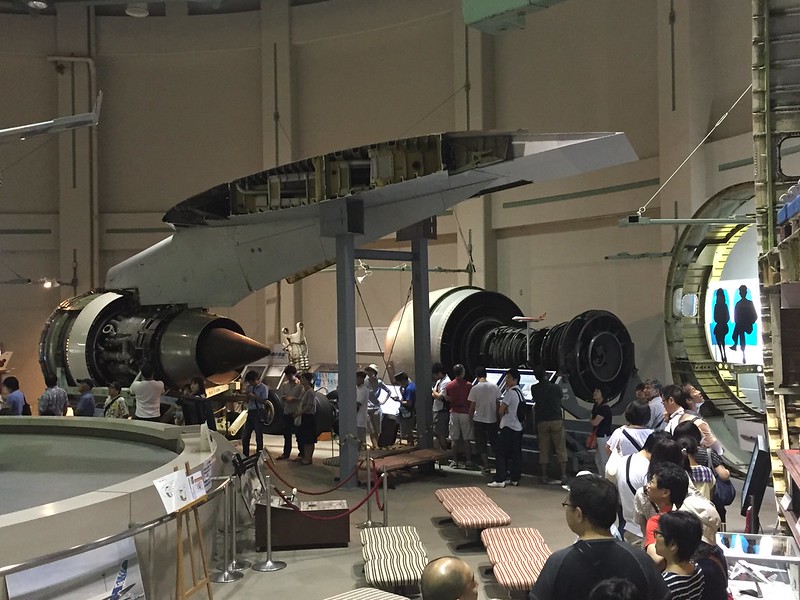 Later, I saw in the news that the earliest arrivals actually started queuing at 5:00 PM the previous day. I really admire their enthusiasm.
 -
SkyVector Introduces Flight Planning Feature
I opened SkyVector today to check the charts and found that the Flight Plan feature has been improved. It allows for creating very nice flight plans, which I highly recommend. However, you need to register an account to use this feature.
This is the data entry screen. Put the Waypoints in. For example, the image below shows the route from Tokyo to Shanghai.
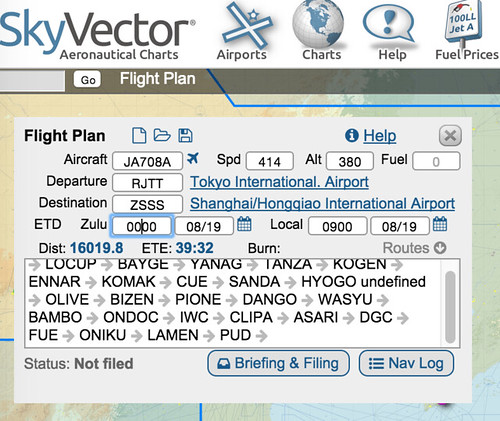 The entire route will then be displayed on the map.
 -
Uneven Runway
I previously wrote a post about the 360-meter extension of Haneda Airport’s Runway C. Today, I checked the latest AIP again and found this diagram quite interesting, so I’m posting it here for a look.
This is a runway slope diagram for RJTT. You can see that each runway has ups and downs; they are surprisingly uneven.
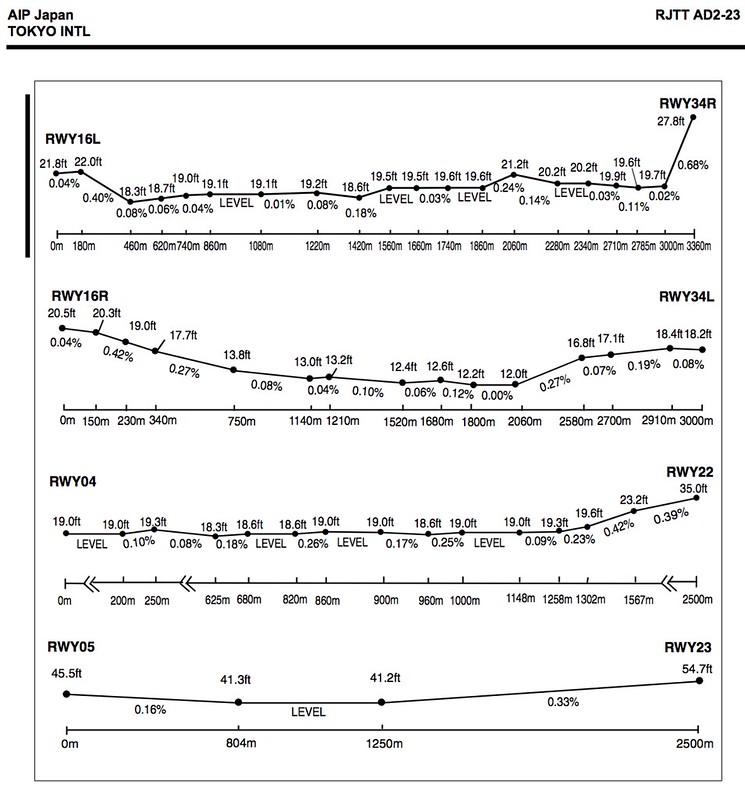 The common feature is that the runway thresholds are higher, while the middle sections are lower.
This is likely to ensure visibility during takeoff and landing.
The common feature is that the runway thresholds are higher, while the middle sections are lower.
This is likely to ensure visibility during takeoff and landing. -
Chongqing Jiangbei Airport Implements New Taxiway Numbering
Checking the news at Chongqing Jiangbei Airport officially启用s new Taxiway numbering and AIP 2015 Nr.08, the long-criticized “double-letter” taxiway numbering format at this airport has finally been changed to the standard “letter-plus-number” format, and officially commenced operations on July 23.
Comparing the new and old airport diagrams, first look at the previous numbering,
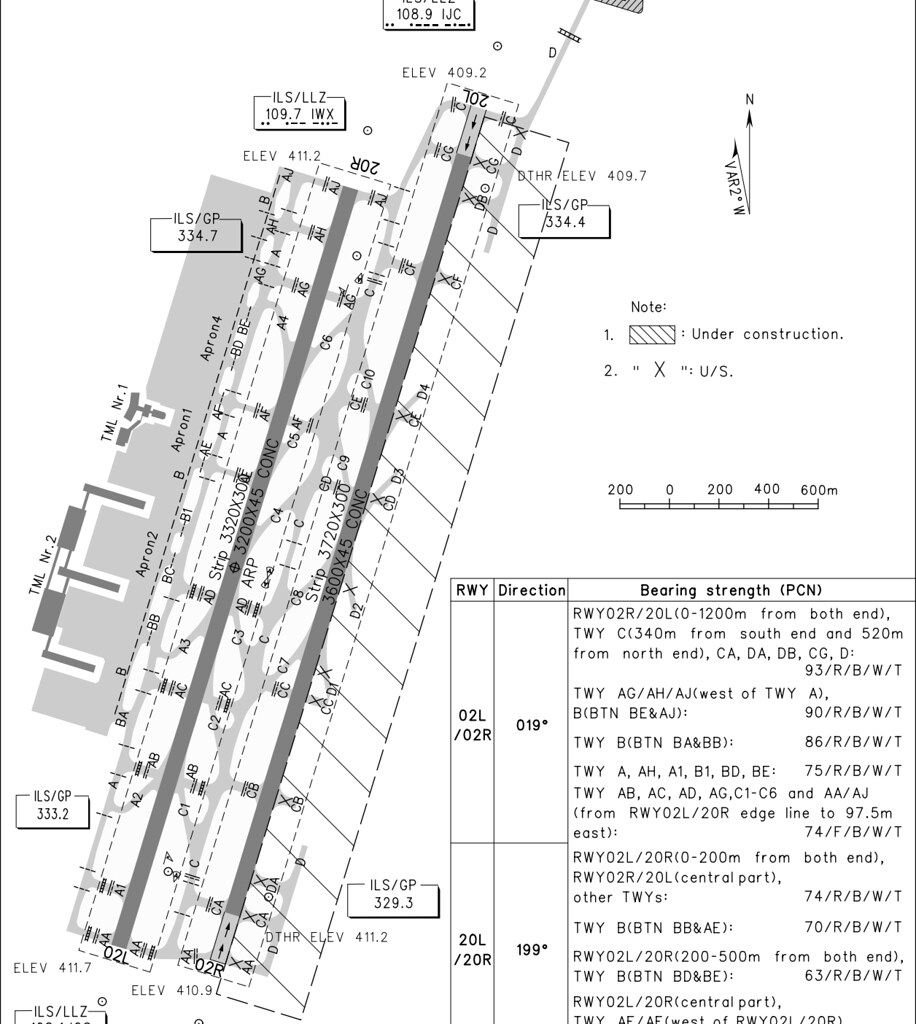 For example, the exit numbers on the Taxiway in front of the Apron are AJ, AH, AG, BE, BD, AF, AE, B1, BC, BB, BA,
showing no discernible pattern; it must have been very effortful for pilots to locate them on the charts every time.
For example, the exit numbers on the Taxiway in front of the Apron are AJ, AH, AG, BE, BD, AF, AE, B1, BC, BB, BA,
showing no discernible pattern; it must have been very effortful for pilots to locate them on the charts every time.