Posting old photos during the COVID-19 pandemic 21 The last production Boeing 727
Continuing my series of posting old photos during the COVID-19 pandemic, today I’m posting the Boeing 727. All photos were taken at the 2018 Farnborough Airshow.
Takeoff


The introduction on wikipedia is as follows:
The Boeing 727 is a medium-range, three-engine, narrow-body passenger aircraft produced and developed by the American Boeing Company. It has a seating capacity of 149 to 189 people and a range of 2,400 to 2,700 nautical miles. The Boeing 727 uses Pratt & Whitney JT8D engines, a T-tail, and places the engines at the rear of the fuselage. The No. 2 engine is located above the fuselage and below the tail, connected to the intake by an S-duct.The Boeing 727 inherited the success of the Boeing 707, using the same cockpit design and fuselage cross-section. The first Boeing 727-100 flew in 1963 and was delivered to Eastern Air Lines the following year to enter service. The Boeing 727-200 is a stretched fuselage version, which flew for the first time in 1967 and was delivered to Northeast Airlines for service. During its production run, the Boeing 727 was the main aircraft type for US domestic routes as well as medium and short-range international routes. The Boeing 727 also has a freighter version and a passenger-freighter convertible version.
The last 727 was delivered in 1984 with a total production of 1,832 units, making it the highest-producing civil aircraft model at the time, a record broken by the Boeing 737 in the early 1990s. As of July 2017, there were still 2 Boeing 727-100s and 55 Boeing 727-200s in operation globally. Affected by civil aviation noise regulations, some Boeing 727s are required to install noise reduction devices (hush kits) to continue operating, but this device increases fuel consumption.
On January 14, 2019, with the retirement of the last 727-200ADV (registration EP-ASB) of Iran Aseman Airlines, the Boeing 727 officially exited the passenger market.
The Boeing 727-200F is the full freighter version of the -200Adv, featuring a reinforced floor, a Boeing 707-style cargo door, the removal of all passenger windows, and the ability to carry up to eleven cargo containers totaling 60,000 pounds of cargo. The aircraft uses JT8D-17A engines with a Thrust of 16,000 pounds-force, saving about 5% fuel. The first 727-200F flew on April 28, 1983, and 15 were produced in total. The last one was delivered to FedEx on September 18, 1984..
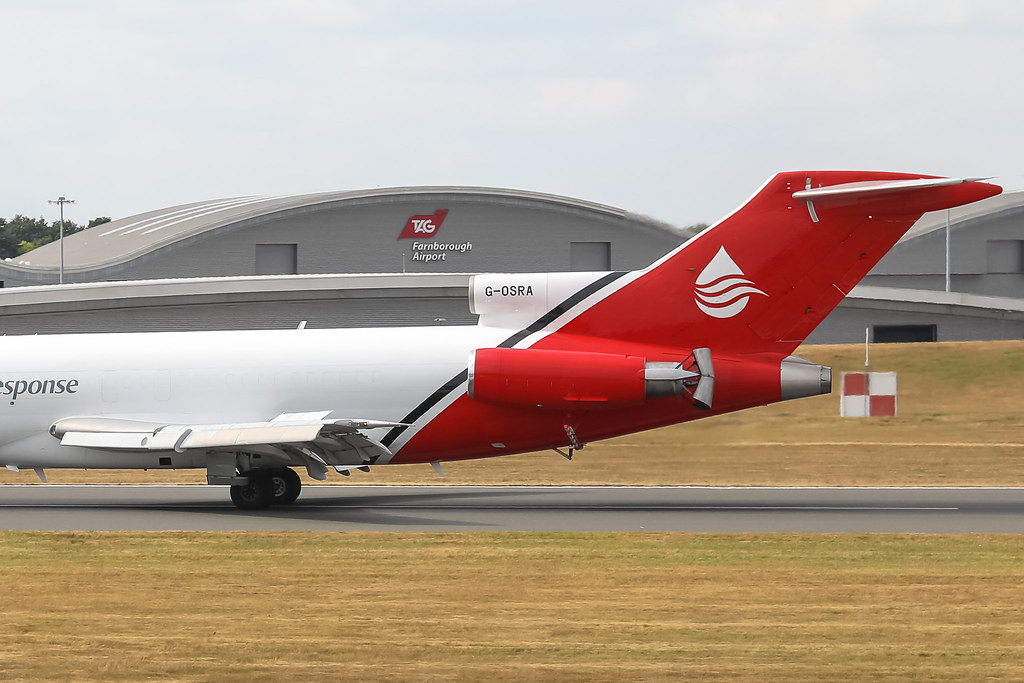
The registration number of the 727 performing at this Farnborough Airshow is G-OSRA, purchased by British 2EXCEL AVIATION from FedEx in July 2013. During its service with FedEx, the aircraft’s registration was N217FE, and it entered service in September 1984. It is claimed that N217FE was the last Boeing 727 produced by Boeing, so being able to photograph this airframe is very memorable.
Aerial Formation Flight


Landing


Ground Taxiing


The wings of the Boeing 727 are equipped with high-lift devices, allowing the aircraft to take off and land on short runways.Since there are no engines on the wings, the entire wing can use leading-edge devices and trailing-edge lift-increasing devices, raising the wing lift coefficient to 3.0.
The Flaps use a triple-slotted design, providing sufficient Lift at low speeds. The aircraft has a total of 6 wheels, and its landing gear can withstand 60,000 landings, and is capable of deploying the landing gear solely by Gravity.
The aircraft is equipped with two sets of hydraulic systems and one backup hydraulic system.
In addition, the aircraft is equipped with an Auxiliary Power Unit (APU), allowing the aircraft to operate on the Apron without needing external ground power generators, and can automatically provide the aircraft with necessary electricity, hydraulic pressure, and air conditioning.
Regarding wing design, Boeing proposed three designs, including an endplate vertical tail, a T-tail, and a V-tail. The T-tail design was ultimately adopted. Although structurally complex, this design prevents the horizontal tail from being damaged by the aircraft’s reverse Thrust and allows the horizontal tail to avoid the influence of wing wake turbulence.
Now let’s look at some details of the airframe



End