China's Civil Aviation Undergoes Largest Airspace Adjustment in History, Viewed from Air Routes near Beijing
Seeing yesterday’s news “Chinese civil aviation welcomes the largest airspace adjustment in history”, this is truly a major event, so I have transcribed the details below:
Yesterday morning, China adjusted over 4,000 flight routes, marking the largest airspace adjustment in the history of Chinese civil aviation. Moving forward, the "sky roads" over Beijing have undergone a major update, making the "paths" for air travel "wider and smoother."At 02:00 yesterday morning, it was established as the effective date for the operational Aeronautical Information Services (AIS) for China’s newly built airport—Daxing International Airport. Consequently, the adjustments involving the new airport Runway, major flight procedure changes, major airspace adjustments, and Airway/route alignment adjustments all came into effect. Nationwide, over 200 Airways and routes were adjusted, and the alignment of over 4,000 flight routes was changed, forming a completely new airspace operational environment. Chinese civil aviation has welcomed the largest airspace adjustment in its history.
This airspace adjustment extends north to the China-Mongolia border, south to the Guilin Control Area, west to western Inner Mongolia, and east to the Dalian Control Area, spanning 1,350 kilometers from east to west and 2,200 kilometers from north to south. Over 200 Airways and routes were adjusted, adding approximately 4,700 kilometers to the route network; the alignment of over 4,000 flight routes was adjusted, involving an estimated 5,300+ flight movements daily; over 100 new Waypoints were added, and 29 civil aviation transport airports nationwide adjusted their flight procedures accordingly.
Yesterday, the northern section of the Jing-Guang (Beijing-Guangzhou) Air Corridor was simultaneously completed, marking the basic completion of the one-way transformation of the Beijing-Wuhan section of the Jing-Guang Air Corridor. The northern section renovation project is an important component of the peripheral airspace adjustment for Beijing Daxing International Airport. The completion of this key node lays an important foundation for the full-line upgrade and renovation of the Jing-Guang Air Corridor. The approximately 2,000-kilometer-long Jing-Guang Airway connects the Beijing-Tianjin-Hebei region and the Guangdong-Hong Kong-Macao Greater Bay Area, two major world-class urban agglomerations. It is a vital north-south air corridor in China, a major north-south traffic artery of the national airway network, and the busiest main trunk airway in the country, holding extremely important strategic status. To date, the average daily traffic flow on the Jing-Guang Airway exceeds 1,000 flight movements.The successful opening of Beijing Daxing International Airport marks the official formation of the “Two Cities, Three Airports” pattern (Beijing and Tianjin; Daxing International Airport, Capital International Airport, and Binhai International Airport) in the Beijing-Tianjin-Hebei region. One Terminal Area, two cities, and three ten-million-passenger-volume airports—this is a first in the history of Chinese civil aviation. The Beijing Terminal Control Area, which officially became effective at 00:00 on October 10, has expanded its jurisdiction airspace to 34,500 square kilometers, double the area of the current Beijing Terminal Control Area. Within the area, 40 Arrival routes and 97 Departure routes connect to main trunk Airways through 18 entry and exit points. The Terminal Area has generally formed an “8 Arrivals, 10 Departures” operational mode, serving 9 Runways in the area.
It is also understood that large-scale Airway adjustments require the aeronautical information department to issue aeronautical information materials in a timely manner based on changes. The Aviation Information Service Center of the Air Traffic Management Bureau of the Civil Aviation Administration of China (CAAC) completed the release of aviation materials for Beijing Daxing New Airport and surrounding airports and Airway adjustments on September 3. The published aviation materials include domestic aviation materials for 38 airports including Beijing Daxing (including 12 airports open to foreign aircraft), totaling 2,479 pages.
To facilitate a comparison before and after the adjustment, this site has posted the new and old versions of several Enroute Charts for your reference.
<a href=/x-plane10/view.php?file=doc/ERC1.pdf>New High Altitude Enroute Chart ERC1
<a href=/x-plane10/view.php?file=doc/ERC2.pdf>New High Altitude Enroute Chart ERC2
<a href=/x-plane10/view.php?file=doc/ERC3.pdf>New High Altitude Enroute Chart ERC3
<a href=/x-plane10/view.php?file=doc/ERC4.pdf>New High Altitude Enroute Chart ERC4
<a href=/x-plane10/view.php?file=doc/ERC1.old.pdf>Old High Altitude Enroute Chart ERC1
<a href=/x-plane10/view.php?file=doc/ERC2.old.pdf>Old High Altitude Enroute Chart ERC2
<a href=/x-plane10/view.php?file=doc/ERC3.old.pdf>Old High Altitude Enroute Chart ERC3
<a href=/x-plane10/view.php?file=doc/ERC4.old.pdf>Old High Altitude Enroute Chart ERC4
Additionally, since the scope of this adjustment is so vast, I have only clipped a section of the airspace near Beijing—the “Two Cities, Three Airports” Terminal Area.
For the new Airways effective October 10, the central section shows Beijing Capital Airport (green) and Beijing Daxing Airport (red).
The VOR above Capital Airport is HUAIROU (HUR 116.3),
connecting Airways W64, W69, B339, B334, W49, W64;
The VOR below Daxing International Airport is DAWANGZHUANG (VYK 112.7),
connecting Airways B215, G212, W56, W37, W157, W40, G212.
 Airways prior to October 10, where the central section did not yet have Daxing Airport,
 You can see the changes are too drastic, so I won’t bother with a tedious comparison of Waypoints here…
Also, looking at the Beijing Capital Airport charts,
<a href=/x-plane10/view.php?file=doc/ZBAA.pdf>Beijing Capital International Airport Charts ZBAA Beijing Capital
The new Arrival and Departure procedures have become very concise, totaling only 4 pages.
Combined with the high-altitude Enroute Charts posted above, they are quite easy to understand.

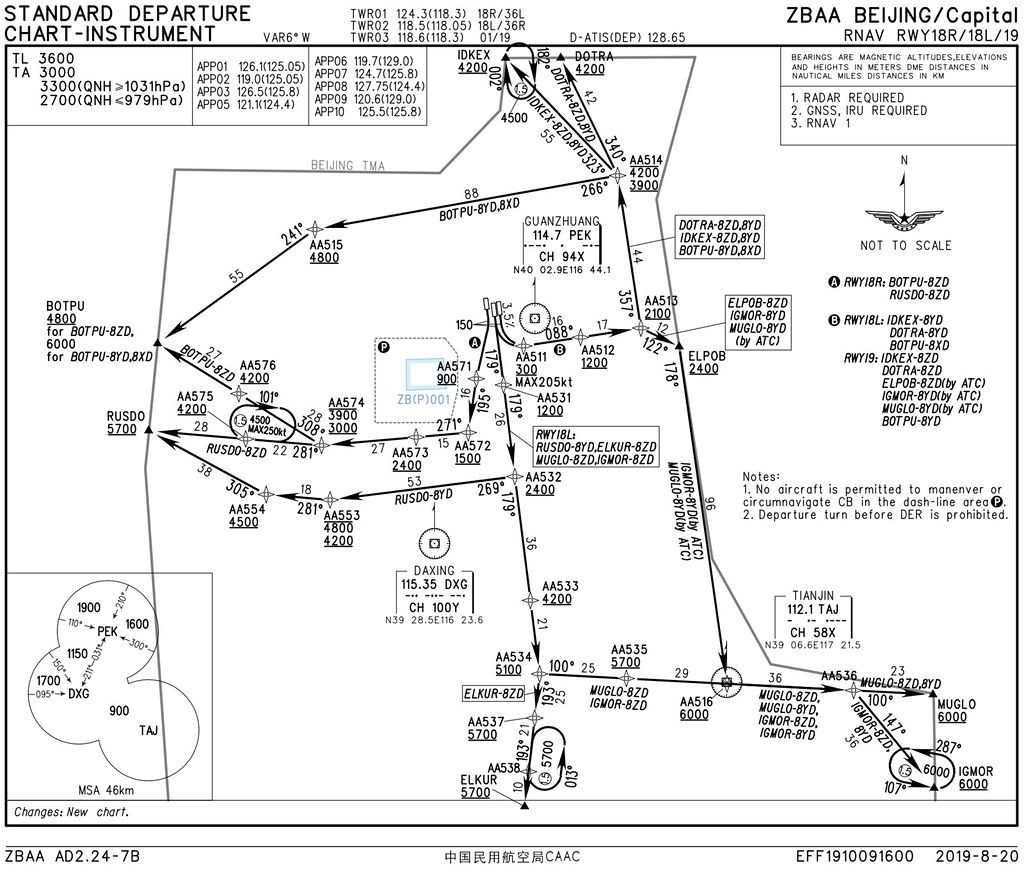

 Here, for the sake of comparison, I have also posted the old charts for your reference.
<a href=/x-plane10/view.php?file=doc/ZBAA.old.pdf>Old Beijing Capital International Airport Charts ZBAA Beijing Capital
Here, for the sake of comparison, I have also posted the old charts for your reference.
<a href=/x-plane10/view.php?file=doc/ZBAA.old.pdf>Old Beijing Capital International Airport Charts ZBAA Beijing Capital