Watching the J-20 at the 2018 Zhuhai Airshow
Ever since making a connection with the Zhuhai Airshow two years ago (please see Unexpected Gains from Zhuhai Airshow 2016), my colleagues Mr. K and Mr. T and I made a pact to return together this year.
As an aviation enthusiast, I wouldn’t call myself a military fanatic, and I don’t have a special passion for fighter jets. However, seeing many friends on Weibo/Moments/Twitter heading to the south side shooting spot “Gun Tower” or the Back Mountain of Zhuhai Airport since late October, such as Taihu Shage and Aviation New Vision - Chibi, whom I met at the Royal International Air Tattoo, and seeing the massive amount of high-definition photos of the stealth fighter J-20 they took, I was truly envious.
However, our scheduled itinerary was merely a short two days: going to the “Gun Tower” on Saturday, November 10th, and shooting inside the airshow venue on the 11th. Especially since the 11th was completely backlit, I didn’t hold much hope for the shooting results.
Surprisingly, this year’s Zhuhai Airshow didn’t feature a single foreign aerobatic team. From the perspective of an aviation enthusiast, this might be considered a very “lackluster” airshow. But luckily, there was the star J-20; as long as I could capture it, the trip would be worthwhile.
November 10th Air Display
On November 10th, we took a taxi from downtown Zhuhai to the “Gun Tower” just before 4 AM. It was cloudy all day, and I wasn’t satisfied with the photos, but I’ll勉强 post a few here.
Two-ship formation, aircraft numbers 78232 and 78233
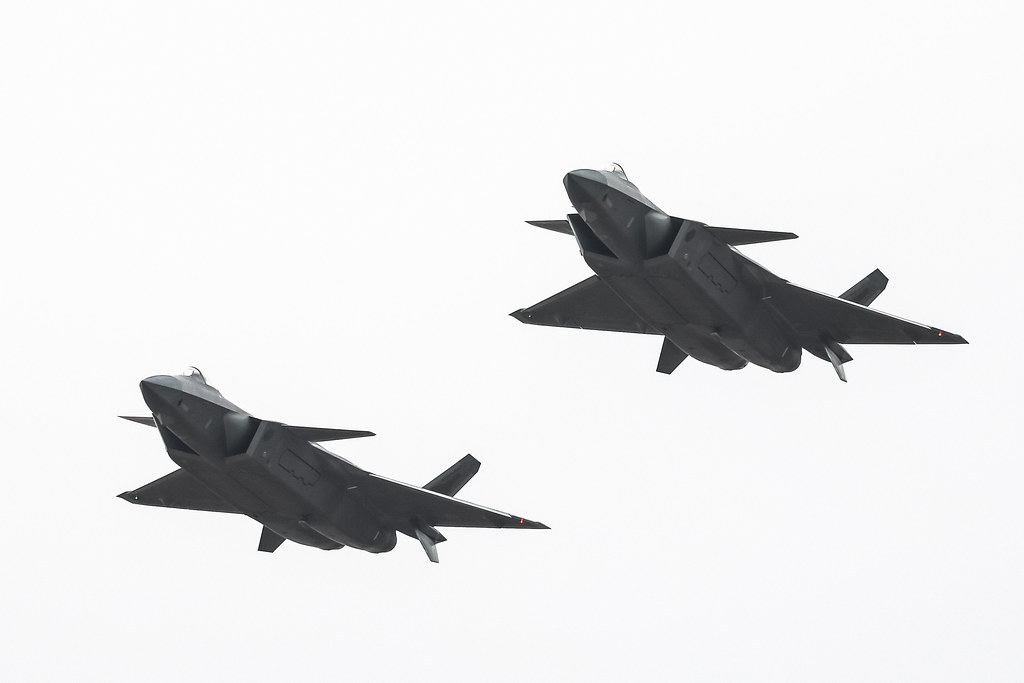
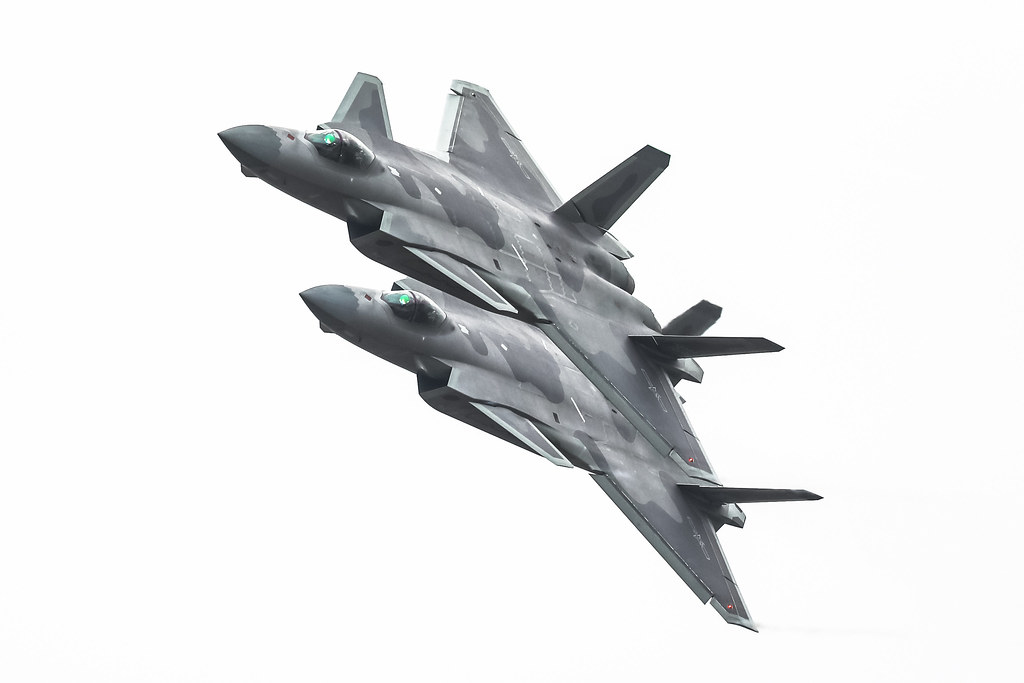 Lead 78232 and wingman 78233 in a level circle with a high roll angle,
The leading-edge slats are extended to increase Lift, the canard wings are deflected slightly downward to reduce nose-up moment, and the vertical stabilizers show virtually no deflection;
In the photo below, you can see the wingman on the right looking at the lead aircraft; he must be fine-tuning the position between the two.
Lead 78232 and wingman 78233 in a level circle with a high roll angle,
The leading-edge slats are extended to increase Lift, the canard wings are deflected slightly downward to reduce nose-up moment, and the vertical stabilizers show virtually no deflection;
In the photo below, you can see the wingman on the right looking at the lead aircraft; he must be fine-tuning the position between the two.
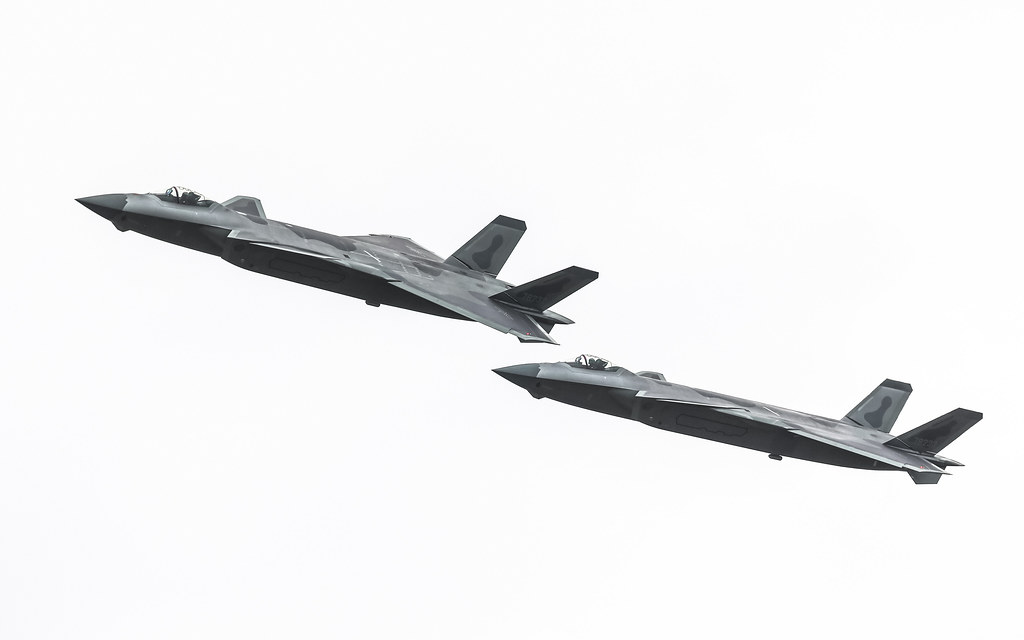
Close-up of the nose of 78232
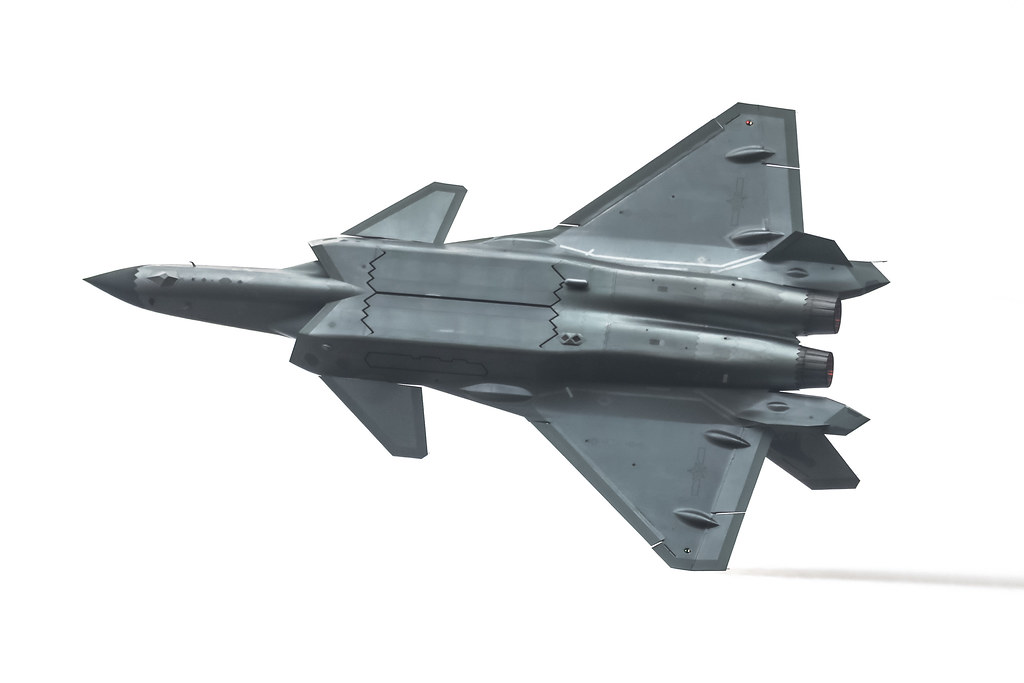
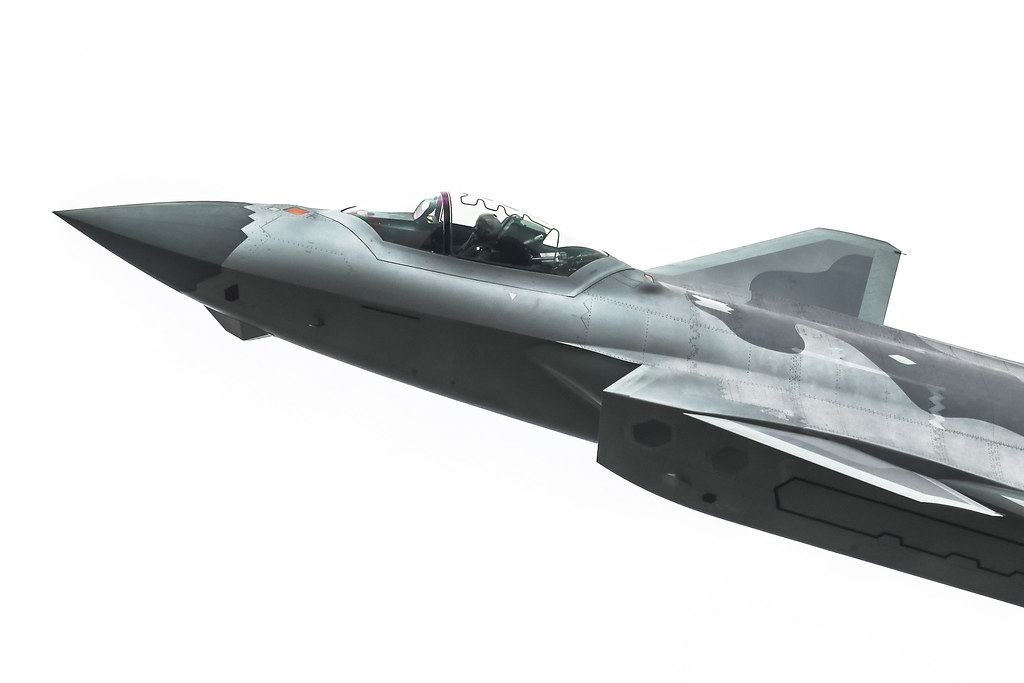 78232’s solo performance
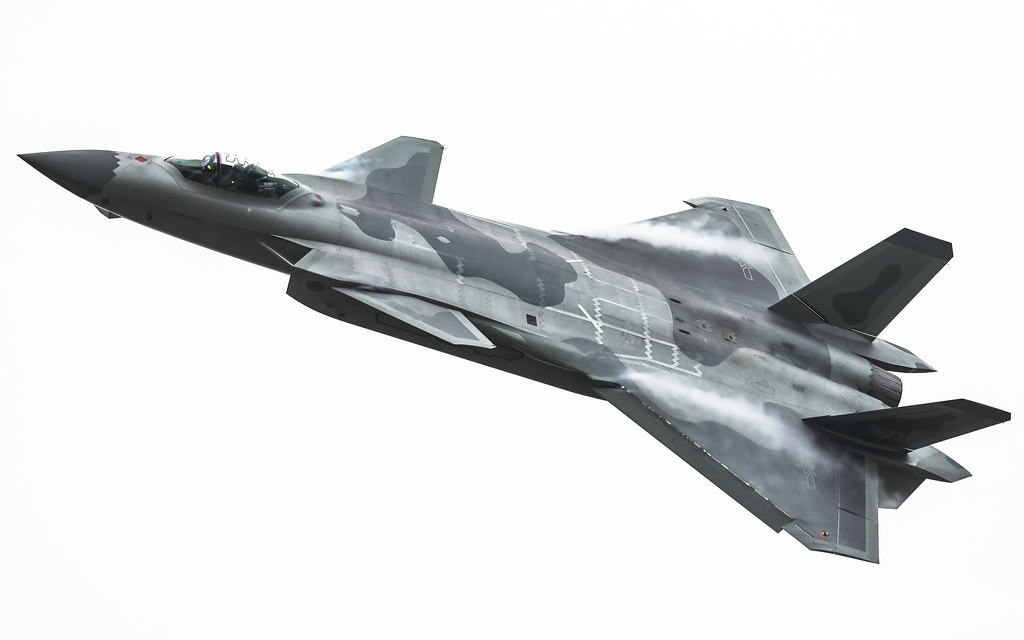 High-agility roll
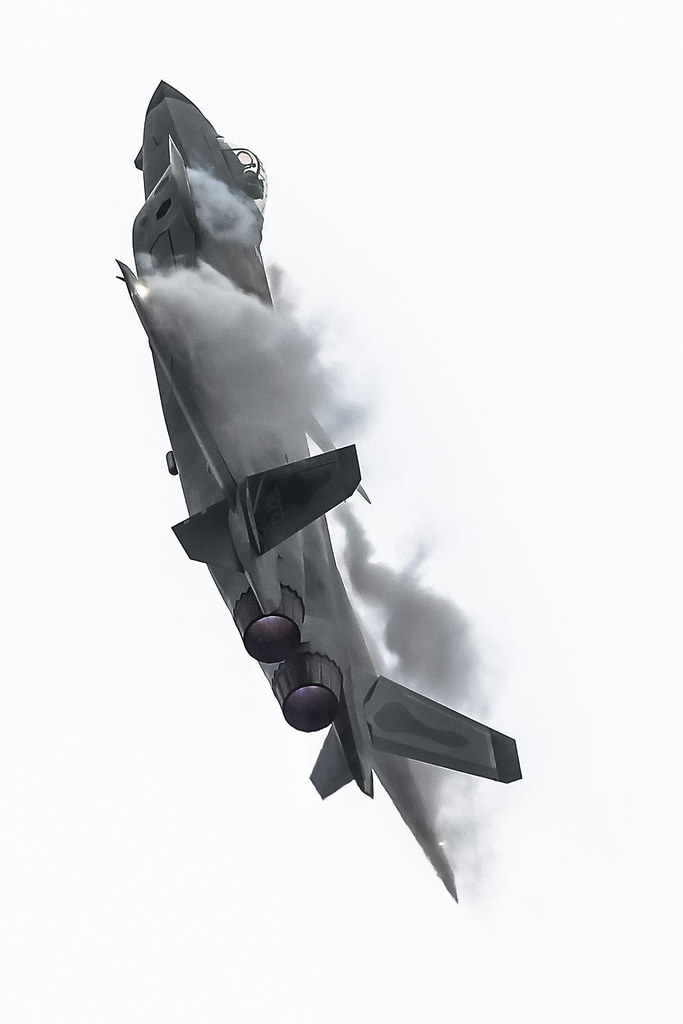
 Vertical Climb
The explanation on Wikipedia is as follows:
The J-20 (Jian-20), also known as the "Mighty Dragon," is a single-seat, twin-engine, canard-configured fifth-generation heavy stealth fighter designed by the Chengdu Aircraft Design Institute, manufactured by Chengdu Aircraft Industry Group, and equipped with the People's Liberation Army Air Force. It was led by Yang Wei, the chief designer of CAC.The J-20 features all-moving canards and vertical stabilizers, as well as DSI intakes. It possesses various low-observability designs: a roughly pentagonal nose and body cross-section, outward-canted twin vertical stabilizers, a sawtooth-edge refueling probe bay, weapons bay and landing gear bay doors, a coated one-piece canopy, and special stealth coatings, all of which are major features of a stealth fighter. The J-20 demonstrator aircraft used 27% composite materials, while the prototype used 20% titanium and 29% composite materials, a significant increase compared to the Chinese 4th-generation heavy fighter J-11B, which only had levels of 15% and 9% respectively. In addition, the J-20 adopts internationally advanced liquid temperature sensing technology and aerodynamic servo control technology to replace platinum resistance temperature sensing technology, uses electromechanical actuation technology, and employs in-situ component detection technology.
At the same time, it is the first Chinese fighter to be equipped with a one-piece canopy. The major development of the one-piece transparent component began in 2010. The team proposed a “gradual suspension + vacuum assist” process to achieve the forming of the one-piece transparent component, inlaid transition edge connection, flexible adsorption positioning for high-precision hole processing, and uniform film coating on complex curved surfaces, making China the second country in the world, after the United States, to possess the capability to develop such transparent components.
It is estimated that the J-20 is about 21 meters long with a wingspan of about 13.8 meters, presumably providing ample space to accommodate internal weapons bays and fuel tanks. Due to the large fuel payload, it is more suitable for long-range missions. Also, due to its larger airframe, it is speculated to be paired with higher-Thrust engines, or to leave room for future upgrades.
November 11th Air Display
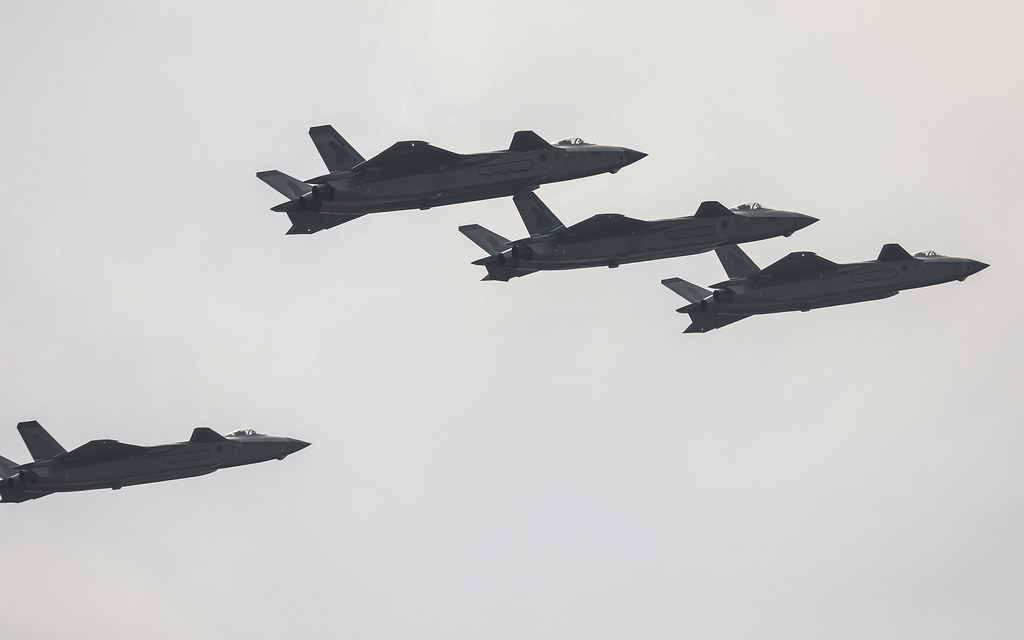
November 11th was PLA Air Force Day. It was partly sunny but slightly hazy, and Visibility was very poor. Combined with the backlit shooting conditions inside the airport, the shooting results were poor. However, catching the J-20’s first 4-ship formation display, and the historic moment of the world’s first public display of opening the weapons bay, I’ll post a few more photos.
4-ship formation appears
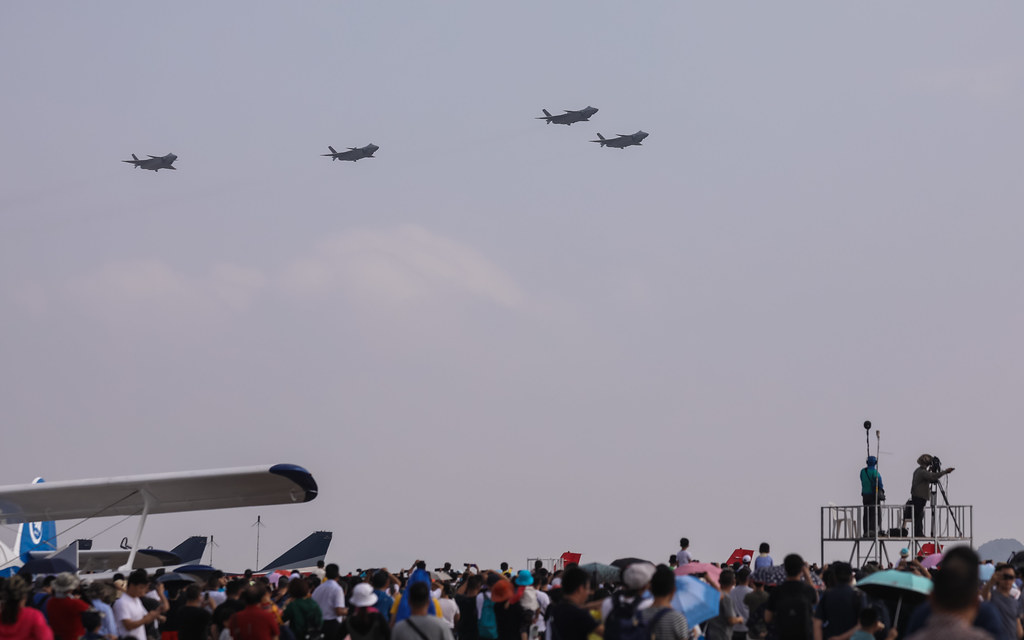 In such lighting conditions, faintly seeing the aircraft numbers from the right,
they should be 78232, 78231, 78230, and 78233 respectively.
In such lighting conditions, faintly seeing the aircraft numbers from the right,
they should be 78232, 78231, 78230, and 78233 respectively.
Next, the 4-ship split. 78230 and 78231 flew back to base,
While yesterday’s 78232 and 78233 circled over the sea south of the airport and returned to continue the performance,
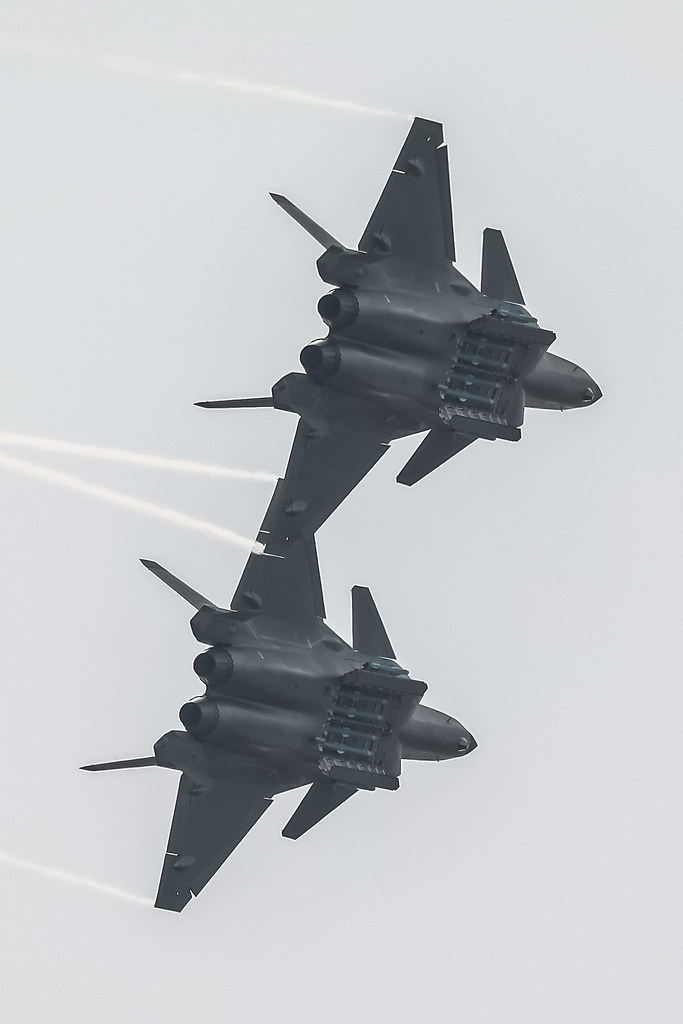
Unveiling the mystery of the J-20’s weapons bay design for aviation enthusiasts.
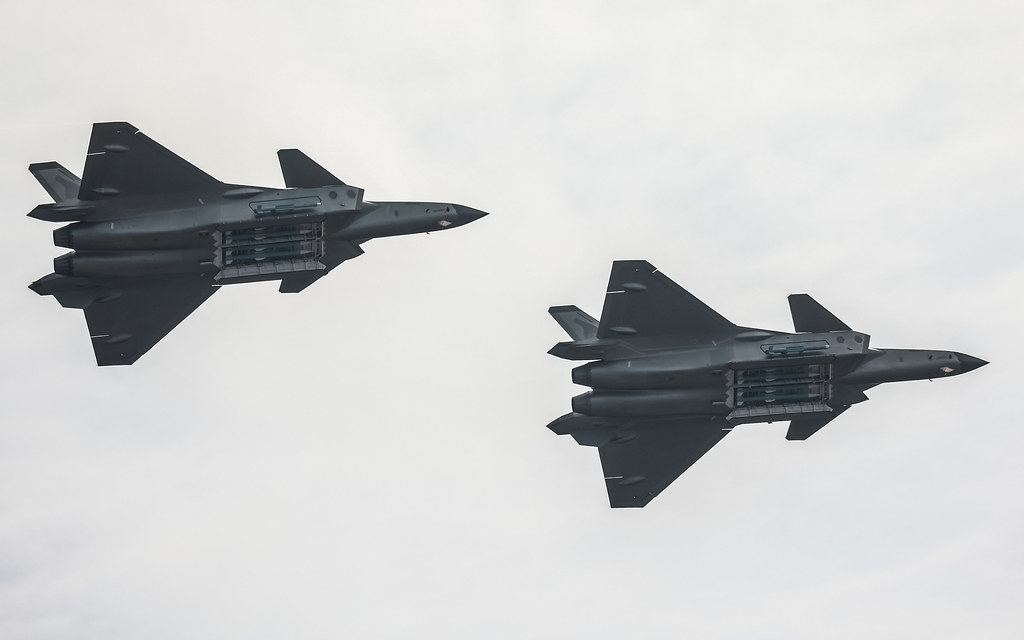

 The explanation on Wikipedia is as follows:
At the 2018 Zhuhai Airshow, the J-20 displayed a weapons bay capacity of 4 medium-range missiles + 2 short-range combat missiles. The side weapon bay door is a unique sub-door design that can extend the missile and then close 80% of the door to ensure smooth aerodynamics. When stealth is useless in close-range combat, aerodynamic maneuverability becomes the key. On the other hand, the aerial refueling probe embedded in the fuselage was showcased for the first time.
The two aircraft made another lap with the weapon bays open. When they turned back, they were open at first,
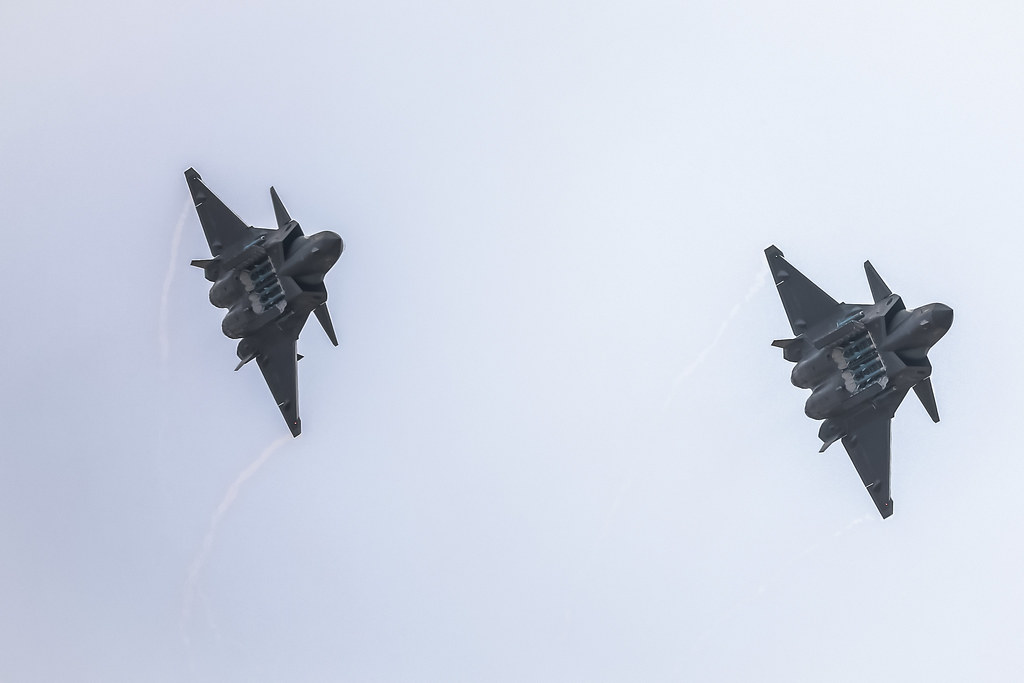 But in the photo above (camera time 56:17), 4 seconds later,
Looking carefully at the photo below (camera time 56:21),
But in the photo above (camera time 56:17), 4 seconds later,
Looking carefully at the photo below (camera time 56:21),
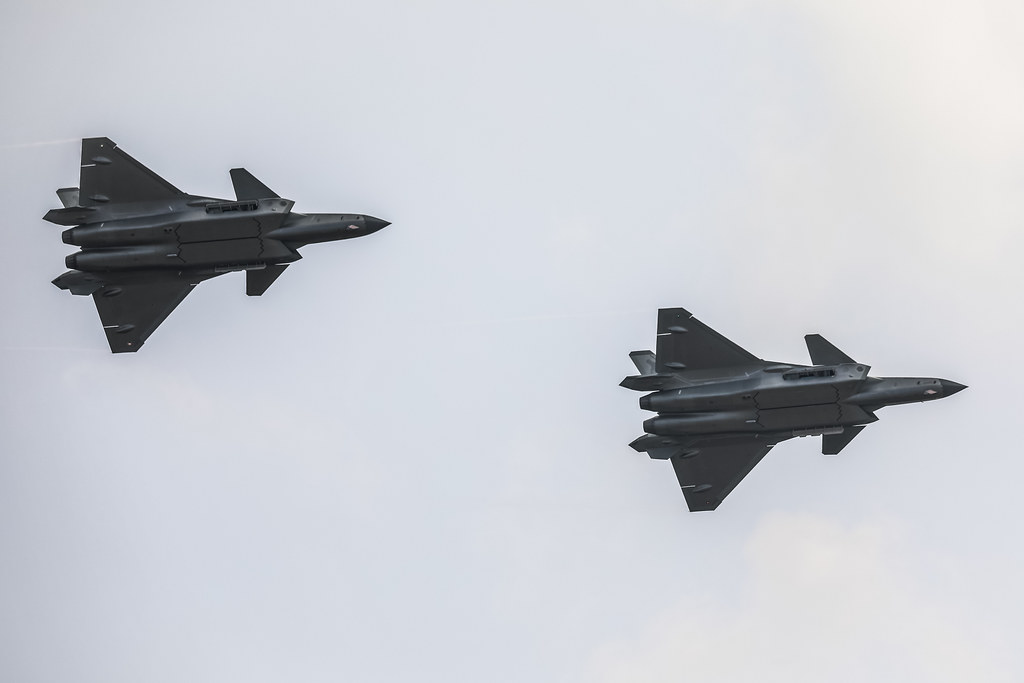 The weapon bay doors for the 4 medium-range missiles under the belly were already closed, and the side weapon bay doors were retracting.
It looks like the J-20 closes its doors really fast.
The weapon bay doors for the 4 medium-range missiles under the belly were already closed, and the side weapon bay doors were retracting.
It looks like the J-20 closes its doors really fast.
Strangely, in the photos taken basically at the same time (camera time 56:21), it can be seen that
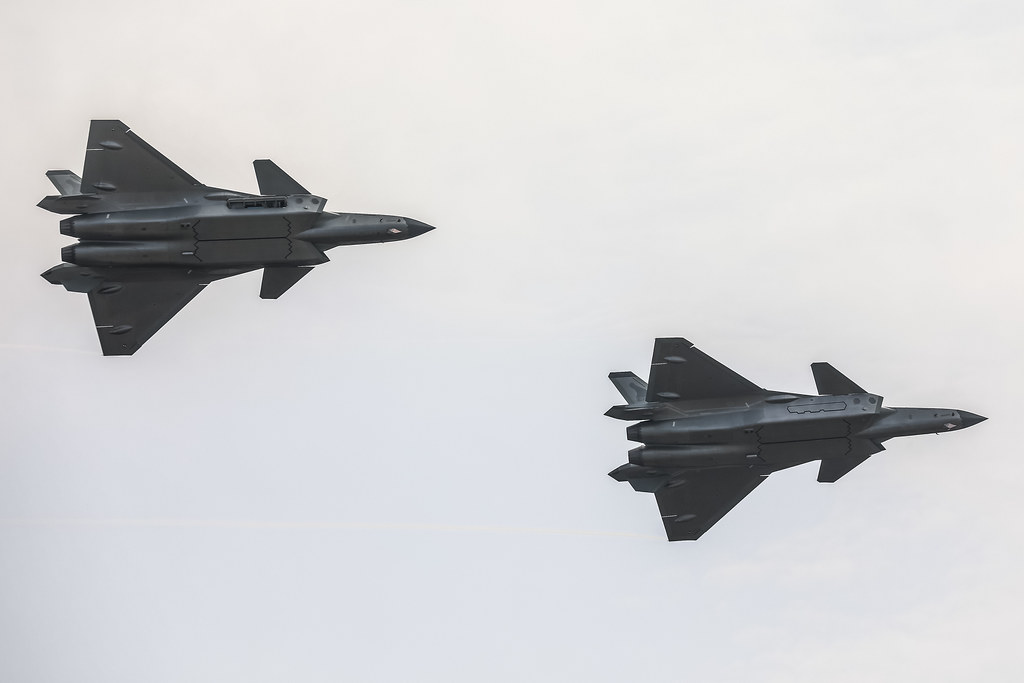 The side weapon bay door of the lead 78232 was already completely closed,
But the side weapon bay door of the wingman 78233 was still half open. I don’t know why (malfunction?).
The side weapon bay door of the lead 78232 was already completely closed,
But the side weapon bay door of the wingman 78233 was still half open. I don’t know why (malfunction?).
This photo taken 2 seconds later (camera time 56:23) makes it clearer:
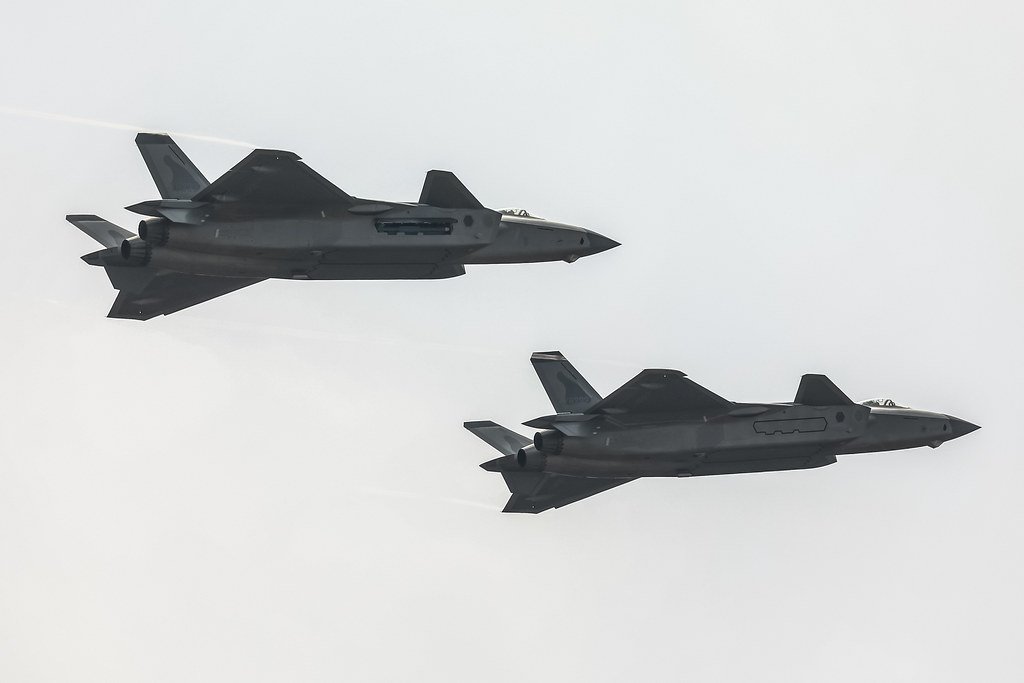
The two aircraft continued to circle the field,
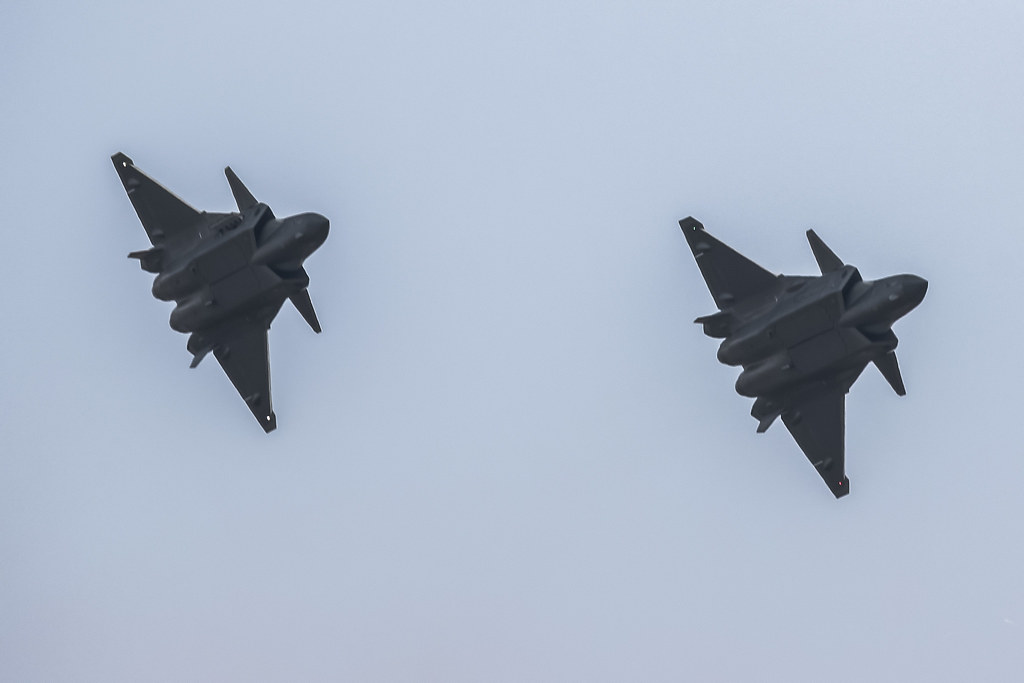 When they turned back, you could see the right side weapon bay door of the left wingman was half open, and the left side door was closed.
The side weapon bay doors on both sides of the right lead aircraft were in the closed state.
When they turned back, you could see the right side weapon bay door of the left wingman was half open, and the left side door was closed.
The side weapon bay doors on both sides of the right lead aircraft were in the closed state.
8 seconds later the two aircraft separated. In the half-open state, you could see lights illuminated inside the side weapon bay.
The difference in the door status of the two aircraft is even clearer.
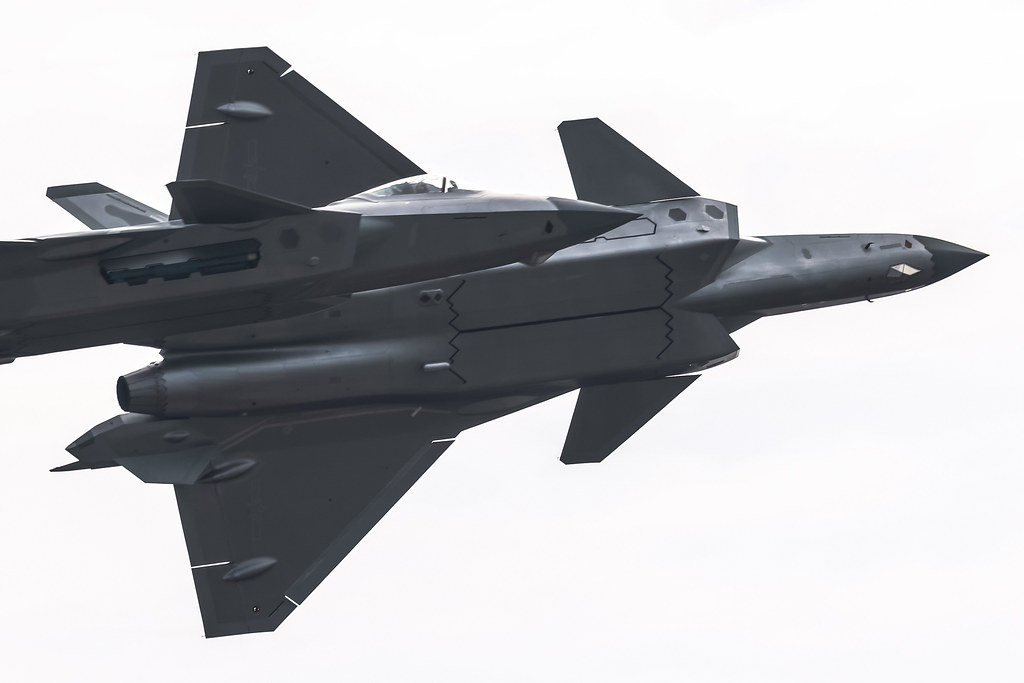
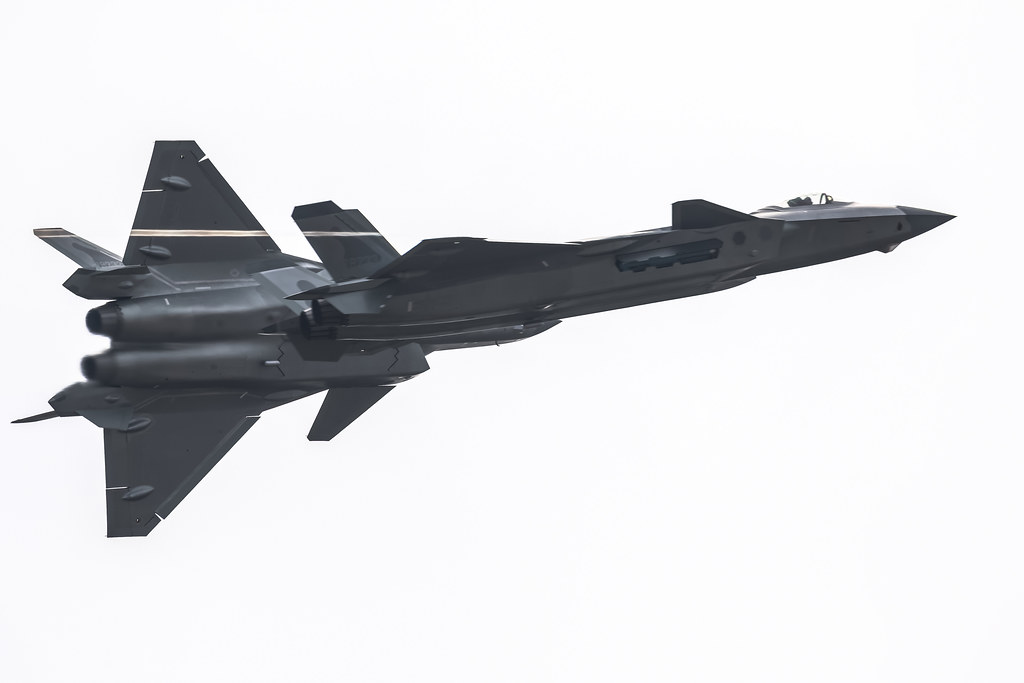
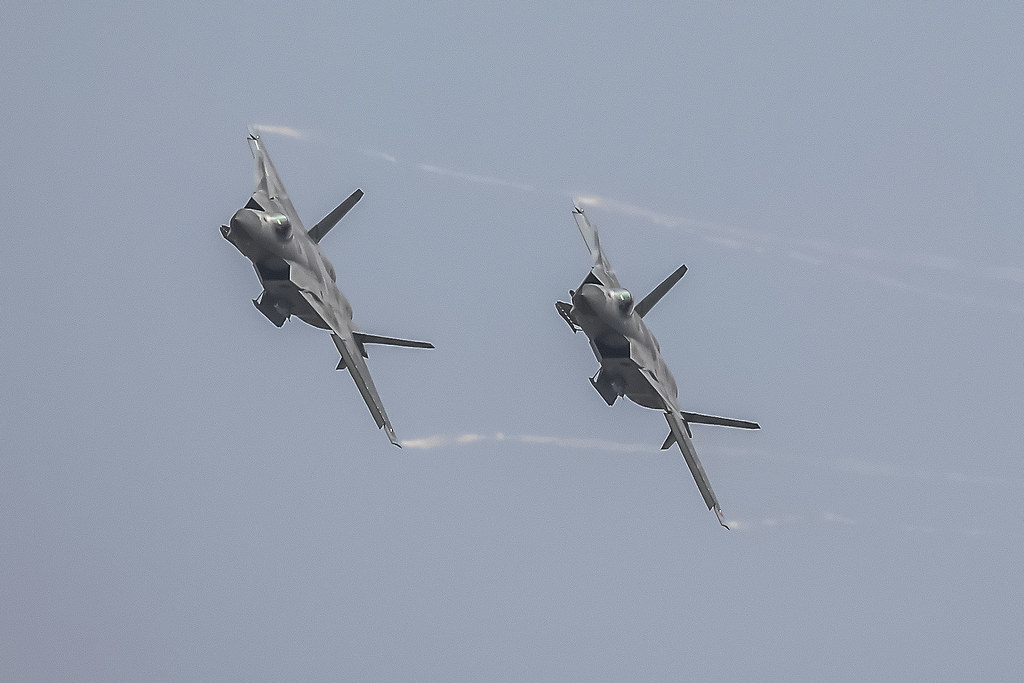
Next, 78232 continued the solo flight display.
In the humid air conditions of the morning, the audience was able to appreciate the huge white vapor (Vapour) they had never seen before,
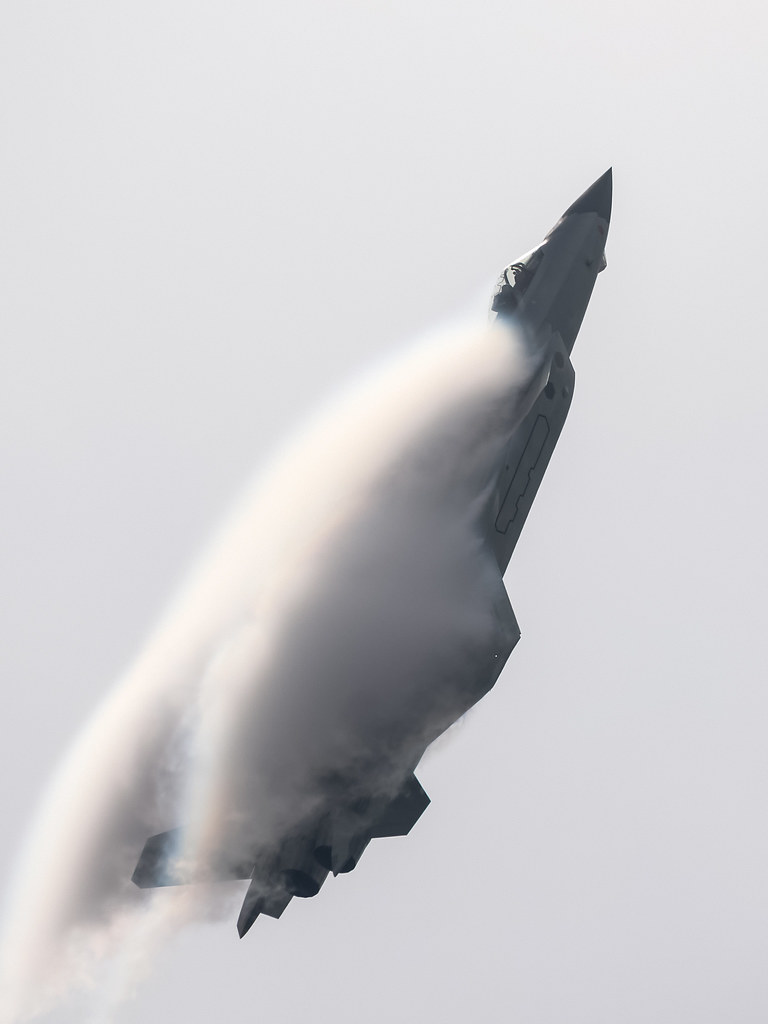 This also demonstrates the J-20’s powerful Vertical Climb capability.
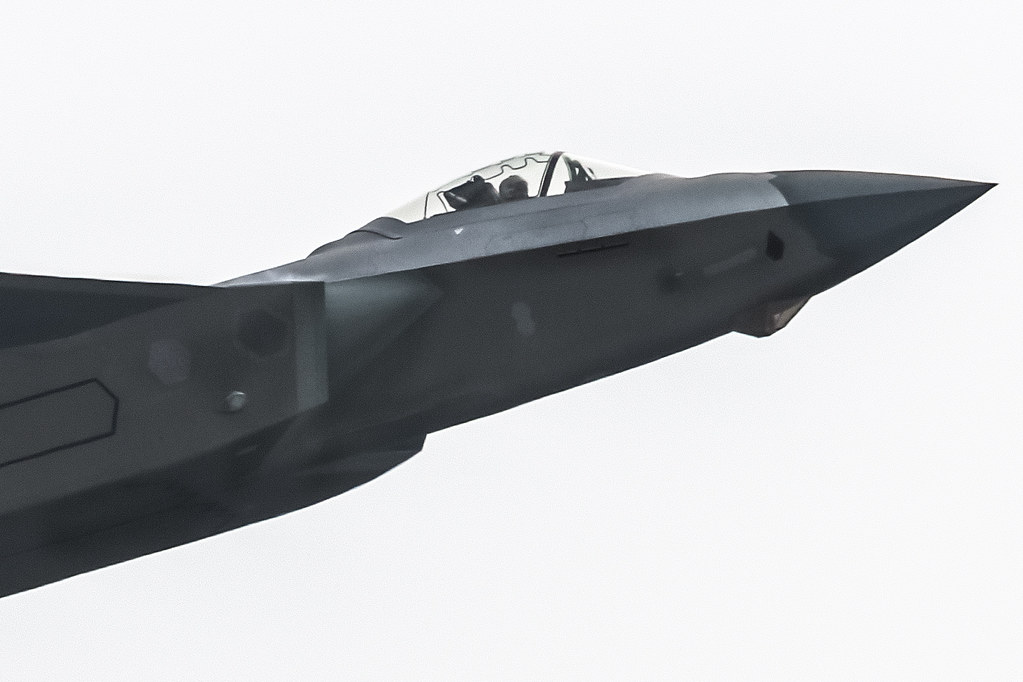
Also, there should be an aerial refueling receptacle on the lower right side of the fuselage near the cockpit,
but in this photo, you can only vaguely see its slender shape.
November 11th Impressions
After dinner, while walking by the seaside, Mr. T sent me a WeChat message saying a few friends were drinking nearby and told me to come over. When I arrived at the restaurant, several old Japanese friends were there; it was a surprise. For example, Mr. I, the professional photographer introduced in Unexpected Gains from Zhuhai Airshow 2016, who is also a writer and photographer for the Japanese magazine “Koku Joho” (Aviation Information). We had shot together and had dinner in the UK back in July.
Mr. Aoki, whom I met the day before while shooting at the “Gun Tower,” was also there. According to Mr. Itakura, I learned that he is a veteran in the aviation reporting industry, and was a writer for “Koku Joho” magazine decades ago. Mr. Aoki has been coming since the first Zhuhai Airshow, and this is the 12th edition. He attends every time; he is truly a senior aviation expert.
There was also a friend who became the focus of Sina.com this day, Tonkatsu298. The video he shot that day went viral on Weibo. [Official Photographer! Japanese Aviation Photographer Captures Chinese J-20 Opening Weapon Bay]
November 11, 2018, was the 69th birthday of the Chinese Air Force and the final display of the 12th Zhuhai Airshow. The Chinese Air Force J-20 four-ship formation opened their weapon bays to display beyond-visual-range air-to-air missiles and close-combat air-to-air missiles, demonstrating powerful combat capabilities. The complex aerobatic maneuvers made the scene explosive. Japanese aviation photographer Tonkatsu298, who was present, filmed this performance and uploaded it to an overseas video website, sparking heated discussion among netizens worldwide.We also met at the Air Tattoo in July and had dinner together in Swindon.
The topic of conversation was, of course, the J-20. For example, Mr. Aoki hasn’t missed a single edition, having attended every Zhuhai Airshow since 1996. He can be described as a bystander witnessing the history of the development of China’s aviation industry. He said that every time he comes, not only the displayed aircraft but also road traffic and urban construction, Down to the photography equipment of the Chinese aviation enthusiasts attending the airshow, He can feel the rapid development of China and the progress made every time.
Mr. Suzuki, who is from the same hometown as Mr. Aoki, has also come to Zhuhai for many editions. He said that when he was at the “Gun Tower” and saw the J-20 open its weapon bay, The Chinese military fans nearby cheered loudly, and he personally felt the power of China’s national strength and the high patriotism of its people. As an aviation enthusiast, he didn’t care about nationality at all. Just seeing such an excellent aircraft and flight display, he jumped and cheered along with the Chinese people next to him.
Mr. Itakura said the speed of development of China’s aviation industry is truly fast. Taking the J-20 as an example, the progress in the last year or two is equivalent to 6-7 years of development in the Japanese aviation industry. This is also a reflection of a country’s overall industrial level, which is admirable. Since coming to Zhuhai in 2014, it has gotten more interesting each time, and more motivation to participate each year. He will definitely come again in 2020.
Drinking and chatting, it was suddenly 10:30. As aviation enthusiasts, not involving national or ethnic politics, Just chatting about pure interest topics was relaxing and pleasant.
November 25th Update
Sharing the introduction of this month's published "Koku Joho" magazine and "Koku Fan" magazine regarding this Zhuhai Airshow.First is “Koku Joho” magazine.
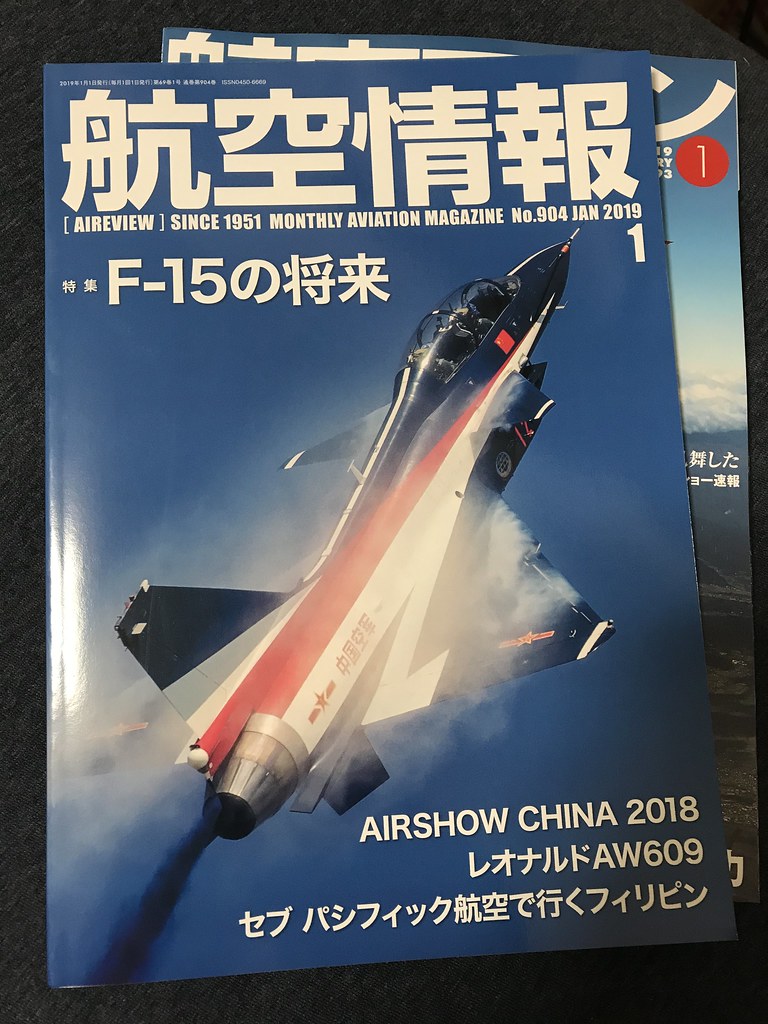
This issue’s cover of “Koku Joho” uses a photo of the Bayi Aerobatic Team taken by my friend Mr. Itakura.
Inside, 4 pages are dedicated to introducing the many aircraft types exhibited at the airshow, with simple and clear explanations.
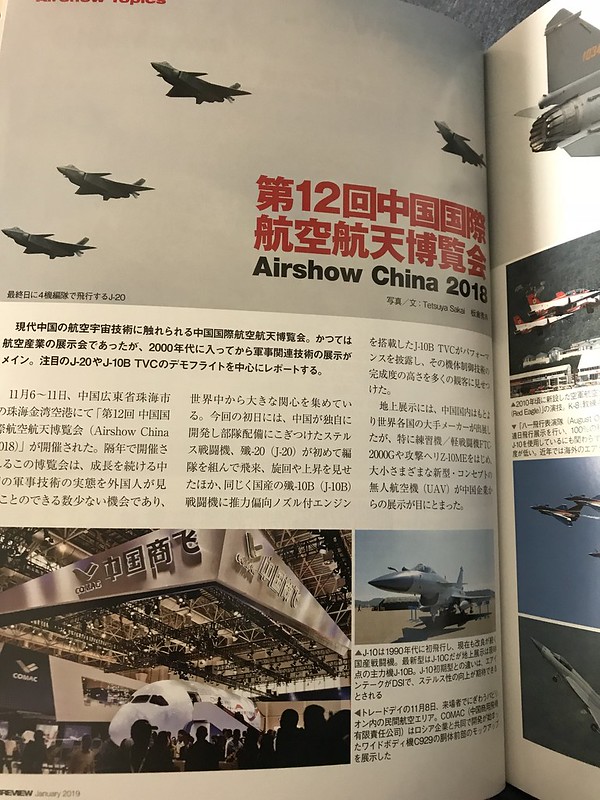 The photos and text were handled by acquaintances—Mr. Itakura and Mr. Sakai.
“Koku Fan” magazine’s introduction to this season’s airshow is much better. Although it didn’t make the cover, It was personally written by the world-renowned aviation photography master Katsuhiko Tokunaga, Using 10 pages with large color photos and extremely professional explanations. Highly recommended.
Below is a brief excerpt of Master Tokunaga’s comments.
- Regarding the newly formed “Red Eagle” Aerobatic Team, although some performance items are exquisite, the connection between various movements in the overall arrangement is not yet mature enough (not compact enough?).
- Regarding the J-10B Thrust Vectoring (TV) demonstrator flight, it was the biggest highlight of this airshow. 2.1 In a high alpha maneuver (maneuvering in a state close to Stall with low speed and high angle of attack), air separation can be seen at the leading edge of the main wing (implying that the Lift provided by the main wing is insufficient and is supplemented by the engine). 2.2 In the flat spin state, the WS-10B3 engine can provide Thrust Vector control from 360 degrees, far exceeding the AL-31L/FN (which only has the pitch axis). 2.3 A J-Turn (a high-yaw-rate turn maneuver with a 180-degree turn in a short time) under extremely high pitch rate, and able to recover to Level Flight without losing altitude, which is amazing. 2.4 Since Thrust Vector maneuvers lose energy, this technology is not practical in modern air combat where missile attacks know the main stream. However, the J-10B TV demonstrator proves that China has fully mastered this technology. In the past, China’s aviation industry was always underrated with words like plagiarism, but in reality, its development scale and speed have now far surpassed other countries in the world. Past prejudices against China should be completely abandoned. 2.5 During the “Pugachev Cobra” maneuver, the J-10 can maintain a high nose angle and move forward. This can be seen from the level smoke from the smoking device under the pylon. It can recover without losing altitude, which is more brilliant than the Su-27’s performance. 2.6 Including the “Kulbit” (Frofloat), which is more difficult than the Cobra maneuver. The WS-10 engine had the afterburner on throughout the 8-minute performance. I worry if it had enough fuel. Because generally, flight displays don’t carry too much fuel to reduce weight.
- Regarding the J-20 3.1 Judging by the Vertical Climb, the engine is still a bottleneck. Looking forward to improvements in the future WS-10G. 3.2 The fuselage camouflage pattern has been named “Milk Camouflage” by the West because it resembles Swiss chocolate. 3.3 The missiles in the weapon bay are for medium and short range, so the J-20 should be an air superiority fighter similar to the F22, not the assault-type fighter for attacking aircraft carriers as previously rumored. 3.4 Since DSI inlets are not efficient during supersonic cruise, it is unknown whether the J-20 has supersonic cruise capability. 3.5 A carrier-based version of the J-20 appeared in AVIC’s promotional video. 3.6 The light-colored part on the side of the intake may be a data link communication antenna. 3.7 The vertical stabilizer area is small. When rolling, it rotates around the pitch axis centered on the leading edge of the main wing. This indicates that more emphasis is placed on the Lift-to-Drag ratio than on maneuverability. 3.8 The flight display content was relatively conservative, causing some to suspect the fighter’s performance. But one must not deny that the J-20 is a successful long-range stealth fighter, and it should possess beyond-visual-range air-to-air missile capabilities. The emergence of the J-20 brings unprecedented threats to its opponents. 3.9 Once equipped with the WS-10G, the overall capability of the fighter will be greatly improved, and the J-20 should be re-evaluated then.