Low Visibility Takeoff and Landing Using HUD
Just taking a note, I didn’t realize the HUD was this useful. Learned something new.
Facing this heavy fog and low visibility, with the strong support of the Shandong ATMB and Jinan Airport, Shandong Airlines enabled HUD to achieve a safe takeoff under 150-meter visibility conditions. This is the first commercial flight in the history of Chinese civil aviation to achieve takeoff with an RVR (Runway Visual Range) of 150 meters.Shandong Airlines took the lead in completing the HUD RVR 150-meter takeoff validation test flight in Beijing on September 8, subsequently successfully completing HUD RVR 150-meter takeoff validation test flights at airports in Jinan, Qingdao, Kunming, Urumqi, and Shijiazhuang.
The reason HUD can lower takeoff and landing standards is that it provides precise flare guidance. On the HUD display, as the aircraft approaches the airport, a "small circle" will appear in the center of the display. The pilot only needs to "center" the aircraft into the "circle" to achieve a precise landing. This is exactly like the "big ring catches small ring" mechanic in many flight video games.“Through the guidance information provided by the HUD instrument landing system, the actual descent trajectory of the flight landing acts as a ‘big circle’, while the HUD displays a ‘small circle’ to guide the landing. By catching the ‘small circle’ provided by the HUD with the aircraft’s ‘big circle’, the aircraft can complete a precise landing.” said Wang Dejie, a senior captain at Shandong Airlines and General Manager of the Standards and Quality Management Department.
Even if weather conditions are poor and the aircraft encounters heavy fog during landing, pilots following the precise flare guidance provided by the HUD can still perfectly execute a precise “blind landing”.
In recent years, the impact of weather factors on flight irregularity rates has been increasing. Among the factors affecting flight on-time performance in 2016, weather factors accounted for 56%. Especially in winter and spring, low visibility weather represented by fog and haze accounts for a large proportion.Taking Capital Airport as an example, statistics from 2008-2015 show that there were 44 days with RVR below 200 meters, 31 days with RVR below 150 meters, and 9 days with RVR below 90 meters. To further improve flight regularity, the Civil Aviation Administration has actively promoted new navigation technologies represented by HUD in recent years, strengthening scientific and technological support.
HUD utilizes computer technology to integrate flight information (such as flight parameters, attitude information, navigation information, etc.) and warning information (such as tail strike margin, angle of attack limits, etc.) onto the head-up display. Pilots can understand these parameters and follow relevant guidance while maintaining external visual observation.
Practice has proven that the use of HUD can have a significant effect in reducing flight dependence on weather and improving flight regularity.
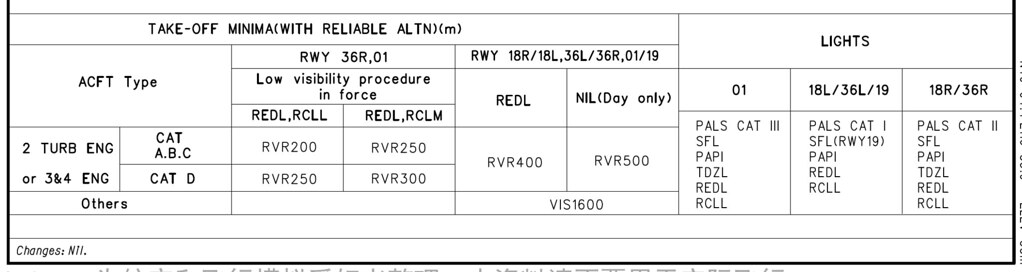
The relevant person in charge of the Flight Standards Department of the Civil Aviation Administration stated that taking Capital Airport as an example, in the case of RVR 150 meters, highways would be closed, and vehicle speeds would not exceed 20 km/h, while aircraft from airlines with HUD operating qualifications can break through Capital Airport’s RVR 200-meter takeoff standard and depart smoothly.
As of now, Chinese civil aviation has a total of 585 transport aircraft equipped with HUD, accounting for 18.9%. According to the “Head-Up Display Application Development Roadmap” released by the Civil Aviation Administration in August 2012, the installation rate on transport aircraft will reach 50% by 2020.
It is expected that as the installation volume increases year by year, HUD’s contribution to flight regularity will become increasingly significant.
I checked the Beijing Capital Airport takeoff standards,
it really is 200 meters.