Book Notes--Topgun Days
Top Gun/壮志凌云/捍衛戰士 is probably my favorite aviation movie. I’ve watched it more than ten times. The F-14 Tomcat in the film looks incredibly cool, and it can be said to be my favorite among all fighters.
The first time I saw an F-14 was 20 years ago. I was visiting a temple near Kamakura when I suddenly heard the roar of huge engines. I looked up to find a twin-tail fighter flying past at high speed. At the time, I couldn’t tell if it was an F-14 or an F-15, but once I learned that there was a nearby naval base, “Atsugi Base,” I knew for sure it was an F-14.
The F-14 has been retired for many years, but its popularity among aviation enthusiasts has never waned. Every so often, you can see new books about it in bookstores.
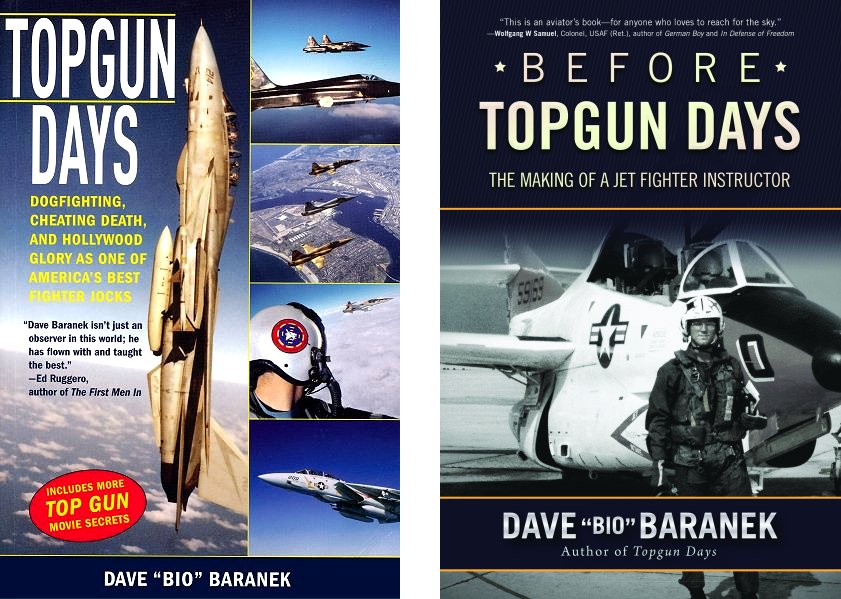
Especially this year, the Japanese edition of the biography titled “Topgun Days,” just published in June, immediately caught my eye. I bought it and finished it right away—it was thoroughly satisfying.

Additionally, here is the link to the original English edition:
Topgun Days: Dogfighting, Cheating Death, and Hollywood Glory as One of America’s Best Fighter Jocks

The author’s experience is legendary. His name is Dave “Bio” Baranek. “Bio” is his callsign. After graduating from university, Bio joined the US Navy, aspiring to become an F-14 pilot. However, due to myopia (nearsightedness), he had to switch to the back seat of the F-14 in 1980, becoming a RIO (Radar Intercept Officer).
The RIO’s primary responsibilities are navigation, radio communication, and most importantly, radar operation. As explained in the book, the radar at that time required extensive manual operation: switching between search and lock modes, determining the radar scan direction and altitude range, and locking onto enemy aircraft—all of these required manipulation by the RIO in the back seat. The pilot in the front could only press the missile launch button after the RIO had achieved a lock.
I initially thought a book written by a non-pilot might be a bit dull, but it turned out to be quite the opposite. Because he was in the RIO’s back seat, Bio was able to view missions from a more detached perspective. Furthermore, he could record numerous live data points during flight, laying a solid foundation for post-flight mission debriefs. Additionally, being a photography enthusiast, he captured many precious moments whenever possible, and these photos are a major highlight of the book. I have to admit that the US Navy’s tolerance and openness reached such a level; to the average person, much of the content in the book would likely be classified as military secrets.
After honing his skills through 1200 hours of flight missions, in 1984 Bio earned the opportunity to attend Topgun, the United States Navy Fighter Weapons School, for advanced training. In previous flights, he had intercepted Soviet Tu-95 bombers and experienced an accident where the arresting cable snapped during a carrier landing, causing the aircraft to plunge into the sea.
The book describes his flight training and mission details in great depth. It is evident that Bio is a very meticulous person. Even during high-G “dogfights”—close-range aerial combat—he would write down combat data like Heading and altitude on his kneeboard. Bear in mind that the G-force during these moments could reach up to 6.5G. I believe it is precisely because he recorded and organized such a vast amount of material that he was able to write such a detailed personal memoir years later. Many details, including flight checklists and radio communication dialogue, greatly enhance the realism and immersion.
After 5 weeks of rigorous Topgun training, Bio successfully passed the assessment, laying the foundation for becoming an excellent F-14 crew member. But he wasn’t satisfied. He applied to become an instructor at Topgun and, through hard work, secured this precious opportunity. During his more than two-year tenure, he trained the Navy’s finest students on maritime aerial threats and intercept combat tactics. Additionally, acting as a back-seat crewman in the F-5F fighter, he organized and managed combat engagements and formation fighting.
In the book, he provides a very detailed explanation of how Topgun conducts training and classes.
For example, the image below describes a 2-vs-many air exercise.
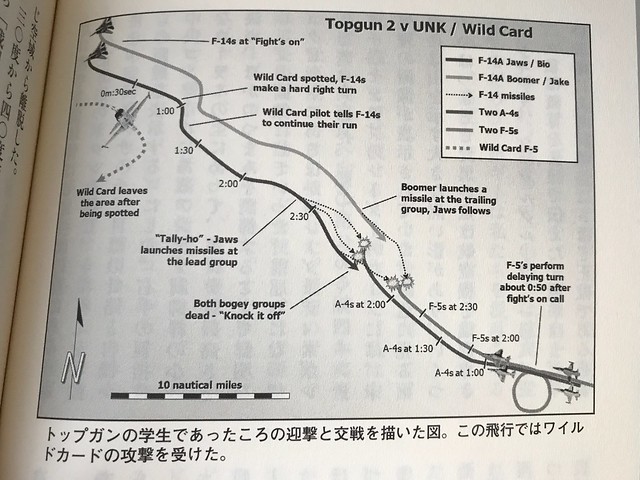 “Wild Card” refers to an ambush aggressor lying in wait above. As a flight of two F-14 students scan and approach a target ahead (2 F-5s and 2 A-4s), the Wild Card will suddenly dive down to launch a surprise attack.
The book explains that when two F-14s are in combat formation, the distance between the two aircraft is 1-2 miles, rather than the close distance seen in parade formations.
When scanning for enemies, one aircraft scans the mid-to-high altitude, while the other scans the mid-to-low altitude. Whoever spots the enemy first immediately becomes the Flight Lead, and the other aircraft naturally becomes the Wingman.
“Wild Card” refers to an ambush aggressor lying in wait above. As a flight of two F-14 students scan and approach a target ahead (2 F-5s and 2 A-4s), the Wild Card will suddenly dive down to launch a surprise attack.
The book explains that when two F-14s are in combat formation, the distance between the two aircraft is 1-2 miles, rather than the close distance seen in parade formations.
When scanning for enemies, one aircraft scans the mid-to-high altitude, while the other scans the mid-to-low altitude. Whoever spots the enemy first immediately becomes the Flight Lead, and the other aircraft naturally becomes the Wingman.
During Bio’s instructor tenure at Topgun, he coincided with the filming of the 1985 movie “Top Gun.” He not only participated in the actual filming as the back-seater of an F-5F—for instance, in the famous opening scene where Tom Cruise’s “Maverick” flies the F-14 directly over a MiG-28, and the RIO “Goose” takes a photo of the MiG—but Bio actually played the MiG pilot in that famous shot, i.e., the one making the surprised motion of looking up at the F-14. Furthermore, after the live-action filming was completed, he went to the Hollywood Paramount Studios and editing room as a representative to provide samples of radio dialogue for the director and screenwriters, enhancing the movie’s realism. The book also reveals many interesting anecdotes from the film set, making it a very engaging read.


As a civil aviation enthusiast, I am fairly familiar with various aviation terminology. I have seen the F-14 flight demonstration with my own eyes, and I love the movie Top Gun. I have also witnessed Tom Cruise’s demeanor in person during a business trip to Las Vegas for a speech one year, and I have visited the Hollywood film studios in Los Angeles. Therefore, most of the plot points in “Topgun Days” resonate with my memories, and I strongly recommend everyone read this interesting book.
Additionally, it is said that Top Gun 2 is about to start filming, and Tom Cruise will continue to appear as the protagonist, now as a Topgun instructor. I am greatly looking forward to it, even though the movie’s release won’t be until 2019.