Successful First Flight of C919 Large Passenger Airliner
Located in Shanghai, the Commercial Aircraft Corporation of China (COMAC) independently developed the C919 large passenger aircraft, which successfully completed its first flight on May 5, 2017. This is a major event in the aviation industry! It marks the emergence of a strong competitor to the Boeing 737 and A320, the world’s best-selling models that have monopolized the market for decades, making it a pride of the Chinese aviation industry.
Below is a collection of news and technical information regarding the C919.
China Civil Aviation Network: Congratulations! Successful First Flight of the Domestic C919 Large Passenger Aircraft (Photos) The Seattle Times: Chinese rival to Boeing 737 and Airbus A320 completes successful first flight On Weibo: Detailed List of C919 Latest Suppliers
The product timeline from COMAC’s C919 Product Introduction Page:
2009 January 6: COMAC officially released the model designation “COMAC919”, abbreviated as “C919”, for its first single-aisle, conventional layout, 150-seat large passenger aircraft. December 21: COMAC and CFM International formally signed a strategic cooperation letter of intent for the C919 powerplant in Beijing, selecting the LEAP-X1C engine developed by CFM as the sole foreign launch powerplant for the C919. December 25: The main structure of the C919 nose engineering mock-up was officially delivered in Shanghai.
2010 November 15: The C919 1:1 display mock-up was exhibited for the first time at the Zhuhai Airshow, securing 100 launch orders. December 24: The Civil Aviation Administration of China (CAAC) officially accepted the application for the C919 Type Certificate.
2011 April 18: The first C919 Type Certificate Certification Committee meeting was held in Shanghai, marking the full entry of the C919 aircraft development into the formal airworthiness review phase. December 9: The C919 project passed the national preliminary design review and transitioned into the detailed design phase.
2012 July 31: The “C919 Project Specific Certification Plan (PSCP)” was signed in Shanghai. December 4: After 19 months, the static and fatigue testing for the composite rear fuselage section—one of the seven major components of the C919—was fully completed.
2013 December 30: The C919 “Iron Bird” test rig was officially put into operation at COMAC’s Shanghai Aircraft Design and Research Institute (SADRI), marking the official launch of system verification work for the C919 project. December 31: The nose section for the first C919 aircraft rolled off the assembly line at AVIC Chengdu Aircraft Industrial (Group) Co., Ltd. (CAC).
2014 May 15: The forward fuselage section of the first C919 aircraft rolled off the assembly line at AVIC Hongdu. July 23: Assembly of the horizontal stabilizer components for the first C919 aircraft officially began at the COMAC Final Assembly Manufacturing Center Pudong Base. August 1: The center fuselage section of the first C919 aircraft rolled off the assembly line at AVIC Xi’an Aircraft Industry Group Company. August 21: The center-aft fuselage section of the first C919 aircraft rolled off the assembly line at AVIC Hongdu. August 29: The center fuselage/center wing and aileron sections of the C919 passed airworthiness inspection and were delivered by AVIC Xi’an Aircraft Industry Group Company. September 19: Structural final assembly of the first C919 aircraft began at the COMAC Final Assembly Manufacturing Center Pudong Base. October 30: The forward section of the rear fuselage for the first C919 aircraft was delivered by AVIC Shenyang Aircraft Corporation (SAC).
2015 February 11: The aft section of the rear fuselage for the first C919 aircraft completed manufacturing, passed airworthiness review, and was formally delivered to COMAC. July 22: CFM International delivered the first CFM LEAP-1C engine to the COMAC Final Assembly Manufacturing Center Pudong Base. November 2: The first C919 aircraft was officially assembled and rolled off the line at the Pudong Base. This marked the formal completion of the major section joining and onboard system installation for the first C919 aircraft, and signified the achievement of phased results in the engineering development phase of the C919 project, laying a solid foundation for the next step: the maiden flight.
2016 April 11: The full-aircraft static test for the C919 was officially launched. June: The C919 horizontal stabilizer smart assembly line construction was listed as a candidate project for the Ministry of Industry and Information Technology’s Intelligent Manufacturing selection. November: China Eastern Airlines became the global launch customer for the C919 aircraft. December 25: The first C919 aircraft was delivered to the Flight Test Center.
2017 April 18: The C919 passed the maiden flight review. April 23: The C919 completed high-speed taxiing and nose wheel lift-off tests. May 5: The C919 successfully completed its maiden flight in Shanghai.
A comparison chart of the 737 MAX, A320neo, and C919 summarized by The Seattle Times:
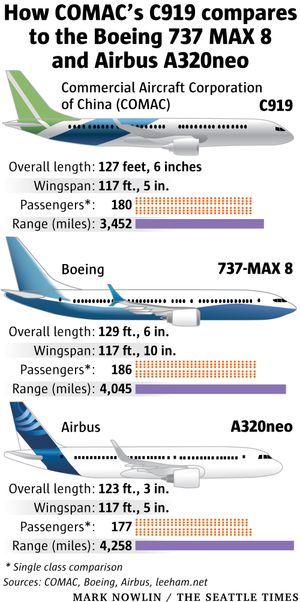 It can be seen that the wingspan, length, and passenger capacity of these three aircraft are basically the same, but the C919’s range is slightly shorter.
According to C919 Successful Maiden Flight: Honeywell’s Innovative Technology Lends Strong Support,
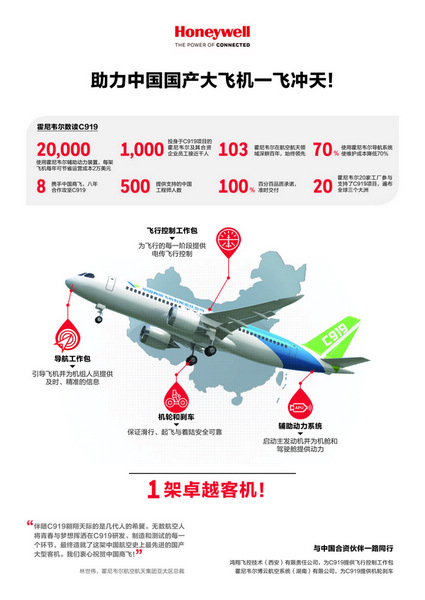 We can see that the HGT750C Auxiliary Power Unit (APU), APU installation package, APU start/generator system, as well as wheels and brakes, flight control work package, and navigation work package are provided by Honeywell.
According to C919 Takes to the Skies: Powerful Central Systems Provide Protection, We learn that “Avionics Joint Venture (AVIC SAKE) is responsible for three avionics work packages for the C919: the Avionics Core Processing System, Integrated Display System, and Onboard Maintenance and Flight Recording System. Among them, the Core Processing System includes the Integrated Modular Avionics (IMA) platform, network, and Flight Management System.” AVIC SAKE (Shanghai Avionics Corporation) is a joint venture equally owned by Aviation Industry Corporation of China (AVIC) and General Electric (GE).
According to Barco LED Backlight LCD Screens “Fly” into COMAC C919,
We know that five DHA-3138 liquid crystal displays from Belgian company Barco serve as the main display equipment for the C919 glass cockpit.

Finally, here are high-resolution photos of the C919 airframe taken by Weibo user “AJT_PROD”: Link

 The static port, large and small pitot-static probes (pitot tubes), total air temperature sensors, external power receptacle at the nose, as well as the APU intake at the tail are all captured very clearly.
Personally, I feel the shape of the C919’s nose and tail resembles the B787, the winglets resemble the A350, and the fuselage looks somewhat similar to the A320neo from the side, making its overall characteristics quite easy to identify. However, I don’t know why there are still quite a few probes behind the 1L cabin door; the photo is too blurry to identify clearly. They might be total air temperature sensors and pitot tubes (or perhaps Angle of Attack (AOA) vanes?). Anyway, it feels quite incredible.

End