Record of Zhuhai Airshow 2016 Part 1
I went to Zhuhai and took four or five thousand photos, but just haven’t had the time to sort through them. This weekend, I checked about a tenth of them, and only retouched a few dozen. I don’t know much about fighter jets, and my photography experience is limited, so I’m really not satisfied with many of the photos..
On the morning of Saturday, November 5th, I didn’t go to the main venue. I went to the south side of Zhuhai Airport first.
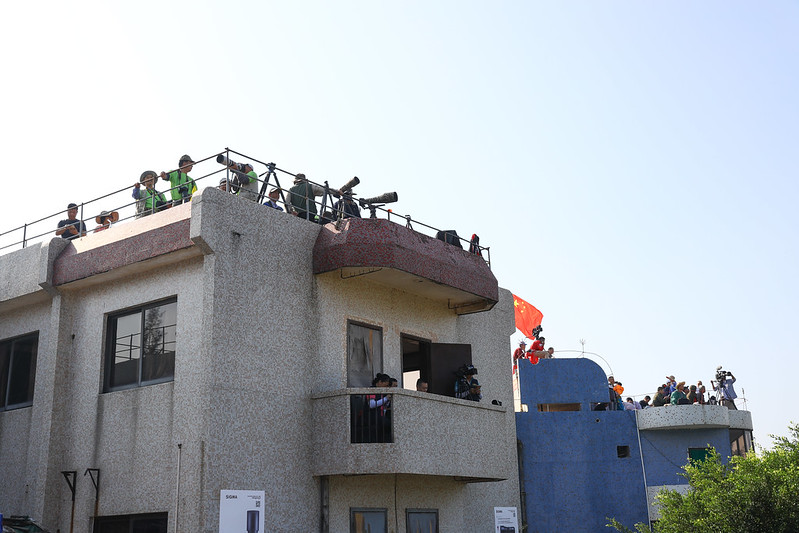
This is the rooftop of a dilapidated hotel, referred to as the “Gun Tower” by Chinese netizens and as “Ruins” by Japanese netizens.
Since this location has front-lighting in the morning, a large number of professionals come here to shoot.
For instance, I saw a CCTV crew, and the world-famous aviation photography master Katsuhiko Tokunaga was also there.
The earliest appearance this day was the JF-17 Thunder (FC-1 Xiao Long) of the Pakistan Air Force. The aircraft registration number is 13-150, and the manufacturer is likely the Chinese Chengdu Aircraft Company. From size to appearance, this aircraft bears some resemblance to the F-16. Watching it fly in the air, it looks extremely agile. I never expected that a modification of the MiG-21 from 50 years ago could produce such a beautiful fighter jet.
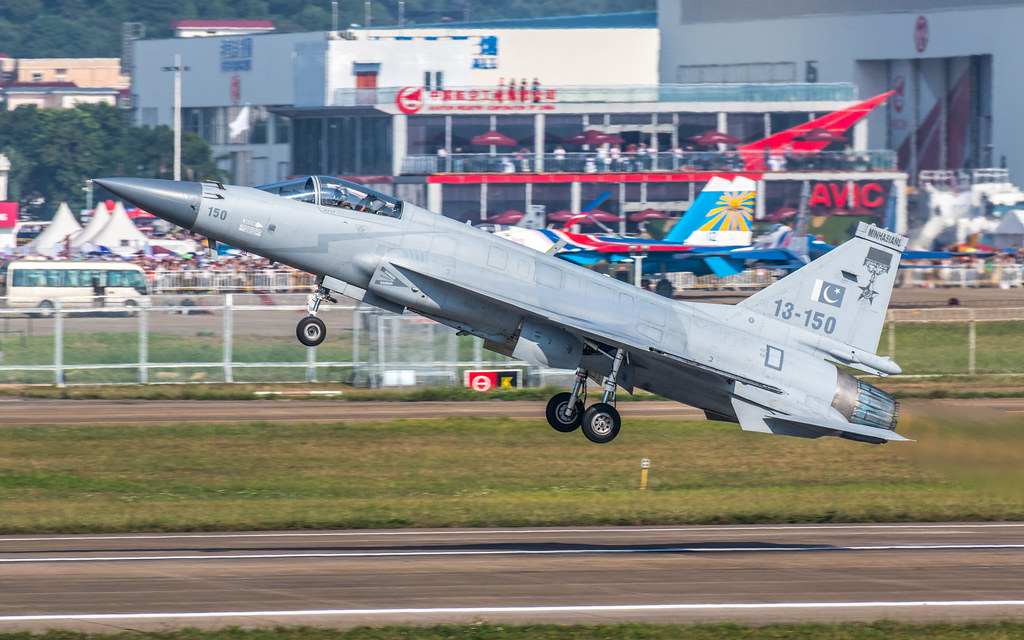 The Pakistan Air Force is quite interesting; they completely disregard common sense regarding wind direction.
Even with a tailwind, they insist on taking off facing their home country.
From my memory, they were the only ones to use the westward Runway 25 for takeoff during the flight displays that day.
The Pakistan Air Force is quite interesting; they completely disregard common sense regarding wind direction.
Even with a tailwind, they insist on taking off facing their home country.
From my memory, they were the only ones to use the westward Runway 25 for takeoff during the flight displays that day.
After liftoff, the landing gear was not retracted, and it immediately entered a high-angle Climb, demonstrating the JF-17’s ample engine performance.
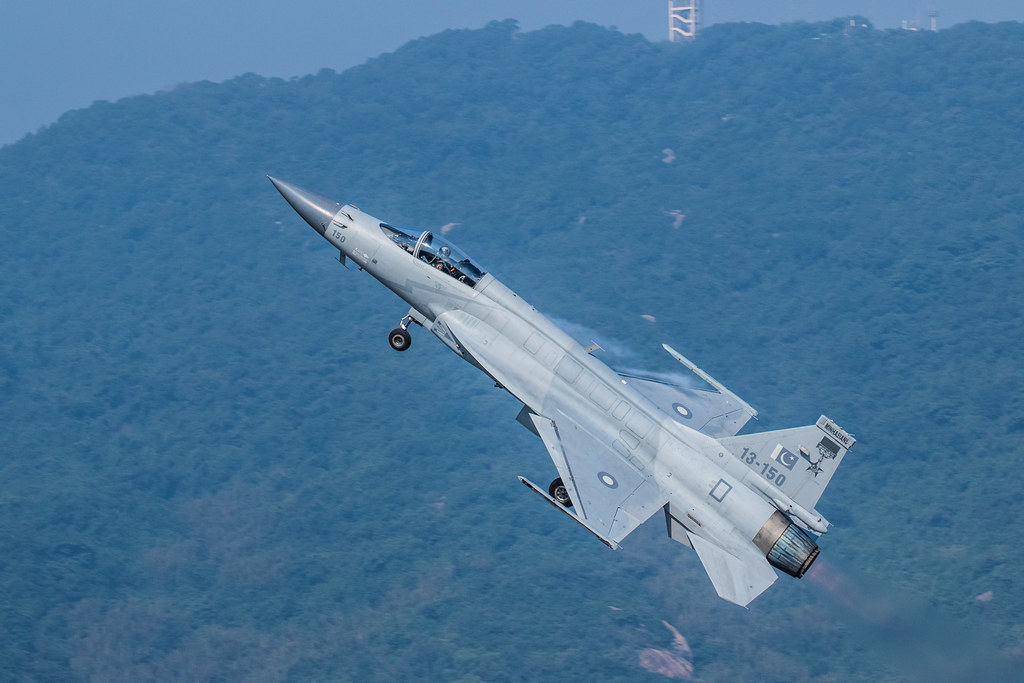
Performing a rolling Climb with the landing gear down, you can see white smoke at the wing strakes.
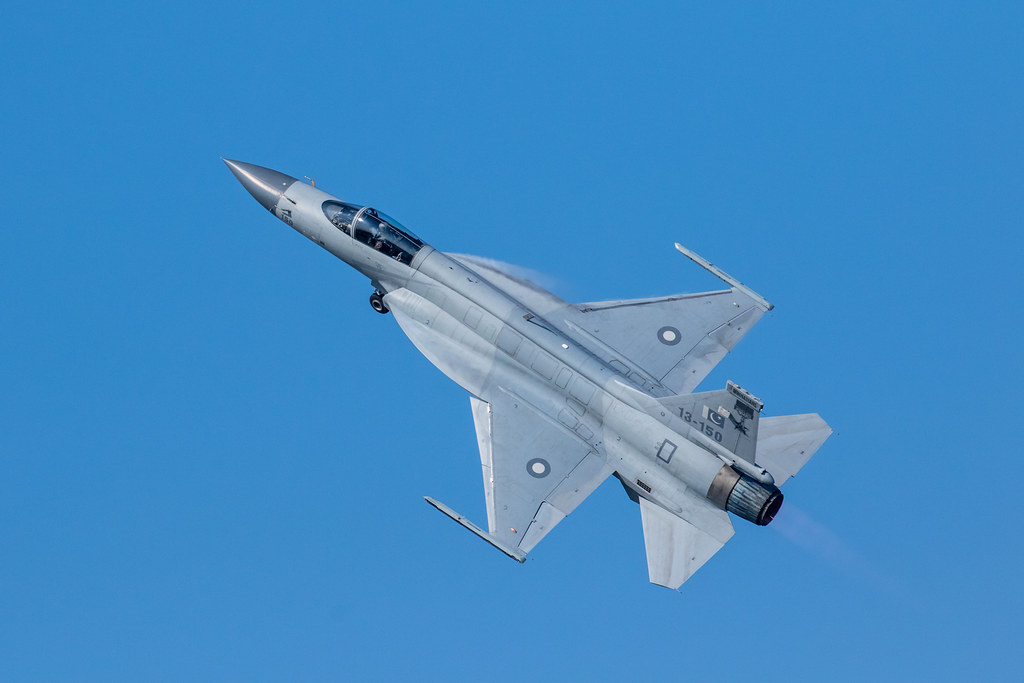
When fighter jets perform maneuvering flight at low altitude, they often require a high Angle of Attack (AoA) to provide sufficient Lift.
According to “Bernoulli’s Principle,” since the airflow is divided into upper and lower parts at the leading edge of the wing, The airflow on the upper surface is faster than that on the lower surface, so the air pressure on the upper surface is lower than that on the lower surface. This pressure difference between the upper and lower surfaces provides Lift.
During high-angle flight, the airflow speed on the upper surface of the wing is even greater, The air pressure decreases accordingly, thus providing greater Lift. But at the same time, due to the adiabatic expansion caused by the drop in air pressure, The temperature of the gas on the upper surface of the wing also drops at this moment.
If the temperature and humidity conditions are right, The water vapor in the cooled air exceeds its saturation state, The water vapor will liquefy into tiny water droplets, Forming these handsome white smoke trails, also known as Vapor Trails.
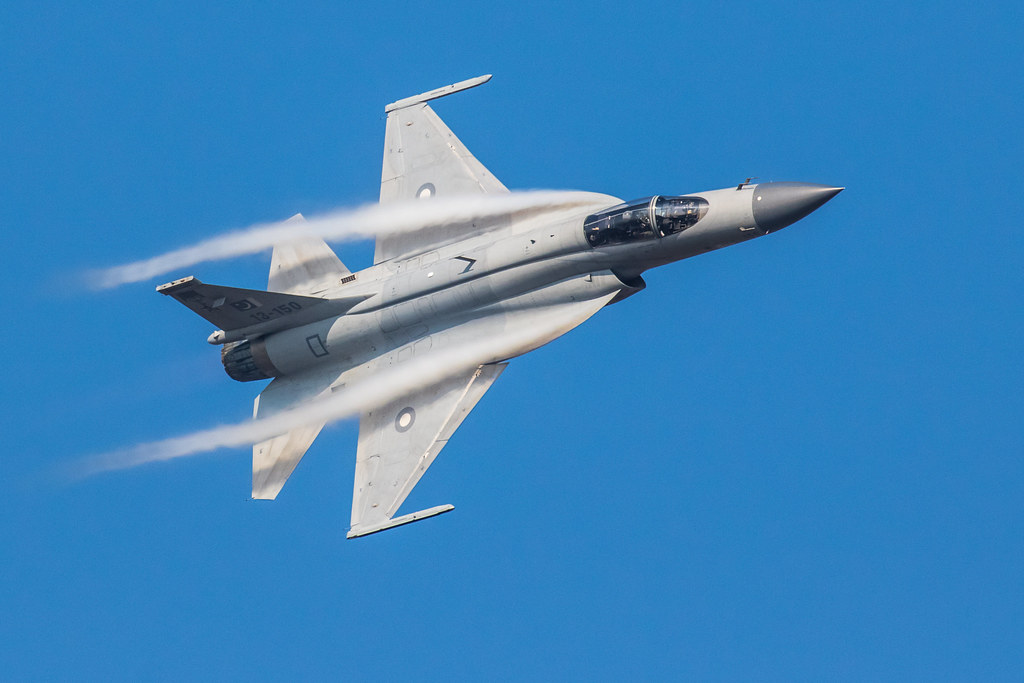 From the photo above, we can observe that
At this moment, the airflow speed at the wing strakes on the upper side of the JF-17’s intake should be the fastest.
From the photo above, we can observe that
At this moment, the airflow speed at the wing strakes on the upper side of the JF-17’s intake should be the fastest.
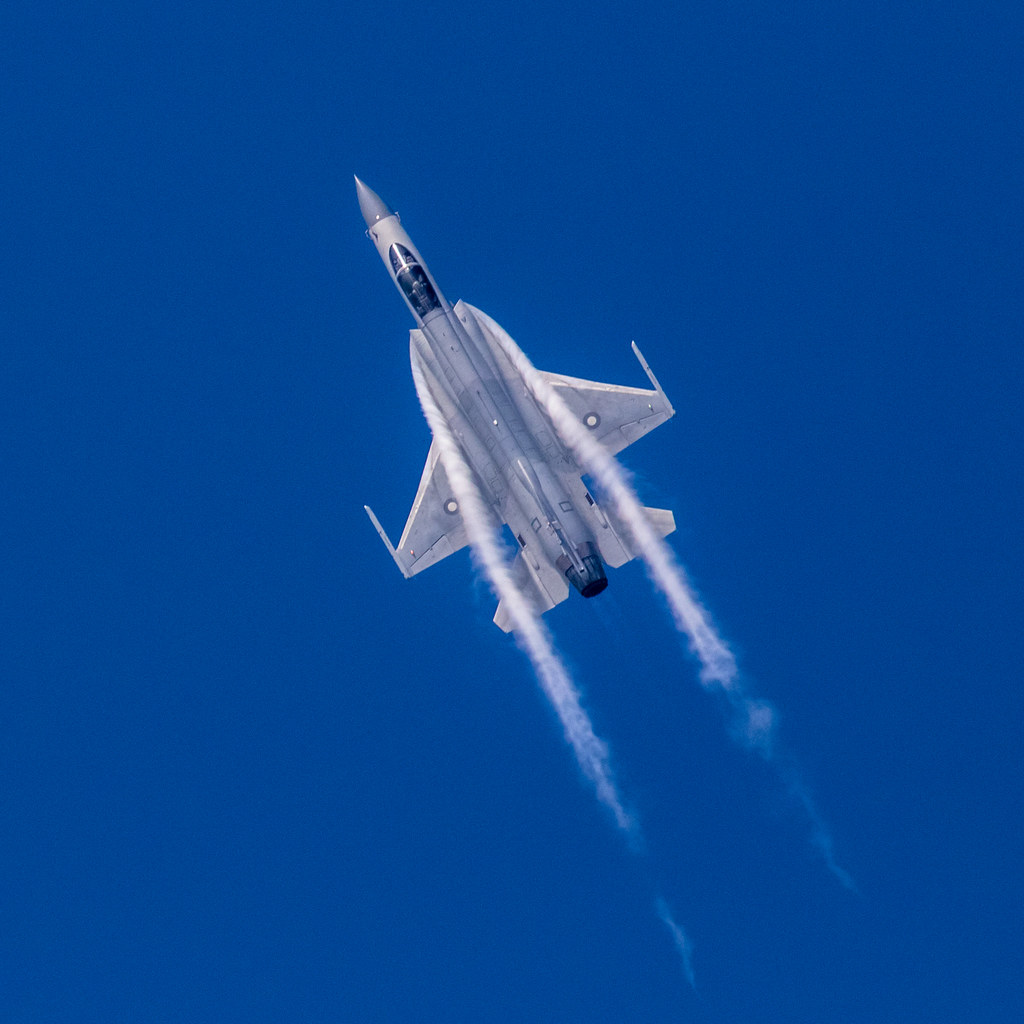 The white smoke trail during a near-vertical Climb looks like a white scarf draped around the aircraft’s neck.
The JF-17’s display time was only a short 10 minutes,
It seemed like they were warming up the stage for the subsequent Russian Knights/Swifts, British Red Arrows, and Chinese August 1st Flight Display Team.
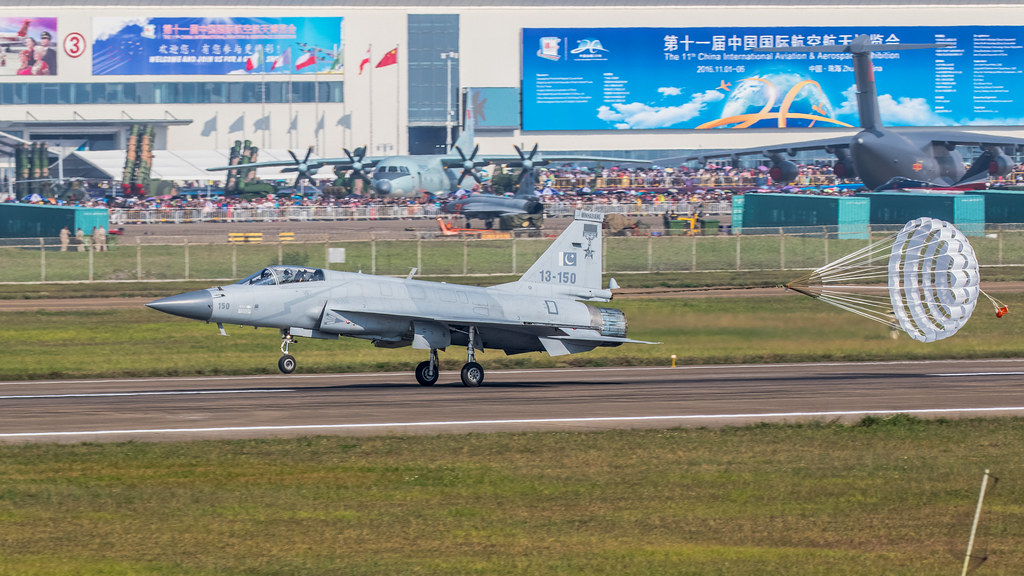 However, its agile maneuvering performance left a deep impression on me.
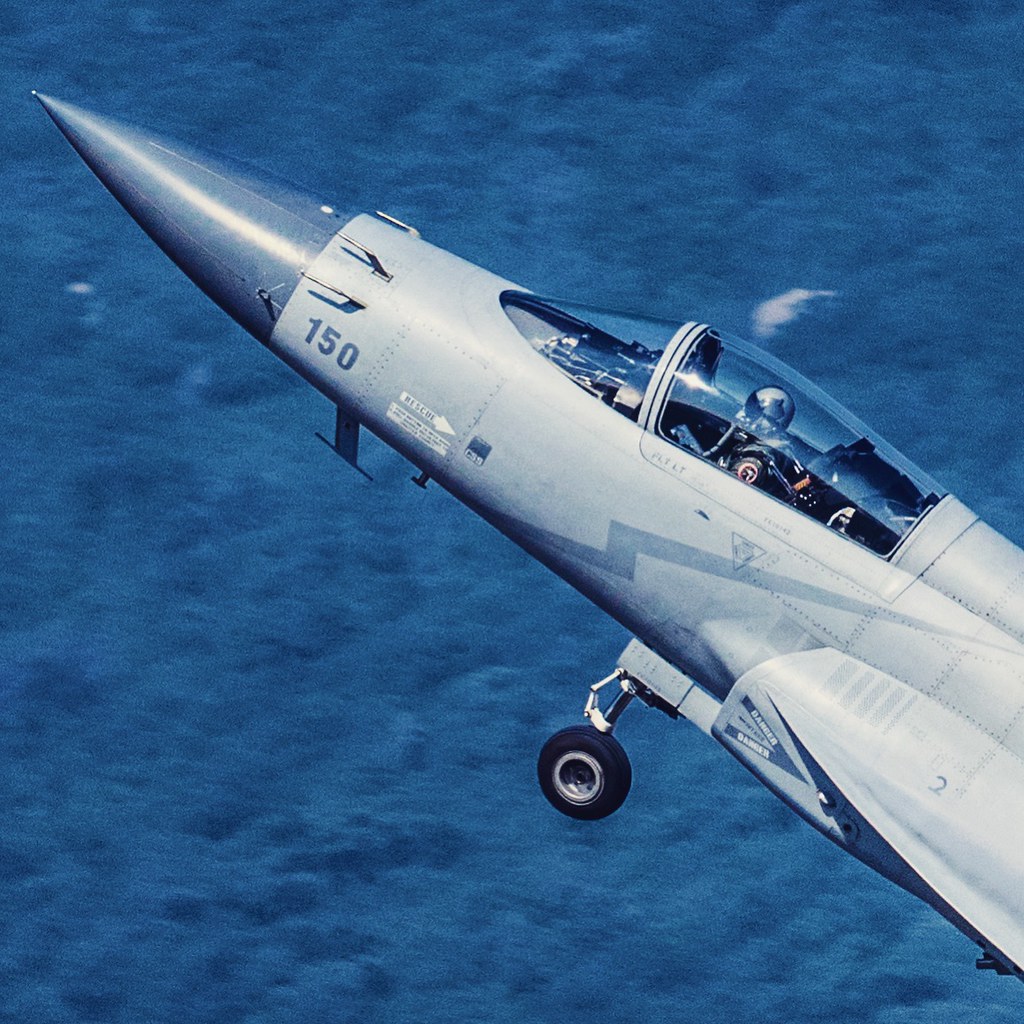
Zooming in to look at the cockpit area and the DSI intake, it looks super cool.
To be continued