C-47 Commemorating The Hump Flight Needs Help
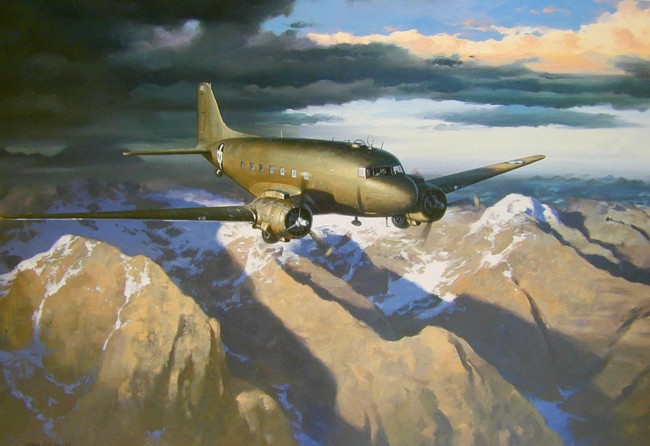
A commemorative flight organized by civilians is currently underway. They are piloting a C-47 named “Buzz Buggy” from Australia to China, planning to fly over the Himalayas to commemorate the famous air route from World War II—The Hump. The homepage for this commemorative event is FLYING THE HUMP, and their Facebook page is here.
However, they encountered engine failure in Malaysia and are facing a severe funding shortage. As a result, they have launched a fundraising campaign online: Commemorative HUMP Flight to China. I donated a few dozen dollars a while back; although it’s just a drop in the bucket, it was a gesture of support. I just saw that they arrived at Seletar Airport in Singapore a few hours ago, but the funding issue remains unresolved.
Regarding The Hump, there is a detailed explanation on Wikipedia. Below is a brief excerpt to provide a summary for friends unfamiliar with this history.
After the Pacific War broke out in December 1941, the United States joined the war against Japan. By May 1942, during the Second Sino-Japanese War, the Japanese army cut off the Burma Road, which was China's last overland supply line. Consequently, China and the United States were forced to open an air corridor for transporting strategic materials between Assam in northeastern India and Kunming, Yunnan, China. This air corridor was known as the "The Hump" (驼峰航线).The route flew over the Himalayas, which was considered an aerial forbidden zone. Due to the altitude of the peaks and the performance limitations of propeller aircraft at the time, planes had to fly tightly hugging the mountain contours. The resulting flight trajectory undulated like a camel’s hump, hence the name. In English, it is called “The Hump”.
This was the most arduous transport line in the history of aviation and warfare. It spanned approximately 800 kilometers. The Hump operation was also the longest-lasting large-scale airlift during World War II. Due to the harsh terrain and climatic conditions, it was known as the “Death Route.” The route passed over peaks with altitudes ranging mostly from 4,500 to 5,500 meters, with the highest exceeding 7,000 meters. Because the aircraft facilities of that era were primitive and lacked pressurization, flying at such extreme altitudes required immense endurance from the crew.
According to official US statistics, during the airlift to China between April 1942 and August 1945, the US Army Air Forces transported 650,000 tons of various war supplies. On the The Hump route, over 500 US aircraft (including C-46s and C-47s) were lost, and 468 American and 46 Chinese crew members sacrificed their lives, totaling over 1,500 people.


Update: October 15 According to news on Twitter, the aircraft has arrived at Kunming Airport.
Buzz Buggy in Kunming, China after successfully crossing The Hump. pic.twitter.com/xHTWlJCZmn
— Alert 5 (@alert5) October 15, 2016
Update: December 16 1. An old aircraft with quite a story parked at Kunming Changshui Airport This article is very well written, detailing the response from the Yunnan ATC bureau when “Buzz Buggy” made an emergency landing in Kunming, as well as the repair process. It also mentions this website, so I highly recommend it. Hehe. 2. The history of VH-XUX Historic Australian Aircraft