The Malfunctioning Delta 767 In-Flight Entertainment System
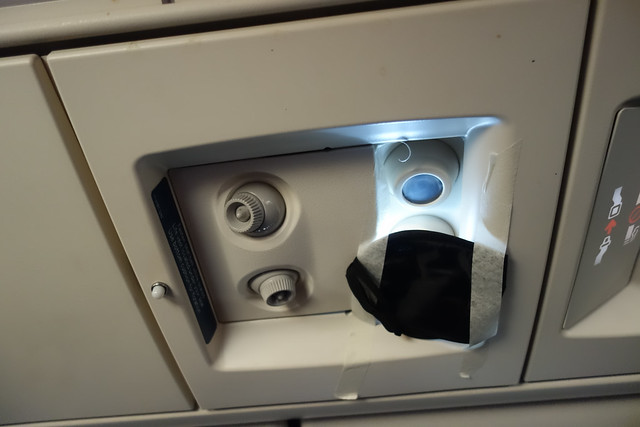
I usually don’t watch movies when I fly, so I haven’t really researched in-flight entertainment systems. On this trip, I took a Delta flight on a Boeing 767-300ER, and encountered a malfunction with the entertainment system. The overhead reading light just couldn’t be turned off. (The button for the light is on the entertainment system’s touchscreen; there is no physical switch.)
I asked a CA (Cabin Attendant) to take a look. They suggested restarting the system.
After 3 restarts with no improvement, we finally resorted to a low-tech solution:
taping an eye mask over the light with tape, which greatly reduced the brightness.
This prevented it from disturbing the rest of the passengers around me.
However, there was a silver lining: I gained a preliminary understanding of Delta’s B767 onboard system. I’ll post the images below for a brief analysis.
The initial boot screen contains a huge amount of information.
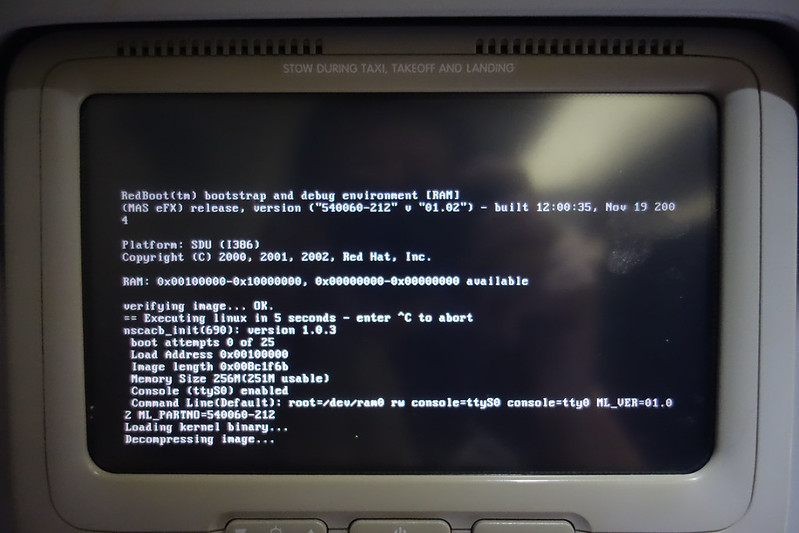
First, I learned it uses RedBoot startup firmware. This is an open-source program that uses the hardware abstraction layer of the eCos real-time operating system to boot this embedded Linux OS from Redhat. Seeing that the RedBoot build time is November 2004 and the Redhat version is even older, I guess this in-flight entertainment system has quite a bit of history.
According to the RedBoot Wikipedia page, besides Delta’s 767, the Airbus A380 also uses it as a bootloader for the in-flight entertainment system.
Entering OS initialization, you can see the familiar Linux penguin logo.
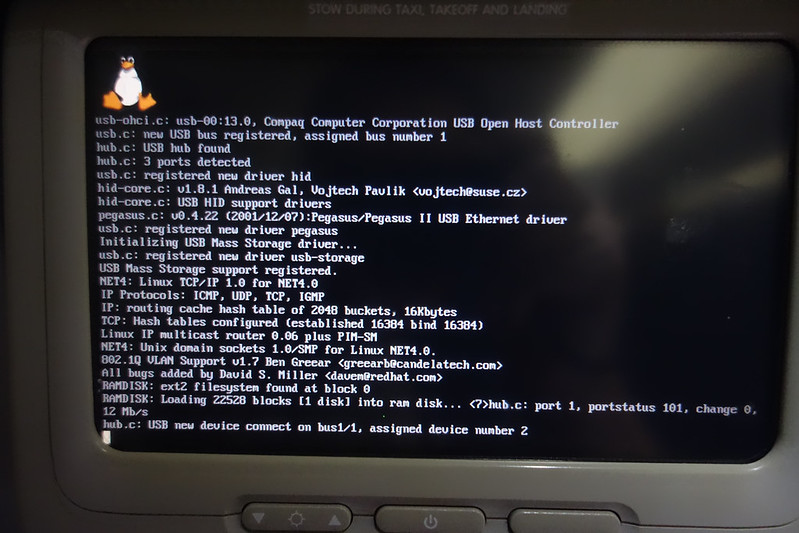 It initializes the USB hub, Human Interface Device (HID), and storage drivers,
followed by the network components: TCP, IP, VLIN, and RAMDISK.
It initializes the USB hub, Human Interface Device (HID), and storage drivers,
followed by the network components: TCP, IP, VLIN, and RAMDISK.
Initialization continues for audio, handset, and credit card reader,
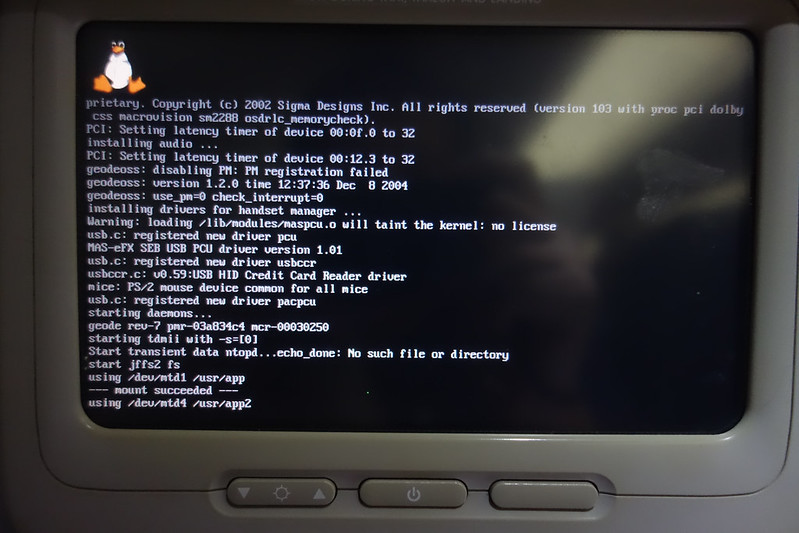 and it uses mtd devices for external storage.
I hadn’t even found where the touchscreen device was initialized when the system already entered GUI mode,
so the console information ends there.
However, I found a more complete video on YouTube where basically all console messages are visible.
You can see the OS version is Linux 2.4.18-3dk1 from 2002, Red Hat Linux 7.3 2.96-113, using gcc version 2.96 from 2000. However, it seems the kernel was recompiled on September 27, 2012, and the CPU clock speed is 266.650MHz. Also, through usrconfig, you can see some application names, such as paxus3air, seatApp, pax_survey, etc., and I think I even spotted sqlite.By the way, the flight data mode on this system is quite nice. Besides the map mode,
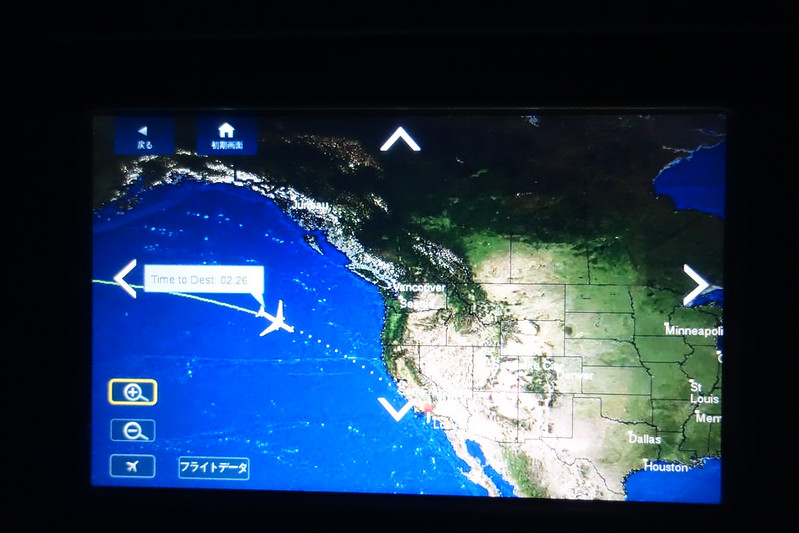 it provides a dedicated page,
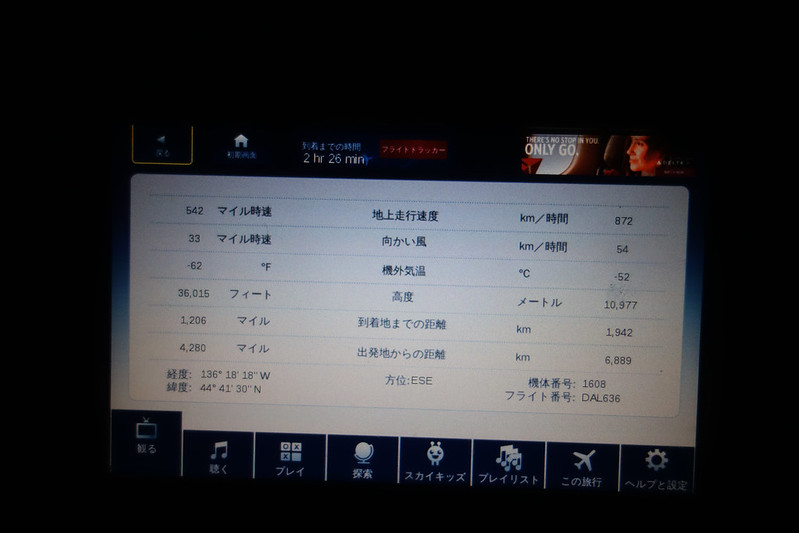 where you can see that during the cruise phase, the Ground Speed (GS) is 872 km/h,
with a headwind of 54 km/h, and an outside air temperature of -52 degrees.
The cruise altitude is 36,000 feet, approximately 11,000 meters.
There are 1,942 kilometers remaining to the destination, and 6,889 kilometers have already been flown.
The current position is 136°18'18" West Longitude, 44°41'30" North Latitude.
The Heading is East-Southeast, aircraft number is 1608, and flight number is DL636.
where you can see that during the cruise phase, the Ground Speed (GS) is 872 km/h,
with a headwind of 54 km/h, and an outside air temperature of -52 degrees.
The cruise altitude is 36,000 feet, approximately 11,000 meters.
There are 1,942 kilometers remaining to the destination, and 6,889 kilometers have already been flown.
The current position is 136°18'18" West Longitude, 44°41'30" North Latitude.
The Heading is East-Southeast, aircraft number is 1608, and flight number is DL636.
In recent years, I’ve mostly flown ANA and JAL. It was rare to take Delta, and I ran into a malfunction, but I learned a lot. As the saying goes, “A blessing in disguise.”