Shoddy Construction Work During Runway Reinforcement at Tokyo International Airport
Most people’s impression of Japanese architecture is that it is very meticulous and sturdy, with high earthquake resistance. However, this does not mean that all construction is flawless. For example, last Friday, NHK reported on corner-cutting in the Runway construction work at Haneda Airport.
The purpose of this project was to prevent soil liquefaction of the Runway during an earthquake, and was contracted to Toa Construction Corporation.
Soil liquefaction mainly occurs in water-saturated sandy or clayey soils distributed at shallow depths. During liquefaction, sand and water mix into a slurry-like liquid, causing the soil to lose its bearing capacity. This results in tilting houses, land subsidence, and rupture or floating of underground pipelines. Historically, soil liquefaction occurred during the 1906 San Francisco earthquake, the 2011 Great East Japan Earthquake, and the February 2016 earthquake in southern Taiwan.
Tokyo International Airport, commonly known as Haneda Airport, has Runway C (RWY34R/16L) built on reclaimed land. If a major earthquake occurs, the possibility of soil liquefaction is very high. Therefore, the Ministry of Land, Infrastructure, Transport and Tourism (MLIT) commissioned Toa Construction Corporation to undertake Runway reinforcement work. The specific method involved injecting a certain chemical agent into the ground, which could turn groundwater into a gel state, achieving the goal of increasing Runway strength.
This project was conducted from last May to March of this year. However, the contractor discovered that due to many underground obstacles, the injection of the chemical agent was hindered, resulting in only 5% of the planned agent being injected.
Toa Construction Corporation was also undertaking other airport projects. In order not to affect its performance, an executive director instructed subordinates to submit a false report to the Ministry of Land, Infrastructure, Transport and Tourism.
It is unknown how this incident was discovered, but the Runway reinforcement work will have to be redone in the future. It is believed that Toa Construction Corporation will also receive the appropriate punishment.
The news reports in the media basically cover these contents, but as an aviation enthusiast, I was not satisfied, so I looked up the data on this Runway reinforcement project.
Interestingly, the Nagoya Port and Airport Technical Research Office of the Ministry of Land, Infrastructure, Transport and Tourism website has an introduction to this method. It is called the “Balloon Ground Method”, and the Japanese name is “バルーングラウト工法” (Balloon Grouting Method).
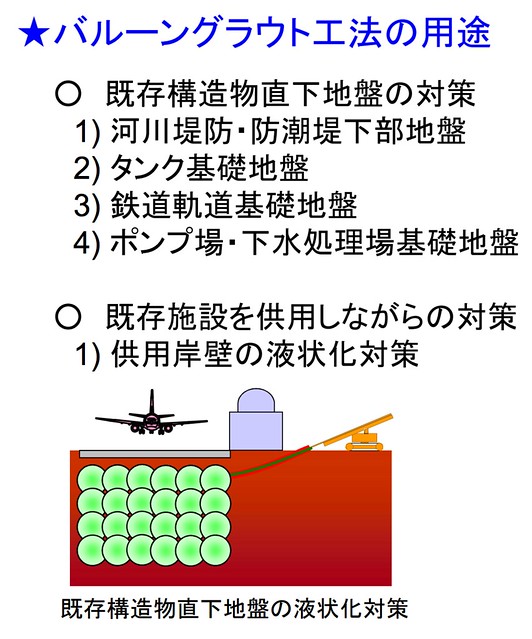 From the image above, it can be seen that an opening is made from the outside of the **Runway**,
and the chemical agent is injected diagonally downward through pipes beneath the **Runway**.
From the image above, it can be seen that an opening is made from the outside of the **Runway**,
and the chemical agent is injected diagonally downward through pipes beneath the **Runway**.
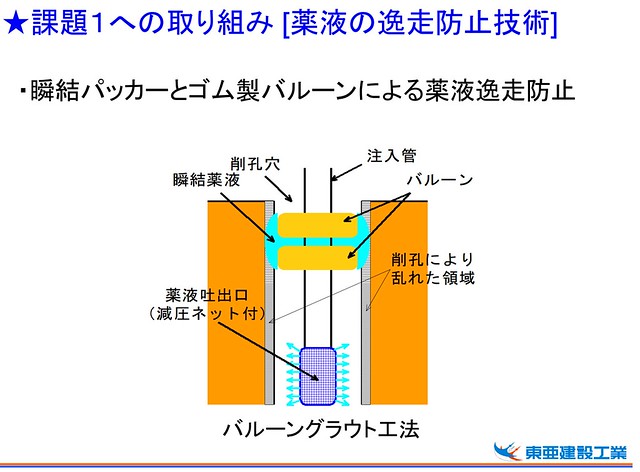 To prevent leakage of the chemical agent, instantaneous packing and rubber balloon technology are used.
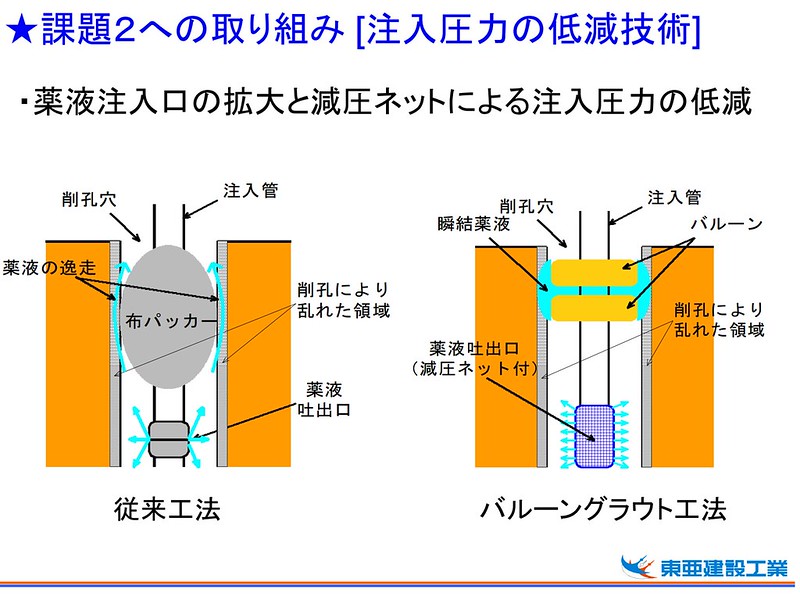 To reduce the pressure when injecting the chemical agent,
the injection port was enlarged, and a pressure reduction network was introduced to lower the penetration speed of the agent.
To reduce the pressure when injecting the chemical agent,
the injection port was enlarged, and a pressure reduction network was introduced to lower the penetration speed of the agent.
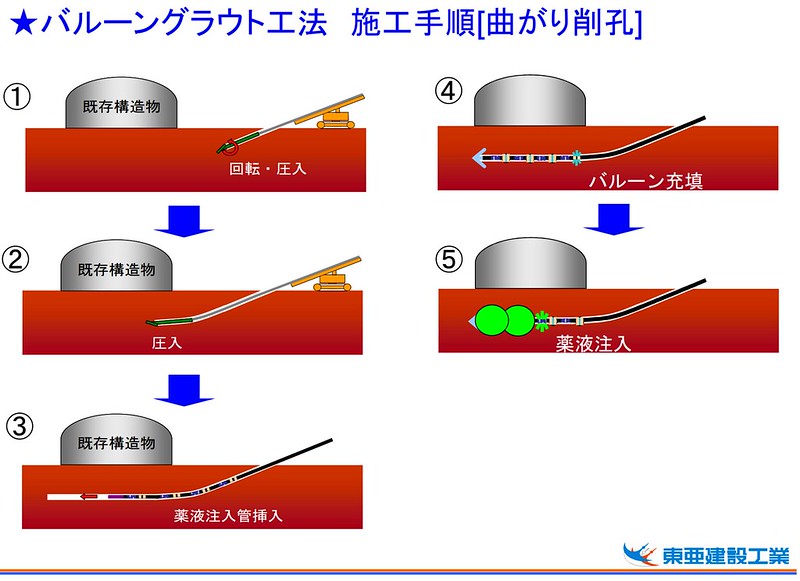 The construction steps are:
1. Rotary drilling
2. Pressing in equipment
3. Inserting chemical injection pipe
4. Filling the rubber balloon
5. Injecting chemical agent, balloon expands
The construction steps are:
1. Rotary drilling
2. Pressing in equipment
3. Inserting chemical injection pipe
4. Filling the rubber balloon
5. Injecting chemical agent, balloon expands
I have no professional knowledge of construction and do not know if my understanding is correct, but from a layman’s perspective, this method looks quite cool.
However, reality is not as beautiful as imagined. I guess perhaps in the work of step 5, due to being obstructed by something in the ground, the balloon could not expand as planned, and the injection of the chemical agent was not successful.
Perhaps the technical problems can be solved in the future, but falsification and submitting false reports are absolutely unforgivable.