A Review of Japanese Aviation Law Regulations on Drones
A couple of days ago, I saw a news report about a Chinese international student who was using a drone to film cherry blossoms at the Kyoto Imperial Palace. Because he did not apply for permission in advance, he was arrested by the police and referred to prosecutors. Since he had also used the drone in Arashiyama and the Philosopher’s Path, he may face stricter penalties.
I previously summarized an article on Japanese Aviation Law regulations regarding drones. As noted in that article, flying in densely populated areas without prior application to the authorities can result in a fine of up to 500,000 yen.
But what exactly counts as a “densely populated area”? And where else can’t you fly a drone?
So, I checked the relevant regulations again and found that the materials on the Ministry of Land, Infrastructure, Transport and Tourism (MLIT) website are more substantial than before. For instance, airspace requiring prior application includes:
 A. Airspace around Airports
B. Altitudes above 150 meters
C. Densely Populated Areas
These three types.
A. Airspace around Airports
B. Altitudes above 150 meters
C. Densely Populated Areas
These three types.
The definition of C can be found on the government’s Geospatial Information Authority of Japan (GSI) map website. For example, the Tokyo area is basically all red,
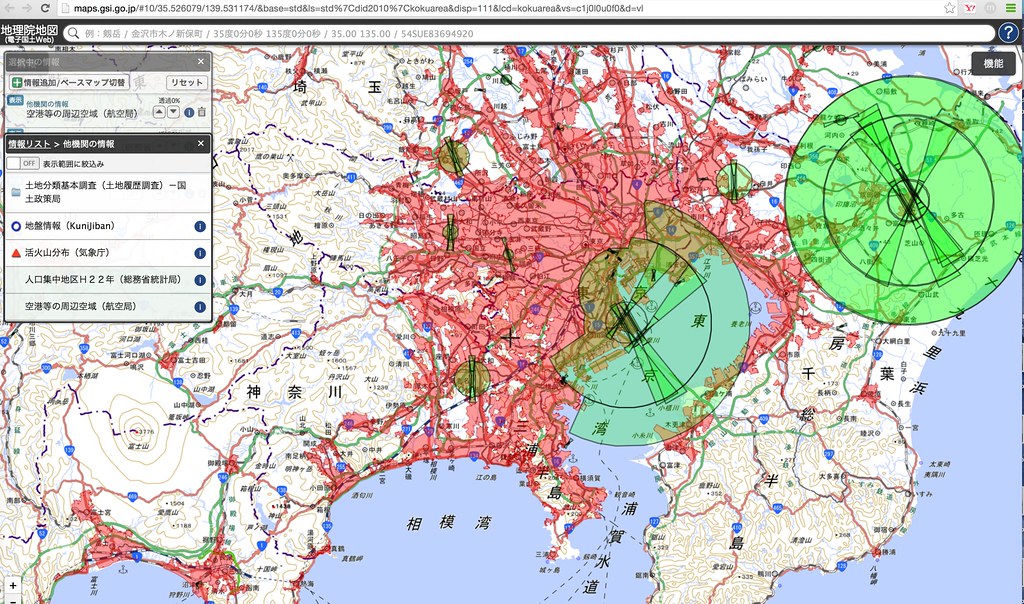 which indicates “Densely Populated Areas” as defined in C.
Looking at the Kyoto-Osaka area,
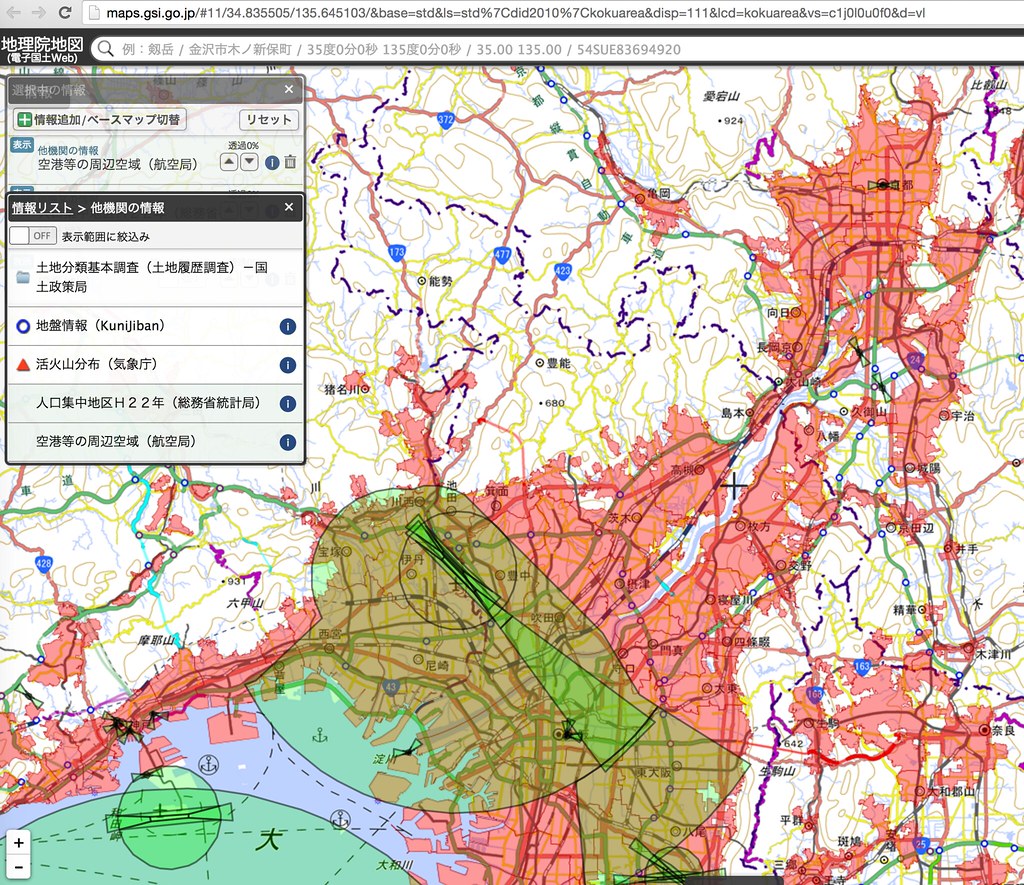 basically everywhere within the city limits is Class C airspace.
The precautions during flight are the same as introduced before, but there is a diagram that makes it more visual.
 Flights under the following conditions also require prior application:
- Flight time is between sunrise and sunset
- Must maintain visual line of sight (VLOS) with the drone and surrounding conditions at all times
- Must maintain a certain distance from people and buildings
- Must not enter venues where crowds gather for holidays, public events, exhibitions, etc.
- Must not carry flammable or explosive materials, or other items likely to injure people or damage ground structures
- Must not drop items likely to injure people or damage ground structures
The application form format is Word. You can see the explanation here. The required content includes: Purpose of flight, time, route, reason for entering prohibited areas, Reasons for requesting specific operational precautions, Drone manufacturer, model, weight, functions and performance, User’s drone piloting experience as well as knowledge and qualifications, Whether third-party liability insurance has been joined, Whether permission from air traffic control was obtained before flying above 150 meters.
Additionally, applications can be submitted by mail to the MLIT or via the online Electronic Application System.
Also note that government approval takes 10 business days, so it is safest to submit the application at least 10 days before your planned flight date.
Finally, the user has an obligation to submit a post-flight report. The report form is also in Word format. Content includes the flight permit number, Flight log (User name, flight summary, aircraft type, takeoff location, takeoff time, landing location, landing time, total flight time, any incidents affecting flight safety), Map of the flight area, etc.
End