What is the purpose of the static port on the vertical stabilizer?
This Star Alliance livery ANA Boeing 777 was shot at Tokyo Haneda Airport Terminal 2.

If you look closely at the Vertical Stabilizer, you can see two small white circles on the leading edge.
So, I zoomed in on the photo. Although it’s not very clear, you can still make out the text “Static Port” to the left of the circle,
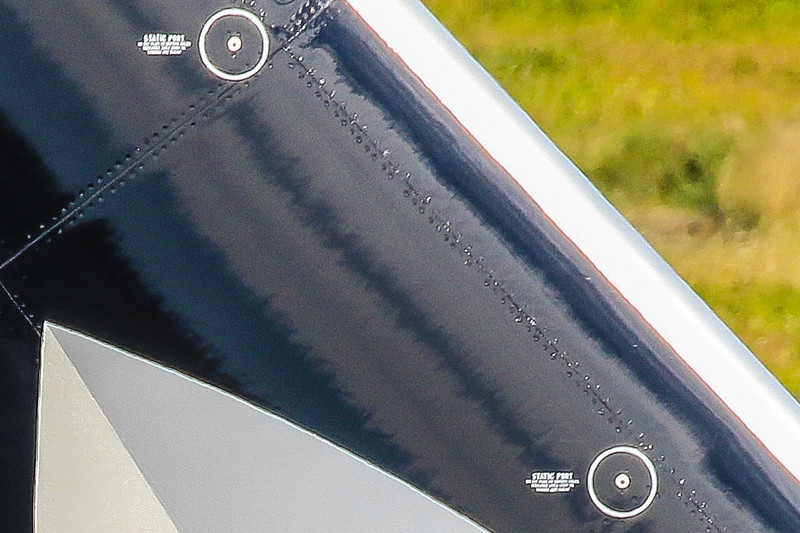 indicating that this is a Static Port, also known as a static pressure sensor.
We know that generally there are several static ports on the front of the aircraft fuselage. Working with the total pressure port, they can measure important flight metrics such as altitude and speed. But what is the function of these static ports mounted on the vertical stabilizer?
It is said that these static ports are also called Gust Suppression ports.
“Gust” can be translated into Chinese as 阵风 or 突风, referring to wind disturbances of significant intensity. When an aircraft flies through a gust, the wind creates additional forces and moments on the aircraft’s structural aerodynamic surfaces. This not only reduces passenger ride comfort but also increases the burden on the pilot to control the aircraft, potentially affecting aviation safety.
The Boeing 777 passenger aircraft employs a “Yaw Gust Suppression” system. Through the 4 static ports on both sides of the vertical stabilizer shown in the photo—specifically the Yaw Gust Suppression ports— the system measures horizontal gusts and automatically controls the rudder deflection to alleviate the load acting on the vertical tail.
It is said that this load alleviation technology ensures that cabin crew members, even when the aircraft encounters gusts, can maintain the aircraft’s stability without interrupting passenger service in the aisle. The results are truly impressive.
Additionally, Boeing’s newer model, the 787, is equipped with a more advanced Vertical Gust Suppression system. It can sense turbulence and command the wing control surfaces to respond to it, thereby significantly improving flight smoothness.