Cost Index CI cost index
In visiting JFlight’s A320 BFPT flight simulator, it was mentioned that the Cost Index (CI) was set to 20 at the time. I wondered what this value typically is during actual flight, so I consulted two professionals. Their answers are as follows.
A Boeing 737 pilot told me it is generally at 35, and according to Cruise speed requirements, the higher the speed, the larger the CI. Senior L told me that their company’s narrow-body aircraft range from 20 to 50, while wide-body aircraft are slightly higher, and international routes are higher than domestic routes. Additionally, this value is calculated by the company’s operations department based on the relationship between fuel costs and time costs. When piloting, the flight crew enters this result into the FMC via the CDU (MCDU).
 #The photo is unrelated to the topic of this article
After learning the actual values, let’s look at the specific explanation of CI. I found a great popular science article on the official Boeing website - Fuel Conservation Strategies: Cost Index Explained.
CI = Time cost (USD) per unit time (Hour) / Fuel cost (US Cents) per unit fuel (Lbs)
The time cost in the numerator refers to costs related to flight time. For instance, it’s easy to associate this with crew salaries. Also, if the flight time is long, aircraft maintenance costs increase. In short, “time is money,” and these costs can all be categorized under fixed costs.
The fuel cost in the denominator is the cost of fuel used per unit weight. This concept is relatively simple and easy to understand.
The Flight Management Computer calculates indicators such as economic (ECOM) Climb speed, economic Cruise speed, and economic Descent speed based on the CI value and other performance parameters entered by the pilot.
If the CI value is high, time cost takes priority over fuel cost, so the economic speed increases accordingly. When the CI value is 0, time cost is completely ignored, fuel consumption is minimized, range speed is maximized, and Range is maximized. When the CI value is at its maximum, fuel cost is completely ignored, flight envelope speed is the fastest, and flight time is the shortest.
Looking at the Cost Index ranges for various Boeing types:
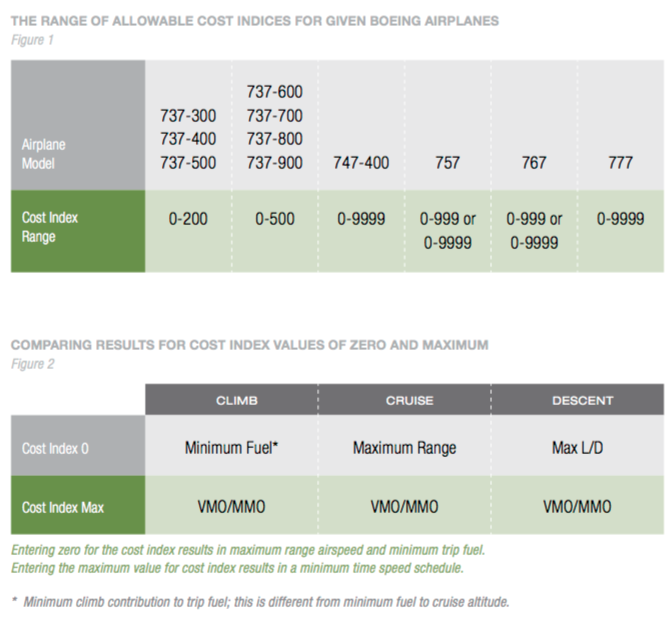 The CI value for the second-generation 737 is between 0 and 200, for 737NG it is between 0 and 500, and for 747-400 and 777, it is between 0 and 9999.
Additionally, Table 2 shows the speed relationship when CI is 0 and Max. Combining this with specific models, the actual data are as follows:
The CI value for the second-generation 737 is between 0 and 200, for 737NG it is between 0 and 500, and for 747-400 and 777, it is between 0 and 9999.
Additionally, Table 2 shows the speed relationship when CI is 0 and Max. Combining this with specific models, the actual data are as follows:
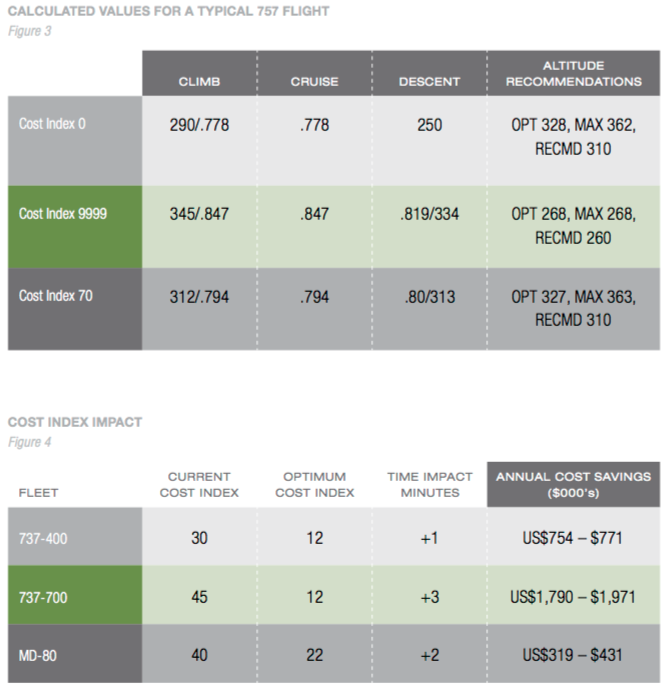 Take the Boeing 757 as an example:
During Climb and Cruise, when CI is 0 the speed is Mach 0.778; when at maximum 9999 it is Mach 0.847; and when CI is 70 the speed is Mach 0.794.
During Descent, when CI is 0 the speed is 250 knots; when at maximum 9999 it is Mach 0.819; and when CI is 70 the speed is Mach 0.794.
Take the Boeing 757 as an example:
During Climb and Cruise, when CI is 0 the speed is Mach 0.778; when at maximum 9999 it is Mach 0.847; and when CI is 70 the speed is Mach 0.794.
During Descent, when CI is 0 the speed is 250 knots; when at maximum 9999 it is Mach 0.819; and when CI is 70 the speed is Mach 0.794.
The following two figures are also quite interesting:
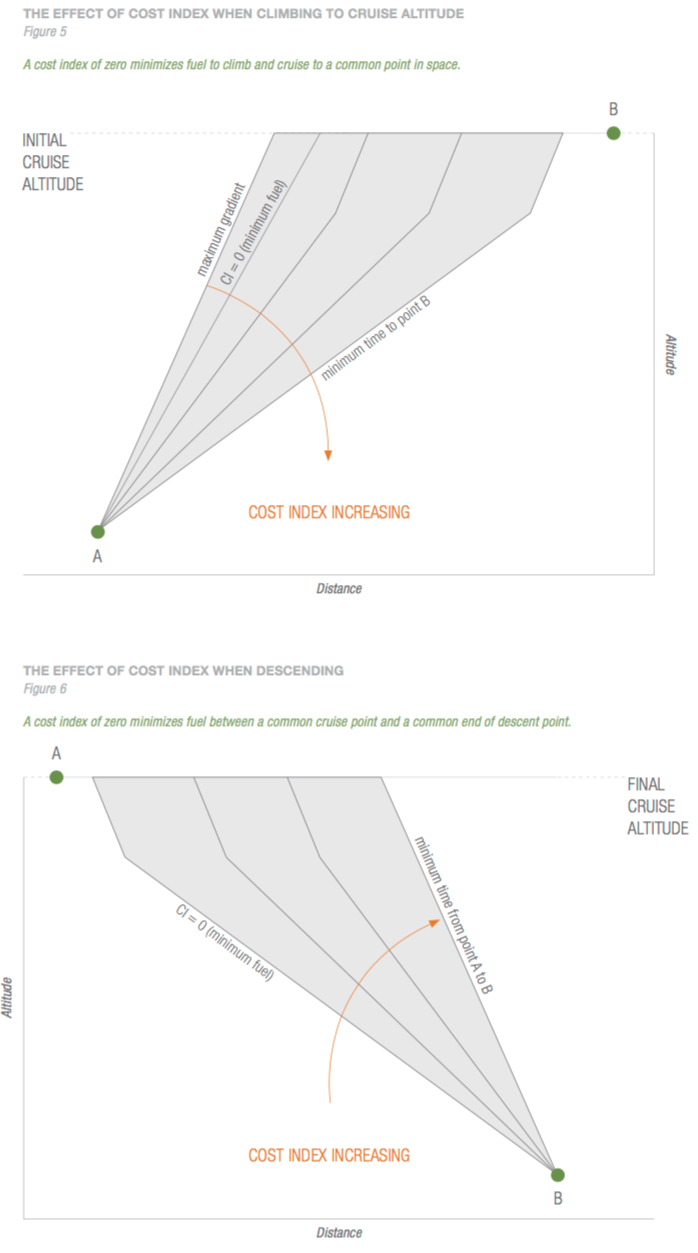 Figure 5 shows the impact of the CI value on ECON CLIMB mode. It can be seen that when CI is 0, the maximum climb angle is obtained.
Note that the maximum climb angle does not mean the aircraft can Climb to the initial Cruise altitude the fastest,
but rather that the distance from point of departure A to reaching Cruise altitude is the shortest; therefore, the distance flown at Cruise altitude is the longest.
At this time, the speed is actually the lowest.
Figure 5 shows the impact of the CI value on ECON CLIMB mode. It can be seen that when CI is 0, the maximum climb angle is obtained.
Note that the maximum climb angle does not mean the aircraft can Climb to the initial Cruise altitude the fastest,
but rather that the distance from point of departure A to reaching Cruise altitude is the shortest; therefore, the distance flown at Cruise altitude is the longest.
At this time, the speed is actually the lowest.
As the CI increases, time cost is prioritized and fuel cost is ignored, so the flight speed is higher. Using the 757 numbers above, this increases from Mach 0.778 to Mach 0.847. At the same time, the climb angle becomes smaller, and the distance to reach Cruise altitude becomes longer.
Figure 6 shows the impact of the CI value on Descent mode. When CI is 0, the descent angle is the gentlest. This can be thought of as maximizing the use of altitude energy, feeling like a slow Glide Descent. As the CI increases, the descent angle becomes steeper, and the distance to fly to destination point B is the shortest, so the flight speed is also the highest. Using the 757 numbers above, the speed increases from 250 knots to 334 knots.
End
2018/07/27 I found that this website summarizes many practical CI values for airlines, which is very helpful. TOGA project Documents library
Cost Index database This file contains some of the real airlines cost index that will help you to simulate your flights as close as possible to the real life.
Excerpts from several typical airlines are as follows: 1 American Airlines Flight duration < 4 hours MD80 CI = 24 A32X CI = 27 B737 CI = 35 B757 CI = 80 B767 CI = 65 B772 CI = 85 B77W CI = 90
Flight duration > 4 hours MD80 CI = 21 A32X CI = 22 B737 CI = 30 B757 CI = 75 B767 CI = 60 B772 CI = 80 B77W CI = 85
2 British Airways
Cruise A318 CI = 30 A319/A320 CI = 15 A321 CI = 20 A380 CI = 120 B737 CL CI = 28 B744 * CI = 90 B757 & B767 CI = 40 B777 * Eco CI = 100 CI = 57 B787 CI = 25
3 United Airlines Flight duration < 4 hours A32X CI = 27 B737 NG & CL CI = 35 B752 CI = 80 B763 CI = 65 B772 CI = 85 B744 CI = 90
Flight duration > 4 hours A32X CI = 22 B737 NG & CL CI = 30 B752 CI = 75 B763 CI = 60 B772 CI = 80 B744 CI = 85