Capturing Vietnam Airlines A350-900: Ground Operations
Since first seeing the A350 last November, this eye-catching latest passenger jet has completed various tests and gradually entered commercial operation. To date, Airbus has delivered a total of 5 aircraft to Qatar Airways, Vietnam Airlines, and Finnair, but I haven’t had the chance to see one with my own eyes until now. Fortunately, on September 20th, Vietnam Airlines finally put the A350-900 into service on the Narita-Ho Chi Minh VN300/VN301 flight. Since it was a Sunday, I couldn’t miss such a great photo opportunity.
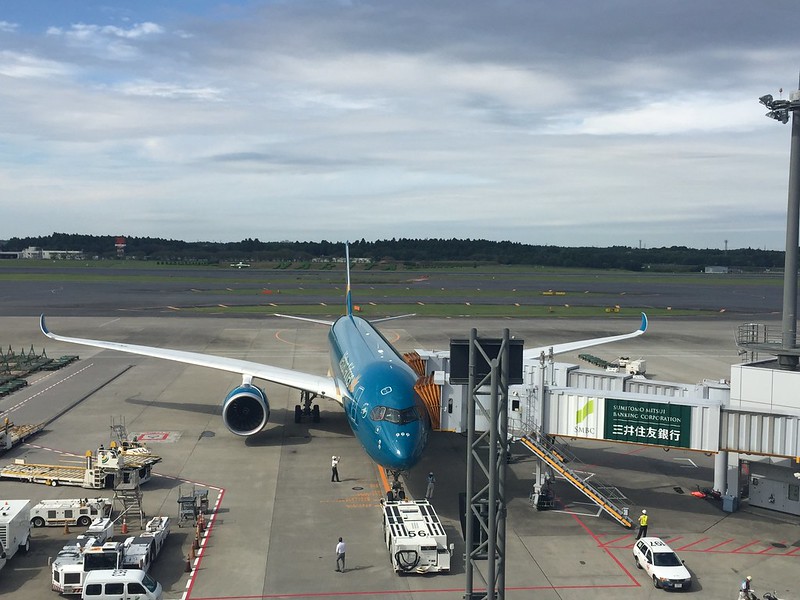
I rushed to the observation deck of Terminal 1 at Narita Airport early in the morning. Isn’t that an A350-900 with registration VN-A886 right in front at parking spot 25?
Finally, I can observe this new darling of the aviation world up close!
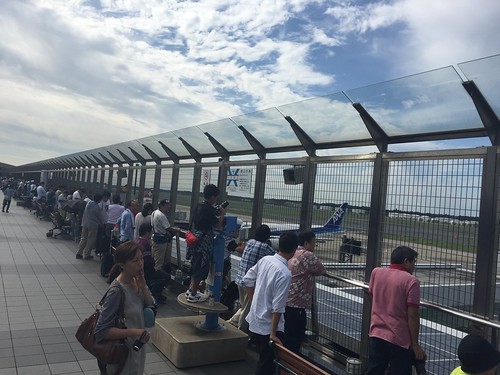
However, there is a practical issue. Due to safety factors, the observation deck at Narita Airport is equipped with high mesh fences. The gap between the meshes is too small to fit a camera lens through. Of course, there are square holes a few tens of centimeters in size provided for photographers every few meters, but these shooting spots had long been occupied by a large number of aviation enthusiasts! It turns out some people left home as early as 4 AM. Impressive, impressive.
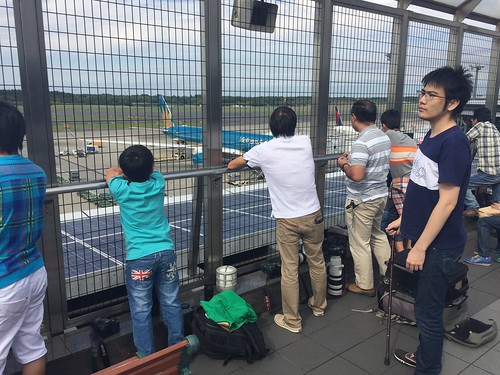
The photography was quite difficult, and many photos were covered by the shadows of the fence. However, I still obtained a lot of precious first-hand material, which was very satisfying. Let’s take a look at the various details of the A350 airframe.
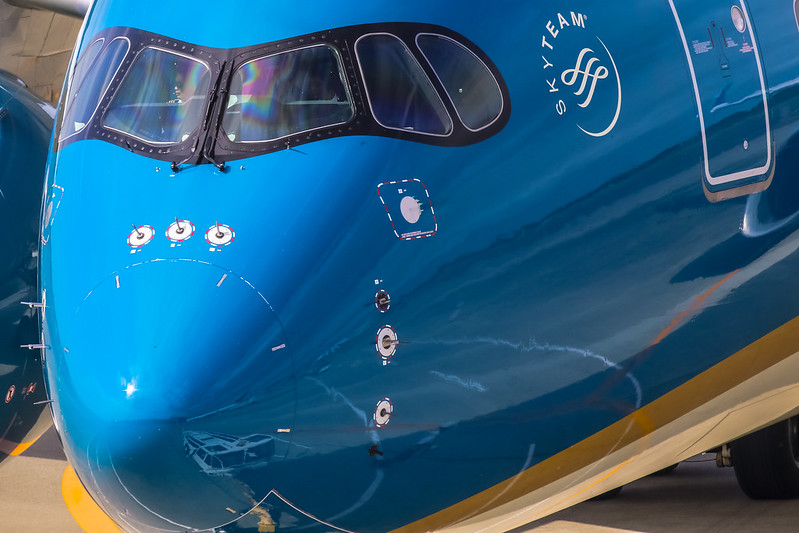
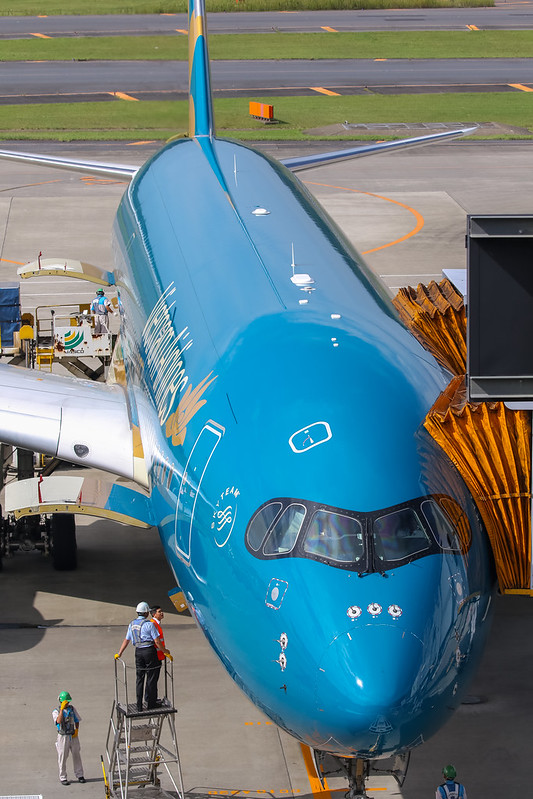
First, a close-up of the pointed nose section. Are the pilots performing the pre-flight procedures? The cockpit with the “Teenage Mutant Ninja Turtles” style black-rimmed glasses looks so cool, haha.
 Looking closely, the windshield structure is actually the same as previous Airbus models, especially the rear windshield which is close to a square shape. This can be observed through the gaps between the windshield panes. However, after painting this black curved frame, it is hard to distinguish from a distance.
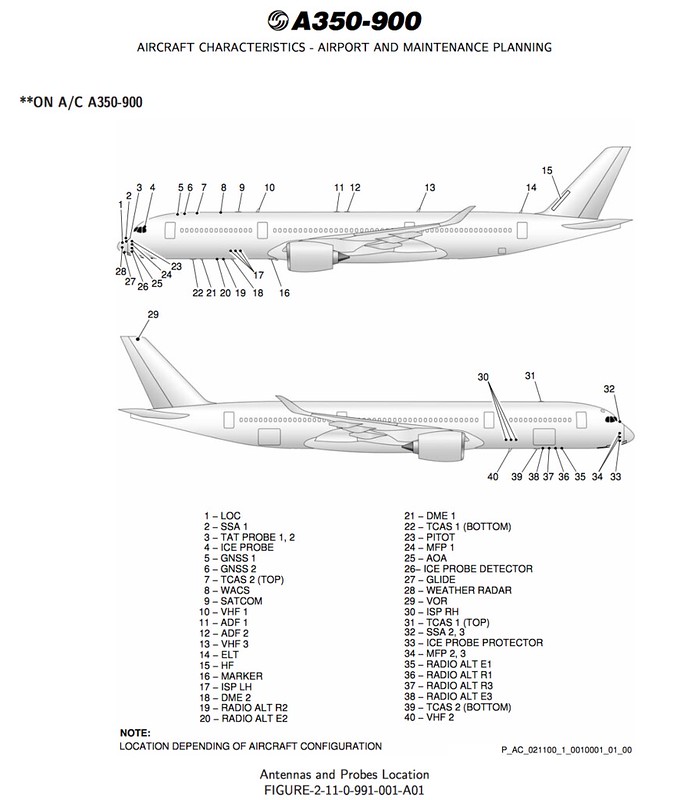
On the right side of the nose, vertically aligned, there are three probes. The upper two are No. 2 and No. 3 Multi-Function Probes (MFP), which can provide Total Pressure (PT), Total Air Temperature (TAT), and Angle of Attack (AOA) data to the avionics system; the bottom black one is the ICE PROBE PROTECTOR.
Directly below the cockpit on the nose, there are three probes arranged side-by-side: No. 1, 2, and 3 Side Slip Angle (SSA) probes. Inside the radome below, the Localizer (LOC) antenna, weather radar antenna, and Glide Slope (GLIDE) antenna are installed respectively.
Looking again at the right side of the nose, there are 4 probes aligned vertically. The top one is the PITOT tube, the second is the No. 1 Multi-Function Probe (MFP), the third is a dedicated Angle of Attack (AOA) probe, and the bottom one is also an ice probe protector.
Looking at the long fuselage from directly above, the A350 looks like a blue silkworm from this angle. Interesting.
Note that the large light at the wing root is the LANDING LIGHTS, and the square exit on the upper fuselage should be the crew escape hatch.
Carefully observe the antennas on the upper fuselage.
The two small square ones at the front are Global Navigation Satellite System (GNSS) antennas. The slightly larger square antenna behind them should be the upper Traffic Collision Avoidance System (TCAS) antenna. The circular one next is likely the strobe light.
The large square antenna behind the strobe light is a satellite communication (SatCom) antenna. I guess there should be Wi-Fi internet access inside the cabin.
Further back, the vertical one should be the No. 1 Very High Frequency (VHF) antenna.
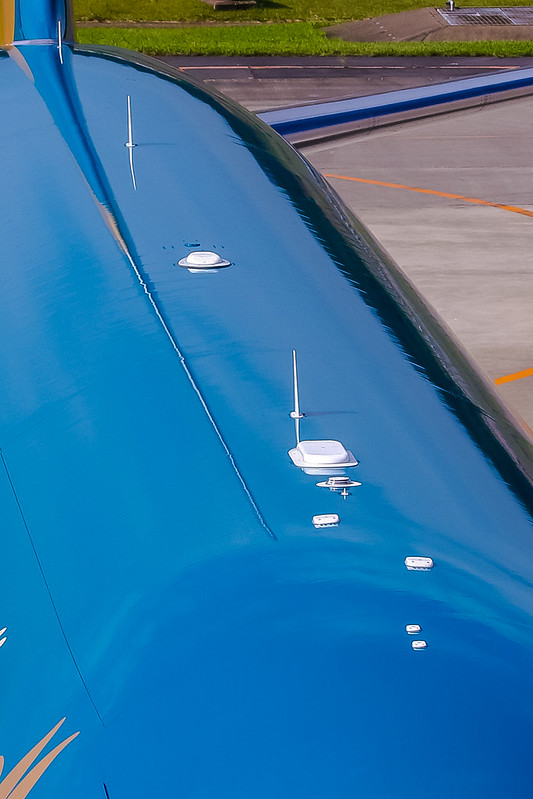 The large circular antenna in the middle of the fuselage is also probably for satellite communication, right? Behind it should be the ADF antenna.
Further back, the vertical one is the No. 3 VHF antenna.
The antenna in front of the vertical stabilizer should be the Emergency Locator Transmitter (ELT) antenna.
The large circular antenna in the middle of the fuselage is also probably for satellite communication, right? Behind it should be the ADF antenna.
Further back, the vertical one is the No. 3 VHF antenna.
The antenna in front of the vertical stabilizer should be the Emergency Locator Transmitter (ELT) antenna.
The A350 fuselage is equipped with 40 antennas and probes. You can refer to the manuals provided by Airbus to identify the details.
By the way, let’s also look at the nose landing gear.
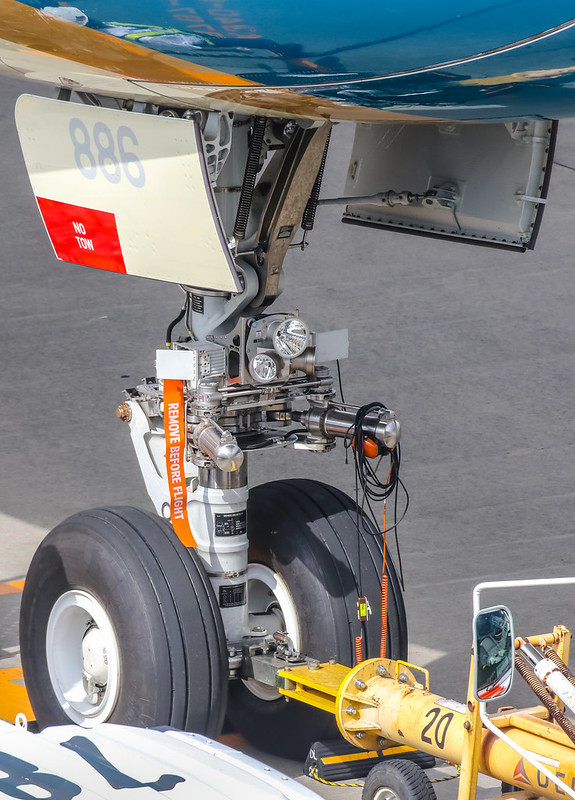 The landing gear safety pin is, of course, inserted. I really want one of those “REMOVE BEFORE FLIGHT” flags, haha.
Three lights are visible in the photo: the left and right are Runway Turn-Off Lights, and the one in the middle is the Taxi Light. Also, although not very clear from the top, there are actually 4 Take-Off Lights.
The landing gear safety pin is, of course, inserted. I really want one of those “REMOVE BEFORE FLIGHT” flags, haha.
Three lights are visible in the photo: the left and right are Runway Turn-Off Lights, and the one in the middle is the Taxi Light. Also, although not very clear from the top, there are actually 4 Take-Off Lights.
 Looking at the nose wheel parking line position, it is parked at the spot for the A340-600 and B767-400.
Since the A350-900 is slightly longer than the A330-300 and B777-200, it is parked here.
Regarding the length comparison of the B787, A350, B777, and A330, it was introduced in this site’s 787-8 VS 787-9 article.
Looking at the nose wheel parking line position, it is parked at the spot for the A340-600 and B767-400.
Since the A350-900 is slightly longer than the A330-300 and B777-200, it is parked here.
Regarding the length comparison of the B787, A350, B777, and A330, it was introduced in this site’s 787-8 VS 787-9 article.
Looking at the front fuselage from the left side, as it is a brand new aircraft just off the production line, the shiny paint is beautiful. Looking at the landing gear, ground power port, right front cargo door, and the positions of the three static ports, they are very close to the A330-200. However, that signature blended winglet is very eye-catching.

Zooming in to look at the left winglet. Does this shape look a bit like a boomerang? Or like a scimitar?
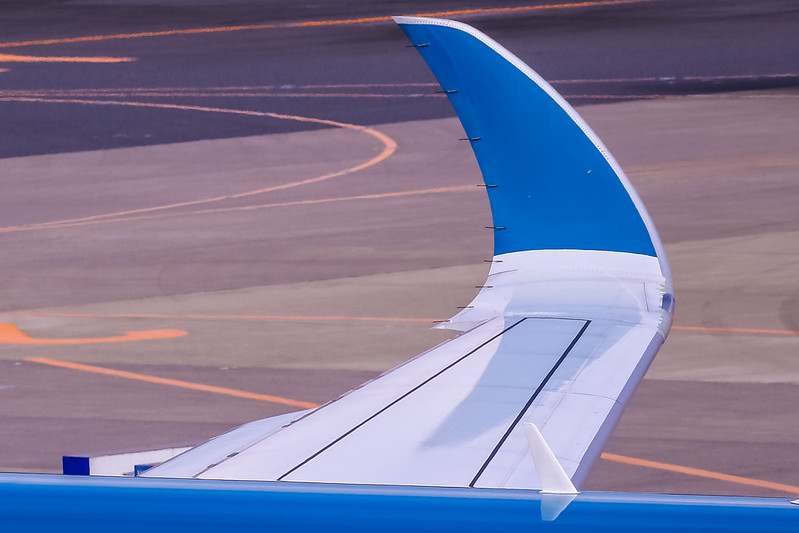 Mr. Chen from Taiwan left a comment on Facebook introducing this:
“The upward curved arc at the wingtip can effectively reduce induced drag, increase the lift-to-drag ratio, and achieve energy-saving effects. In addition, it can also reduce wingtip vortices.”
So I will just copy it here as is. Sorry about that!
Mr. Chen from Taiwan left a comment on Facebook introducing this:
“The upward curved arc at the wingtip can effectively reduce induced drag, increase the lift-to-drag ratio, and achieve energy-saving effects. In addition, it can also reduce wingtip vortices.”
So I will just copy it here as is. Sorry about that!
Next, zooming in to look at the right winglet. This is simply an exquisite work of art!
Smooth curves, metallic texture, precision machining, modern industrial products bring a sense of beauty!
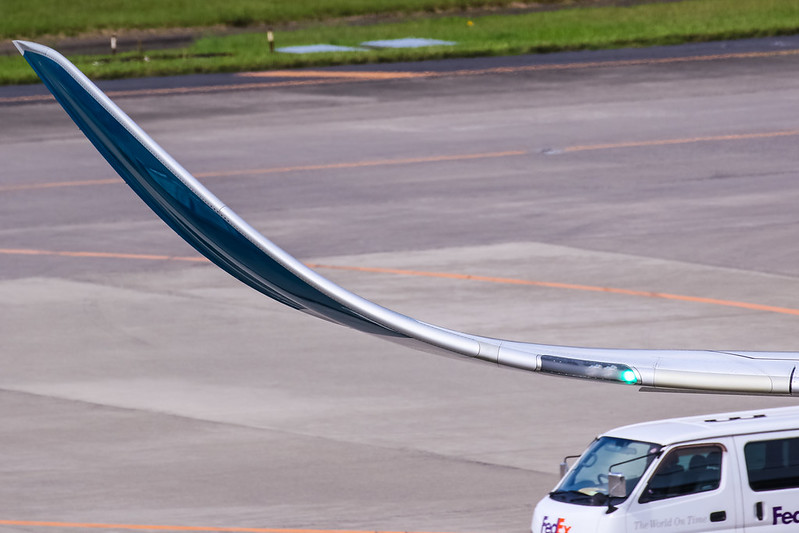 Note that there are also two important external lights here. The inner one is the green Right Navigation Light (GREEN), and the outer one is the white Wing Strobe Light (HIGH INTENSITY, WHITE).
We also need to look at the engines. The Trent XWB, Rolls-Royce’s sixth-generation product, is said to be developed specifically for the A350. However, there is no Rolls-Royce nameplate on the engine nacelle, which is rare.
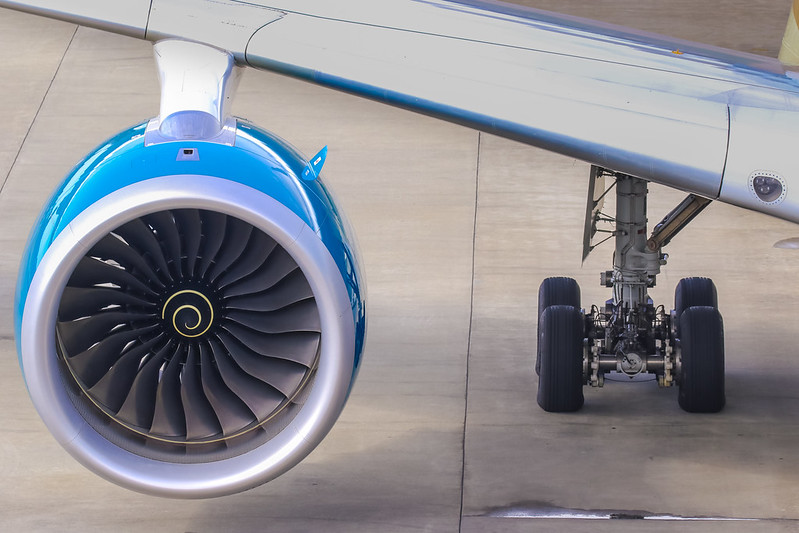 The technical data for the Trent XWB is as follows:
Three-shaft turbofan
High bypass ratio: 9.3
Take-off Thrust: 75,000 - 97,000 lbs (330 - 430 kN)
Fan diameter: 3.0 m (118 inches)
Air mass flow: approx 1440 kg/s
Overall pressure ratio >= 52:1
Intermediate Pressure Compressor: 8-stage axial
High Pressure Compressor: 6-stage axial
High Pressure Turbine: single-stage air-cooled
Intermediate Pressure Turbine: 2-stage air-cooled
Low Pressure Turbine: 6-stage non-air-cooled
The technical data for the Trent XWB is as follows:
Three-shaft turbofan
High bypass ratio: 9.3
Take-off Thrust: 75,000 - 97,000 lbs (330 - 430 kN)
Fan diameter: 3.0 m (118 inches)
Air mass flow: approx 1440 kg/s
Overall pressure ratio >= 52:1
Intermediate Pressure Compressor: 8-stage axial
High Pressure Compressor: 6-stage axial
High Pressure Turbine: single-stage air-cooled
Intermediate Pressure Turbine: 2-stage air-cooled
Low Pressure Turbine: 6-stage non-air-cooled
You can see a very detailed mesh structure on the inside of the engine nacelle. I wonder what the principle is?
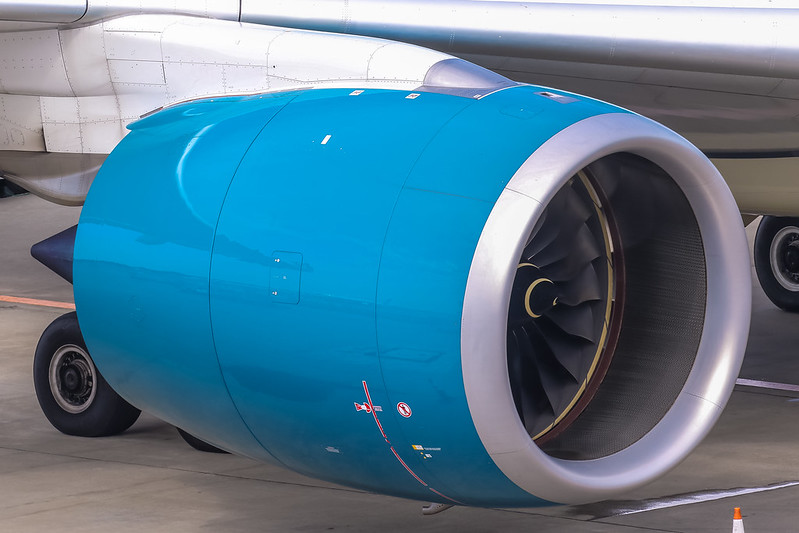 A prominent feature in appearance is a small nozzle on the lower part of the engine. This is a common feature of the Trent, I suppose.
Also, the small square opening on the outside is used for oil maintenance.
A prominent feature in appearance is a small nozzle on the lower part of the engine. This is a common feature of the Trent, I suppose.
Also, the small square opening on the outside is used for oil maintenance.
Finally, let’s look at the tail. At this time, the APU was already running, and the air intake could be seen open, as well as the hot air discharged from the exhaust nozzle.
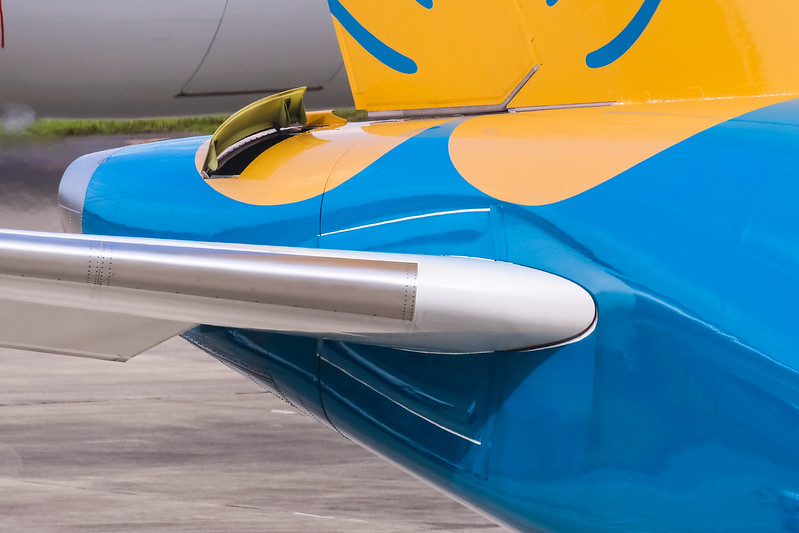 In my impression, the movable part of the horizontal stabilizer of the A330 is often painted silver, but this A350 maintains the fuselage color, preserving the overall aesthetic effect of the livery. Very nice.
Alright, the notes on observing the A350 fuselage from the ground conclude here. For the take-off part, go here.