JA4060 PA-46 Malibu Takeoff Failure and Crash at Chofu Airport
This site has previously introduced the general aviation airport in Tokyo—Chofu Airport RJTF, Tokyo Chofu Airport Photo Note and Revisiting Chofu Airport Open Day, and I have quite a fondness for this place.
It is heartbreaking that last Sunday, July 26th, a Piper PA-46-350P Malibu crashed just over twenty seconds after taking off from here. The aircraft fell into a dense residential area, causing 3 deaths and 2 serious injuries.
8.28 Chofu Airport / JA4060 (cn 4622011) / Bell Hand Club / Piper PA-46-350P Malibu Mirage pic.twitter.com/4MqoN4aYgy
— ゆりっぺ (@MisatoTachibana) August 28, 2013The accident aircraft had the registration number JA4060. It took off from Chofu Airport Runway 17 around 10:58 on that day. According to the video below, filmed at the soccer field outside the runway, it can be seen that the aircraft’s altitude was extremely low. Its condition appeared to be insufficient speed, completely unable to climb, and it was banking to the left.
More than 20 seconds later, the aircraft struck the roofs of two houses in the residential area on the left, 700 meters away from the runway. It then flipped over in the air and crashed upside down into another house nearby, causing a massive fire. There were one pilot and four passengers on board; three of them escaped, but the pilot and one passenger died. At the same time, a woman inside the house perished in the flames because she could not escape in time. According to post-mortem examinations, the cause of death for all three deceased was burning.
【JA4060機】調布に墜落した機体は、過去にも事故2回 https://t.co/pM3k0ZX884 pic.twitter.com/lD3iDf6Kzy
— ハフィントンポスト日本版 (@HuffPostJapan) July 26, 2015The weather on the day was as follows: RJTF 260100Z VRB01KT 9999 FEW030 BKN/// 33/22 Q1011 RMK 1CU030 A2986= RJTF 260200Z VRB02KT 9999 FEW030 SCT/// 34/22 Q1010 RMK 1CU030 A2984= RJTF 260257Z VRB03KT 9999 FEW030 SCT/// 36/22 Q1010 RMK 2CU030 A2983=
It can be seen that the temperature was very high, there was basically no wind, and it was a humid day. One knows that the airport’s density altitude should have been relatively high, so the aircraft needed more Lift than usual for takeoff.
I checked the takeoff distance section of the manual. With Flap 0,
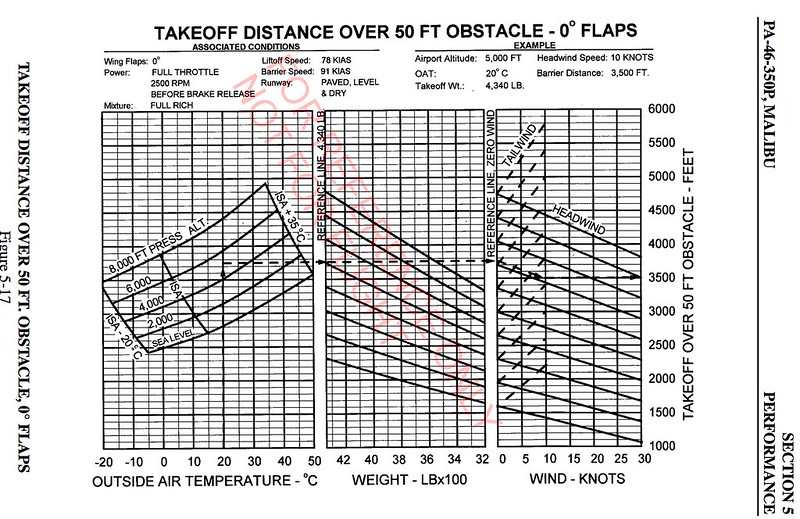 calculating with a temperature of 35 degrees, wind speed 0 knots, and maximum takeoff weight of 4340 lbs,
the takeoff distance is approximately 3200 feet, or 975 meters.
The airport’s 800-meter runway is completely insufficient.
calculating with a temperature of 35 degrees, wind speed 0 knots, and maximum takeoff weight of 4340 lbs,
the takeoff distance is approximately 3200 feet, or 975 meters.
The airport’s 800-meter runway is completely insufficient.
However, if using Flap 20,
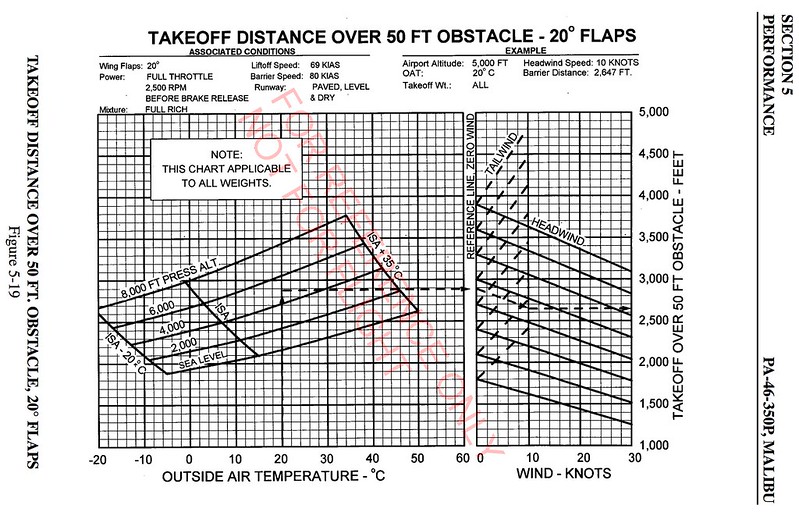 at 35 degrees temperature and 0 knots wind, the takeoff distance is approximately 2400 feet,
or 730 meters, so the airport’s 800-meter runway is sufficient.
at 35 degrees temperature and 0 knots wind, the takeoff distance is approximately 2400 feet,
or 730 meters, so the airport’s 800-meter runway is sufficient.
According to the flight plan submitted by the pilot, the purpose of this flight was to fly to Oshima Airport (RJTO) in the ocean to the south for training. But it is unclear why there were four passengers, or what the flap setting was used. The facts are still under investigation.
According to a <a href=http://headlines.yahoo.co.jp/videonews/ann?a=20150728-00000017-ann-soci>news report today, the aircraft was fully loaded with fuel sufficient for 5 hours of flight. The round trip from Chofu Airport to Oshima Airport RJTO takes only about an hour. With the addition of 5 crew members, the aircraft’s total weight reached 1850 kg. However, it must be noted that the maximum takeoff weight for this model is only 1955 kg. Considering the weather conditions that day, it is easy to wonder if it met the required takeoff conditions. Additionally, the calculation of the center of gravity is not very clear.
The aircraft accelerated on the runway and rotated, indicating that the speed had exceeded V1 at that time, so the pilot did not abort the takeoff.
According to another video seen on TV, when the aircraft was over the soccer field, the pilot could be seen continuously pulling back on the yoke, attempting to raise the nose. Perhaps the pilot realized the problem of insufficient speed, but pulling back likely caused the aircraft to Stall, ultimately resulting in the tragedy of the aircraft’s destruction and loss of life.
The pilot had 1500 hours of flight experience; by common sense, he should not have blindly taken off without calculating the takeoff weight.
Of course, everything still needs to wait for the investigation results from the relevant authorities. Today, the engine of the crashed aircraft was found and is basically intact in appearance, so the mystery of whether the engine itself malfunctioned may soon be revealed.
Additionally, according to another piece of <a href=http://www.charlies.co.jp/?p=1205>information online, the Malibu’s takeoff performance is not very good. While its high-altitude performance is decent, its inability to gain speed at low altitudes may also be related to this crash.
Finally, a few words on the media coverage over the past few days. In Japan, although people fly on airliners every day, the general public knows very little about general aviation aircraft. With such a significant event occurring, major TV stations put this news in the headlines and invited many retired pilots and aviation commentators to explain. However, airline pilots don’t know much about general aviation aircraft, so I feel many of the speculations and comments are unreliable. In this morning’s news, I finally found a private pilot who owns the same type of aircraft, and his comments made it feel like there was finally some improvement.
To be continued
References http://www.rebay.at/fliegen/manuals/pa46_350_manual.pdf
2017/07/19 Update The latest investigation report is out. The conclusion is that the pilot had low safety awareness, disregarding weight (estimated at 2008kg, the pilot did not ask passengers for their weight) and center of gravity calculation (which had reached the rear critical point), resulting in an exceedance of the maximum takeoff weight (1950kg) by 58kg! After the aircraft became airborne, the pilot mishandled it by continuously raising the nose, causing a Stall and ultimately the crash. Additionally, according to the report, the flap position during takeoff was 10 degrees, so indeed the Lift was insufficient.
It seems that following basic procedures and not relying on luck is the first and most important step of safe flight; when violated, one will inevitably face such ruthless punishment.