Interference with ILS Signals
I was reading the Aviation Safety Newsletter from Taiwan’s Aviation Confidential Reporting System and saw a report about signal interference affecting the ILS, causing an aircraft on autoland to land deviated from the runway.
I had heard about this kind of thing from a senior pilot before, but I didn’t realize it could be this serious, so I have copied it down here.
------Start of Original Text------- A certain flight was cleared by ATC to use the Runway 23R ILS (Instrument Landing System) at Taoyuan Airport for arrival. The flight crew used autoland in good weather conditions but did not notify the Tower in advance. During the approach, about 4 nautical miles from the airport, the Tower cleared another A320 aircraft for takeoff on the same runway. This caused the accident aircraft to experience navigation signal interference during landing because the departing aircraft flew over the sensitive area of that runway’s Instrument Landing System.
During the flare phase of approach, the accident aircraft’s Track began to deviate to the right, and it touched down on the right side of the Runway centerline. The flight crew failed to appropriately control the aircraft during the landing process and did not remain vigilant. When the autopilot displayed unexpected behavior, they did not immediately disengage the autopilot and switch to manual control; consequently, the aircraft deviated from the Runway after landing.
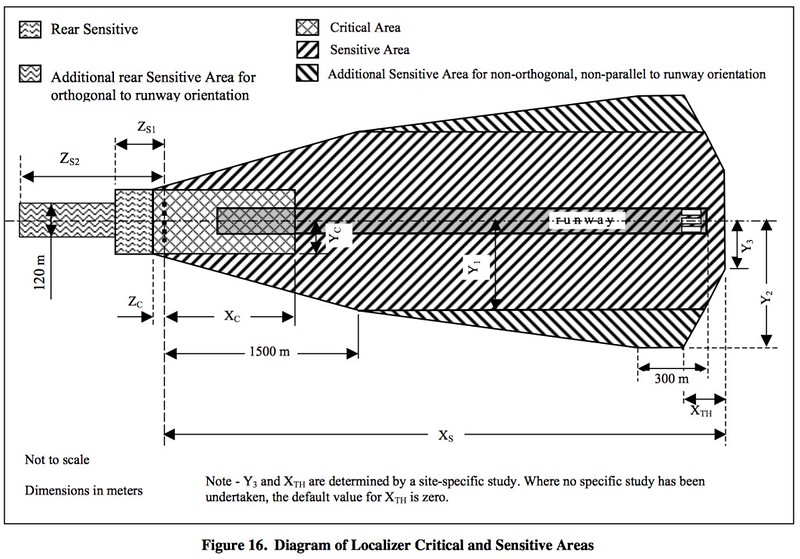
Referring to the ILS Signal Interference description, Section 1-1-9, Item K, of the Federal Aviation Administration’s Aeronautical Information Manual (AIM), both the ILS localizer and glideslope signals are subject to interference by ground vehicles or aircraft. Therefore, airports have established ILS Critical Areas near the ILS localizer and glideslope transmitter sites. When the cloud ceiling is below 800 feet and/or Visibility is below 2 miles, and an arriving aircraft is between the ILS final approach fix and the airport, vehicles and aircraft are not permitted to enter the ILS Critical Areas. When the cloud ceiling is above 800 feet and/or Visibility is greater than 2 miles, the ILS Critical Areas are not protected. In this situation, if conducting autoland or a coupled approach, the flight crew should inform the Tower to ensure the ILS Critical Areas are protected.
The flight crew of this aircraft did not notify the Tower of their intention to conduct autoland during this arrival. Therefore, ATC did not restrict aircraft in the critical area, nor did they notify the accident aircraft that the localizer signal was unprotected. This caused the aircraft, while landing using autoland, to have its normal functionality affected by interference to the localizer signal. Upon reviewing the relevant content of the company’s flight operations manual, there was no regulation requiring flight crew to inform ATC when conducting autoland in good weather conditions.
About 10 seconds before landing, the localizer was affected and interfered with by the departing aircraft, starting to show the aircraft on the left side of the Runway centerline. At that time, the autopilot was set to “Localizer” mode and then transitioned to “Rollout” mode. The autopilot should have followed the localizer signal to guide and control the aircraft; thus, the aircraft would Turn right to achieve zero deviation with the localizer. About 5 seconds before landing, the flight crew used the control yoke and rudder pedals to override (forcing the automatic control to temporarily fail and switching to manual operation) the autopilot mode, correcting the aircraft’s flight direction to the left. This showed the flight crew’s attempt to keep the aircraft on the Runway centerline. However, after the flight crew released this manual operation, the autopilot immediately followed the interfered localizer signal with full right deflection, causing the aircraft’s body and main wheels to touch down on the right side of the Runway centerline. About 2 seconds after landing, the right main wheel ran off the Runway edge line.
Boeing Flight Operations Review does not recommend using override operations to replace disengaging the autopilot while in autopilot mode, because overriding requires significant force and is difficult to sustain.
------End of Original Text-------
Notes
1 Where are the ILS Critical Areas located? I found this diagram online. You can see the shaded hatched area near the localizer antenna marks the Critical Area.
2 So it turns out that when overriding the autopilot, if the pilot doesn’t apply enough force, they can’t win against the autopilot…
3 What is a coupled approach?
End