Factual Report of TransAsia Airways Flight GE235 Accident
Yesterday, the Taiwan Aviation Safety Council (ASC) released the Factual Data Report on the TransAsia Airways Flight GE235 accident and a press conference briefing (in Chinese). Compared to previous summaries, the new report contains very detailed data. However, since it is in English, I didn’t read it all through and just selected the parts I was interested in.
Looking at the Chinese briefing first, the fatal part is here:
10:52:38
 The aircraft passed through 1,200 ft, an aural warning sounded in the cockpit;
 The procedure "ENG2 FLAME OUT AT TAKE OFF" appeared on the Engine and Warning Display (EWD).
10:52:43
 PF said: I'm bringing back No. 1 engine;
 PM replied: Wait a second, cross check;
 At this time, the ENG1 throttle position was recorded moving from 75 degrees to 66 degrees.
10:53:00
 PM: Okay, engine flame out check.
 Continued: Check up-trim yes, auto feather yes.
10:53:06
 PF: Number one brought back;
 Afterward, ENG1 throttle was moved to 49 degrees,
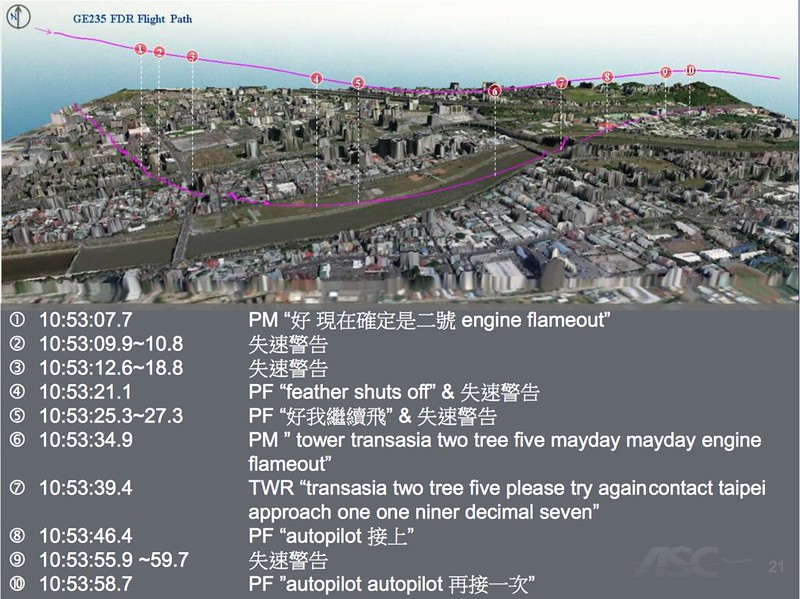
 Meanwhile PM: Okay, now confirmed it's No. 2 engine flameout.
10:53:09
 PF replied: Okay;
 ENG1 throttle remained at the 49-degree position.
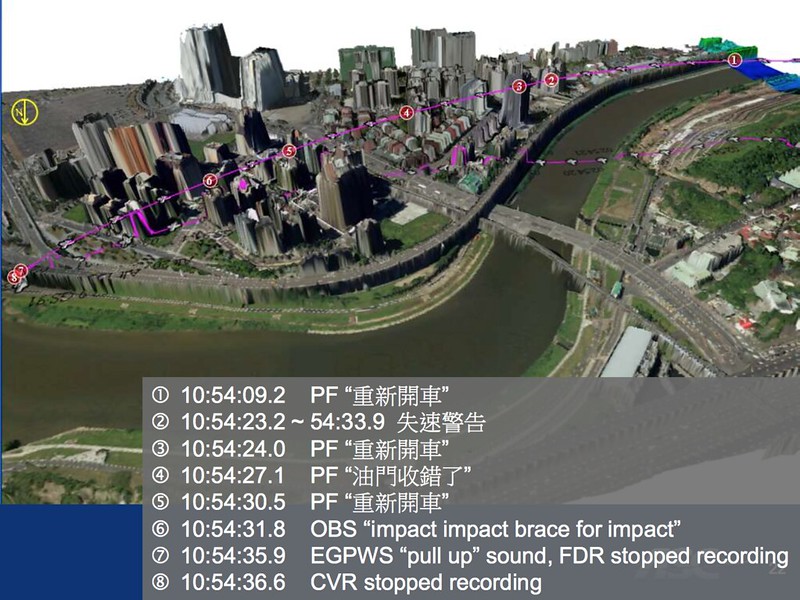
Regarding the alarm for the No. 2 engine, the PF immediately disengaged the autopilot and then began to retard the throttle on the No. 1 engine. Although the PM mentioned the No. 2 engine, the PF seemingly didn’t notice. He then continued to pull the throttle back, and shockingly, the PM failed to spot this error and neglected his monitoring duties, ultimately resulting in the terrible tragedy of the aircraft’s destruction and loss of life.
I don’t know why the PF would disengage the autopilot immediately after hearing the warning. I took a look at the engine failure procedure provided in the report.
 Under the ENG1(2) FLAME OUT IN FLIGHT item, there are only two steps: first, retard the PL (Power Lever) on the affected side to FI (Flight Idle); then, when the high-speed turbine spool NH is below 30%, retard the CL (Condition Lever) on the affected side to FTR (Feather) THEN FUEL SO (Shutoff) for feathering and fuel cutoff. So, the PF’s method of operation was correct, just that the target for shutdown was reversed.
According to the press conference briefing, the ATPCS (Automatic Takeoff Power Control System) is capable of detecting an engine failure and automatically increasing the power on the normal side, while auto-feathering the failed engine.
Looking further at the factual data report, I was interested in the cause of the PF’s error, so I read the section on his background. I feel that TransAsia Airways may still have issues regarding pilot training. For example, this section:
He then completed line training from 2 July to 10 August 2014. During the process, the comments addressed by the instructors were summarized as follows:  Prone to be nervous and may make oral errors during the engine start procedure; Insufficient knowledge leading to hesitations in "Both EEC Failure" and "Engine Failure after V1" situation during the oral test; Lack of confidence and being nervous while answering the Smoke procedure during the oral test; Incompletion in certain procedure check and execution; Prone to be hesitated when facing situation that requires making decisions; Flight planning should be improved.
Instructor comments from the training period between July and August 2014 were: Prone to nervousness, making verbal errors during engine start procedures; Insufficient knowledge leading to hesitation during oral tests on “Dual EEC Failure” and “Engine Failure after V1”; Lack of confidence and becoming nervous during oral tests on smoke procedures; Incomplete checks and execution of certain procedures; Prone to hesitation when facing scenarios requiring decision-making; Flight planning skills need improvement.
Although he subsequently passed the training and obtained pilot qualification, one can imagine that this PF’s psychological resilience was not sufficiently robust. When a real malfunction occurred during the flight, he made errors in judgment and operation.
Therefore, it can be seen that while the direct cause of the accident was the pilot’s operational error, I personally believe the indirect cause was TransAsia Airways’ lax training system and the local aviation authorities’ insufficient scrutiny of pilot qualifications.
End