Asiana Airlines Flight OZ162 Landing Failure Accident
On April 14, 2015, at 20:05, Asiana Airlines flight OZ162 from Incheon Airport, Korea, to Hiroshima Airport, Japan, was conducting a Standard Terminal Arrival Route (STAR) using Area Navigation (RNAV). While landing on Runway 28 on the east side of Hiroshima Airport, the aircraft struck the ILS localizer antenna 325 meters from the runway threshold because its flight altitude was lower than the standard altitude. After landing, the aircraft overshot the runway, skidded sideways, turned approximately 180 degrees, and finally came to a stop on the grass area outside the runway.
BBC is showing more pictures of yesterday's #OZ162 landing accident at Hiroshima Airport
https://t.co/jJbtFfja2K pic.twitter.com/Jmz8PO4egm
— Flightradar24 (@flightradar24) April 15, 2015ケータイで十分撮れる pic.twitter.com/qReBvpWskx
— けいたん@爆音欠乏症 (@pon_ikee) April 17, 2015The aircraft involved in the accident was an Airbus A320, registration HL7762. There were 73 passengers and 8 crew members on board that day. 27 people were injured, but fortunately, there were no fatalities.
From the photos below, it can be seen that the ILS localizer antenna was wrapped around the deformed left landing gear, and parts of the engine nacelle had detached. It is conceivable that the wheel on that side of the landing gear was locked, causing the fuselage to skid to the left.
OZ162の事故機の写真で衝撃的なのがランディングギアに巻きついたLLZのアンテナ。左右ともに巻きついていますが、とくに左側が激しく、ギアホイールが大きく変形。このせいでホイールの回転がロックして、機体が左に逸脱したと推測されます。 pic.twitter.com/bJ3s6rl8S0
— 月刊エアライン編集部 (@ikarosairline) April 19, 2015The right wing and engine were also severely damaged, and a red ILS localizer antenna can be seen hanging on the wing.
@sis_sis ニュース等では機体左側を主に写していますが本日機体右側を撮影してきましたのでご参考にどうぞ。右主翼・右主脚にもローカライザーのパーツが突き刺さっていました。 pic.twitter.com/VR7mK0Kx8a
— けいたん@爆音欠乏症 (@pon_ikee) April 17, 2015The weather conditions at the time of the accident were as follows: the ceiling was 0, there was fog, and visibility was extremely low, but the wind was very light.
@hiroki_h2 FEW000 SCT015ですから、地表面付近だけ霧に覆われていたのかもしれ無いですね。 pic.twitter.com/6BNvxwxcd1
— asumi,受験:技術士,電験二,総通 (@asumiriio) April 14, 2015広島:アシアナ機事故当時の天候は霧が出ていた様です。風は強くありません。 pic.twitter.com/PnjtMtri1w
— Flightradar24ウォッチャー (@FR24spotter_jp) April 14, 2015Because the ILS antenna at Hiroshima Airport was damaged, all flights were suspended from the 14th to the 16th after the accident, causing great inconvenience to various airlines and passengers.
A)RJOA B)1504141150 C)UFN
E)ILS-LOC,GP FOR RWY 10-U/S DUE TO TROUBLE) pic.twitter.com/DR7c4Ec4el
— final approach (@fin_app) April 14, 2015The cause of the accident is still under investigation, and no official investigation report has been released yet. I will continue to update once official information becomes available.
What does the localizer antenna look like when it is intact?
Two years ago, I went to Hiroshima Airport to take photos.
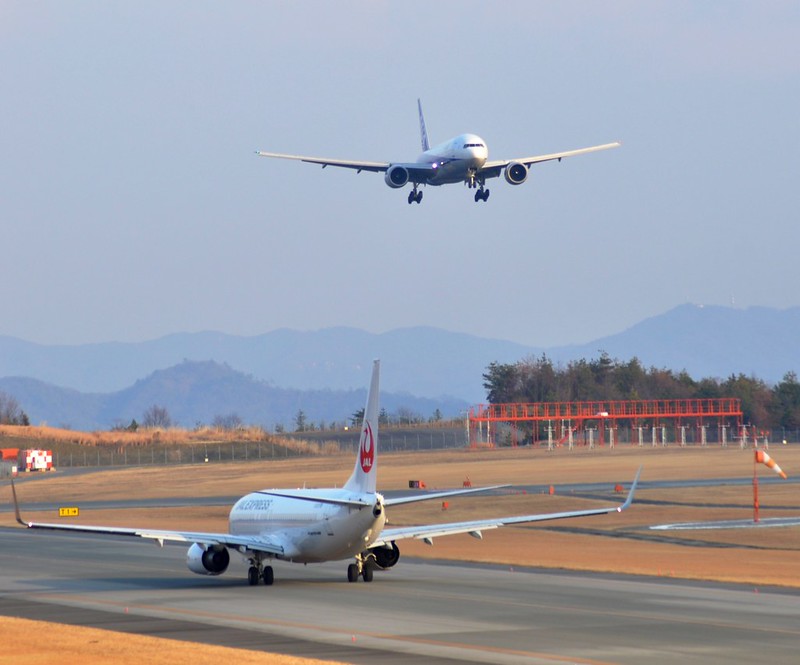 From the photo I took above, you can see an ANA Boeing 777 landing on Runway 28 and the red antenna device below. Under normal conditions, there is a distance of several tens of meters between the aircraft and the localizer antenna. In the OZ162 accident, however, the aircraft actually struck the antenna, which gives you an idea of how dangerous the flight altitude was at that time.
Updated on May 2, 2015
The Japan Civil Aviation Bureau announced that the Category I Instrument Landing System (CAT I) at Hiroshima Airport will resume operations on May 4. The usage conditions for the Category I ILS are:
- Decision Height above 200 feet,
- Runway Visual Range (RVR) above 550 meters (1800 feet), or Visibility above 800 meters.
Before the maintenance, the required RVR was over 1600 meters. Through this emergency repair, Runway 10 at Hiroshima Airport can now be used with an RVR of over 500 meters.
Hiroshima Airport’s Category IIIA Instrument Landing System (CAT IIIA) began operation in June 2008, and Category IIIB (CAT IIIB) began operation in June 2009. However, the resumption of the Category III systems is expected to wait until the end of 2015.
According to historical data for Hiroshima Airport, the number of flights affected by weather was 49 times in 2006, 38 times in 2007, and 13 times before June 2008 (before the activation of CAT III). After the activation of the CAT III system, the numbers were 13 in 2009, 12 in 2010, 15 in 2011, and 11 in 2012. It can be said that the effect of the CAT III system is very significant.
Updated on May 13, 2015
On May 13, the Japan Transport Safety Board released an investigation report, providing meteorological information at the time and data from the FDR (Flight Data Recorder).
First, looking at the METAR, the accident occurred around 20:05. The data for 20:00 and 20:08 is as follows: 2000 JST VRB02KT 6000 -SHRA PRFG FEW000 SCT012 BKN020 09/08 Q1006 RMK 1ST000 4CU012 5CU020 A2973 FG BANK SE-S= 2008 JST VRB02KT 4000 R28/0300VP1800D -SHRA PRFG FEW000 SCT005 BKN012 09/08 Q1006 RMK 1ST000 4ST005 6CU012 A2973 1500E FG E-S The minimum RVR for Runway 28 was 300 meters; visibility was indeed very poor. Additionally, the weather was light rain showers with partial fog and a ceiling of 0.
The aircraft received landing clearance from Air Traffic Control at 20:00. At that time, the weather condition was an RVR of 1800, which met the requirement of 1600 meters. However, a few minutes later, it dropped to around 300-400, representing a rapid deterioration.
Looking at the flight path, the flight used the RNAV GNSS RWY28 procedure for arrival. The aircraft disengaged the autopilot at 20:03:55, approximately 1 minute and 15 seconds before the accident, at an altitude of around 650 meters.
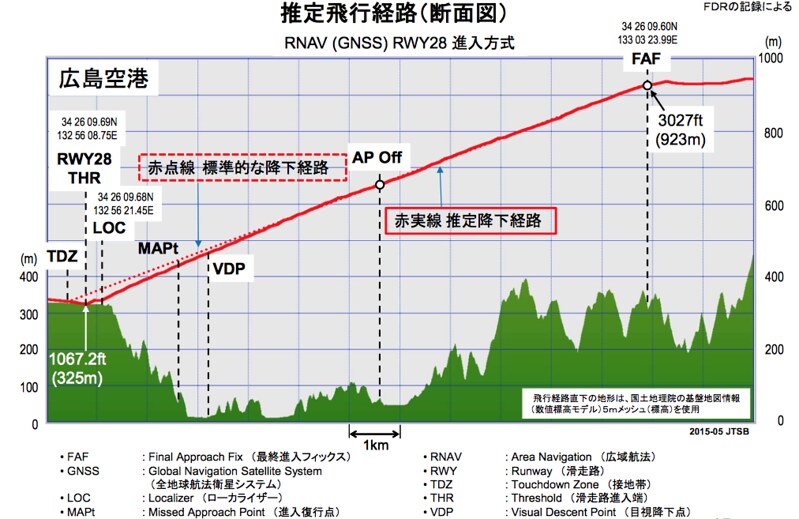 Afterwards, below approximately 550 meters and about 4 kilometers from the runway threshold, the altitude gradually deviated from the normal glide path. The aircraft struck the approach lighting guide lights, which were at a height of 4 meters, at a point 360 meters from the runway threshold, and then struck the localizer antenna, which was at a height of 6.4 meters.
Finally, looking at the Flight Data Recorder records, the changes in the Altimeter were relatively smooth, and the Airspeed was very stable, so it feels like there shouldn’t have been any piloting errors.
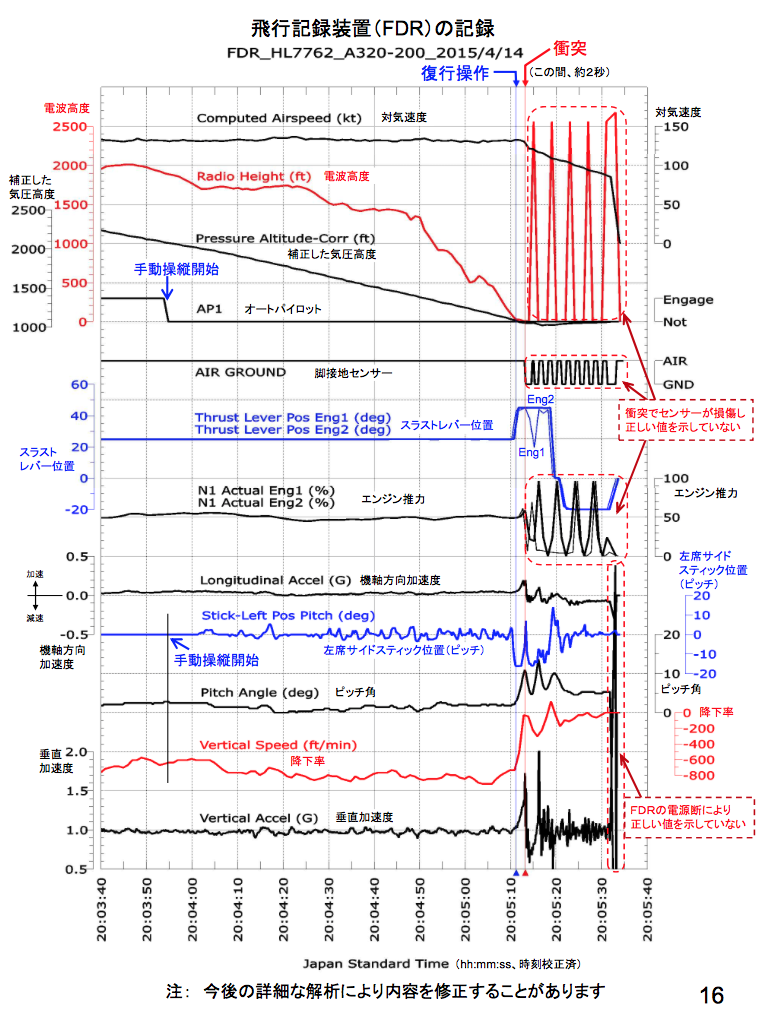 It can be seen that the Captain performed a Go-Around operation 2 seconds before striking the antenna. The engine Thrust levers were moved forward, but unfortunately, it was too late. The aircraft could not generate enough Lift in time to avoid the collision. After the collision, sensors were damaged, and much of the data became abnormal.
This report does not contain records of the pilot’s statement, so it is not yet known how the changing weather conditions affected the pilots.
To be continued