Harrison Ford and the Ryan PT-22 Trainer
Harrison Ford, the famous Hollywood actor, crashed a small aircraft in Santa Monica, California.
It has long been known that Harrison Ford is a very famous general aviation pilot who frequently flies at Santa Monica Municipal Airport. I never expected such a major accident to happen. Fortunately, thanks to his extensive piloting experience, he managed a successful forced landing, which is truly a blessing in disguise.
Harrison Ford completes safe emergency landing. We wish him a speedy recovery. https://t.co/NcHR0vDmS8 pic.twitter.com/2tZ4J8AY9G
— Flying Magazine (@FlyingMagazine) March 6, 2015I read online that there was a recording of his communications on LiveATC, so I went to check. <a href=http://www.liveatc.net/archive.php?m=ksmo2>KSMO Sure enough, I found this segment at 2015/03/05 22:00Z! The link is here, His conversation with the Santa Monica Tower starts at 21:20, reporting an engine failure and requesting an immediate return.
Harrison Ford: 53178, engine failure, request immediate return Tower: 53178, Runway 28, cleared to land
After that, the Tower instructed another aircraft in flight to hold with a 360-degree turn, then reported the wind and speed. Tower: wind 260 at 10 However, no response was received after that.
According to news reports, Harrison made a forced landing on a nearby golf course. It is estimated that the engine had already stopped by then, making it impossible to return to KSMO.
The aircraft Harrison Ford was piloting was a Ryan PT-22 primary trainer from the early 1940s, Numbered N53178. According to the link above, the aircraft model is ST3KR, which corresponds to the PT-22 in military service. This airframe rolled off the production line in 1942 with a manufacturing number of 1859. The PT-22 is a fixed-wing, single-engine propeller aircraft with tandem seating, owned by Mg Aviation Inc.
The TMZ website has a very detailed report, including photos of the old man piloting this plane in the past.
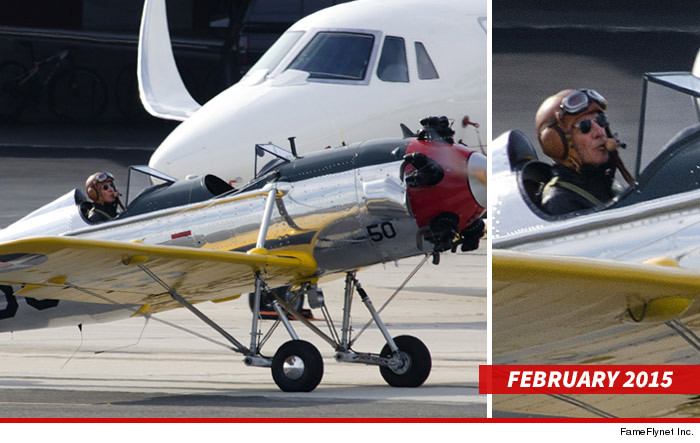 If you are interested, take a look.
Also, a video of him taking off in this aircraft can be found here.
If you are interested, take a look.
Also, a video of him taking off in this aircraft can be found here.
Although the Ryan ST series was a very popular trainer produced in the US during the 1930s and 1940s, with a total of 1,568 built. The primary users at the time were the US Army Air Corps and the US Navy.
The ST series includes many variants. According to wikipedia, the models are as follows:
ST Prototype, used Menasco B4 engine (95hp), 5 built ST-A ST development for aerobatics, used Menasco C4 engine (125hp), 73 built ST-A Special Development of the ST-A, used Menasco C4S engine (150hp), 10 built ST-B Single-seat version of the ST-A, front cockpit converted to fuel tank, only 1 built. Later converted back to ST-A STM ST-A Special military version with a more spacious cockpit and equipped with machine guns, 22 built STM-2 Variant for the Dutch East Indies, 95 built STM-2E Variant for China, used Menasco C4S2 engine (150hp), 48 built total STM-2P Single-seat version of the STM-2E, also for China, equipped with one 7.62mm machine gun, 2 built STM-S2 Variant of the STM-2 capable of water landings, 13 built, Dutch East Indies Navy ST-W Experimental equipped with Warner Scarab radial engine (125hp), converted from USAAC YPT-16 airframe. Also a conversion from PT-20A using Super Scarab (160hp) ST-3 Variant using Kinner B-5 radial engine (125hp), only 1 built ST-3KR ST-3 using Kinner R-5 radial engine (160hp), only 1 built ST-4 Variant with wooden fuselage converted from ST-3, only 1 built
Military variants included the PT-16, PT-20, PT-21, PT-22, PT-22A, PT-22C, etc. Among them, the PT-22 was produced in 1,048 units as the military version of the ST-3KR, equipped with the Kinner R-540-1 engine.
The mention of China in the introduction above sparked my interest in this history. Unfortunately, after searching online for a while, I couldn’t find more clues, only seeing an article titled “<a href=http://www.sbanzu.com/topicdisplay.asp?BoardID=9&Page=2011&TopicID=1920552>Lost Ryan”, which introduced an STM-2E reduced to a bare skeleton at the Beijing Aviation Museum, but the information was very scant. Using my imagination, it was likely purchased from the US to train Air Force pilots to defend the country during the Second World War. I wonder if any friends online have more detailed information?
Begging for more historical knowledge, thanks!!
Update: August 10, 2015
Harrison Ford’s <a href=http://www.ntsb.gov/_layouts/ntsb.aviation/brief.aspx?ev_id=20150305X93207>NTSB Accident Report WPR15FA121 is out, identifying the cause as engine failure.

The engine failure was specifically caused by the loosening of the carburetor’s main metering jet. It unscrewed from its seat and rotated laterally 90 degrees. “The main metering jet cover was removed from the housing at the bottom of the carburetor. The main metering jet was found unscrewed from its seat and rotated laterally about 90 degrees. The internal cap, main metering jet, and seat appeared to be bright in color and polished. Portions of the jet threads appeared to be rounded off. No gasket was observed within the main metering jet housing. In addition, no evidence of thread locking compound was observed on the threads of the main metering jet or the threads of the seat.
According to the 1943 Holley Aircraft Carburetors Instruction Manual for Models 419 and 429, the actual metering of the fuel is accomplished by the main metering jet located in the passage between the discharge nozzle and the float chamber. The metering system provides a constant mixture ratio over the cruising range of engine operating speeds.”
The metering jet is a nut-like component located in the passage between the discharge nozzle and the float chamber to accomplish the actual metering of fuel.

Additionally, according to Harrison’s report, at the time of the accident he realized the engine was losing power. He attempted a restart but was unsuccessful. He maintained a speed of 85 knots and began a left Turn to prepare for a return to the airport, but realized he would not be able to make it back. Later, the plane struck a 20-meter-high tree and crashed onto the golf course. He has amnesia regarding the scene of the crash.