Slip and Skid
It seems that “slip” and “skid” are both translated as 侧滑, so what is the specific difference? Let me try to summarize them.
When watching car racing, you can often see drivers using slipping techniques during turns, intentionally causing the car body to move “sideways” to achieve a quick turn. (Generally speaking, slip refers to oversteering or fishtailing; for example, if the steering wheel is turned 30 degrees, but the car actually turns 40 degrees.)
In terms of aerodynamics, to make the plane turn right, you turn the control wheel clockwise. This causes the left aileron to go down and the right aileron to go up, so the lift on the left wing is greater than on the right. The aircraft rolls clockwise along the longitudinal axis, thus the heading turns to the right. However, at this moment, due to the drag produced by the lowered left aileron, adverse yaw is created, causing the nose to yaw in the opposite direction (to the left), reducing the turn rate and efficiency.
This phenomenon is a “slip”. The phenomenon itself is a type of sideslip, because the fuselage is not facing the relative airflow straight on. Put simply, it is flying sideways or at an angle, like a crab walking sideways.
To correct adverse yaw, you need to push the right rudder pedal to yaw the nose to the right around the vertical axis. But if the correction is excessive and the sideslip angle exceeds what is required, this phenomenon is a “skid”. You can associate it with the racing driver’s intentional slip example mentioned above, as it is easier to remember. A skid is more dangerous than a slip because when close to stall speed, the low wing will stall before the high wing, which can easily develop into a spin. Whereas in a slip, the high wing stalls before the low wing, causing the bank angle to decrease, reducing the possibility of a stall.
The problem with slips and skids lies in drag; they consume energy and reduce lift. Novices often end up in a slip when coordinating rudder poorly during turns. Slips are also easily generated when climbing in windy weather, causing climb performance to degrade, which becomes especially dangerous when avoiding obstacles. The perfect state with neither slip nor skid is “Coordinated flight,” which ensures a high Lift/Drag (L/D) ratio.
 In the image above, the aircraft on the left is in a slip state. This is due to the bank angle being too steep or insufficient yaw.
The aircraft's track biases to the inside, so the ball in the inclinometer is deflected to the left.
Conversely, the aircraft on the right is in a skid state. This is due to the bank angle being too shallow or excessive yaw.
The aircraft's track biases to the outside, so the ball in the inclinometer is deflected to the right.
In the image above, the aircraft on the left is in a slip state. This is due to the bank angle being too steep or insufficient yaw.
The aircraft's track biases to the inside, so the ball in the inclinometer is deflected to the left.
Conversely, the aircraft on the right is in a skid state. This is due to the bank angle being too shallow or excessive yaw.
The aircraft's track biases to the outside, so the ball in the inclinometer is deflected to the right.
Good examples of needing a slip include crosswind flight, where the fuselage and heading are intentionally put at a drift angle; and short field landings, where slip is used to increase drag to land on a short runway while avoiding obstacles. During landing with low power, using opposite direction rudder and aileron controls—also known as cross-controlling—achieves the desired slip effect.
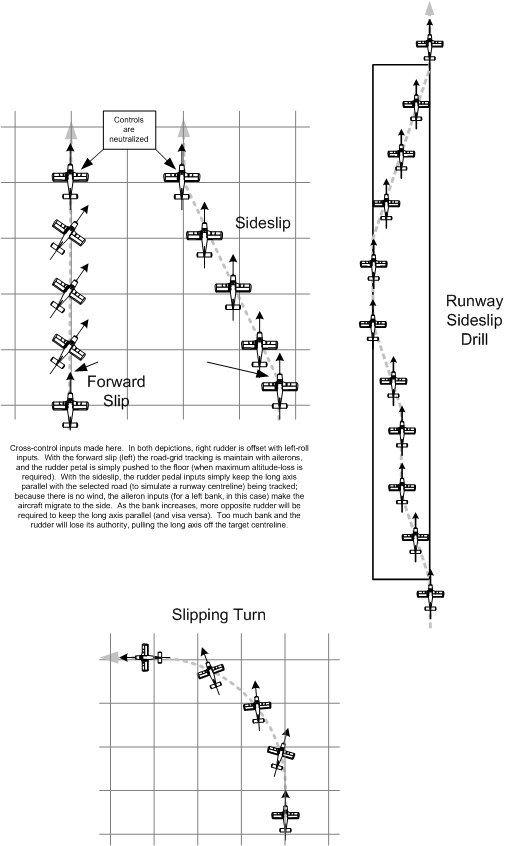
Using cross-controls to enter a slip can be divided into two situations: forward-slip and sideslip. Their attitudes are similar, but the purpose of entering the slip is different, and the flight ground track and heading differ.
A forward-slip is generally used to rapidly lose altitude during approach while maintaining the original flight track without increasing speed (after all, small planes don’t have spoilers). The heading points to one side, so from the front, there is an angle between the plane’s direction of travel and the nose direction. As the plane approaches the runway, the heading in a forward-slip needs to be adjusted to the runway direction before touchdown to align the wheels with the runway. (If there is a crosswind at this time, the sideslip maneuver below is also required)
A sideslip banks the aircraft and is generally used for flare or landing maneuvers in crosswind conditions. Unlike a forward-slip, the heading remains consistent with what it was before entering the sideslip, meaning the longitudinal axis stays parallel to the original heading, but the ground track changes. Since the two wings are high and low, there is a component of the plane sliding sideways towards the low wing tip. When initiating a sideslip, the pilot first rolls the aircraft into the wind and uses the rudder to keep the heading aligned with the runway centerline. A sideslip causes the upwind wheel to touch down first.
The ball in a state of “Coordinated flight”
Turn and Slip indicator
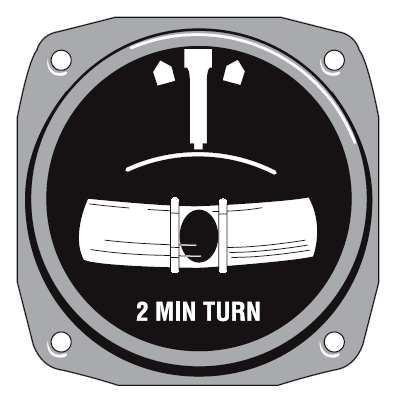
Turn coordinator
