CP+ 2015 Camera and Photo Imaging Show and Aviation Photography Seminar
Every year in mid-February, there is a large-scale photography equipment exhibition in Yokohama – CP+. I have been attending for several years. When I go, I look at the equipment, but my main purpose is to attend the free lectures, because every camera manufacturer invites some excellent photographers to give explanations to the audience, such as their works, shooting and post-production skills, and of course, introductions to the latest camera products.
But this year there was a new change: manufacturers began to focus on aviation photography, or rather, the user base of aircraft photography, and thus specially invited several famous aviation photographers to give lectures.
In recent years, with the improvement of digital camera technology, camera bodies with high-speed autofocus and high-speed continuous shooting functions have emerged one after another. Therefore, even some new photography enthusiasts can produce many decent works. Everyone finds that shooting fast-flying airplanes is no longer a difficult task. At the same time, some excellent telephoto lenses have also emerged, such as Nikon’s AF-S NIKKOR 80-400mm f/4.5-5.6G ED VR and Canon’s EF100-400mm F4.5-5.6L IS II USM. They are fast, have good image quality, and prevent camera shake, so they are selling very well.
Japan has some very famous aviation photographers. The older generation includes Mitsuo Shibata, who was introduced in this blog before, and Katsuhiko Tokunaga, who can be said to be a master.
In addition, the new generation of photographers active on the front line recently, that is, the generation in their 40s and 50s, has become the main force in newspapers, magazines, and aviation books. Among them, there are a few people I have long admired, and they all came to give lectures this year. How could I not go and listen?
One is Koji Nakano, who mainly introduced his works using the Alpha 7 at the Sony booth.
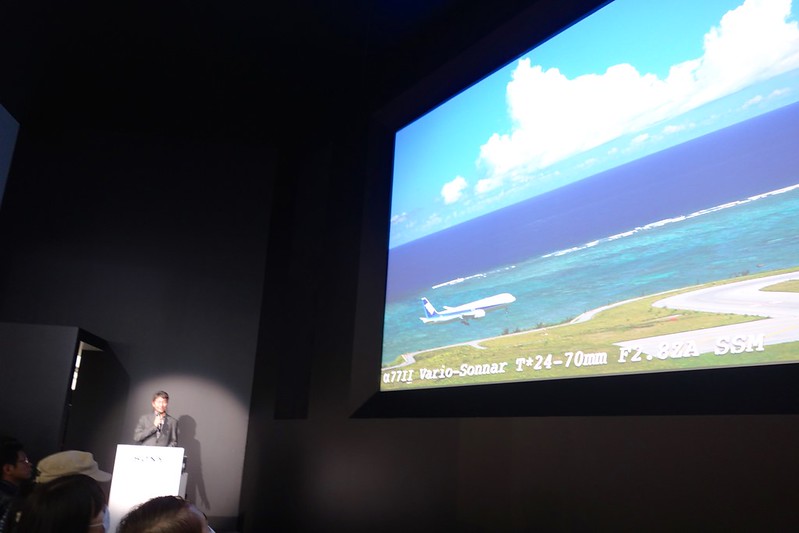 Nakano’s chosen works featured civil airliners in Okinawa and Osaka. The photos of Miyako Island taken from a small mountain were particularly impressive.
He also showed night works at Senri River at Osaka Airport. It looks like the Alpha 7 performs quite well at high ISO.
Nakano’s chosen works featured civil airliners in Okinawa and Osaka. The photos of Miyako Island taken from a small mountain were particularly impressive.
He also showed night works at Senri River at Osaka Airport. It looks like the Alpha 7 performs quite well at high ISO.
There is also Charlie Furusho. Not only does he shoot airplanes, but he is also the person who has flown on the most airline routes in the world, entering the Guinness World Records last year. Furusho is also a pilot. He used to run a tourism company with friends in the United States, conducting sightseeing flights and so on. But later, he became a professional photographer and published quite a few books. His lecture at the Canon booth overlapped somewhat with Nakano’s, so I only caught the tail end. I wasn’t deeply impressed by the works, but he spoke very highly of Canon’s latest product, the EOS 7D Mark II.
Next was another excellent photographer, Hidenori Suzaki, giving a lecture at the Ricoh booth.
He uses the PENTAX K-3. To be honest, I didn’t really know about this product, but I found his works to be amazing!
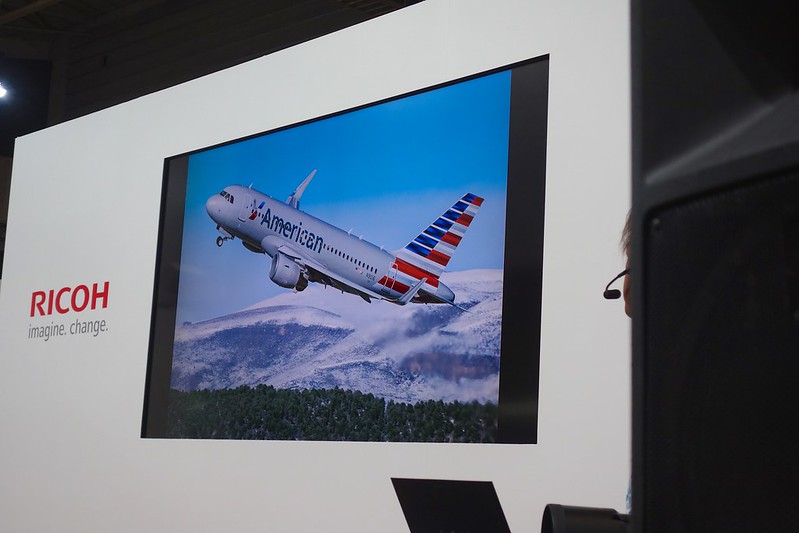 Suzaki introduced his works at Eagle Country Airport in the USA, as shown above.
This was also taken from a mountain near the airport. The distance is close, and the photo sharpness is extremely perfect.
Suzaki introduced his works at Eagle Country Airport in the USA, as shown above.
This was also taken from a mountain near the airport. The distance is close, and the photo sharpness is extremely perfect.
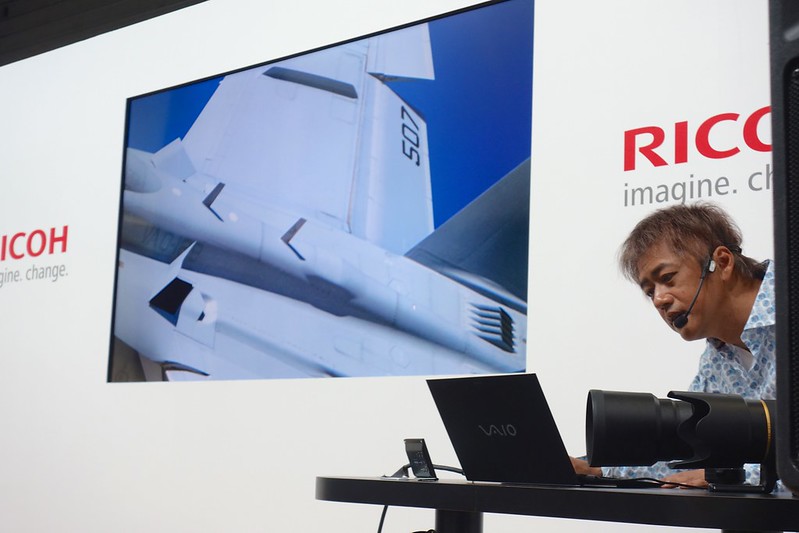 Later, he also introduced shots of fighter jets in Death Valley, as shown above, as well as works at airports like Las Vegas and Los Angeles.
Watching them made me want to go to the US to take photos immediately.
Also, unlike other lecturers, he used many aviation-specific terms during his speech, which felt very familiar and greatly increased my liking for him.
Later, he also introduced shots of fighter jets in Death Valley, as shown above, as well as works at airports like Las Vegas and Los Angeles.
Watching them made me want to go to the US to take photos immediately.
Also, unlike other lecturers, he used many aviation-specific terms during his speech, which felt very familiar and greatly increased my liking for him.
The last one was a heavyweight, Luke H. Ozawa,
who took the stage as the final keynote speaker for the entire CP+ Canon booth. He had such a great style.
 Combining his own works, he mainly recommended the EOS 7D Mark II and EF100-400mm F4.5-5.6L IS II USM.
Ozawa’s works are truly beautiful, blending the aircraft into the scenery, so even non-aviation enthusiasts can appreciate them.
Combining his own works, he mainly recommended the EOS 7D Mark II and EF100-400mm F4.5-5.6L IS II USM.
Ozawa’s works are truly beautiful, blending the aircraft into the scenery, so even non-aviation enthusiasts can appreciate them.
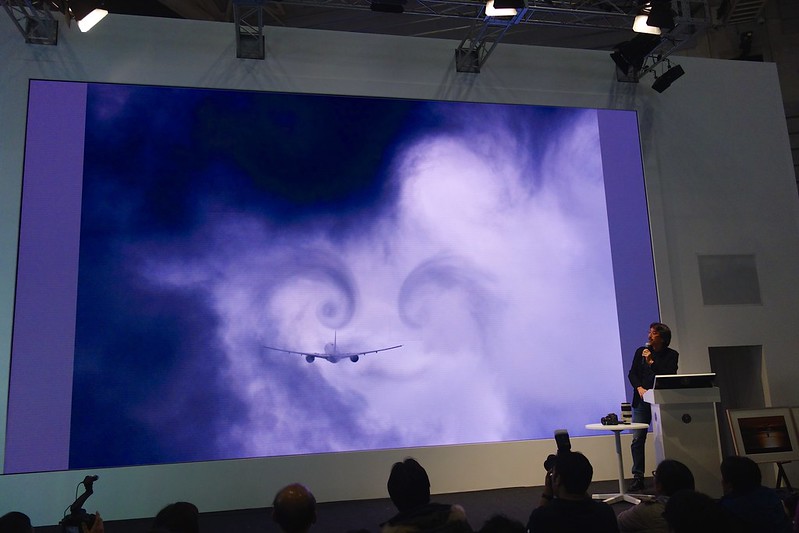 He mentioned his shooting experience includes never compromising easily and never giving up any shutter opportunity;
being good at using light, such as reflections from the sea surface illuminating the bottom of the fuselage;
basically shooting handheld; almost always using a polarizer;
once the composition is set, he no longer moves the lens, and keeps pressing the shutter as long as the aircraft is within the composition frame; both the upper and lower photos were taken this way;
he introduced several recommended photography spots. I knew about and had been to the spots at Tokyo Haneda and Osaka Itami, but I haven’t been to the Kumamoto Airport spot he introduced this time. I’d really like to see it if there’s a chance in the future, but for the photo below, it can only be taken on one day of the year…
He mentioned his shooting experience includes never compromising easily and never giving up any shutter opportunity;
being good at using light, such as reflections from the sea surface illuminating the bottom of the fuselage;
basically shooting handheld; almost always using a polarizer;
once the composition is set, he no longer moves the lens, and keeps pressing the shutter as long as the aircraft is within the composition frame; both the upper and lower photos were taken this way;
he introduced several recommended photography spots. I knew about and had been to the spots at Tokyo Haneda and Osaka Itami, but I haven’t been to the Kumamoto Airport spot he introduced this time. I’d really like to see it if there’s a chance in the future, but for the photo below, it can only be taken on one day of the year…
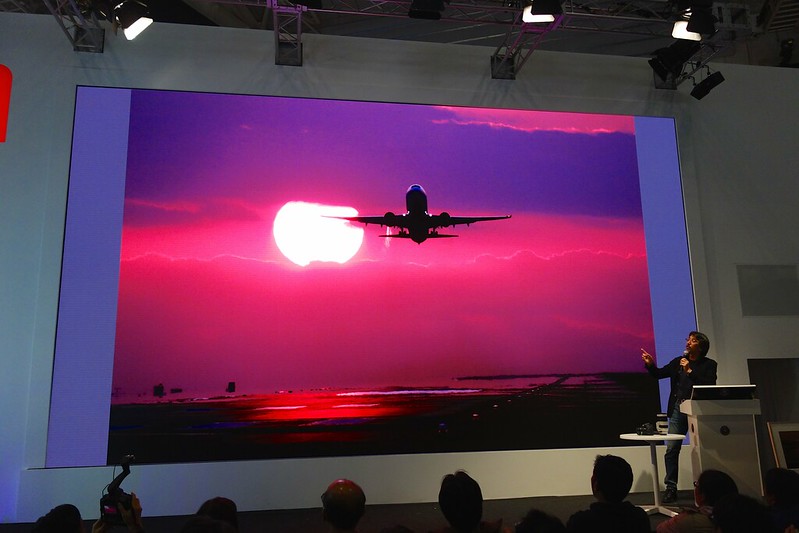 In short, his content was very inspiring. I learned a few tricks and was very satisfied.
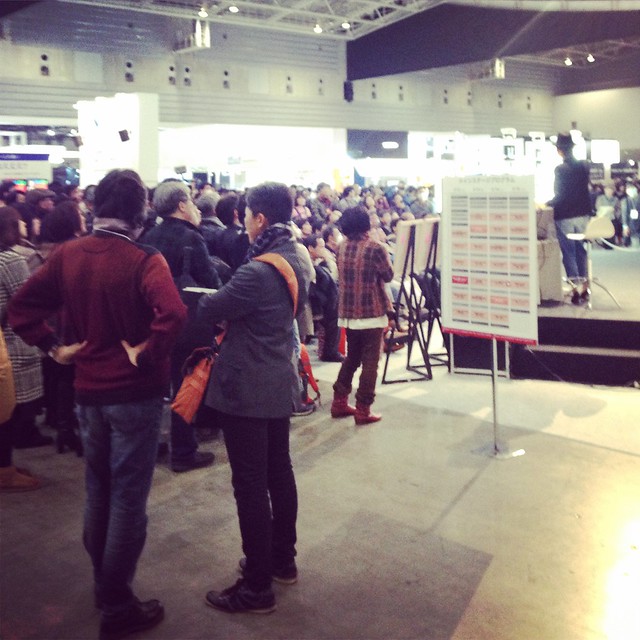 I found Koji Nakano to be a very interesting person. When Ozawa and Hidenori Suzaki were giving lectures, he also mixed into the crowd and listened earnestly. Very humble.
The photo above shows him chatting with Ozawa. I wonder what technical issues they were discussing.
I found Koji Nakano to be a very interesting person. When Ozawa and Hidenori Suzaki were giving lectures, he also mixed into the crowd and listened earnestly. Very humble.
The photo above shows him chatting with Ozawa. I wonder what technical issues they were discussing.
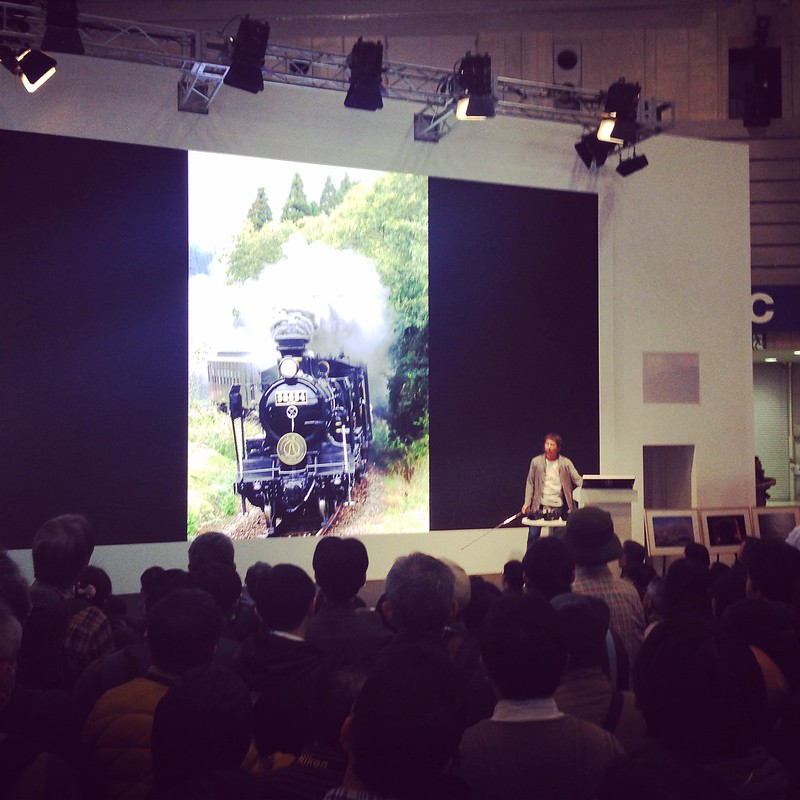
Besides the lectures mentioned above, I also watched Tomoya Yazaki’s railway photography lecture,
 and Hirokazu Nagane’s lecture at the Sandisk booth,
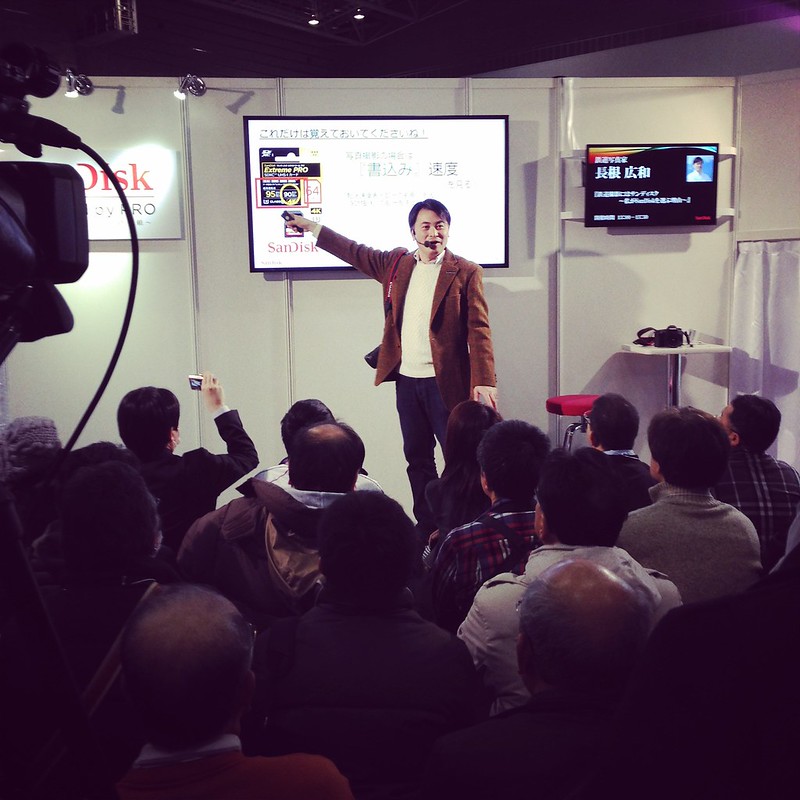 He emphasized that when looking at SD cards, don’t just look at the read speed, but even more so at the speed value written on the right side of the box. This is indeed quite important.
Also, Nagane came over to watch Ozawa’s lecture and stood behind me. It seems there are many humble people among successful individuals.
He emphasized that when looking at SD cards, don’t just look at the read speed, but even more so at the speed value written on the right side of the box. This is indeed quite important.
Also, Nagane came over to watch Ozawa’s lecture and stood behind me. It seems there are many humble people among successful individuals.
I also listened to some lectures at other booths like Olympus, Sony, and Fuji, but I won’t post the photos here.
Also, Shenzhen DJI set up a very large booth,
 I’m not too familiar with this product, so I didn’t look too closely, but it’s still very proud that Chinese products can open up the Japanese market.
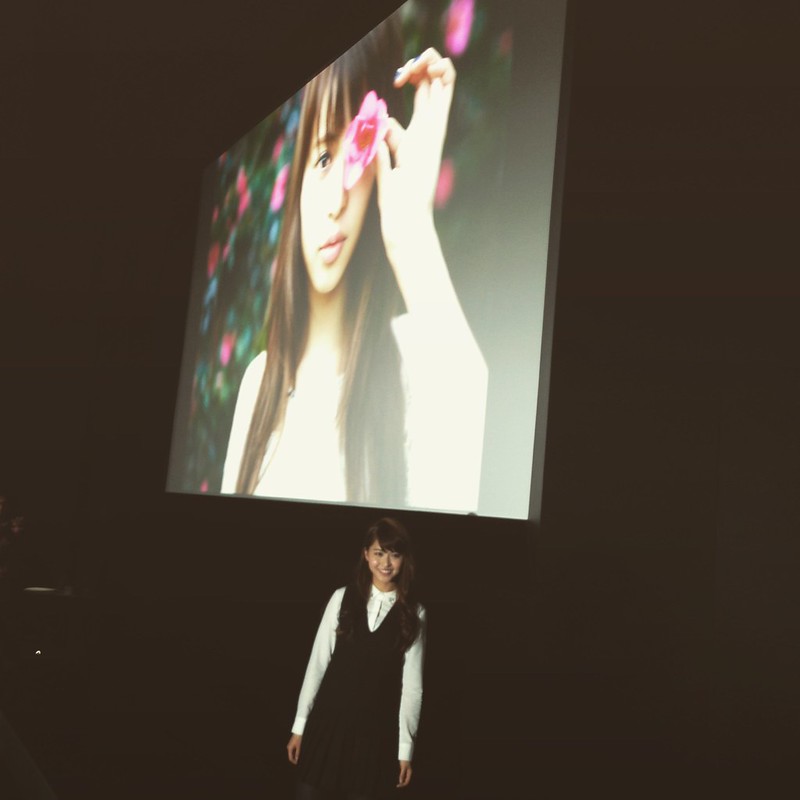
Finally, a pleasing photo. Looking forward to next year’s CP+, and then considering whether to jump into the Canon pit?
End
Postscript 1
 The strange ship seen in Yokohama Port today, according to a senior’s pointer,
turns out to be the US Navy’s latest missile satellite tracking and measurement ship “USNS Howard O. Lorenzen” (T-AGM 25).
The “USNS Howard O. Lorenzen” is produced by VT Halter Marine and is equipped with the “Cobra Judy” upgraded radar system.
The “Cobra Judy” upgraded radar system provides high-precision dual-band radar data services for global ballistic missile verification.
I’m not very familiar with ships. Seeing that this guy looks very special, I took a photo as a souvenir.
The strange ship seen in Yokohama Port today, according to a senior’s pointer,
turns out to be the US Navy’s latest missile satellite tracking and measurement ship “USNS Howard O. Lorenzen” (T-AGM 25).
The “USNS Howard O. Lorenzen” is produced by VT Halter Marine and is equipped with the “Cobra Judy” upgraded radar system.
The “Cobra Judy” upgraded radar system provides high-precision dual-band radar data services for global ballistic missile verification.
I’m not very familiar with ships. Seeing that this guy looks very special, I took a photo as a souvenir.
Postscript 2 The lecture video from the Sony booth has been released online. It’s great: CP+ After Report.
2017