How Does an Airplane Generate Lift? Bernoulli's Principle, Kutta-Joukowski Theorem, Starting Vortex, and Wingtip Vortices
Regarding the principles of flight, specifically the question of where an aircraft’s Lift comes from, most books mention Bernoulli’s Principle. Because the airflow is divided into upper and lower parts at the leading edge of the wing, the airflow speed on the upper surface is faster than that on the lower surface. Consequently, the air pressure on the upper surface is lower than that on the lower surface, and the pressure difference between the upper and lower surfaces generates Lift.
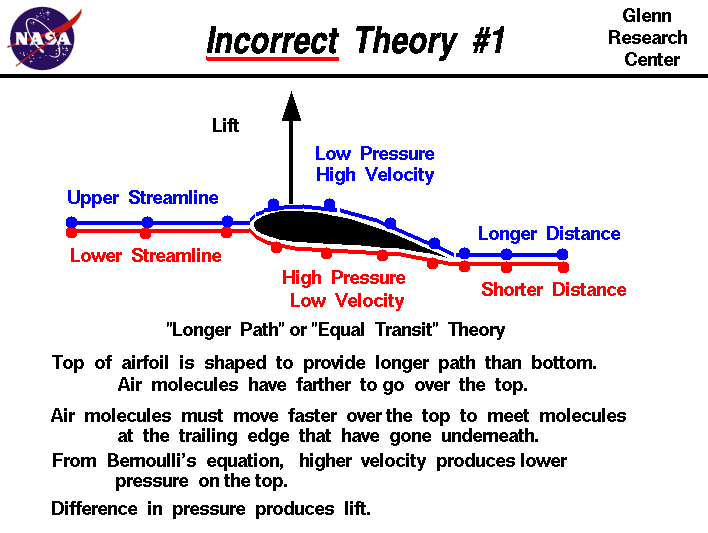
However, I never quite understood why the “upper airflow is faster than the lower airflow.” For instance, many explanations state that the airflow is split at the leading edge of the wing and finally meets at the trailing edge of the wing. But since the shape of the upper and lower surfaces of the wing is asymmetrical—the lower surface is flat and the upper surface is curved—the distance the airflow travels over the upper surface is longer, so the flow speed is naturally faster.
However, this explanation is incorrect because, obviously, it cannot explain the phenomenon of paper airplanes or fighter jets flying upside down.
NASA calls this the “Longer path” or “Equal transit” Theory,
and explained it in the article Incorrect theory #1 “Longer path” or “Equal transit” Theory on their official website.
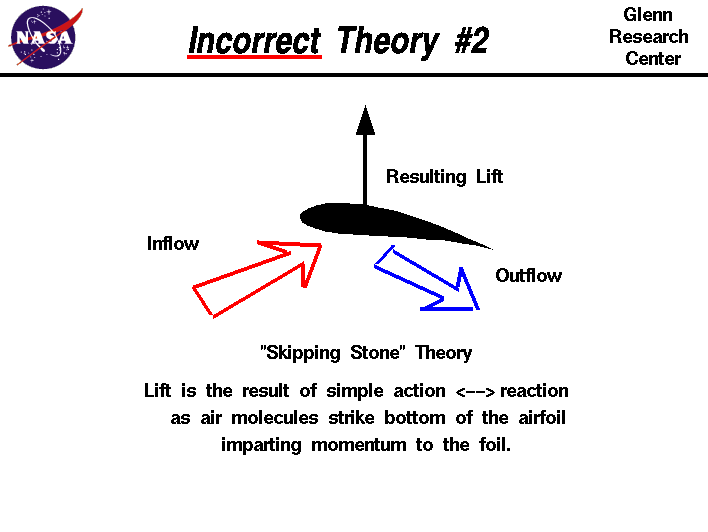
In addition, there is another misconception that does not involve “Bernoulli’s Principle,” which states that Lift comes from the reaction force of air on the bottom of the wing.
NASA also addressed this in Incorrect theory #2, “Skipping stone” theory.
So, going back to the initial question, why is the “upper airflow faster than the lower airflow”? I saw an explanation that aircraft Lift involves the Kutta-Joukowsky condition and Vortexes.
When the aircraft accelerates from a stationary state to take off, the airflow speeds above and below the wing are the same.
This causes the lower airflow to reach the trailing edge while the upper airflow has not yet arrived, meaning the rear stagnation point is located at a point above the airfoil.
The lower airflow must wrap around the sharp trailing edge to meet the upper airflow.
After the upper and lower airflows meet, they flow past the rear of the wing, but flow disturbance is visible.
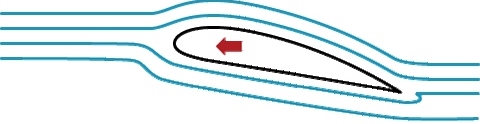
Due to fluid viscosity, or the Coanda effect, fluids have a tendency to leave their original flow direction and follow the surface of a protruding object.
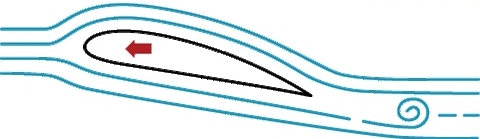
When the lower airflow wraps around the trailing edge, a low-pressure Vortex is formed,
creating a large adverse pressure gradient at the trailing edge.
Immediately, this Vortex is washed away by the incoming flow; this Vortex is called the starting Vortex.

The aircraft continues to move forward, but the energy generated by the starting Vortex affects the airflow above the wing,
creating an effect that pulls the upper airflow backward.

The aircraft continues to move forward, and the starting Vortex stays in place, detaching from the aircraft.
According to Helmholtz’s vortex theorems, for an ideal incompressible fluid under potential force,
a Vortex of equal strength and opposite direction to the starting Vortex exists around the airfoil, called circulation, or circulation around the wing.
Circulation flows from the leading edge of the lower surface to the leading edge of the upper surface.
Therefore, circulation added to the incoming flow causes the rear stagnation point to eventually move to the trailing edge, thereby satisfying the Kutta condition–
“On a real, Lift-generating wing, the airflow always meets at the trailing edge.
Otherwise, a point of infinite airflow velocity would be created at the trailing edge.
Only when this condition is met can the wing generate Lift.”
With this circulation on the wing, the problem of why the upper and lower speeds differ can be explained. The vortices on the wing in the image above are the reason why airplanes can fly in the air!
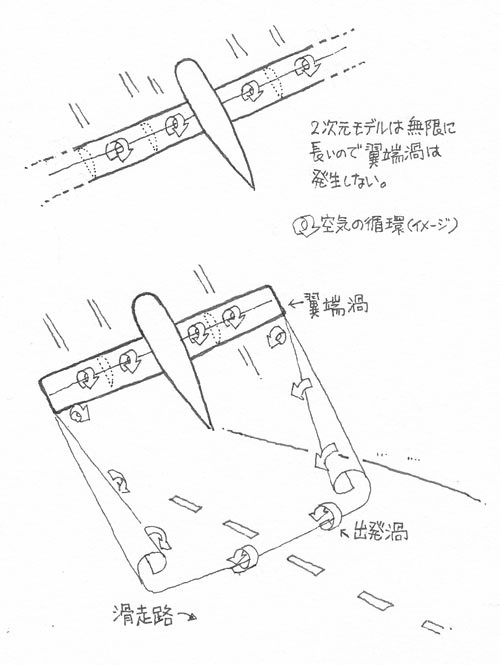
However, in real life, this circulation cannot be seen with the naked eye, and it is also difficult to record with test equipment. After all, compared to the speed of the incoming flow, the circulation is very weak. Therefore, we have to rely on wingtip Vortexes to prove its existence. Since the wingspan is finite, the circulation on the wing flows backward from the wingtip, with the left side rotating clockwise and the right side rotating counter-clockwise, forming wingtip Vortexes. A video of NASA’s experiment on wingtip Vortexes can be found on YouTube,
You can see that the strength of the wingtip **Vortex**es formed by the C5 is very strong.Here is another section of NASA’s commentary on wingtip Vortexes.
An even more interesting video is this demonstration in a wind tunnel, which shows the airflow over the wing changing with the Angle of Attack. The rear stagnation point mentioned above, and the situation where airflow turbulence causes a decrease in Lift at high angles of attack, are all demonstrated.
#Regarding the airflow disturbance caused by an excessive Angle of Attack, there is a very good video on YouTube for reference,
Through the many small strips attached to the aircraft wing, the airflow changes during a **Stall** are very clear, and it is also very clear that the airflow at the wing root **Stall**s before the outer side.Regarding the starting Vortex, there is also a simulation video on YouTube for reference.
Since the starting **Vortex** and wingtip **Vortex**es will stay on the **Runway** for a period of time, affecting the aircraft that will take off subsequently, airport operations will control the takeoff time of two consecutive aircraft, leaving an interval of about 2 minutes.Reference materials https://www.grc.nasa.gov/WWW/k-12/airplane/wrong1.html http://firstflight.open.ac.uk/pages/aerodynamics/how_planes_fly/vortex.php http://jein.jp/jifs/scientific-topics/887-topic49.html http://baike.baidu.com/view/3831899.htm wikipedia: starting vortex